


You finish a session with a patient. You check the clock: 25 minutes of manual therapy, 25 minutes of exercises, and 10 minutes of hot packs. You bill 4 units.
Denied.
You just worked for free because you treated billing like a stopwatch instead of a formula.
If you are learning how to bill insurance for therapy, you already know the process is filled with pitfalls. But for Physical Therapists (PT), Occupational Therapists (OT), and SLPs, the 8 Minute Rule is the specific mathematical framework that dictates your revenue. Get it right, and you get reimbursed for every minute of skill you provide. Get it wrong by sixty seconds, and you lose money.
This isn’t just about memorizing a chart. It’s about understanding why Medicare (CMS) and private insurance (AMA) still fight over the math in 2026, and how you can stop getting short-changed.
Key Takeaways
- The Baseline: You must provide at least 8 minutes of a specific time-based service to bill a single unit.
- The Split: Medicare lets you “stack” leftover minutes from different services to create new units. Private insurance usually doesn’t.
- Service vs. Time: Never use the 8 minute rule for flat-fee codes like evaluations or hot packs.
- Total Time Matters: Your units are calculated based on the total time spent on timed codes, not just by adding up individual activities.
What Is the 8 Minute Rule?
Medicare (CMS) created this guideline to stop providers from rounding up. You can’t do 5 minutes of exercise and charge for a full 15-minute block. The rule is simple: you must provide at least 8 minutes of direct, one-on-one treatment to bill for one unit.
Know Your Codes
Before doing any math, separate your codes. The rule only applies to one type.
- Service-Based (Untimed) Codes: These are flat fees. It doesn’t matter if you take 5 minutes or 50. You bill 1 unit.
- Examples: PT Evaluation (97161), Hot/Cold Packs (97010), unattended E-Stim (97014).
- Time-Based (Constant Attendance) Codes: These are billed in 15-minute chunks. This is where the 8 Minute Rule applies.
- Examples: Therapeutic Exercise (97110), Manual Therapy (97140), Ultrasound (97035).
The Big Disconnect: CMS vs. AMA
Here is where most practices lose revenue. Not all insurance companies count the same way.
If you are billing Medicare, you follow CMS guidelines. If you are billing Blue Cross or United, you likely follow AMA guidelines. They look similar, but the math is different.
Comparison Table 1: CMS vs. AMA Billing Logic
| Feature | CMS (Medicare/Medicaid) | AMA (Private/Commercial) |
|---|---|---|
| How they count | Cumulative: They add all your timed minutes together first, then divide by 15. | Individual: They look at each CPT code separately. |
| Leftover Minutes | You keep them: Leftover minutes from different codes can be combined to make a new unit. | You lose them: If you have 7 minutes of excess time on a code, it is dropped. |
| Flexibility | High (Maximizes your units). | Low (Often results in fewer units). |
| The Rule | Must meet 8 minutes of total time to bill 1 unit. | Must meet 8 minutes on each specific code. |
Note: Always check your contract. Some private payers will follow Medicare rules, but never assume they do.
The Cheat Sheet: Medicare 8 Minute Rule Intervals
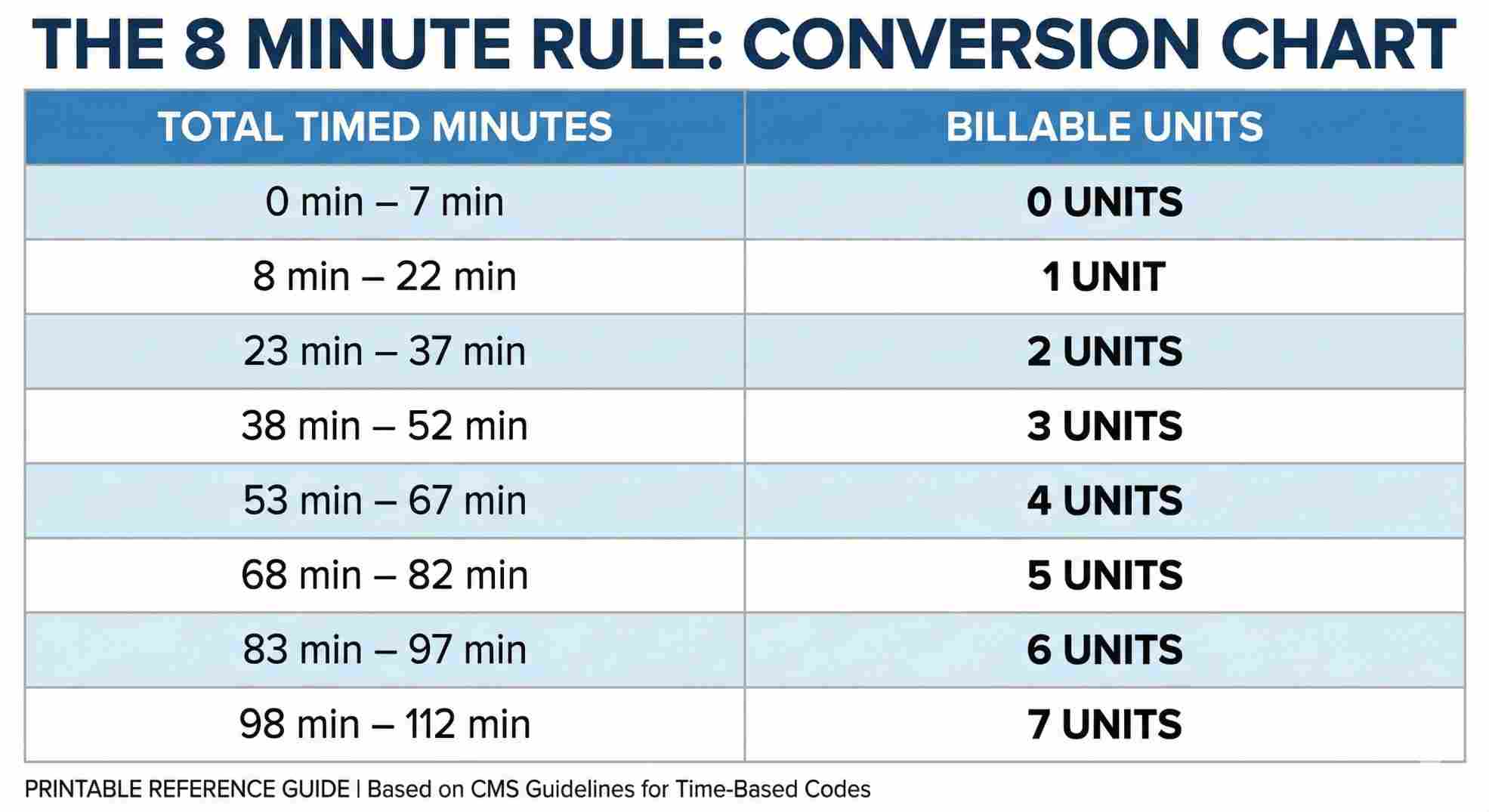
Stop doing long division in your head while the patient is waiting. Use this chart to see exactly how many units your total time allows.
Comparison Table 2: The 8 Minute Rule Conversion Chart
| Total Timed Minutes | Billable Units |
|---|---|
| 0 min – 7 min | 0 Units |
| 8 min – 22 min | 1 Unit |
| 23 min – 37 min | 2 Units |
| 38 min – 52 min | 3 Units |
| 53 min – 67 min | 4 Units |
| 68 min – 82 min | 5 Units |
| 83 min – 97 min | 6 Units |
| 98 min – 112 min | 7 Units |
Real World Math: Handling “Mixed Remainders”
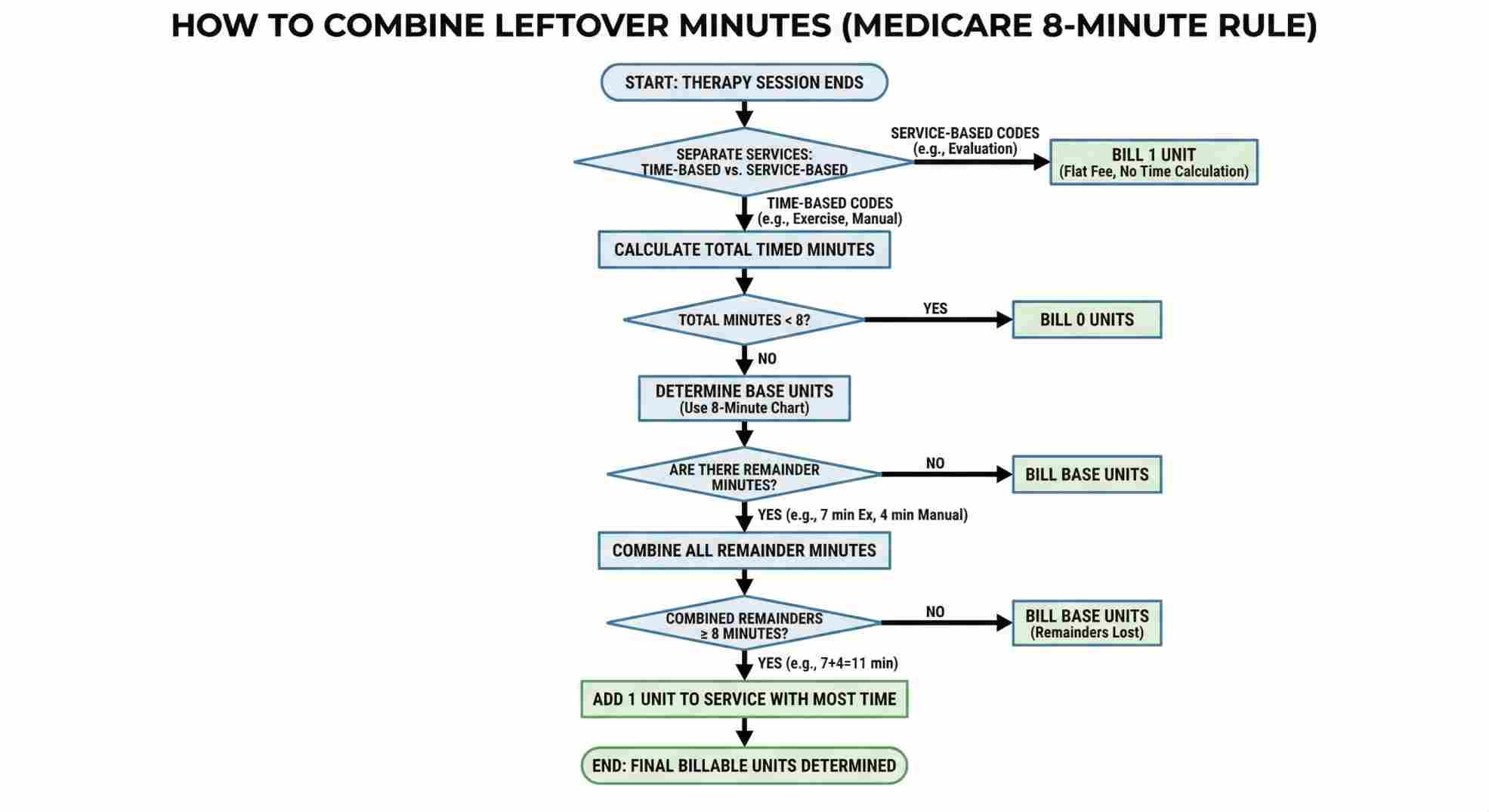
Software usually handles this, but when it glitches, you get audited. You need to know how to calculate this manually.
The “Mixed Remainder” Scenario
This is the classic Medicare situation where you have leftover minutes.
- Therapeutic Exercise: 25 minutes
- Manual Therapy: 7 minutes
- Total Timed Minutes: 32 minutes
Step 1: Check the Total Time
Look at the chart above. 32 minutes falls in the 23–37 minute range. This allows you to bill 2 Units total.
Step 2: Assign the Units
* Therapeutic Ex (25 mins): The first 15 minutes = 1 Unit. You have 10 minutes left over.
* Manual Therapy (7 mins): This is under 8 minutes. On its own, it is 0 Units.
Step 3: Combine the Leftovers
* You have 10 minutes (Ex) + 7 minutes (Manual).
* 10 + 7 = 17 minutes.
* Since 17 is greater than 8, you earned a second unit.
Step 4: Who gets the unit?
Medicare says the service with the most time gets the bill.
* Exercise Remainder: 10 mins
* Manual Total: 7 mins
* Winner: Therapeutic Exercise.
Final Bill: 2 Units of Therapeutic Exercise (97110).
3 Ways You Will Get Denied
1. The “Almost There” Round Up
You did 20 minutes of gait training. You think, “That’s closer to 30 than 15, so I’ll bill 2 units.”
No. 20 minutes is in the 8–22 minute range. That is 1 Unit. Billing 2 is fraud.
2. Mixing Code Types
You did 15 minutes of Ultrasound (Timed) and 15 minutes of Unattended E-Stim (Service-based).
You cannot say “30 minutes total = 2 units.”
* The Ultrasound is 1 unit.
* The E-Stim is 1 unit.
* They are calculated separately.
3. The “7 Minute” Loss (Private Insurance)
If you bill a private payer that strictly follows AMA rules:
* Therapeutic Ex: 22 mins (1 Unit + 7 min leftover)
* Manual Therapy: 7 mins (0 Units)
* Total: 29 mins.
* Result: You only bill 1 Unit of Ex. Those extra 14 minutes are lost because neither code reached the 8-minute mark on its own.
Comparison Table 3: Which Codes Use the Rule?
| CPT Code | Description | Type | 8-Minute Rule Applies? |
|---|---|---|---|
| 97110 | Therapeutic Exercise | Time-Based | YES |
| 97112 | Neuromuscular Re-ed | Time-Based | YES |
| 97140 | Manual Therapy | Time-Based | YES |
| 97530 | Therapeutic Activities | Time-Based | YES |
| 97035 | Ultrasound | Time-Based | YES |
| 97161 | PT Evaluation (Low) | Service-Based | NO |
| 97164 | PT Re-evaluation | Service-Based | NO |
| 97010 | Hot/Cold Packs | Service-Based | NO |
| G0283 | E-Stim (Unattended) | Service-Based | NO |
Wrapping Up
The 8 minute rule is the difference between a profitable clinic and a billing nightmare. You have to know the difference between the CMS cumulative method and the strict AMA method.
Don’t leave money on the table. Check your notes from last week. Did you lose units to “remainders” you forgot to add up? Print the chart above, tape it to your monitor, and start billing for the work you actually did.