


You are likely treating anxiety and depression in your practice right now, but if you haven’t read the 99484 CPT code description, you are probably working for free. You listen to patients. You adjust meds. You worry about them after they leave. That “invisible work”—the check-ins, the coordination, the planning—is fully billable. Yet, most doctors ignore this code because they think “integration” means hiring a psychiatrist.
It doesn’t. Things have changed. Specialists are hard to find. The waitlists are months long. So, the burden falls on primary care. You are the frontline. But doing this work for free burns out your staff and hurts your revenue. You need a better way to handle the workload without going broke.
The solution lies in General Behavioral Health Integration (BHI). While this is just one part of The Real Truth About Coding and Billing for Mental Health Services, understanding the 99484 CPT code description is your first step to stop leaving money on the table. This guide cuts through the confusion of CMS regulations to show you how to start billing it next week.
The One Thing You Need to Know
Here is the main point. You do not need a psychiatric consultant to bill CPT 99484.
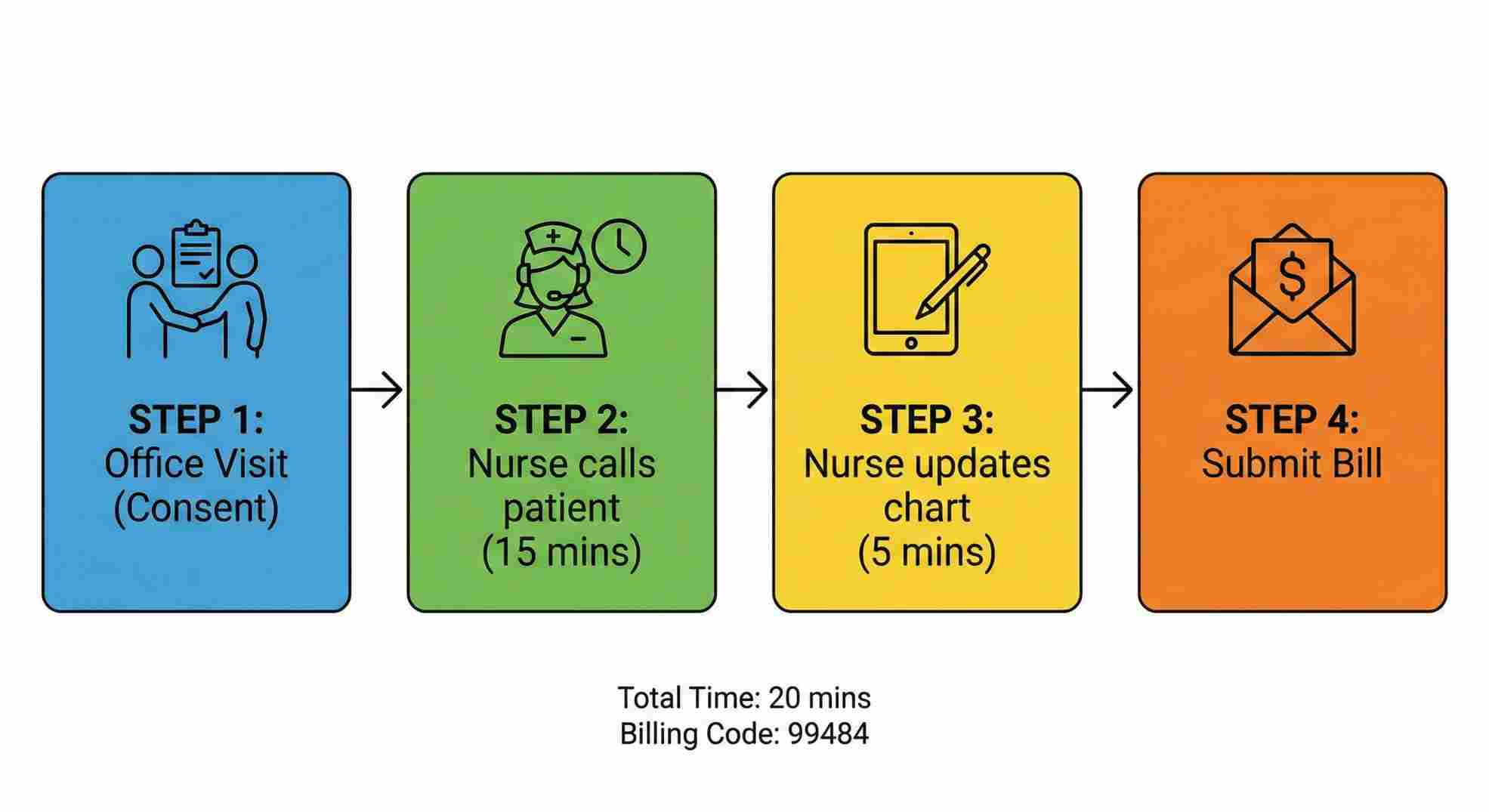
I see providers mix this up all the time. They confuse cpt code 99484 with the heavy-duty CoCM codes. Those require contracts with psychiatrists. General BHI (99484) does not. It only requires you and your staff. If your nurse or MA spends 20 minutes a month managing a patient’s care, you can bill this. It is the easiest entry point into behavioral health billing.

What the 99484 CPT Code Description Actually Says
To get paid, we have to look at the exact wording. The official CMS Behavioral Health Integration Services booklet defines the 99484 CPT code description as “Care management services for behavioral health conditions, at least 20 minutes of clinical staff time, directed by a physician or other qualified health care professional, per calendar month.”
Let’s break that down into plain English.
The 99484 CPT code description is not for a visit. It is for a month of service. You don’t bill it because you saw the patient once. You bill it because your team spent time working on that patient’s case over the course of 30 days.
Who Qualifies?
This code works for patients with mental or behavioral conditions that you are treating.
- Depression
- Anxiety
- Alcohol or drug issues
- Psychotic disorders
Unlike other codes that demand a severe diagnosis, the 99484 CPT code description is wide open. If you are managing the condition and tracking progress, it likely counts.
The Requirements
Your staff needs to do four specific things during those 20 minutes to meet the 99484 CPT code description:
- Assess: Use a scale like the PHQ-9.
- Plan: Make a plan for their care.
- Coordinate: Talk to other providers if needed.
- Connect: Talk to the patient to keep them on track.
Read the 99484 CPT code description carefully. It says “directed by a physician.” This means you don’t have to do the legwork. You supervise. Your staff does the calls and the charting.
Billing Guidelines for 99484
Definitions are fine. But you want to get paid. The AAFP billing guidelines for 99484 are strict about how you start.
The First Visit
You can’t just slap cpt code 99484 on a claim. You need an “initiating visit.” This is a regular face-to-face or video appointment. You have to:
- Diagnose the problem.
- Get the patient’s permission.
- Tell them coinsurance applies.
If you don’t write down that the patient agreed, you will fail an audit. It doesn’t matter if you followed the rest of the 99484 CPT code description perfectly. No consent means no money.
Time Rules
You bill this once a month. The clock resets on the 1st. If your staff only spends 18 minutes? You bill nothing. If they spend 20 minutes? You bill 99484.
Note: The 99484 CPT code description is a flat rate. You don’t get extra for spending 40 minutes. It is one code, one price.
BHI vs. CoCM: Which Code Do I Use?
This is where it gets messy. You hear about cocm codes and cocm cpt codes. That is the Collaborative Care Model (CoCM). It is different. The 99484 CPT code description is for general cases. CoCM is for the hard stuff.
Look at the 99492 cpt code description. That is for the first 70 minutes of CoCM. It pays well, but you need a psychiatrist to review the chart.
Then there is the 99493 cpt code description. That is for the months after the first one. It requires 60 minutes of time. If you have a patient who isn’t getting better, CoCM makes sense. But for most patients, the 99484 CPT code description is better because it is less paperwork.
Here is the comparison:
Table 1: General BHI vs. Collaborative Care (CoCM)
| Feature | CPT 99484 (General BHI) | CPT 99492 / 99493 (CoCM) |
|---|---|---|
| Description | 99484 CPT code description: Care management, min 20 mins/month. | 99492 cpt code description: First 70 mins. 99493 cpt code description: Subsequent 60 mins. |
| Who is needed? | Clinical Staff + You. | Staff + You + Psychiatric Consultant. |
| Severity | Mild to Moderate. | Complex cases. |
| Time Needed | 20 minutes. | 70 mins (Start), 60 mins (Ongoing). |
| Registry? | No. | Yes, mandatory. |
There is also the 99494 cpt code description. That is an add-on code for CoCM when you go way over time. You won’t use it with general BHI.
Also, watch out for the g2214 cpt code description. Medicare made this for shorter CoCM times (30 minutes) because hitting the 60 minutes for the 99493 cpt code was too hard for many clinics. But for 99484, the bar stays at 20 minutes.
What Does It Pay?
Why learn the 99484 CPT code description? Because it stabilizes your cash flow.
The average 99484 reimbursement rate is around $40 – $48 per patient, per month.
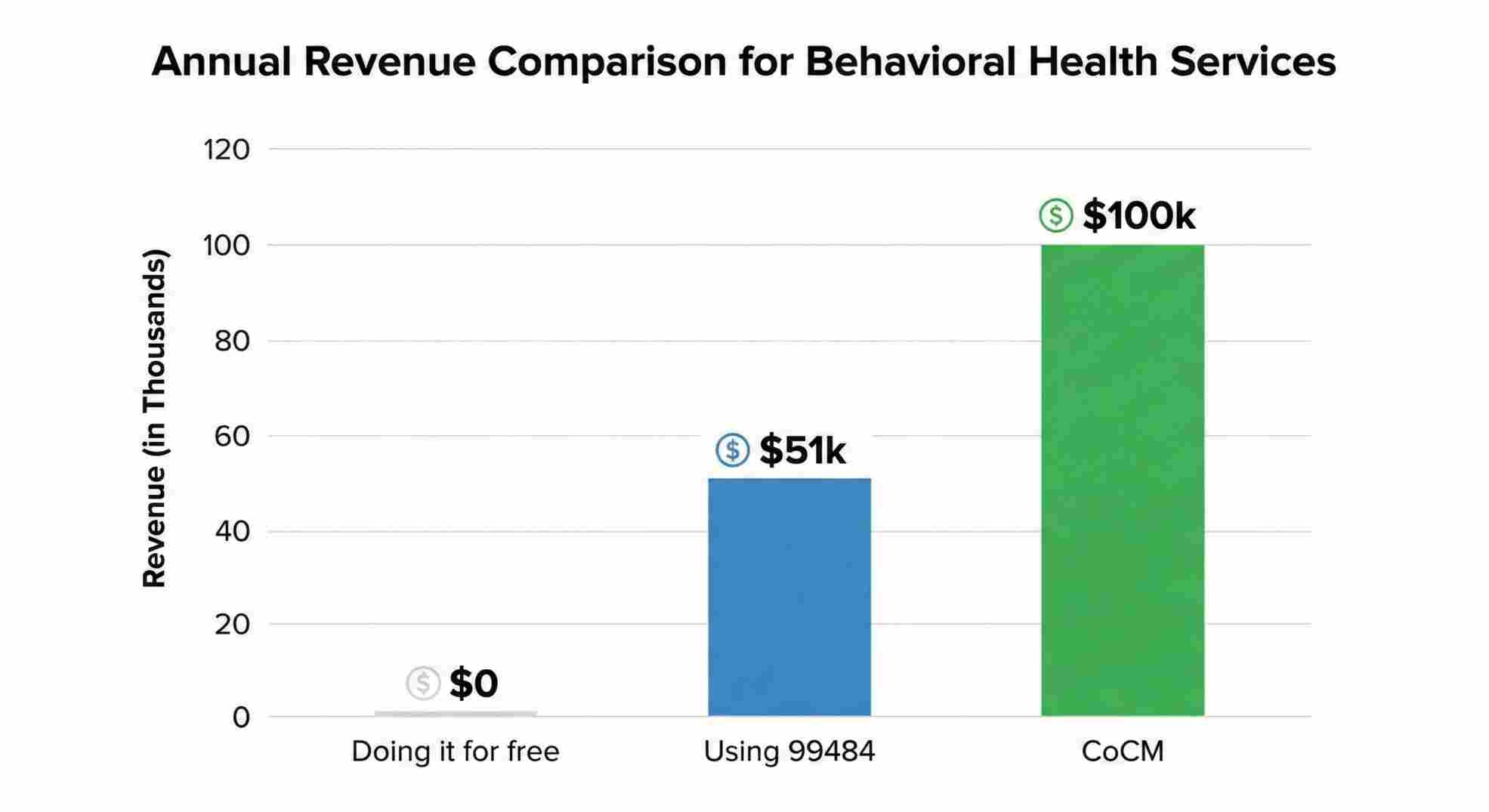
Let’s do the math. Say you have 2,000 patients. Stats say about 400 of them have a behavioral need. If you enroll just half of those (200 patients):
Table 2: Revenue Potential
| Metric | Small Start | Medium Effort | Full Program |
|---|---|---|---|
| Patients Enrolled | 50 | 100 | 200 |
| Monthly Payment (~$43 avg) | $2,150 | $4,300 | $8,600 |
| Yearly Revenue | $25,800 | $51,600 | $103,200 |
That is $100k a year. Your staff is probably doing the work anyway. The 99484 CPT code description lets you get paid for it.
Compare that to the 99493 cpt code, which pays around $130 but forces you to pay a psychiatrist. 99484 keeps the money in your practice.
Software & Documentation
You need to prove you did the work. Your notes must match the 99484 CPT code description.
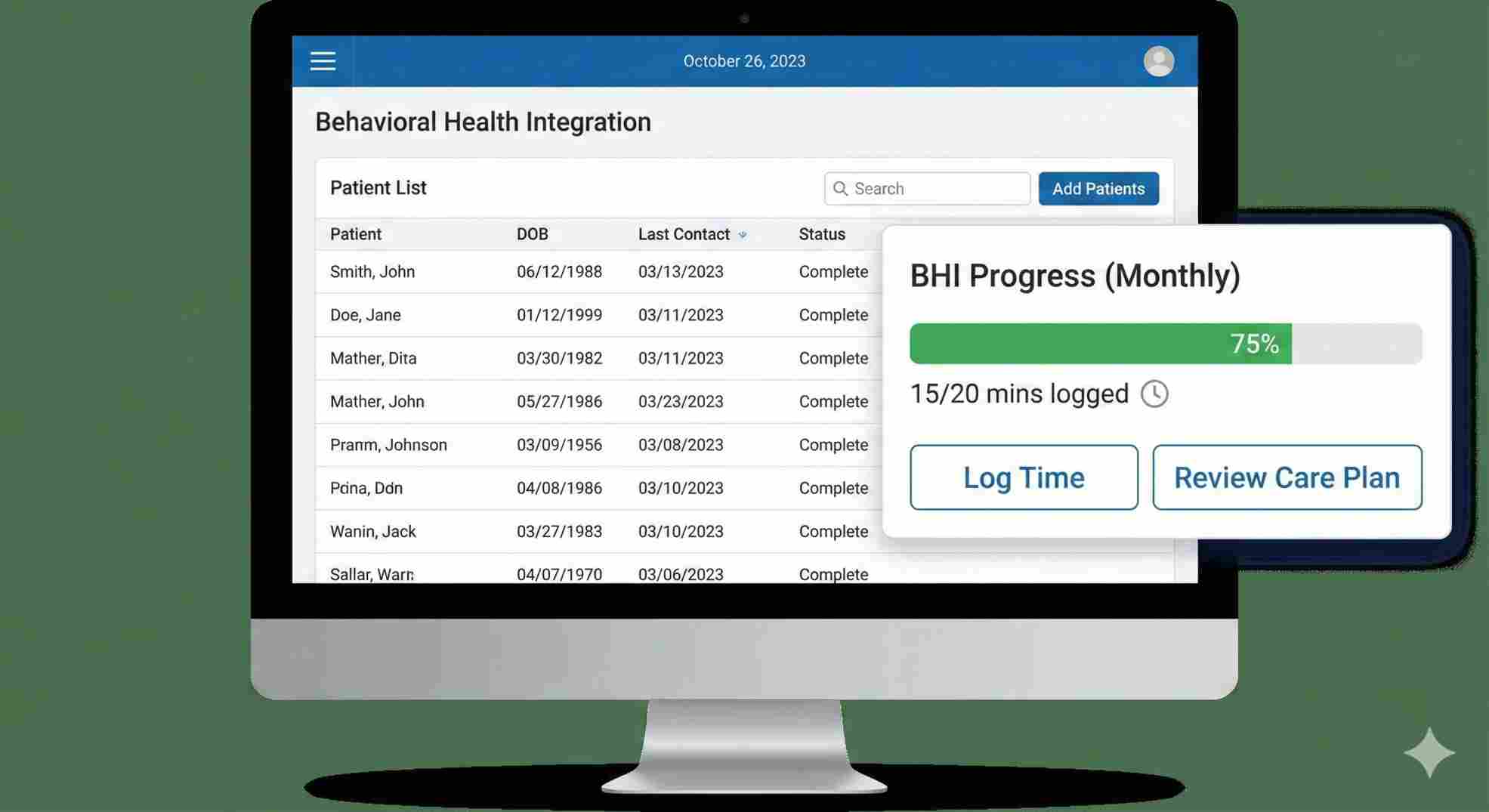
You need an EHR that tracks time. Most systems have a timer, but BHI is tricky because the time happens over different days. You might talk for 5 minutes on Tuesday and 15 minutes on Friday. You need to add that up to hit the 20 minutes required by the 99484 CPT code description.
What Your EHR Needs
When checking ehr functionalities for medicare bhi cpt codes billing, look for these:
- Templates: The 99484 CPT code description asks for a “systematic assessment.” You need built-in PHQ-9 forms.
- Time Logs: A way to tag a phone call to the BHI code.
- Reminders: Alerts that tell your staff, “Hey, call Mrs. Jones, we only have 10 minutes logged.”
If you use cocm cpt codes, you need a registry. For cpt code 99484, you can technically use a spreadsheet, but it is risky.
Why Claims Get Denied
You can know the 99484 CPT code description by heart and still get denied. Here are the traps.
1. The Calendar Month Rule
The 99484 CPT code description says “calendar month.” January is January. If you do the work from Jan 15 to Feb 15, you can’t combine it. You lose that money.
2. The “Ghosting” Problem
The 99484 CPT code description requires “continuity.” If you bill this for six months but never update the care plan or talk to the patient, auditors will take the money back. You have to show you are actually managing the care.
3. Double Billing
You usually can’t bill cpt code 99484 in the same month as cpt code 99492 or 99493. Pick one. However, you can bill it with Chronic Care Management (CCM), as long as the time is separate.
Table 3: How to Pass an Audit
| Requirement | What Auditors Look For |
|---|---|
| Consent | Did you write down that the patient agreed to the fee? |
| Time | Is there a log showing 20+ minutes of clinical work? |
| Role | Did the doctor oversee the work as per the 99484 CPT code description? |
| Plan | Is there a current care plan in the file? |
| Diagnosis | Is there a valid ICD-10 mental health code? |

Final Words
Integrating behavioral health is just good business. By learning the 99484 CPT code description, you can treat the whole patient and get paid for it.
Don’t overthink it. Start small. Pick ten patients who need help. Get their consent. Track the time. Once you see the checks come in, you will wonder why you waited. The 99484 CPT code description is your tool to fix the gap in care. Use it.