
How to bill insurance for therapy comes down to seven steps: get on the plan, verify the client's benefits, choose the CPT code that matches the session time, document it, submit a complete claim, read the remittance and collect the client's share. Most denials start in the first three steps.
Therapists are trained to treat clients, not to chase claims, and the billing side is easy to get wrong. This guide gives the order of work, the fixed rules we could verify from Medicare contractors, NUCC and eCFR, and the points where each plan sets its own rules. It keeps code-level detail brief and links to our deeper posts. This is general information, not legal, coding or compliance advice.
Key takeaways
- Verify benefits yourself before session one; a card does not tell you what therapy is covered.
- Choose the code from documented time: 16 to 37, 38 to 52, or 53 or more minutes for 90832, 90834 and 90837.
- 90839 is the stand-alone crisis code; +90840 is the add-on.
- Medicare generally allows one calendar year from the date of service to file; other payers set their own limit, so ask.
- Read the reason code and group code on the remittance before you bill the client.
The seven steps to bill insurance for therapy
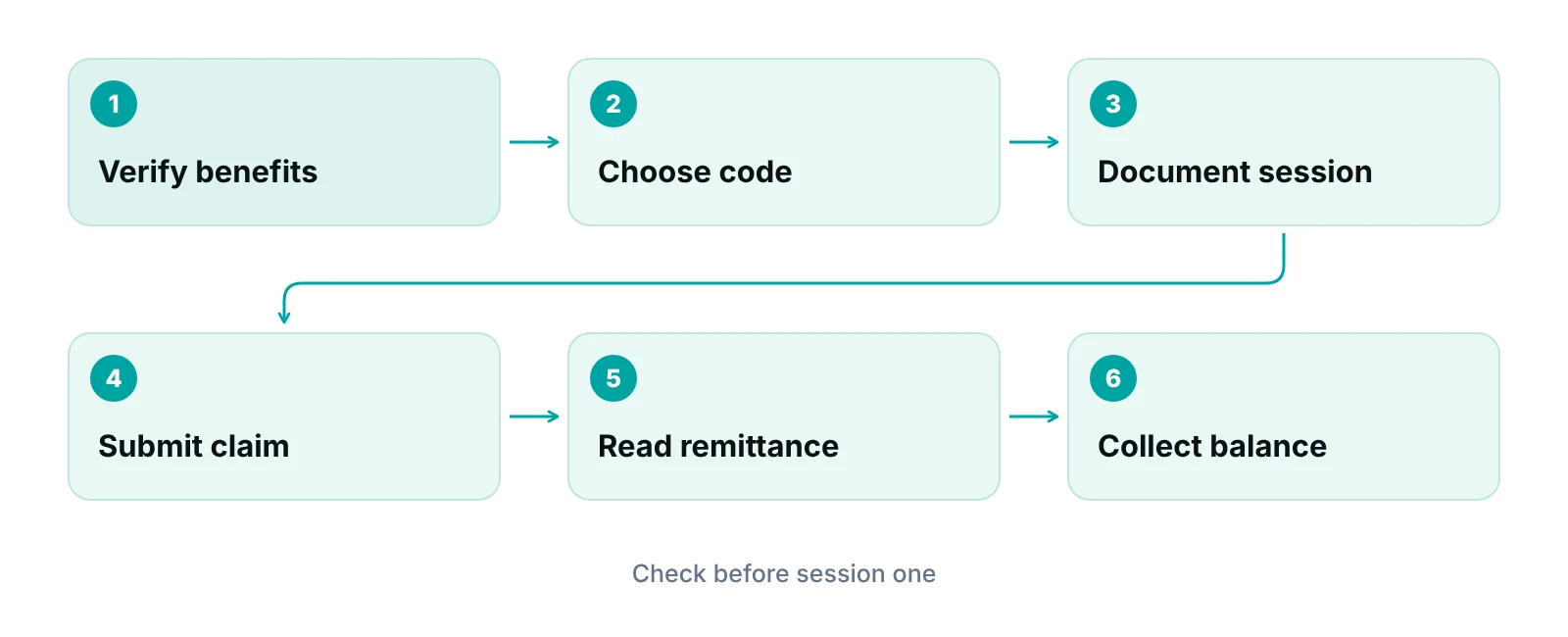
Billing insurance for therapy is a loop of seven steps: get on the plan, verify benefits, pick the code, document the session, submit the claim, read the payer’s response and collect the balance. Most unpaid claims trace back to a mistake in the first three or in the data on the claim, not to the therapy itself.
- Be in network, or know you are not. Confirm the plan has given you an effective date before you bill it.
- Verify benefits for every client. Do this before the first session and again when a new plan year starts.
- Choose the code that matches the service and the time. Intake, individual session, family session or crisis.
- Document what happened. Diagnosis, treatment plan, session time and progress, in the same note.
- Submit a complete claim. Right diagnosis, right provider IDs, right modifiers, filed well inside the deadline.
- Read the remittance. Post the payment, then work every adjustment and denial.
- Collect what the client owes. Copay at the visit, the rest once the payer has finished processing.
The rest of this guide walks through each step at a high level. For code-by-code detail we link out rather than repeat it: see our guides to mental health billing, the 90832 time range, 90836 with an E/M visit and 90846 family therapy.
Step 1: Get on the plan before you bill it
You can bill a plan as an in-network provider only after the plan has credentialed you, you have a signed contract and you have an effective date. Billing earlier can mean denied claims for dates of service that fall before that date.
Credentialing and contracting are their own project, and we cover them in our therapist insurance credentialing guide. For billing purposes, three checks matter. Get your effective date in writing. Make sure your name, license, NPI and tax ID are written the same way on every enrollment and every claim. Ask the plan which claim format and submission route (portal, clearinghouse or paper) it wants.
If you are out of network, you do not submit claims to the plan as a participating provider. Some out-of-network therapists give the client an itemized receipt to send to their own plan. Reimbursement is then between the client and the plan, so explain that before the first session.
Step 2: Verify benefits yourself, before session one
Verify every client’s benefits for behavioral health outpatient therapy before the first session, using the plan’s portal or a phone call. A card showing the plan name does not tell you whether therapy is covered, what the client owes or whether you are in network for that specific plan.
The answer can differ between two plans from the same insurer. Ask these every time and record the answers, the date and the name of the person you spoke to:
- Is the client active on the date of the first session, and what is the plan name and ID?
- Are you in network for this exact plan? Who administers behavioral health benefits, the insurer or a separate company?
- What is the copay or coinsurance for outpatient psychotherapy, and has the deductible been met?
- Is there a limit on visits per year, or a requirement for authorization or a referral?
- Are telehealth sessions covered, and which code set, place of service and modifier does the plan want?
- What is the plan’s timely filing limit, and where do claims go?
Re-verify when a new plan year starts, because deductibles and visit limits can reset when the plan year starts. If you see many clients, our behavioral health eligibility verification guide covers how practices build this into the front desk.
Step 3: Choose the CPT code that matches the service
For individual outpatient therapy, the code follows the length of the face-to-face psychotherapy session. Medicare contractor guidance gives 16 to 37 minutes for 90832, 38 to 52 minutes for 90834 and 53 minutes or longer for 90837, and says to report no psychotherapy code for a session under 16 minutes.
| Code | What it is for | Time rule to know |
|---|---|---|
| 90791 | Psychiatric diagnostic evaluation (the intake) without medical services | Not a timed psychotherapy code. Medicare contractor guidance limits it to one per day. |
| 90832 | Individual psychotherapy, shortest band | 16 to 37 minutes |
| 90834 | Individual psychotherapy, middle band | 38 to 52 minutes |
| 90837 | Individual psychotherapy, longest band | 53 minutes or more |
| 90846 / 90847 | Family psychotherapy; 90846 is a family session without the patient present | Document exact times |
| 90839 / +90840 | Psychotherapy for crisis: 90839 is the first 60 minutes, +90840 is each additional 30 minutes | 90840 is an add-on and cannot stand alone |
Source: First Coast Service Options (Medicare contractor) psychotherapy services; American Psychiatric Association CPT overview; CGS Administrators psychotherapy checklist. Descriptions are paraphrased; the AMA owns CPT descriptors.
The older version of this post listed 90839 as the add-on. It is the stand-alone crisis code, and +90840 is the add-on. Check codes against the current AMA CPT book or your payer’s fee schedule before you set them up in your billing system, since descriptors and payer coverage are updated over time.
Three practical points. Pick the code from the time you documented, not the time you booked. Report one unit for a standard psychotherapy session; one Medicare contractor says it denies claims for more than one unit outside partial hospitalization. And do not assume a longer code is a risk or a safe bet: payers set their own policies on 90837, so read each plan’s behavioral health policy and match your documentation to it.
If you add an E/M service on the same day as psychotherapy, the two must be separately identifiable, and the add-on psychotherapy codes (90833, 90836, 90838) are the ones paired with E/M. That is mostly a prescriber question; our 90836 guide covers it, and the 90846 guide covers family sessions. We do not repeat that detail here.
Step 4: Document so the note supports the claim
A claim is only as strong as the note behind it. The note should show the diagnosis, the treatment approach, the session time, and how the session moved the treatment plan forward, so someone reading it cold can see why the service was needed.
A Medicare contractor’s psychotherapy checklist lists what it looks for: exact start and stop times, the modalities used and how often, the diagnosis, symptoms and functional status, a focused mental status exam, and the treatment plan, prognosis and progress. It also expects the provider’s name, credentials and signature, and the patient present for all or part of the session. Commercial plans write their own rules, but this list is a sensible default.
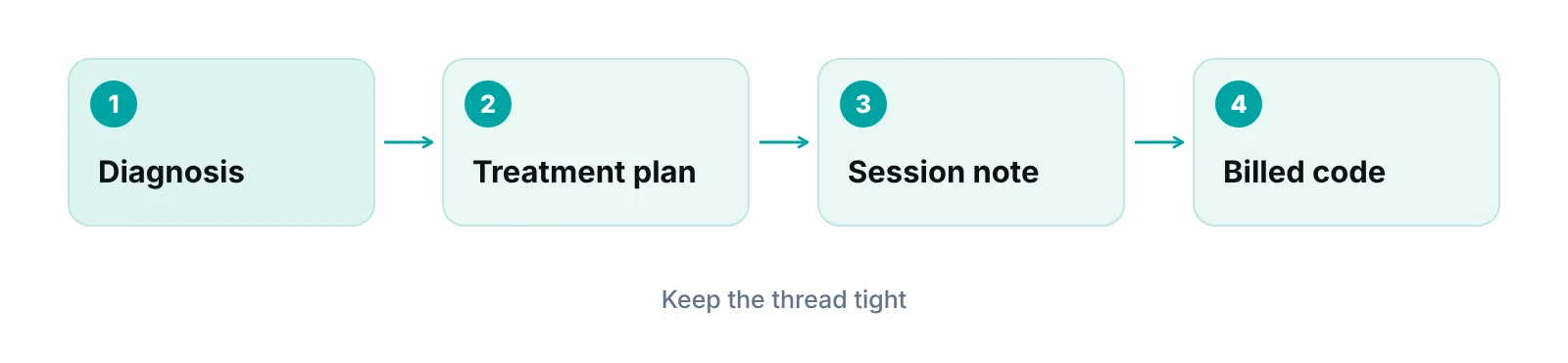
The link between diagnosis, treatment plan and session note is sometimes called the golden thread. A note that says only “discussed work stress” leaves that thread loose. A note that names the technique, ties it to the diagnosed condition and records what the client did in session does not.
Couples and family sessions
Insurance generally pays for treating a diagnosed condition, not for the relationship itself. The same checklist says family-only sessions fall under 90846, and that the patient is present for all or part of other sessions. Name the identified patient and the diagnosis in the note, and check your payer’s family therapy policy. Our 90846 time range guide goes deeper.
Step 5: Build and submit a complete claim
Whether you use practice software or fill the form by hand, the claim carries the same data as the CMS-1500 (the NUCC 1500 form). Most rejections come from a handful of fields, so check these before you submit.
| Box | What the NUCC manual says goes there | Common mix-up |
|---|---|---|
| 11 | The insured’s policy or group number, as shown on the health card | Treating it as a patient-to-policyholder link; it is the policy or group number |
| 21 | An ICD indicator, then up to 12 ICD-10-CM codes lettered A to L, no decimal points and no narrative text | Entering decimal points, or a less specific code than the record supports |
| 24J | Rendering provider NPI, reported when it differs from the box 33a NPI | Entering the billing NPI when the rendering therapist is a different person |
| 25 | The billing provider’s federal tax ID (EIN or SSN) | Entering hyphens, or a different ID than the one enrolled |
| 33 / 33a | The billing provider’s name, address, phone and NPI; must always be completed | Using a different name or address than on the enrollment |
Source: NUCC, 1500 Claim Form Reference Instruction Manual (July 2020 version, v8). The manual says to follow current payer instructions where they differ.
Three more points. First, the NUCC manual is a general guide and tells users to follow the most current payer instructions, so keep each plan’s claim guide on hand. Second, diagnoses should be as specific as the clinical record allows. Some plans do not accept certain secondary or Z-codes as a primary diagnosis, so check the plan’s policy before using one, and see our mental health ICD-10 guide for common diagnosis choices.
Third, telehealth. Do not assume the old “add 95 or GT” rule. In Medicare contractor guidance, modifier 95 is listed for a narrow set of uses and GT is limited to critical access hospital Method II claims, and CMS updates its telehealth list every year, effective January 1. Commercial plans differ again. Ask each plan which place of service code and modifier it wants for video and audio-only therapy, and write the answer down.
Know the filing deadline
Medicare generally requires a claim to be filed by the end of one calendar year after the date of service, with limited exceptions (42 CFR 424.44). Commercial plans and Medicaid set their own deadlines in their contracts and manuals. A flat “90 days” is not a universal rule, so find each plan’s number and file well before it.
Step 6: Read the remittance and work every denial
The payer’s remittance, as a paper EOB or an electronic remittance, shows what it allowed, what it paid and why anything was reduced or denied. Post it line by line and compare the allowed amount to your contract rate. A payment that is lower than expected is a work item, not a loss.
Each adjustment carries a claim adjustment reason code, usually written with a group code such as CO or PR. Read the group code, because a reason code can be patient responsibility or provider liability depending on how it is used. The table shows common reason codes and the first thing to check.
| Code | Standard meaning | First thing to check |
|---|---|---|
| 1, 2, 3 | Deductible, coinsurance and copay amounts | Usually the client’s share, depending on the group code. Confirm against the benefit check, then bill the client. |
| 4 | Procedure code inconsistent with the modifier | Telehealth or other modifier on the line, against the plan’s policy |
| 11 | Diagnosis inconsistent with the procedure | Box 21 diagnosis and the pointer on the service line |
| 18 | Exact duplicate claim or service | Whether the first claim already paid before you resubmit |
| 27 | Expenses incurred after coverage terminated | Eligibility on the date of service, and whether the client has a new plan |
| 29 | Time limit for filing has expired | Original submission proof such as a clearinghouse acceptance report, then the plan’s appeal rules |
| 50 | Not deemed a medical necessity by the payer | The note, the diagnosis and the plan’s medical necessity policy |
Source: MassHealth CARC memo (February 2025), listing X12 claim adjustment reason code descriptions. Group codes (CO, PR and others) change who is liable.
Work denials by cause. Data errors (demographics, IDs, diagnosis, modifier) are usually fixed and resubmitted as a corrected claim. Medical necessity denials need the note and often a written appeal. Timely filing denials depend on whether you can prove an earlier submission. Ask the payer for its appeal deadline in writing, because it is often shorter than people expect. When denials repeat, our denial management services are built for that follow-up.
Step 7: Collect what the client owes
Collect the copay at the visit and bill coinsurance or deductible amounts only after the remittance tells you the client’s share. Collecting from your verification alone is a guess, because the allowed amount is not final until the claim is processed.
- Copays: take them at check-in or session end, and record them against the claim.
- Coinsurance and deductible: send a statement from the posted remittance, with the date of service and the code described in plain words.
- In-network limits: your participation agreement sets what you may charge beyond the client’s plan share. Read it before you set a no-show or late-fee policy.
Review your unpaid claims on a schedule, weekly if you see many clients, not once a quarter. Any claim with no response after the plan’s normal processing time needs a status check. Our behavioral and mental health RCM operations page describes how we handle this follow-up for therapy practices.
Keeping the whole loop under control
A claim has a life: drafted, submitted, accepted, paid, denied, appealed. Practices lose money when nobody owns the stage a claim is stuck in. Whatever tool you use, track each claim by stage with a named owner.
A spreadsheet works for a handful of clients. At higher volume you want software that tracks claims by stage, checks that required data is present before submission and flags payments below the expected amount. That is the idea behind a practice management system that tracks claims by stage. If you would rather not do the work yourself, our medical billing services handle submission and follow-up inside your existing EHR.
See what unpaid claims may be costing your practice
Use our revenue calculator for a rough estimate, or ask for a free practice audit if you want a person to look at your claims workflow.
Our recommendations
- Verify first, every time. We would never schedule a first insured session without a benefit check recorded in the client file.
- Match the code to documented time. We would pick the code from the start and stop times in the note and leave the long-versus-short debate to the payer policy.
- Keep one source for provider data. Use the same name, license, NPI and tax ID on every enrollment and claim, so mismatches do not become rejections.
- Write down each plan's rules. A one-page sheet per plan with the filing deadline, telehealth modifier, authorization rule and appeal deadline saves repeated calls.
- Work denials within days. Read the code and group code, fix what is fixable and appeal what is not, before the appeal deadline passes.
- Review unpaid claims on a schedule. Pick a day each week and look at every claim with no payment. A fixed routine beats an occasional clean-up.
If you want a tool that follows each claim from submission to payment.
Our practice management system tracks claims by stage with an owner, checks required data before submission and flags payments below the expected amount. It is a claim-centred system, not an EHR.
See how the RCM Finder portal works · Create a portal account
Disclosure: RCM Finder builds and sells this portal. It is a practice management system, not an EHR.
Bottom line
Billing insurance for therapy gets easier once the steps run in the same order every time: verify, code from documented time, write a note that supports it, file a complete claim and work the remittance. If you would like help, our medical billing services cover claims and follow-up, and our denial management services handle repeat denials. You can also contact our team with questions.
Frequently asked questions
What do I need before I can bill insurance for therapy?
You need a license, an NPI and a tax ID, and for in-network billing a contract with an effective date from each plan. You also need a way to submit claims, such as practice software or a clearinghouse. Out-of-network therapists usually give clients an itemized receipt instead. Our credentialing guide covers the enrollment steps.
Which CPT code should I use for a 45-minute therapy session?
Medicare contractor guidance gives 38 to 52 minutes for 90834 and 53 minutes or longer for 90837. A 45-minute session usually falls in the 90834 band, but code from the time you documented, not the time you scheduled. Payers can set their own policies, so check the plan’s behavioral health policy.
How long do I have to submit a claim?
It depends on the payer. Medicare generally requires filing by the end of one calendar year after the date of service, with limited exceptions. Commercial plans and Medicaid set their own deadlines. Ask each plan for its timely filing limit and submit well before it.
Do I add modifier 95 or GT to telehealth therapy claims?
Not automatically. In Medicare contractor guidance, modifier 95 is listed for a narrow set of uses and GT is limited to critical access hospital Method II claims. Place of service and modifier rules also vary by commercial plan and change over time. Ask each plan what it wants for video and audio-only sessions.
What should I do when a therapy claim is denied?
Read the reason code and the group code on the remittance. Fix data errors and resubmit a corrected claim. For medical necessity, send the note with a written appeal. For timely filing, find proof of the earlier submission. Ask the payer for the appeal deadline in writing.
Can an intern or unlicensed associate bill insurance?
It depends on the payer, the license type and the state. Each plan sets its own rules on who can enroll and whether supervised services can be billed under a supervisor. Do not bill under another provider’s NPI unless the payer’s written policy clearly allows it.
Get your free practice audit
Tell us about your practice. We will contact you using the details you give.
- A review of your recent claims, denials and A/R aging
- Where your front desk and prior authorizations slow payment
- A prioritized fix list you keep, whether or not you hire us
Pricing is quoted after the audit, based on your volume and the services you choose. Prefer to talk? Call +1 (302) 556-2288.
Sources
- Psychotherapy Services — First Coast Service Options (Medicare Administrative Contractor) (current)
- CPT overview: psychotherapy and psychiatric diagnostic evaluation — American Psychiatric Association (n.d.)
- Psychotherapy documentation checklist — CGS Administrators, LLC (Medicare Administrative Contractor) (n.d.)
- 1500 Claim Form Reference Instruction Manual (v8, July 2020) — National Uniform Claim Committee (2020)
- 1500 Claim Form FAQ — National Uniform Claim Committee (n.d.)
- 42 CFR 424.44 Time limits for filing claims — eCFR / HHS (current)
- CARC memo: Denied and Adjusted CARCs — Massachusetts Executive Office of Health and Human Services (MassHealth) (2025)
- Telehealth service modifiers — First Coast Service Options (Medicare Administrative Contractor) (current)
- Telehealth — Centers for Medicare & Medicaid Services (current)
Disclaimer: This page is general educational information for therapists and practice managers. It is not legal, coding, billing-compliance or financial advice. CPT is a trademark of the American Medical Association. Payer rules, codes and deadlines vary and change; confirm current requirements with each payer, your Medicare contractor and a qualified advisor before acting.