
The 90846 CPT code time range starts at 26 minutes. It is a 50-minute family psychotherapy code for sessions where the patient is not present, and CPT's time rule lets you report it once more than half that time has passed. Record start and stop times, and check your payer's limits.
A mother and father sit with you for 35 minutes to go over their teenager’s treatment plan. The teenager stays home. You know the work counted. The open question is which code the claim should carry and whether your note can prove it.
This guide covers the time rule, who may attend, and the payer limits that differ from one plan to the next. It stays on family psychotherapy without the patient. For the shorter individual codes, see our 90832 CPT code guide and our 90836 CPT code guide. For the full family-therapy picture, including 90847, see our 90846 family therapy billing guide.
Key takeaways
- 90846 is a 50-minute family psychotherapy code for sessions without the patient, and 26 minutes is the working floor under the CPT time rule.
- Payers publish their own rules for units, patient presence and same-day billing, so check each contract.
- Notes need exact start and stop times, who attended, and how the session served the patient.
- Taking a family history and therapy with professional caretakers are not 90846 services.
- A 22-minute call does not support 90846. Do not stretch the time.
What the 90846 CPT code reports
CPT 90846 reports family psychotherapy delivered while the patient is not in the session. A Medicare contractor’s fact sheet puts it plainly: it is the family psychotherapy code for when the patient is absent (CGS Administrators, fact sheet revised 2021). We describe the code in our own words because the AMA owns the official CPT wording. Check the current CPT book when you build your charge master.
Think of it as treatment for the patient, delivered through the people around them. A parent learns how to respond to a child’s escalating behavior. A spouse learns what to watch for after a medication change. A Medicare contractor’s published policy ties family psychotherapy to one purpose: treating the patient’s condition, not the family’s own needs (WPS policy PSYCH-014, 2012 revision). That purpose is what the claim has to show. It is also the first thing a reviewer looks for. If your practice mainly sees behavioral health patients, our page on behavioral and mental health billing operations shows how we think about these claims across the whole revenue cycle. For the wider code set, see our guide to coding and billing for mental health services.
Three things 90846 is not
The same WPS policy says family psychotherapy codes should not be used when the service is taking a family history, and that evaluation and management counseling is coded as an E/M service by time. It also says family counseling does not include supervising or providing therapy to professional caretakers or staff. A history interview with a parent is intake work. It is not a 90846 session.
How the 26-minute time range works
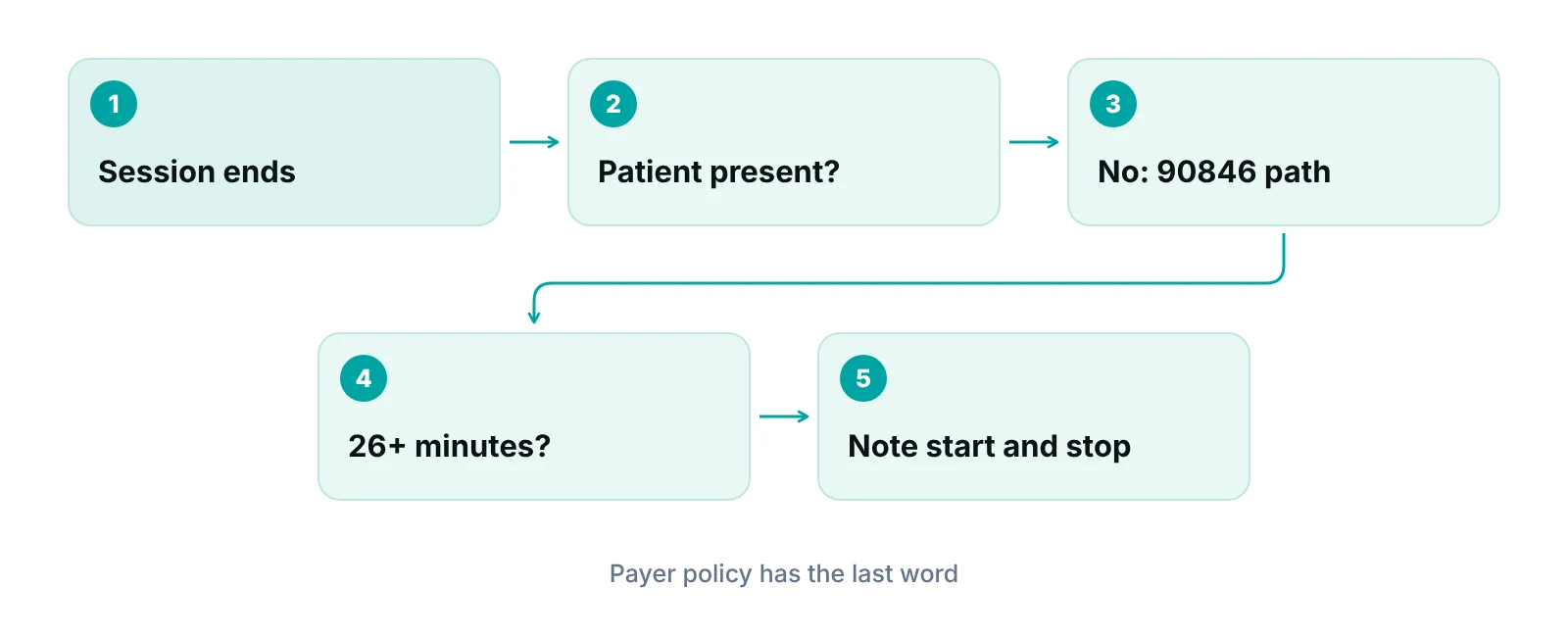
The minimum is 26 minutes, and the number comes from arithmetic. 90846 is a 50-minute code. In 2016, Psychiatric News (published by the American Psychiatric Association) explained that from 2017 these family codes became time-based at 50 minutes, and that the CPT time rule lets a clinician report a code once half the threshold time is reached (Psychiatric News, 2016). Half of 50 is 25, so 26 is the first minute past the midpoint. A Georgia Medicaid health plan’s 2019 provider notice states the same figure for both 90846 and 90847 (Peach State Health Plan).
Two cautions apply. First, 26 is the CPT convention, not a number every payer repeats. The South Carolina Medicaid manual we reviewed lists the 50-minute descriptor and does not state a separate minimum (SCDHHS, 2025). Second, the CGS fact sheet states no minimum for these codes either, and it says exact times must be documented in the record. So 26 is the working floor, and your payer’s own policy is the final word.
| Code | Who is in the session | Time to report it | Where to read more |
|---|---|---|---|
| 90846 | Family or support people, patient not present | 26 minutes or more (50-minute code, midpoint passed) | This guide |
| 90847 | Family or support people, patient present | 26 minutes or more (50-minute code, midpoint passed) | 90846 family therapy billing guide |
| 90832 | Patient, and family members if present | 16 to 37 minutes | 90832 CPT code guide |
| 90834 | Patient, and family members if present | 38 to 52 minutes | Mental health coding and billing guide |
| 90837 | Patient, and family members if present | 53 minutes or longer | Mental health coding and billing guide |
Source: Psychiatric News, American Psychiatric Association (2016); Peach State Health Plan (2019); First Coast Service Options, Psychotherapy services (page dated August 6, 2026); American Psychiatric Association, CPT overview (2013).
What if the session runs long?
We found no published upper limit for 90846 in the sources we reviewed, so the old idea of a fixed 60-minute ceiling is not something we can support. What we can support is a unit rule. South Carolina Medicaid defines one unit as one session and allows one per date of service, with four sessions per month (SCDHHS, manual updated January 2025). A 90-minute family meeting is still one session under that rule. Other payers set their own limits, so read the contract before you assume a second unit is payable.
Who can attend a 90846 session
Family members and other people who support the patient can attend. A Medicare contractor fact sheet says family involvement is allowed but does not list eligible attendees (CGS Administrators, 2021). A Florida teaching-hospital checklist built on a Medicare local coverage determination defines a family member broadly, as someone who spends significant time with the patient and gives psychological support (checklist for LCD L33252, 2018). That makes a grandparent, a foster parent or a partner reasonable attendees, as long as the session is about the patient.
- Usually fits: parents or guardians learning how to support a child’s treatment plan.
- Usually fits: a spouse or adult child learning how to respond to a patient’s symptoms.
- Does not fit: therapy for professional caretakers or staff, which the WPS policy excludes.
- Needs a closer look: a couple working on their relationship when neither person is the identified patient. The policies we reviewed tie family psychotherapy to treating the patient, so coverage depends on the plan.
Who may deliver the service is a separate question, and it is set by the payer. South Carolina Medicaid lists doctoral-level physicians, licensed psychologists and master’s-level clinicians for one program, and adds physician assistants and advanced practice nurses for another (SCDHHS, 2025). That list is one state’s rule, not a national one. Confirm licensure and enrollment for each payer before you schedule the session.
Payer limits to check before you bill
Payers disagree on units, patient presence and same-day billing, so the safest habit is to build a short rules sheet for each of your top payers. The table shows how much the published policies we read differ.
| Source | What it says | What to do with it |
|---|---|---|
| CGS Administrators fact sheet (2021) | 90846 is for family psychotherapy without the patient. Exact times must be documented. Family services generally require the patient to be present for all or some of the time. | Treat times as mandatory in every note. |
| First Coast Service Options (August 2026) | Family psychotherapy may be reported with 90832-90838 on the same date if it is a separate and distinct service in a separate time interval. | Keep separate start and stop times for each service. |
| WPS policy PSYCH-014 (2012 revision) | Covered when the main purpose is treating the patient’s condition. Not for taking a family history. | Write the patient link into the note. |
| South Carolina Medicaid manual (January 2025) | One unit equals one session. One per date of service and four per month. | Ask each state plan for its own frequency limit. |
| Peach State Health Plan notice (2019) | Midpoint rule of at least 26 minutes applies to 90846 and 90847. | Use 26 as the working floor. |
| Florida checklist for LCD L33252 (2018) | Family is defined broadly. No unit limit listed for 90846 or 90847. For family therapy with the patient, documentation should show the patient present for the majority of the service. | Confirm the patient-presence rule with your contractor. |
Sources: CGS Administrators (2021); First Coast Service Options (2026); WPS Insurance Corporation via CMS Medicare Coverage Database (2012); South Carolina Department of Health and Human Services (2025); Peach State Health Plan (2019); University of Florida Jacksonville compliance checklist (2018).
Notice what the table does not give you: one national answer. Medicare contractors, state Medicaid programs and commercial plans each publish their own rules, and several of these documents are years old. Treat any policy as a starting point, then confirm that the current version still applies.
Mixed sessions and same-day services
The hardest cases are sessions that do not fit one box. Here are the three we see most often, and how we would approach each.
The patient joins for part of the visit
Say a teenager is in the room for ten minutes, then you spend forty minutes with the parents. The old version of this post said to bill whichever part ran longer. We could not verify that rule. What the sources do show is that contractors word patient presence differently: CGS says the patient must be present for all or some of the time for family services, while the Florida checklist says the majority (CGS, 2021; checklist, 2018). Ask your payer which code it expects when the patient is present for part of the session, and get the answer in writing.
Individual and family services on the same day
First Coast says family psychotherapy may be reported separately with 90832 through 90838 on the same date when it is a separate and distinct service during a separate time interval (First Coast Service Options, 2026). Each service then needs its own start and stop times and its own medical necessity. A ten-minute individual segment does not reach the 16-minute floor that contractors set for those individual codes, so it cannot be billed alone. Whether a modifier is needed on the second service is payer specific, and we could not confirm a general rule. Our guide to telehealth modifiers covers modifier basics, and the contract is your final check.
A short call with a parent
A 22-minute call does not reach the 26-minute floor, so 90846 is not supported. Do not stretch the time. Ask the payer whether another service fits, and if none does, treat it as unbilled clinical time.
Do not stack minutes
Add up only the time you actually spent in the family session. Waiting time, charting and a hallway chat afterward are not session minutes. Reviewers compare your stated times with the schedule and with the note.
What the note should show
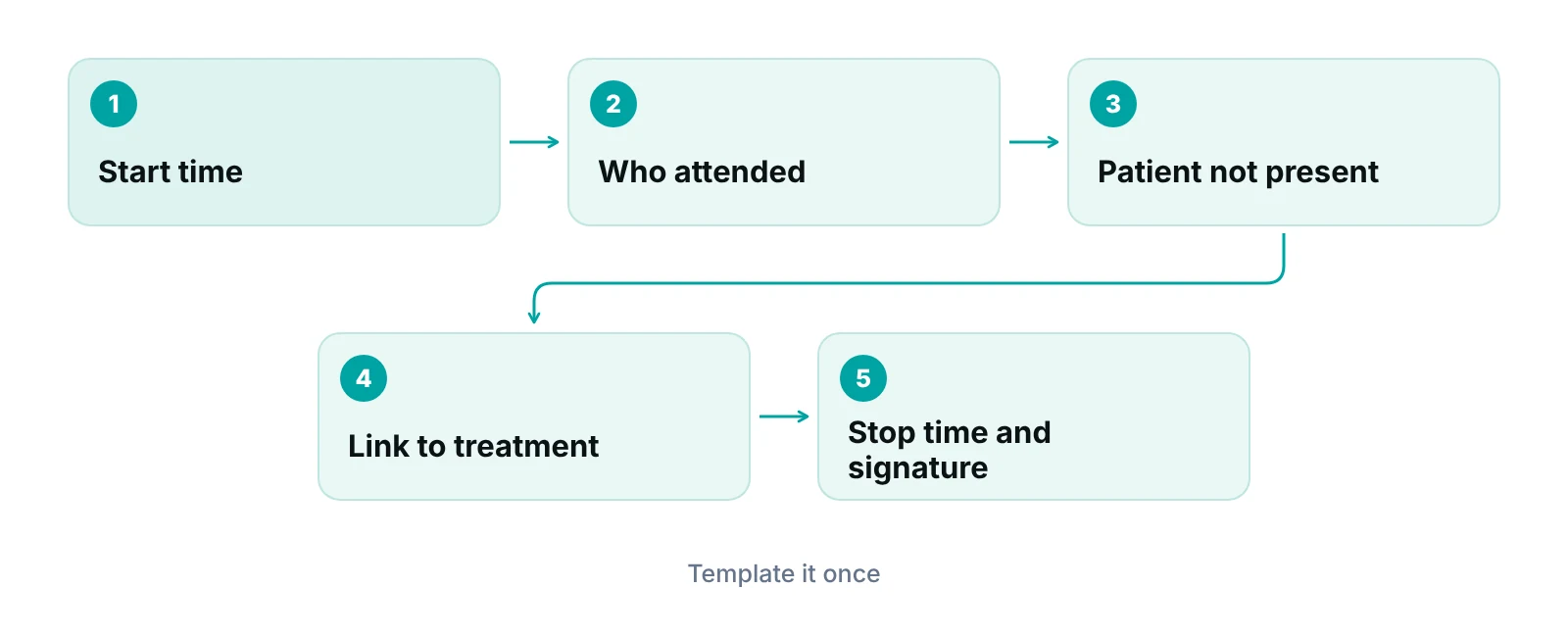
A 90846 note should let a reviewer see the time, the attendees and the link to the patient without asking you a question. CGS says exact times must be documented and that notes should show items such as symptoms, functional status, treatment plan and progress, with the provider’s name, signature and credentials (CGS Administrators, 2021). The checklist below adds the points that matter most for a patient-absent session.
- Start and stop times. Write “9:00 to 9:40 AM”, not just “40 minutes”. The CGS fact sheet requires exact times in the record.
- Who attended. Name the people and their relationship to the patient.
- Patient not present. Say so, and add the clinical reason if there is one.
- The patient link. State how the session served the patient’s treatment, tied to the diagnosis and plan.
- What you did. Summarize the interventions and the family’s response, in a few specific lines.
- Signature and credentials. Sign it, as the CGS fact sheet requires for all services.
| Risk | Why it happens | Fix |
|---|---|---|
| Session under 26 minutes | Time shortfall against the 50-minute code | Do not bill 90846. Ask the payer about other options |
| Missing start and stop times | Note states total minutes only | Make both times required fields in the template |
| History interview coded as therapy | Intake work billed as family psychotherapy | Code the intake service that fits instead |
| No link to the patient’s treatment | Note reads like family counseling | Add one sentence tying the session to the plan |
| Units above the plan limit | Long session billed as two units | Check unit and monthly limits for each payer |
| Patient present but 90846 billed | Code does not match who attended | Check who was in the room before coding |
Source: our summary of CGS Administrators (2021) and WPS policy PSYCH-014 (2012) for time, history and purpose rules; South Carolina Medicaid manual (2025) for units. Risk list is our own.
“If a stranger can read the note and see when the session ran, who sat in it, and why it helped the patient, the claim is much easier to defend. – Awais Afzal”
— Awais Afzal, Healthcare Operations & Data Analyst
Handle 90846 billing yourself or get help?
Handle it in-house when family sessions are rare, one person codes every claim, and you already keep a rules sheet for each payer. Get help when payer rules differ across your panel, denials on family sessions repeat, or your clinicians chart in different styles. Our medical billing services team works inside your existing EHR (for example PrognoCIS, eClinicalWorks or athenahealth), reviews psychotherapy claims against the payer’s own policy, and can flag missing times before a claim goes out.
Pricing is quoted after a free audit, so you can see what we find in your claims before you decide on anything.
See how your family-therapy claims would hold up
We will review a sample of your psychotherapy claims and notes against your payers' published rules, and tell you what we find.
Estimate what denials are costing you
Use our revenue calculator to see how a small change in clean-claim rate affects your cash flow.
Our recommendations
- Make start and stop times mandatory. We would block a family-session note from being signed until both times are filled in. It is the cheapest protection against a time denial.
- Set 26 as the internal floor. Build a hard stop in your scheduling and charge-capture workflow so a 22-minute session cannot flow into a 90846 claim.
- Keep a one-page rules sheet per top payer. For each payer, record units per day, monthly limits, patient-presence wording and who may render the service. Re-read it every January.
- Write the patient link in one sentence. Train clinicians to finish each note with how the session supported the patient’s treatment plan.
- Audit ten family claims each quarter. Pull ten claims, compare the minutes in the note with the code, and fix the template if you find the same gap twice.
Bottom line
The 90846 CPT code time range comes down to three checks: the patient was not present, the session passed 26 minutes, and the note shows times and a link to the patient’s care. Then confirm the payer’s limits, because they differ. If your team wants a second pair of eyes, our denial management services team can work the family-therapy denials you already have, or you can talk to our team about reviewing your process.
Frequently asked questions
How many minutes do I need to bill 90846?
The working minimum is 26 minutes. 90846 is a 50-minute code, and CPT’s time rule lets you report it once the midpoint has passed. Not every payer repeats that number, and some state the 50-minute descriptor only. Record exact start and stop times, and confirm your payer’s policy.
Is the 90847 time range the same as 90846?
Both are 50-minute family psychotherapy codes, and the midpoint rule applies to each, so the working floor is 26 minutes for both. The difference is who is present: 90846 is for sessions without the patient, and 90847 is for sessions with the patient present.
Can 90846 be billed if the patient joins for part of the session?
Payers word this differently. One Medicare contractor says family services need the patient present for all or some of the time. A Florida checklist says the majority. Ask the payer which code it expects for a mixed session, and keep the answer in writing.
Who can attend a 90846 session?
Family members and others who support the patient, such as parents, a spouse or a guardian. The session must aim at treating the patient. Policies we reviewed exclude therapy for professional caretakers or staff, and taking a family history is not family psychotherapy.
Can I bill more than one unit of 90846 for a long session?
Do not assume so. South Carolina Medicaid defines one unit as one session and allows one per date of service and four per month. Other payers set their own limits. We found no national rule that allows a second unit for a longer session, so check your contract.
Can 90846 be delivered by telehealth?
It depends on the payer and the year. South Carolina Medicaid lists the GT modifier among the modifiers for 90846 in its 2025 manual. We did not verify the current Medicare telehealth list, so confirm your payer’s policy first.
Get your free practice audit
Tell us about your practice. We will contact you using the details you give.
- A review of your recent claims, denials and A/R aging
- Where your front desk and prior authorizations slow payment
- A prioritized fix list you keep, whether or not you hire us
Pricing is quoted after the audit, based on your volume and the services you choose. Prefer to talk? Call +1 (302) 556-2288.
Sources
- Expert Explains Updated CPT Codes, How to Estimate E/M, Therapy Time — Psychiatric News, American Psychiatric Association (2016)
- Outpatient Psychiatry & Psychology Services Fact Sheet (LCD L34353) — CGS Administrators, LLC (2021)
- Psychotherapy services — First Coast Service Options (Medicare Administrative Contractor) (2026)
- Psychiatry and Psychology Services, policy PSYCH-014 (L30489) — Wisconsin Physicians Service Insurance Corporation via CMS Medicare Coverage Database (2012)
- Rehabilitative Behavioral Health Services Provider Manual, Section 4: Procedure Codes — South Carolina Department of Health and Human Services (2025)
- Behavioral Health Services – Use of Individual and Family Therapy Codes for Nonphysicians — Peach State Health Plan (Georgia) (2019)
- Psychiatric Diagnostic Evaluation and Psychotherapy Services LCD L33252 Checklist — University of Florida College of Medicine – Jacksonville, compliance office (2018)
- CPT overview: psychotherapy and interactive complexity — American Psychiatric Association (2013)
Disclaimer: This article is educational and is not legal, coding or compliance advice. CPT is a registered trademark of the American Medical Association, and its official descriptors are not reproduced here. Payer rules and Medicare contractor policies differ and change, and several documents cited here are older, so confirm the current rule with your payer, your Medicare contractor and the current CPT book before you bill.
