

Ever spent an hour on a tough patient case, only to get paid for a basic visit? It happens entirely too often. Pinning down the exact cpt code for physical therapy evaluation and treatment feels like a trap built to make clinics fail.
Here is why this matters today more than ever. Medicare cuts are digging deep into our margins. Commercial payers are denying claims faster than humanly possible. If you guess your codes, you lose money. You simply cannot run a successful clinic on blind luck and hope.
We are going to fix this right now. I will show you how to match your clinical notes to the right codes, stop the endless denials, and get paid what you actually earned. Let’s get to work.
The Big Shift in Clinic Mindset
Let’s address the elephant in the room. Most therapists are terrified of audits, so they automatically bill low-complexity codes to stay off the radar. Stop doing this.
If you did the hard work, bill the higher code. Document the comorbidities. Document the standardized tests. The highest-paying code is often the most accurate one. When you stop downgrading your own work out of fear, your entire revenue model shifts. Choosing the right cpt code for physical therapy evaluation and treatment is not about gaming the system; it is about claiming the exact value of the care you provided.

Breaking Down the CPT Code for Physical Therapy Evaluation and Treatment
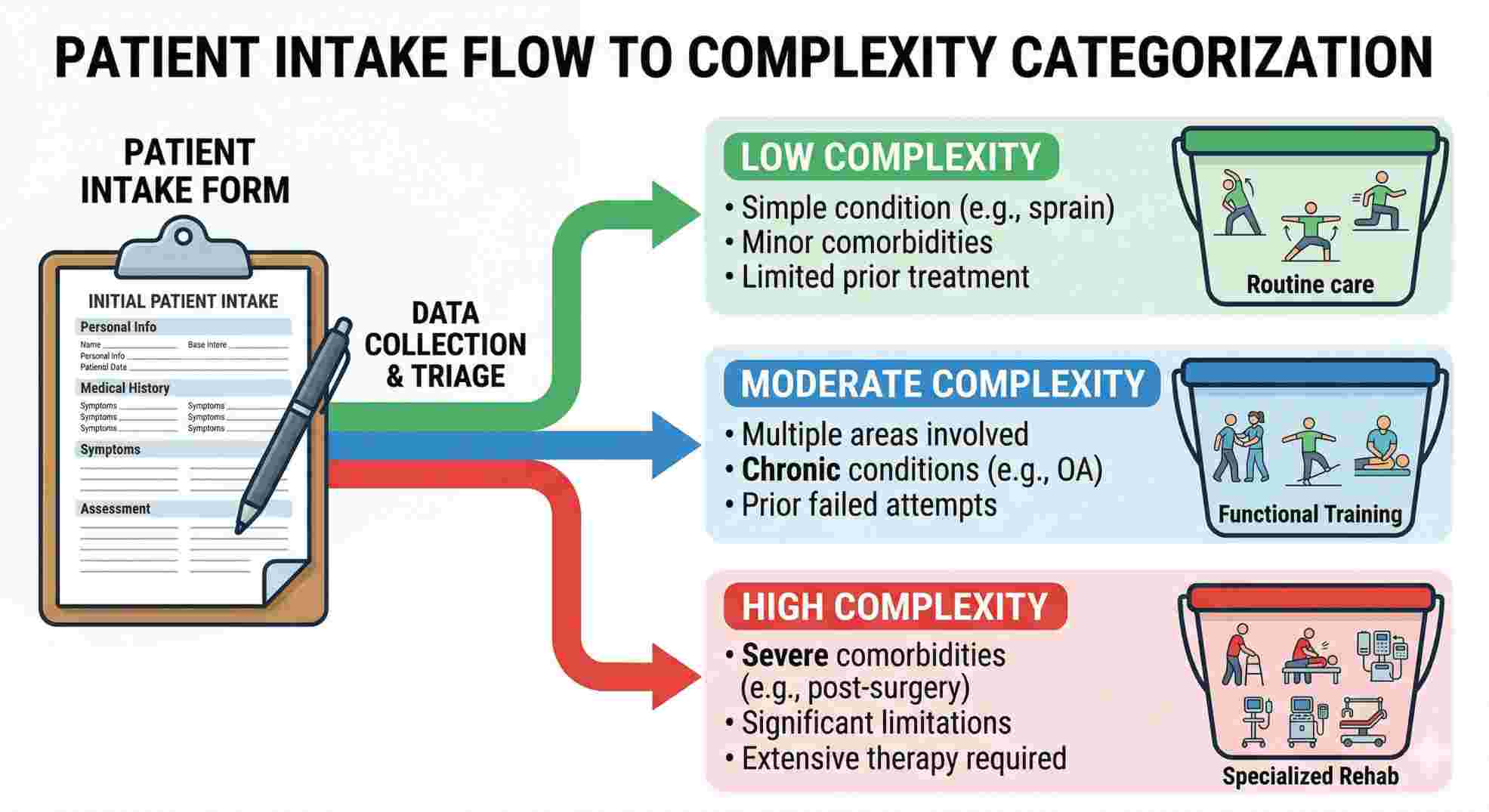
Choosing the correct cpt code for physical therapy evaluation and treatment starts with the tier system. The American Medical Association forces us to classify our initial patient encounters into three levels: low, moderate, and high.
You must look at three things: the patient’s history, your physical examination, and their clinical presentation. The lowest category you score in dictates your final pt evaluation cpt code.
1. The Low Complexity Evaluation (97161)
Use the 97161 code when the patient walks in with a very straightforward problem. Think of a healthy teenager with a minor ankle sprain.
- History: Zero personal factors or comorbidities impact the care plan.
- Examination: You look at one to two elements (like range of motion and strength).
- Clinical Presentation: Stable. There are no surprises here.
- Code Application: This is the lowest tier cpt code for physical therapy evaluation and treatment.
2. The Moderate Complexity Evaluation (97162)
This is the middle ground. For most clinics, 97162 is the most common cpt code for physical therapy evaluation and treatment. Picture a middle-aged office worker with chronic back pain and mild obesity.
- History: One to two personal factors or comorbidities directly affect your plan.
- Examination: You assess three or more elements.
- Clinical Presentation: Evolving. Their symptoms change or fluctuate.
- Code Application: This moderate complexity pt eval code requires solid documentation of those comorbidities.
3. The High Complexity Evaluation (97163)
Do not hide from the 97163 cpt code description. If you see an elderly patient recovering from a stroke with diabetes and a history of falls, you are doing high-complexity work. Bill for it.
- History: Three or more personal factors or comorbidities complicate the care.
- Examination: You assess four or more distinct elements.
- Clinical Presentation: Unstable. The patient is unpredictable.
- Code Application: This is the highest tier cpt code for physical therapy evaluation and treatment.
Quick Reference Guide: Evaluation Tiers
Keep this reference handy. It makes choosing the right cpt code for physical therapy evaluation and treatment much faster.
| CPT Code | Complexity Level | History (Comorbidities) | Examination Elements | Clinical Presentation |
|---|---|---|---|---|
| 97161 | Low | 0 | 1 – 2 | Stable |
| 97162 | Moderate | 1 – 2 | 3 or more | Evolving |
| 97163 | High | 3 or more | 4 or more | Unstable |
Moving from Evaluation to Daily PT Procedure Codes
You finished the evaluation. Now, you actually have to treat the patient. Every initial cpt code for physical therapy evaluation and treatment must link up with accurate pt treatment codes for the following visits.
If you mess up your daily treatment codes, your initial evaluation codes will not save your bottom line. Let’s look at the most common pt cpt codes used on the clinic floor.
Therapeutic Exercise (97110)
This is the absolute foundation of cpt for physical therapy. Use 97110 when you instruct a patient through exercises to build strength, endurance, range of motion, or flexibility. Wall slides, hamstring stretches, and bicep curls all live here.
Therapeutic Activities (97530)
Auditors watch this code closely. Do not confuse 97110 with 97530. The 97530 code requires dynamic activities to improve functional performance. The magic word is functional. If your patient is lifting boxes, swinging a tool, or practicing getting out of a car, you bill 97530. Proper physical therapy coding and billing here is crucial because 97530 often pays slightly better.

Manual Therapy (97140)
When your hands are on the patient, you use 97140. This covers soft tissue mobilization, joint mobilization, and manual traction. Since this is a time-based code, your notes must state exactly what body part you touched and what specific technique you used. “Massaged back” will get your claim denied instantly.
Neuromuscular Re-education (97112)
You bill 97112 when you fix movement, balance, coordination, posture, or proprioception. If your patient is standing on a foam pad, doing stabilization drills, or retraining their gait, this code is the perfect fit.
Core Treatment Codes Breakdown
| CPT Code | Description | Key Requirement | Example Activity |
|---|---|---|---|
| 97110 | Therapeutic Exercise | Parameter-based (strength/ROM) | Hamstring stretches |
| 97530 | Therapeutic Activities | Function-based (real-life tasks) | Lifting a weighted box |
| 97140 | Manual Therapy | Hands-on mobilization | Joint manipulation |
| 97112 | Neuromuscular Re-ed | Balance and coordination | Single-leg stance work |
The Brutal Truth About Time-Based Codes
Here is where the math starts. Managing a cpt code for physical therapy evaluation and treatment requires you to understand time. Your evaluation codes (97161, 97162, 97163) are untimed. It does not matter if the intake takes 25 minutes or 55 minutes; you only bill one unit.
But your daily physical therapy billing codes are usually time-based. Welcome to the Medicare 8-Minute Rule.
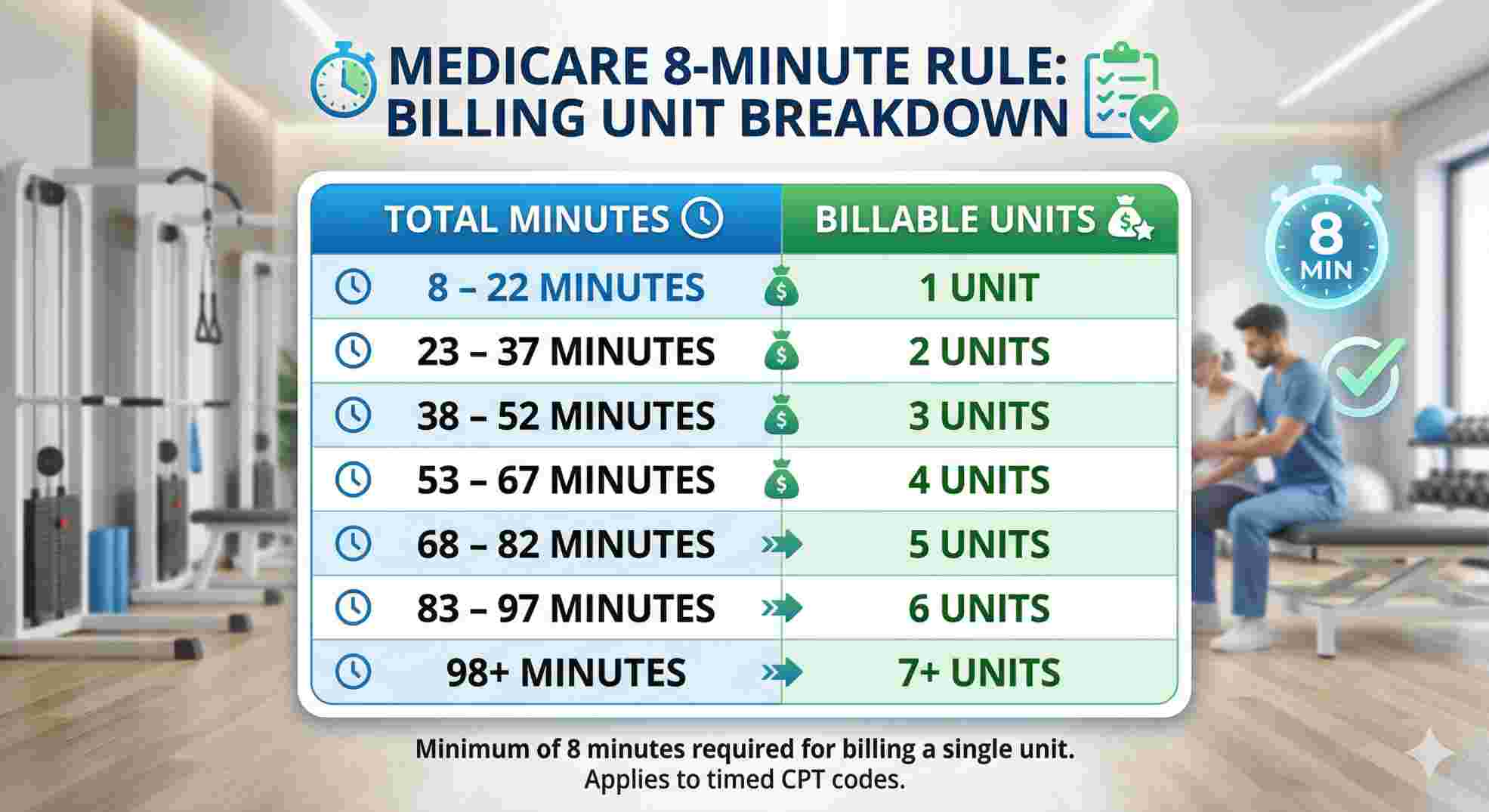
Medicare demands that you provide at least 8 minutes of direct, one-on-one patient contact to bill a single unit of a time-based code. You cannot round up just because you feel like it.
How to Calculate Your Daily Units
To get your total billable units, add up every single minute you spent on timed pt billing codes. Then, chop that total time into 15-minute blocks. The leftover minutes determine your final unit count based on the 8-minute rule.
If you spend 20 minutes on therapeutic exercise and 12 minutes on manual therapy, your total time is 32 minutes. Look at the chart below. 32 total minutes means you can legally bill 2 units.
| Total Timed Minutes | Billable Units Allowed |
|---|---|
| 08 – 22 minutes | 1 Unit |
| 23 – 37 minutes | 2 Units |
| 38 – 52 minutes | 3 Units |
| 53 – 67 minutes | 4 Units |
| 68 – 82 minutes | 5 Units |
Defending Your Physical Therapy Billing Codes in Your Notes
Selecting the perfect cpt code for physical therapy evaluation and treatment means nothing if your documentation is trash. If it is not in the notes, it never happened.
- Log Exact Times: Never write “10:00 to 11:00.” Write “10:04 to 10:52.” Exact minutes prove to an auditor that you are tracking real time, not guessing.
- Prove the Complexity: If you bill a high complexity cpt pt evaluation, your note must list the three comorbidities and the four examination elements clearly. Make it stupidly easy for the auditor to see why you chose that code.
- Stop Cloning Notes: Copying and pasting notes from Tuesday’s visit into Thursday’s visit is a massive liability. Every single note must show what actually happened on that specific day.

The Reality of Modifiers
Modifiers are tiny two-character codes, but they dictate whether you get paid. When you submit a cpt code for evaluate and treat, you will likely need one of these:
- Modifier 59: Use this when you perform two distinct procedures on different body parts or during separate time blocks. Misusing the 59 modifier triggers audits instantly. Only use it when you can clearly prove the treatments were separate.
- GP Modifier: This proves the services happened under an outpatient physical therapy plan of care. If you bill Medicare, this is non-negotiable.
- KX Modifier: Attach this when a patient blows past the Medicare therapy threshold. It tells Medicare, “Yes, we are over the limit, but this continued care is 100% medically necessary.”
Many multi-disciplinary clinics are now expanding their services beyond physical rehab. If your practice is growing into new territories, the coding rules change completely. For an in-depth look at how those specific claims operate, read our complete pillar page on The Real Truth About Coding and Billing for Mental Health Services.
Stop leaving money on the table due to coding errors across your practice. Our experts handle the heavy lifting so you can focus on patient care.
Securing Your Clinic’s Revenue
You hustle every day to get your patients back on their feet. Do not let bad coding habits drain the money your clinic needs to stay open. By fully understanding the evaluation tiers, respecting the 8-minute rule, and writing bulletproof notes, you take the power back from the insurance companies.
Train your staff. Refuse to guess. When you confidently bill the exact cpt code for physical therapy evaluation and treatment every single time, you protect your business, guarantee your revenue, and set your clinic up to thrive for years to come.