

Behavioral health billing services cover the coding, claims, and collections work for psychiatric care, therapy, and substance use disorder (SUD) treatment — and they fail in specific, predictable ways: a prior authorization stuck on hold, a 90837 claim denied because the note didn’t clearly support a full 60-minute session. These fields run on time-based CPT (Current Procedural Terminology) codes, payer session limits, and prior-authorization cycles that standard medical billing doesn’t track, and SUD treatment adds 42 CFR Part 2 confidentiality rules on top.
If that’s a normal Tuesday for your billing team, the problem isn’t carelessness — it’s structure. Use what follows to evaluate what’s actually driving your denials, what a real RCM partnership should look like, and where a newly-enforceable federal rule affects your next move.
Why Behavioral Health Billing Is Under More Pressure Right Now
Demand for behavioral health services is rising faster than the workforce that delivers it, and claim volume — along with denial exposure — is rising with it. More than one-third of Americans live in an area with a behavioral health workforce shortage. More than 60% of rural Americans live in a designated shortage area, according to a March 2026 SAMHSA advisory. The American Medical Association cites SAMHSA data showing roughly one in five U.S. adults experience a clinically significant mental health or substance use condition in a given year.
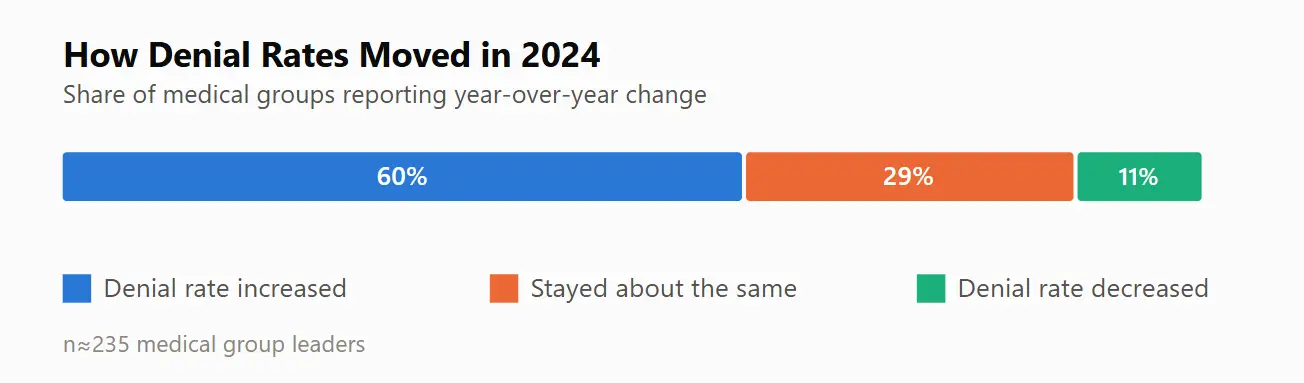
More demand means more claims moving through a system already under strain. A February 2024 MGMA Stat poll of roughly 235 medical group leaders found 60% reporting increased denial rates year-over-year, versus 29% unchanged and 11% improved. That’s the most recent MGMA denial-trend data available at publication, and it isn’t behavioral-health-specific. Still, it’s the direction the whole industry is moving, and behavioral health adds denial triggers most specialties don’t face.
Curious what your own denial trend looks like?
The Revenue Calculator takes about two minutes against your claim volume and current denial rate — no account setup required.
What Makes Behavioral Health Billing Different From Standard Medical Billing?
Behavioral health billing runs on time-based CPT codes, payer-set session limits, and heavier prior-authorization requirements than most specialties. Substance use disorder claims add a separate federal confidentiality law on top of standard HIPAA rules. A psychiatric diagnostic evaluation (90791), a 45-minute psychotherapy session (90834), and a 60-minute session (90837) aren’t interchangeable on a claim — the documented session length has to match the billed code, every time.
Standard medical billing mostly deals with procedure-based or flat E/M codes. Behavioral health billing has to track session duration, session count against annual or episodic limits, and — for testing and extended treatment — prior authorizations that can expire mid-course. That’s more moving parts per claim, and more places for a claim to fail before it ever reaches the payer.
For physicians, this complexity shows up as time, not just denied revenue. Every hour spent untangling a coding question or chasing a denied claim is an hour not spent with patients — and in a field already short on providers, that trade-off carries more weight than it would elsewhere.
Going deeper on time-based coding: see our breakdown of psychotherapy billing with CPT codes 90834 and 90837.
Why Do Psychiatric and Substance Use Claims Get Denied More Than Average?
Most behavioral health denials trace back to a short, repeatable list of causes. Session-length documentation that doesn’t match the billed code is one; lapsed prior authorizations, session-limit caps, and out-of-network mismatches are others. For SUD claims specifically, consent documentation gaps round out the list. None of these require unusual coding knowledge to prevent — they require a workflow that catches them before submission instead of after denial.
Reworking a single denied claim costs a practice an estimated $25–$118 in staff time (MGMA) — and that adds up fast across a mixed service line. Consider a 12-clinician outpatient group running psychiatric medication management, individual therapy, and a small intensive outpatient (IOP) track for substance use treatment — a composite, illustrative example, not a specific client. A denial queue that mixes all three service lines needs staff who can tell a session-limit denial apart from a Part 2 consent gap at a glance. Treating every denial the same way, regardless of cause, is how a backlog becomes permanent.
If your own denial queue looks like a mix of these causes
the Free Practice Audit maps exactly where they’re coming from, using your last 30 days of claims — before you change anything in your current workflow.
The Behavioral Health Claim Lifecycle, From Intake to Payment Posting
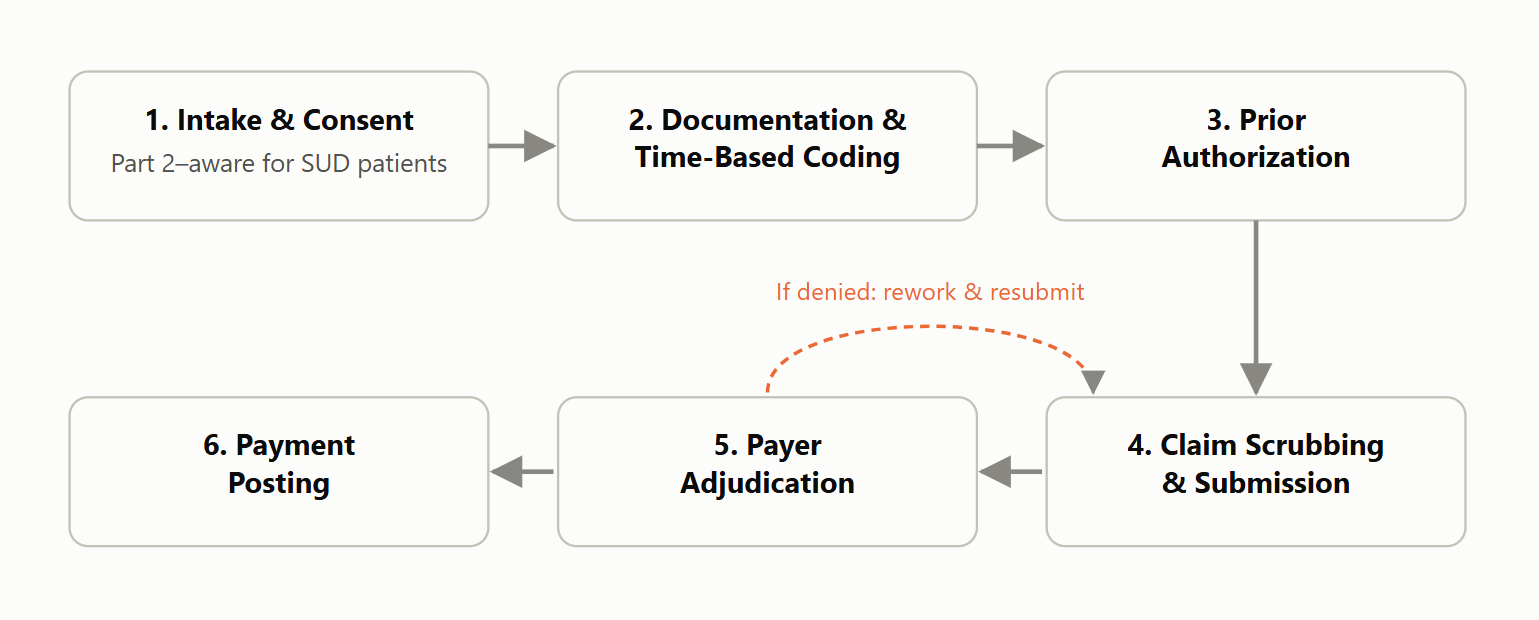
A behavioral health claim moves through six stages before it’s paid. Those stages are consent-aware intake, time-based documentation and coding, prior-authorization checks, claim scrubbing and submission, payer adjudication, and payment posting. When a claim is denied, it loops back to submission for rework. Each stage has a behavioral-health-specific failure point that a generic RCM process tends to miss — worth asking about directly when you’re evaluating a partner.
Related reading: CPT 96127 documentation requirements — relevant if your intake includes standardized behavioral health screening tools.
42 CFR Part 2: What It Means for Your Billing Partner
42 CFR Part 2 governs the confidentiality of substance use disorder patient records, and it’s stricter than standard HIPAA — which matters directly for any billing vendor touching SUD claims data. The current final rule took effect April 16, 2024, and aligned Part 2 more closely with HIPAA’s treatment-payment-operations framework. Its mandatory compliance deadline was February 16, 2026 — the same date OCR (the HHS Office for Civil Rights) enforcement, including complaint filing, became active, according to HHS.
For a practice evaluating a behavioral health billing partner, that enforcement date changes the conversation from “best practice” to “active compliance requirement.”
One adjacent note worth flagging accurately: the Mental Health Parity and Addiction Equity Act (MHPAEA) is a separate law governing how payers cover behavioral health versus medical benefits. As of a May 15, 2025 joint statement from the Departments of Labor, HHS, and Treasury, enforcement of the 2024 final rule’s new nonquantitative treatment limitation provisions is paused, pending litigation. MHPAEA’s underlying statutory parity requirements, under the 2013 rule, remain fully in effect. Treat this as an evolving area, and verify current status before citing it to a client or payer.
Not sure your current billing workflow actually handles Part 2 correctly?
The Free Practice Audit reviews your consent and claims process alongside your billing performance — no cost, no commitment.
Behavioral Health Billing and Coding Services: What “Good” Actually Looks Like
Good behavioral health coding means matching documented session length and content to the correct time-based CPT code. It means applying add-on codes correctly when psychotherapy is billed alongside an E/M visit. And it means using the right HCPCS level-of-care codes for SUD treatment intensity — not just knowing these codes exist. A billing team that can’t tell you why a 90837 claim was billed instead of a 90834 hasn’t actually reviewed the note.
Common codes in behavioral health billing include 90791 and 90792 for psychiatric diagnostic evaluations, and 90832/90834/90837 for individual psychotherapy at 30, 45, and 60 minutes. Add 90853 for group psychotherapy, plus add-on codes like +90833/+90836/+90838 when psychotherapy is billed with a separate E/M service. Substance use treatment adds HCPCS (Healthcare Common Procedure Coding System) Level II codes such as H0015, defined as intensive outpatient treatment operating at least three hours a day, three days a week, with an individualized treatment plan. These H-codes vary by state Medicaid program and payer, so they need local verification every time — never assumed nationwide consistency.
Coding-specific resources: billing psychotherapy add-on code 90836 with E/M services and CPT 96127 documentation requirements.
Outsourced vs. In-House Behavioral Health Billing
The real question isn’t whether outsourcing is “better” — it’s whether your current in-house capacity can keep pace with denial rework, prior-auth tracking, and time-based coding review as claim volume grows. In-house billing keeps full control but scales only by adding headcount; outsourced billing trades a contingency fee for dedicated denial and coding review that doesn’t depend on one or two people’s ongoing training.
Weighing this tradeoff for your own practice?
Run your numbers through the Revenue Calculator — it’s a two-minute, no-commitment ROI estimate.
How Much Does Outsourcing Behavioral Health Billing Cost?
Outsourced behavioral health billing is typically priced as a contingency fee on collections, commonly cited industry-wide in the 4–8% range, rather than a flat monthly rate. The exact figure depends on claim volume and payer mix. It also depends on how much of the workflow the vendor actually owns — coding, prior auth, denial rework, patient statements — versus what stays with your front desk.
A practice comparing costs should weigh the fee against what a denial backlog is already costing in staff time and delayed cash flow, not just against a biller’s salary line. A lower headline fee that doesn’t include dedicated denial rework can end up costing more in unresolved A/R than a higher fee that does.
See what’s included in RCM Finder’s behavioral health approach: Behavioral & Mental Health RCM Operations.
Expert Recommendations for Behavioral Health Billing Services
These five steps improve behavioral health billing performance regardless of who handles your claims — in-house team, current vendor, or a switch to a new partner. Each has a concrete cadence or metric attached, not just general advice.
- Audit your top five denial reason codes monthly, ranked by dollar volume, not frequency. A low-frequency denial on high-value testing claims can cost more than a dozen small session denials combined.
- Get prior authorization for psychological or neuropsychological testing in writing before the first billed session, and file the confirmation number directly in the claim notes.
- Build one Part 2–compliant consent form covering treatment, payment, and operations for every SUD patient file, and train front-desk staff to use it consistently rather than case by case.
- Timestamp start and stop times on every psychotherapy note, not just total minutes, so a 90837 claim has documentation that actually supports the code billed.
- Renegotiate your highest-volume commercial behavioral health payer contract at least once a year, and bring your own denial-rate data into that conversation.
“In the behavioral health claims we’ve reviewed, the pattern repeats: most denials trace back to session-length documentation and lapsed prior authorizations — not exotic coding errors.” — Awais Afzal, Healthcare Operations Strategist
If benchmarking your own denial rate against these five steps turns up a gap
that’s exactly what the Free Practice Audit quantifies, at no cost or commitment.
Why Practices Work With RCM Finder
RCM Finder is 100% HIPAA compliant and SOC-2 certified, with real-time Power BI reporting. It integrates directly with PrognoCIS, eClinicalWorks, and Athenahealth — deployed alongside your existing behavioral health EHR, not in place of it.
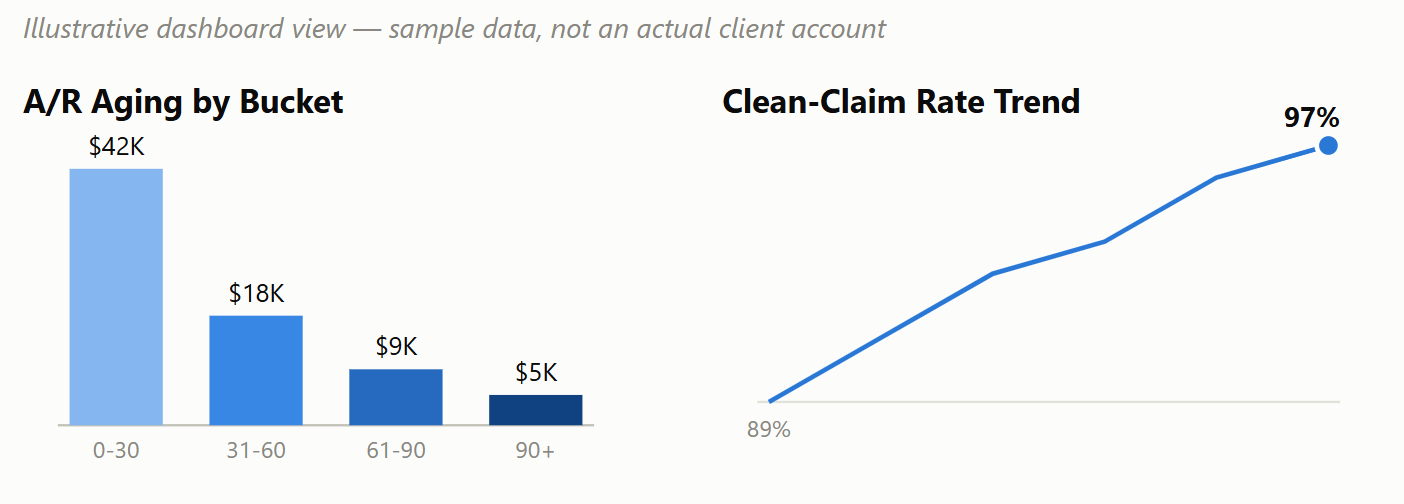
Those same integrations show up in the numbers. One RCM Finder client, a family practice, cut its days in A/R from 45 to 18 within the first quarter — a result specific to that practice, not a guarantee, but a real reference point for what a properly scoped transition can look like. RCM Finder also tracks first-pass clean claim rate as a standard performance metric for behavioral health clients; ask for current figures during a Free Practice Audit.
“Dropped our A/R days from 45 down to 18 in the first quarter. Cash flow has never been better.”
— Dr. Sarah Jenkins, Lead Physician, Family Practice
“The Power BI dashboards provide total transparency. We can finally see every dollar in the pipeline.”
— Marcus T., Clinic Administrator
Getting Your Behavioral Health Billing Under Control
Behavioral health billing doesn’t fail because of one bad hire or one confusing payer. It fails because several things stack at once: time-based coding, session limits, prior authorizations, and, for SUD claims, 42 CFR Part 2. Fixing it means treating each denial trigger as its own workflow problem, not one generic “denial management” fix.
Whether you handle billing in-house or through a partner, the practices that keep denial rates down are the ones auditing their own numbers regularly — not reacting claim by claim. If you want that audit done for you, the Free Practice Audit can help. It reviews your last 30 days of behavioral health claims and shows exactly where revenue is leaking — before you change anything in your current workflow.