
What does CMS actually require for code specificity?
CMS requires the most specific ICD-10-CM code your documentation supports — never an unspecified code out of convenience, but also never a guess beyond what the chart shows. The FY2026 ICD-10-CM Official Guidelines for Coding and Reporting (in effect October 1, 2025 through September 30, 2026) make this explicit. Section I.B.2 states plainly: “Diagnosis codes are to be used and reported at their highest number of characters available and to the highest level of specificity documented in the medical record.” That single sentence is why a payer’s system flags F41.9 more often than F41.1 — not because unspecified codes are banned, but because the guideline expects the more detailed code whenever the note supports one.
CMS also addresses the other side of that coin. Section I.B.18 confirms: “When sufficient clinical information isn’t known or available about a particular health condition to assign a more specific code, it is acceptable to report the appropriate ‘unspecified’ code.” F41.9 isn’t a lesser code. It’s the correct code when the clinical picture genuinely hasn’t resolved to a specific subtype — an initial visit, before a full symptom history is documented, is a common example.
The practical implication for a physician’s note is direct. The code your billing team can defensibly use is a function of what you wrote down. That includes duration, whether panic attacks are episodic or ongoing, and whether a depressive component is independently diagnosable or simply present alongside the anxiety. [CLUSTER SUB-ARTICLE: EHR documentation templates for anxiety-spectrum visits]
One dating note: FY2027’s ICD-10-CM code set takes effect October 1, 2026. No F41 changes had surfaced as of this review — confirm against that year’s CMS addenda before relying on this guide past that date.
What’s the ICD-10 code for generalized anxiety disorder (GAD)?
Generalized anxiety disorder is billed as F41.1. It applies when documentation supports persistent, excessive worry across multiple areas of life — work, health, relationships. That worry must last six months or longer and not be confined to a single trigger. F41.1 is one of the more specific, defensible codes in the F41 family, provided the chart supports both duration and breadth.
The most common reason a clearly-intended GAD diagnosis gets billed as F41.9 instead isn’t a coding error. It’s a documentation gap. If the note describes anxiety symptoms but never states how long they’ve persisted, or that they span more than one life domain, a coder correctly defaults to the less specific code. F41.1’s criteria simply aren’t demonstrated in the record.
Symptoms worth documenting explicitly include restlessness, fatigue, difficulty concentrating, irritability, muscle tension, and sleep disturbance. GAD requires three or more of these alongside the worry itself. A single sentence noting duration and symptom count is often the difference between F41.1 and F41.9 — on otherwise identical clinical presentations. [CLUSTER SUB-ARTICLE: GAD documentation checklist for physicians]
When is F41.9 (anxiety, unspecified) the right call — and when does it become a denial risk?
F41.9 is CMS-sanctioned, not a fallback to avoid entirely. It’s the right code when the clinical picture genuinely hasn’t resolved to a specific subtype yet. That’s commonly true at a first visit, before duration, triggers, or a symptom pattern are established in the chart.
It becomes a denial risk on a different pattern. Picture a patient four months into treatment, whose chart already documents six-month duration and multi-domain worry — still billed as F41.9 because that’s what auto-populated. Payers’ specificity edits are tuned to catch exactly this: an unspecified code persisting past the point the record supports something more precise.
The table below maps the full anxiety-code family. Your team can check, in seconds, whether a chart’s documented detail matches the code being billed.
| Code | Description | Use when documentation shows | Key exclusion |
|---|---|---|---|
| F41.0 | Panic disorder | Recurrent, unexpected panic attacks plus ≥1 month of anticipatory worry or avoidance behavior | A single, isolated panic attack without a documented pattern |
| F41.1 | Generalized anxiety disorder | Persistent, excessive worry across multiple domains, ≥6 months, with ≥3 associated symptoms | Anxiety confined to one recent, identifiable stressor |
| F41.2 | Mixed anxiety and depressive disorder | Both anxiety and depressive symptoms present at a sub-threshold level; neither independently diagnosable | Independently diagnosable anxiety and depressive disorders (code both separately) |
| F41.3 | Other mixed anxiety disorders | Anxiety mixed with symptoms other than depression, clearly specified | Presentations better captured by F41.2 or a single specific code |
| F41.8 | Other specified anxiety disorders | A characterized anxiety presentation that doesn’t fit F41.0, F41.1, or F41.2 | Anxiety with no further detail documented (use F41.9 instead) |
| F41.9 | Anxiety disorder, unspecified | Anxiety symptoms are documented, but subtype, duration, or trigger are not yet established | Acute stress reaction, adjustment disorder, separation anxiety (each has its own code) |
| F40.10 | Social anxiety disorder, unspecified | Anxiety specific to social or performance situations | Free-floating anxiety not tied to social settings (F41.1 instead) |
Source: current ICD-10-CM code set (CMS/CDC, effective October 1, 2025–September 30, 2026); code descriptions and exclusion notes per the ICD-10-CM Tabular List and FY2026 Official Guidelines.
Does your denial log show anxiety claims returning for “diagnosis does not support level of service,” or a similar medical-necessity flag? F41.9 persisting on an established patient is the first thing worth auditing. [CLUSTER SUB-ARTICLE: payer-by-payer F41.9 scrutiny thresholds]
How do you code a single panic attack versus panic disorder?
Panic disorder (F41.0) requires a pattern. That means recurrent, unexpected panic attacks, plus at least a month of persistent worry about having another one — or a significant behavior change made to avoid triggering one. A single panic attack, on its own, doesn’t automatically meet that bar.
This matters because F41.0 is frequently billed after one dramatic episode in the office, before the pattern criteria are actually documented. Say a patient presents with one panic attack and no history of recurrence. The more defensible approach is to document that episode clearly, then revisit the diagnosis — and the code — if a pattern emerges over later visits.
Once the pattern is documented, F41.0 is one of the more straightforward anxiety codes to defend on audit. Its criteria are behavioral and specific — anticipatory worry, avoidance — rather than purely subjective. [CLUSTER SUB-ARTICLE: distinguishing panic disorder from cardiac and other medical rule-outs in the note]
What’s the ICD-10 code for “acute anxiety” or stress-related anxiety?
“Acute anxiety” isn’t its own ICD-10-CM category. Say the anxiety is a direct reaction to a specific, identifiable stressor within the past month. The correct family is usually F43 (acute stress reaction or adjustment disorder), not F41 — the F41 anxiety-disorder codes explicitly exclude acute stress reaction.
The distinction comes down to trigger and timeline. Say symptoms began within hours or days of an identifiable, highly stressful event, and are expected to resolve as the person processes it. F43.0 (acute stress reaction) or an F43.2x adjustment-disorder code fits better than anything in the F41 family. If the anxiety isn’t tied to a specific recent event — or has persisted well past the timeframe an acute or adjustment reaction would cover — an F41 code is the correct family instead.
| Clinical picture | Trigger | Typical timeline | Code family |
|---|---|---|---|
| Free-floating or recurrent anxiety, not tied to one event | None specific, or longstanding | ≥6 months (GAD) or ongoing pattern (panic disorder) | F41.x |
| Sudden anxiety reaction to a specific traumatic or highly stressful event | Single identifiable event | Within days of the event; expected to resolve | F43.0 (acute stress reaction) |
| Anxiety and/or low mood following an identifiable stressor, disproportionate to the stressor | Single identifiable stressor | Within 3 months of the stressor; up to 6 months post-resolution | F43.2x (adjustment disorder) |
| Social- or performance-specific anxiety | Social/performance situations | Situational, recurring in that context | F40.10 |
Getting this wrong in either direction creates the same problem. The code no longer matches the clinical narrative in the note — exactly what a payer’s automated consistency check is built to catch. [CLUSTER SUB-ARTICLE: coding trauma- and stressor-related disorders, the F43 family in depth]
How should you code anxiety with co-occurring depression?
F41.2 (mixed anxiety and depressive disorder) exists for a narrower situation than its name suggests. Both anxiety and depressive symptoms are present, but at a low-to-moderate, sub-threshold level. Neither alone would justify an independent diagnosis. It’s a single code for a genuinely mixed, not-quite-either presentation.
That’s different from a patient with clearly documented generalized anxiety disorder who also has a clearly documented major depressive episode. When both conditions independently meet diagnostic criteria, code both. Report F41.1 alongside the appropriate depression code, rather than substitute F41.2 for what are actually two distinct, billable diagnoses.
The CMS guidelines reviewed for this article carry no chapter-specific narrative guidance on this exact distinction. That’s part of why it trips up coding teams — there’s no single bulletin to point to. The working rule among experienced behavioral-health coders is simple: F41.2 for a sub-threshold, undifferentiated mix, and dual codes when each condition is independently documented. [CLUSTER SUB-ARTICLE: dual-coding anxiety and depression without triggering a medical-necessity denial]
What about less common anxiety presentations — F41.8, F41.3, and social anxiety?
F41.8 (other specified anxiety disorders) is easy to confuse with F41.9, but they’re not interchangeable. F41.8 means the clinician has specified what’s going on. It just doesn’t map to panic disorder, GAD, or mixed anxiety-depression. Anxiety with prominent, atypical features the physician has described belongs here, not under F41.9’s catch-all.
F41.3 (other mixed anxiety disorders) applies to anxiety combined with symptom types other than depression — again, a specified presentation, not a default. F40.10 (social anxiety disorder, unspecified) covers anxiety that’s specifically situational, tied to social or performance settings, rather than the free-floating pattern that defines GAD.
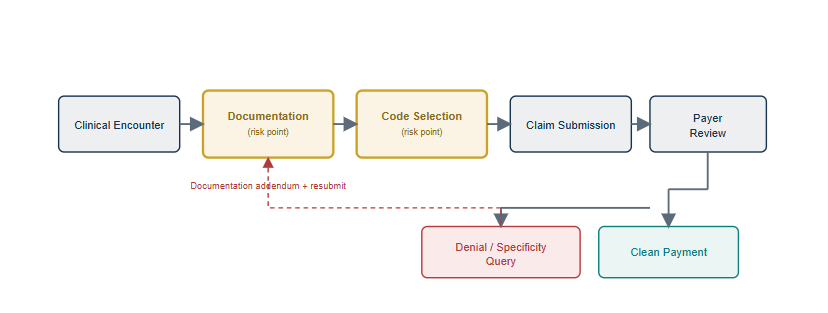
The diagram below traces the full path from diagnosis to payment. It shows where a mismatch between any of these codes and the documented presentation tends to surface — usually earlier than practices expect.
Expert Recommendations for Anxiety ICD-10 Coding
“In claims we’ve reviewed, the anxiety-coding denials that repeat aren’t from picking the wrong code once — they’re from letting a default code outlive the documentation that justified it,” says Awais Afzal, Healthcare Operations Strategist.
| Denial reason | Typical trigger | Prevention tactic |
|---|---|---|
| Diagnosis does not support medical necessity | F41.9 billed on an established patient whose chart already documents a specific subtype | Route to the physician for a documentation addendum; re-code to the specific subtype before resubmission |
| Diagnosis inconsistent with procedure or service billed | An unspecified or mild-presentation code billed alongside a high-intensity service | Confirm the diagnosis code’s specificity matches the documented severity and service type before submission |
| Missing or non-specific documentation of duration or pattern | Note lacks explicit duration (GAD) or recurrence pattern (panic disorder) language | Use EHR template fields for duration and pattern, completed at the point of care |
| Code excluded under the billed diagnosis category | An F41.x code billed for a presentation that a specific, recent stressor actually triggered | Apply the trigger-and-timeline check in Table 2 before finalizing the code |
| Prior-authorization or visit-cap threshold exceeded | Payer-specific policy caps visits or adds review once a threshold of unspecified-code claims is reached | Review your top payers’ specificity policies annually (see Recommendation 4) |
Source: denial-reason categories reflect common payer adjudication language and RCM Finder’s claims-review experience; specific thresholds vary by payer — verify against each payer’s current policy.
- Run a 90-day audit of every anxiety-related claim (F40–F43). Flag any patient on their third visit or later still coded F41.9. That pattern — not first-visit use of F41.9 — is where documentation-to-code mismatches concentrate.
- Add two required fields to your EHR’s anxiety-visit template: symptom duration and whether depressive symptoms are independently diagnosable. These two data points resolve most F41.1-vs-F41.9 and F41.2-vs-dual-coding decisions before a coder has to guess.
- Route specificity denials to the physician within five business days. Any anxiety-code denial citing “medical necessity” or “diagnosis specificity” should go back to the ordering physician for a documentation addendum — not straight to resubmission with the same code.
- Review your top three payers’ behavioral-health specificity policies annually. Some apply stricter unspecified-code scrutiny than others, and that threshold shifts with plan-year updates.
- Confirm the current code set every October 1. Check that year’s CMS ICD-10-CM release against the F41 and F43 descriptions used in your templates — a code correct in August can be revised, and rarely, retired, effective October 1.
Why does this matter for your revenue cycle?
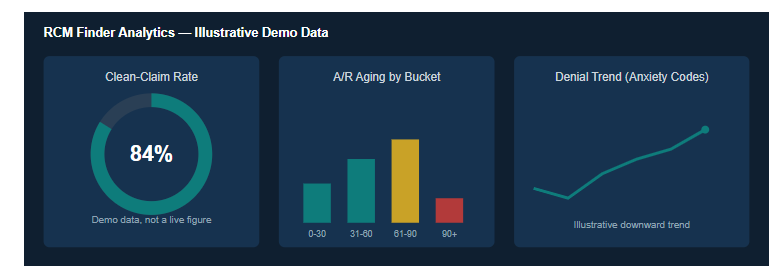
Coding specificity is a revenue-cycle lever, not just a compliance checkbox — cleaner anxiety codes mean fewer specificity denials and faster payment. RCM Finder is HIPAA-compliant and maintains SOC 2 Type I and Type II attestation. Real-time Power BI dashboards give your practice visibility into clean-claim rate and A/R aging by diagnosis category, anxiety and other behavioral-health codes included. The platform integrates with PrognoCIS, eClinicalWorks, and Athenahealth alongside your existing EHR, with no downtime during deployment.
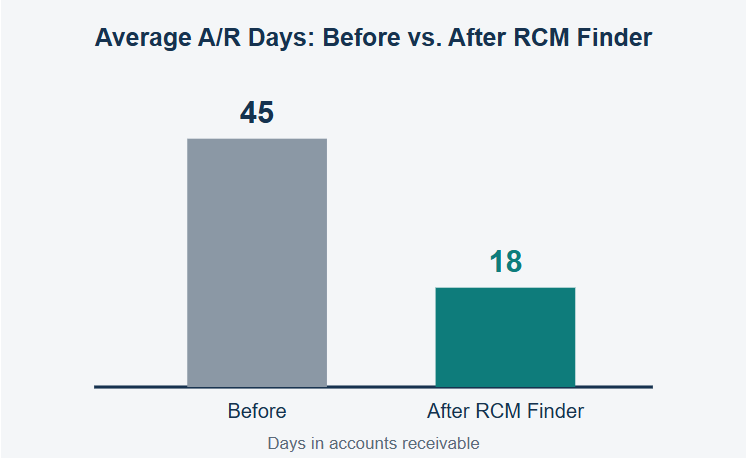
“Dropped our A/R days from 45 down to 18 in the first quarter. Cash flow has never been better.” — Dr. Sarah Jenkins, Lead Physician, Family Practice
“The Power BI dashboards provide total transparency. We can finally see every dollar in the pipeline.” — Marcus T., Clinic Administrator (homepage testimonial, verified September 2026)
Get Your Anxiety Coding — and Your Revenue Cycle — Aligned
Anxiety-spectrum ICD-10 codes aren’t complicated once the decision points are clear. Duration and breadth decide F41.1; pattern decides F41.0; trigger and timeline decide F43.0; and whether a depressive component is independent or sub-threshold decides F41.2 versus dual coding. F41.9 stays legitimate exactly as long as the chart hasn’t resolved to something more specific — and becomes a liability the moment it has.
Does your denial log already show anxiety or behavioral-health claims coming back on specificity or medical-necessity grounds? That’s a documentation-and-coding gap worth quantifying before it compounds across every visit type it touches. The Free Practice Audit reviews your last 30 days of claims, anxiety codes included, and maps exactly where that gap is costing you — at no cost or commitment.
For a broader look at ICD-10 coding across other mental-health diagnoses, see our guide to ICD-10 codes for mental health. For related CPT-code guidance on the treatment side, see our psychotherapy billing guide (CPT 90834 & 90837) and behavioral health billing optimization guide.
Questions about your specific coding or documentation workflow? Contact RCM Finder or call +1 (302) 599-6661.