

You are likely leaving money on the table by ignoring the 90836 CPT code. It happens to the best of us. You finish a session, you are tired, and you default to the codes you know best. But if you are a psychiatrist, nurse practitioner, or PA who spends actual time talking to patients about their lives—not just their lithium levels—missing this code is a mistake. It is literally the difference between getting paid for your full skillset or giving your time away for free.
Here is the reality: Insurance payers are watching these codes closely. They know that “medication management with therapy” is a high-value claim, and they want to see if you actually did the work or if you are just upcoding. If you don’t know the exact time rules (down to the minute) or how to split your notes, you are painting a target on your back for an audit.
This isn’t just about compliance; it’s about survival in private practice. You need to know exactly when to use this code, how to pair it with an evaluation and management (E/M) code, and what words need to be in your chart to keep the money you earn. (If you want to understand the entire ecosystem beyond just this code, read our comprehensive guide: The Real Truth About Coding and Billing for Mental Health Services). Now, let’s get your billing process tightened up.
The One Rule You Can’t Break
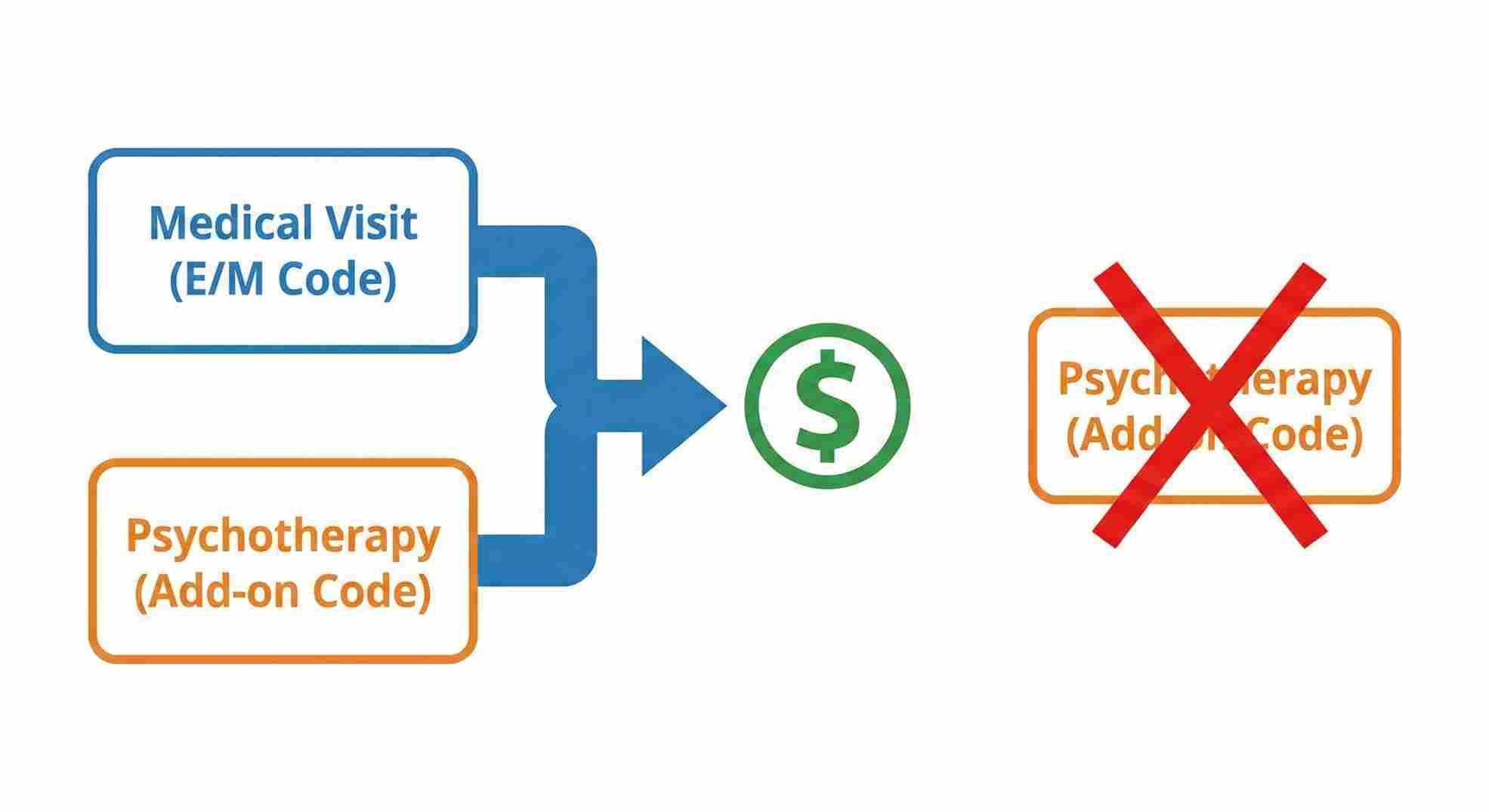
Before we get into the weeds, here is the single most important thing to remember: The 90836 CPT code is an “add-on” code.
It cannot survive on its own. If you put 90836 on a claim form without a primary medical code (like 99213 or 99214), the insurance computer will auto-reject it before a human ever sees it. You are telling the payer, “I did a medical visit, AND I did this therapy on top of it.” No medical visit? No add-on payment.
What the 90836 CPT Code Actually Covers
In plain English, this code is for a session where you do two distinct jobs. First, you put on your “medical provider” hat to handle the diagnosis, prescription, and side effects. Then, you switch to your “therapist” hat to dig into the psychological work.
Officially, in the official CPT manual, it stands for individual psychotherapy, 45 minutes, with medical evaluation and management services.
But “45 minutes” is a label, not a strict law. You don’t need to hit exactly 45 minutes on the nose. You have a window.
The “Safe Zone” for Time
This is where people mess up. The CPT manual gives you a specific range. If you are under it, you are downcoding. If you are over it, you are losing billable time.
- The Code: 90836 CPT code
- The Label: 45 minutes
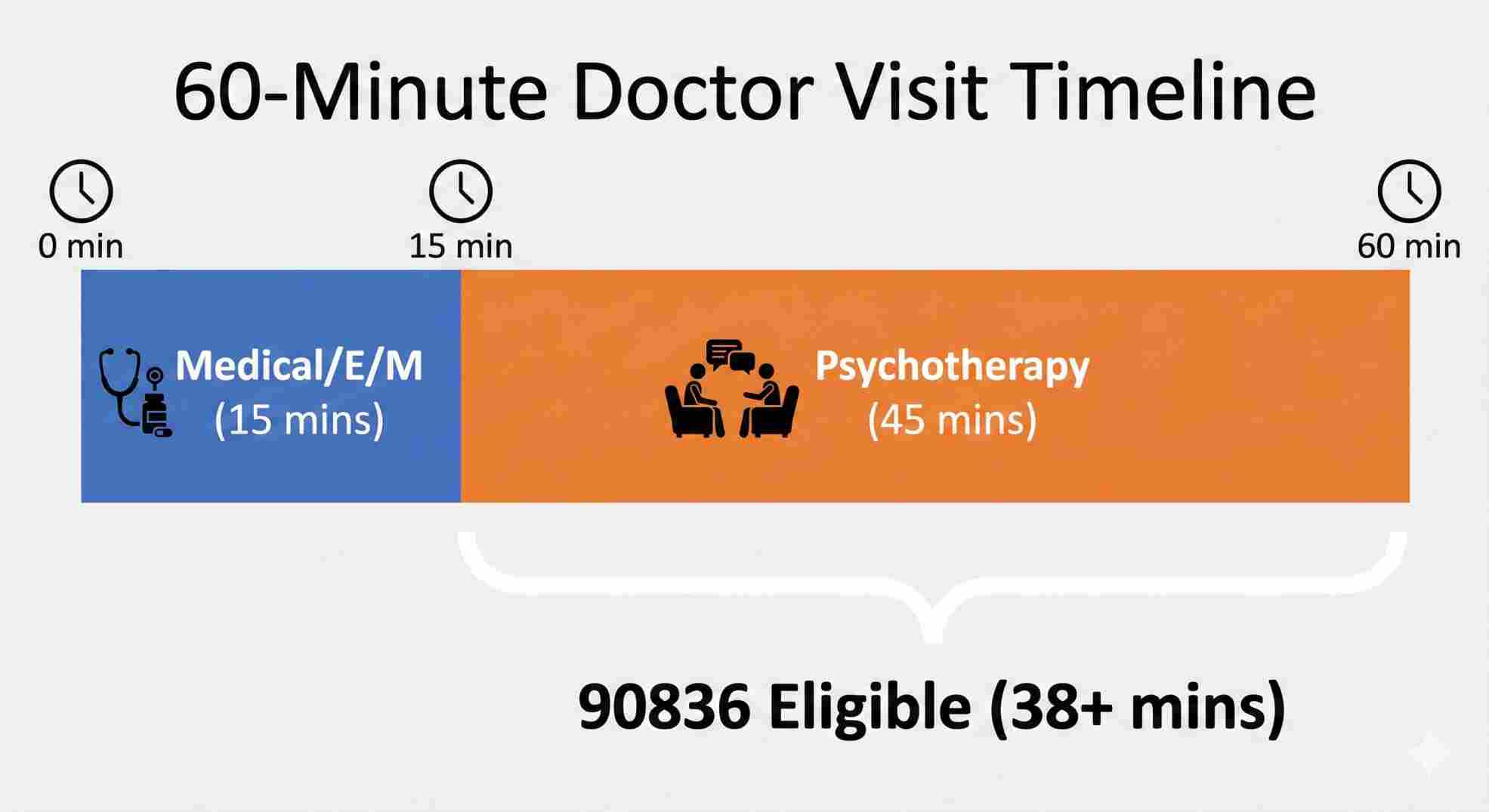
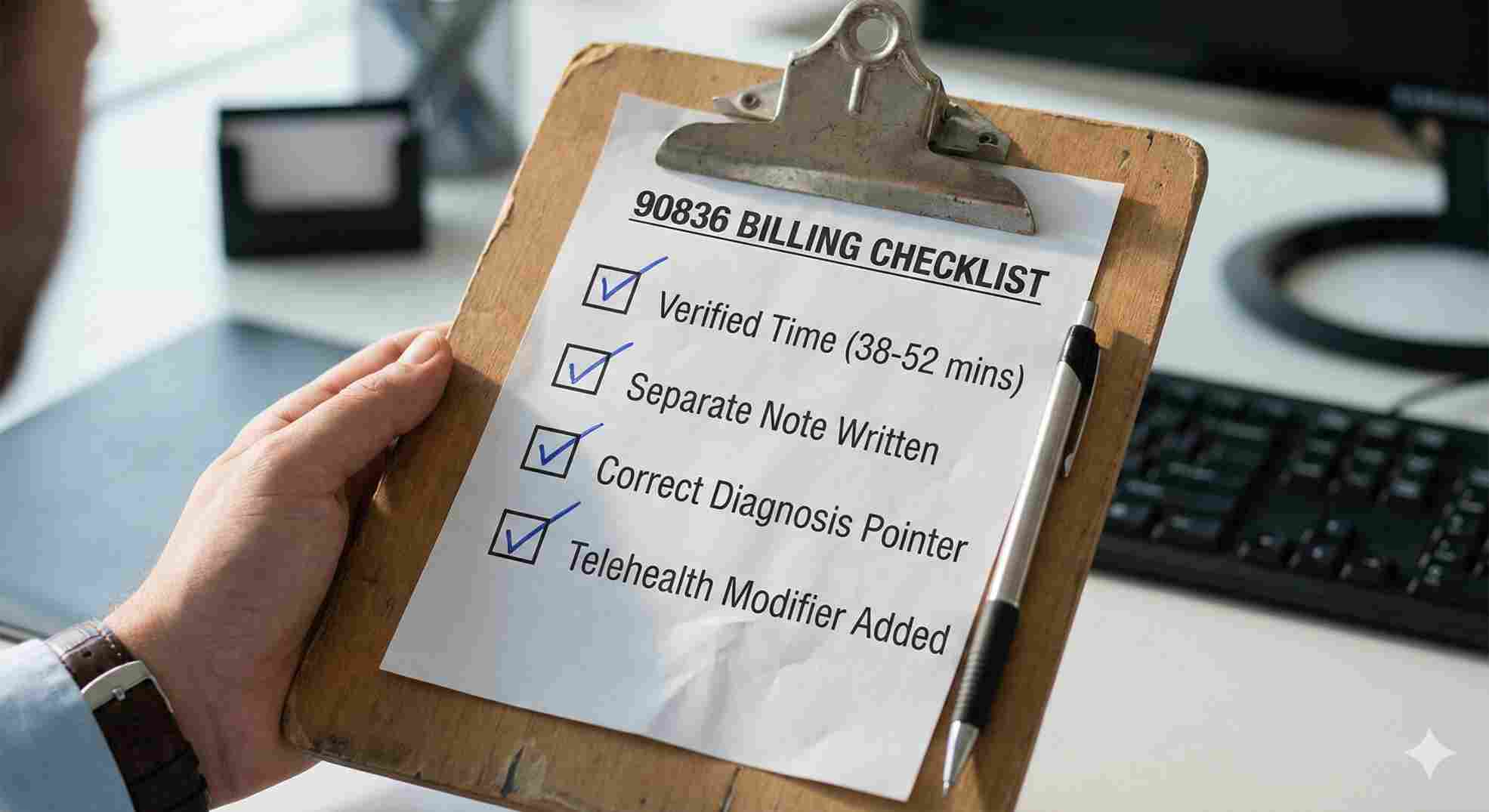
- The Real Requirement: 38 to 52 minutes
If your therapy time—exclusive of the medical check—is 37 minutes, you cannot use this code. You have to drop down to the 90833 code (16-37 minutes). If you hit 53 minutes, you are looking at the 90838 code.
Crucial Point: You cannot count the time you spend writing the prescription or checking blood pressure toward these 38-52 minutes. That time belongs to the medical code. The clock for 90836 only starts when the medical check ends and the therapy begins (or vice versa).
Matching 90836 with the Right E/M Code
Since 90836 is just a sidecar, you need to drive the motorcycle. That motorcycle is your Evaluation and Management (E/M) code.
Which one do you pick? It depends on how sick the patient is and how much thinking you have to do. You don’t choose based on time (because you are using time for the therapy code); you choose based on Medical Decision Making (MDM).
Common Pairings
Here is what I see most often in successful practices:
| E/M Code | What It Means | When You Use It with 90836 |
|---|---|---|
| 99213 | Low Complexity | The patient is stable. You are refilling meds, maybe tweaking a dose slightly. No new major problems. |
| 99214 | Moderate Complexity | The workhorse. The patient has a new symptom, or the current meds aren’t working, or there is a mild risk factor you are managing. |
| 99215 | High Complexity | High risk. Suicidal ideation is present, or you are managing a dangerous drug combination. This is for heavy-duty psychiatric care. |
The Strategy:
Most psychiatrists bill a 99214 + 90836 CPT code for a standard “long visit” with an active patient. This combination pays significantly better than just billing a therapy code (90834) alone because you are getting credit for your medical license.
Documentation: How to Write Notes That Auditors Hate
I mean “hate” in a good way—notes so clear that auditors look at them, sigh, and move on to someone else.
If you get audited, they are looking for one thing: Double Dipping. They suspect you are counting the same minutes twice. You need to prove you didn’t.
The “Split Note” Technique
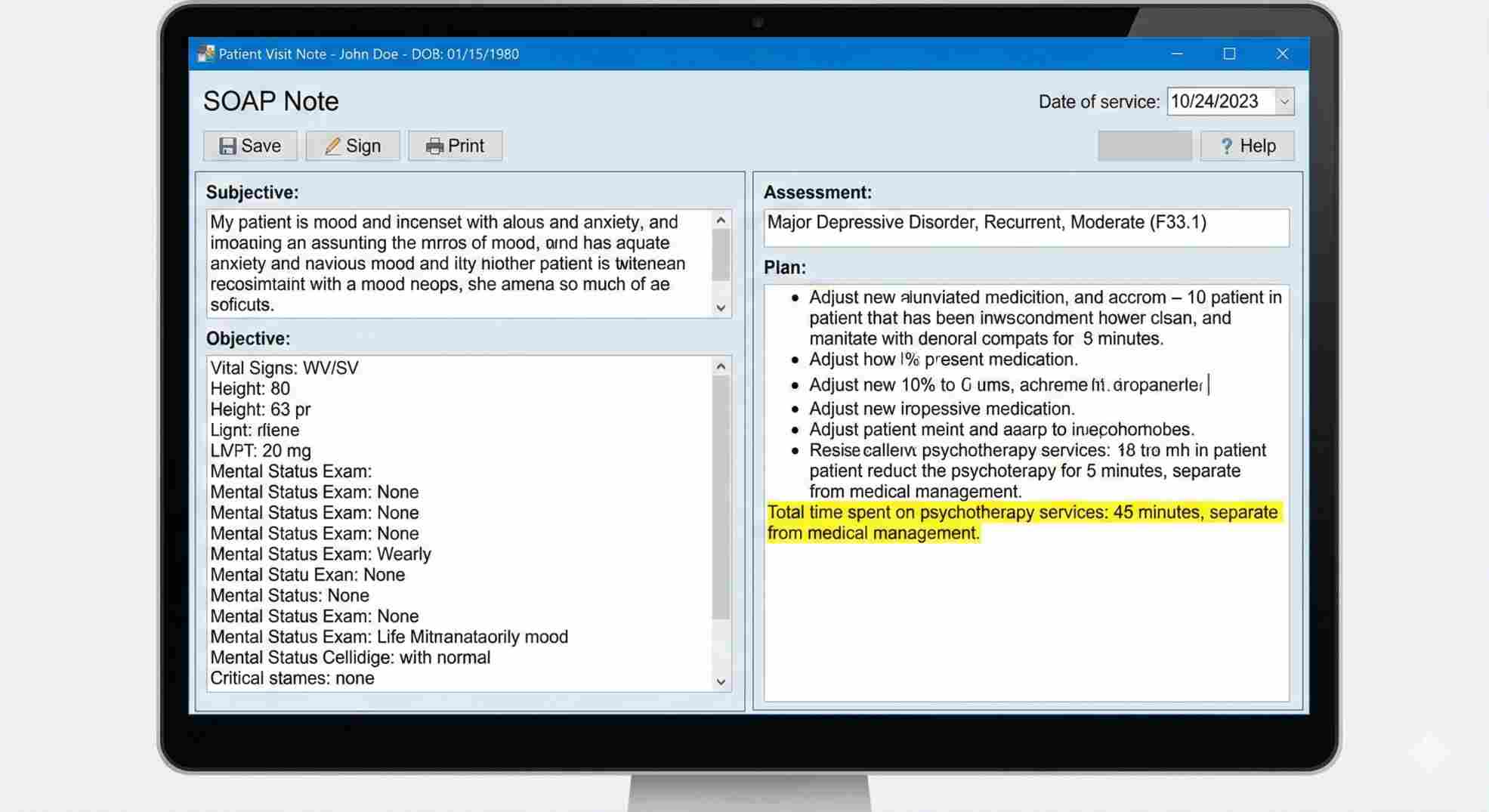
Your progress note needs two clear headers. Do not merge them into one big paragraph.
- Section 1: Medical Management (The E/M Note)
- List the meds.
- Note the compliance (taking them or not?).
- Mention side effects.
- Write your assessment (e.g., “Depression worsening, increasing dosage”).
- Section 2: Psychotherapy Note (The 90836 Note)
- Start/Stop Time: “Therapy Start: 10:15 AM. Therapy End: 11:00 AM. Total: 45 mins.”
- Topic: What did you talk about? (e.g., “discussed anxiety triggers at work”).
- Intervention: What did you do? (e.g., “Used CBT techniques to reframe negative thoughts”).
If you don’t write down the specific therapy time, you lose. It is that simple. “Spent 45 minutes with patient” is not enough. You must write “Spent 45 minutes on psychotherapy.”
Confusion Control: 90833 vs. 90836 vs. 90838
I get asked this constantly: “I talked to them for a while, which code is it?”
Stop guessing. Look at your watch.
| Code | The Breakdown | Strict Time Rule |
|---|---|---|
| 90833 | The “Short” Add-on | 16 to 37 minutes |
| 90836 | The “Standard” Add-on | 38 to 52 minutes |
| 90838 | The “Long” Add-on | 53 minutes and up |
What About the Intake (90792)?
This is a different beast. 90792 is your initial psychiatric evaluation. You typically do NOT bill the 90836 CPT code with an intake. The intake code is designed to cover all the talking, history taking, and initial planning you do in that first hour. Keep 90836 for your follow-ups.
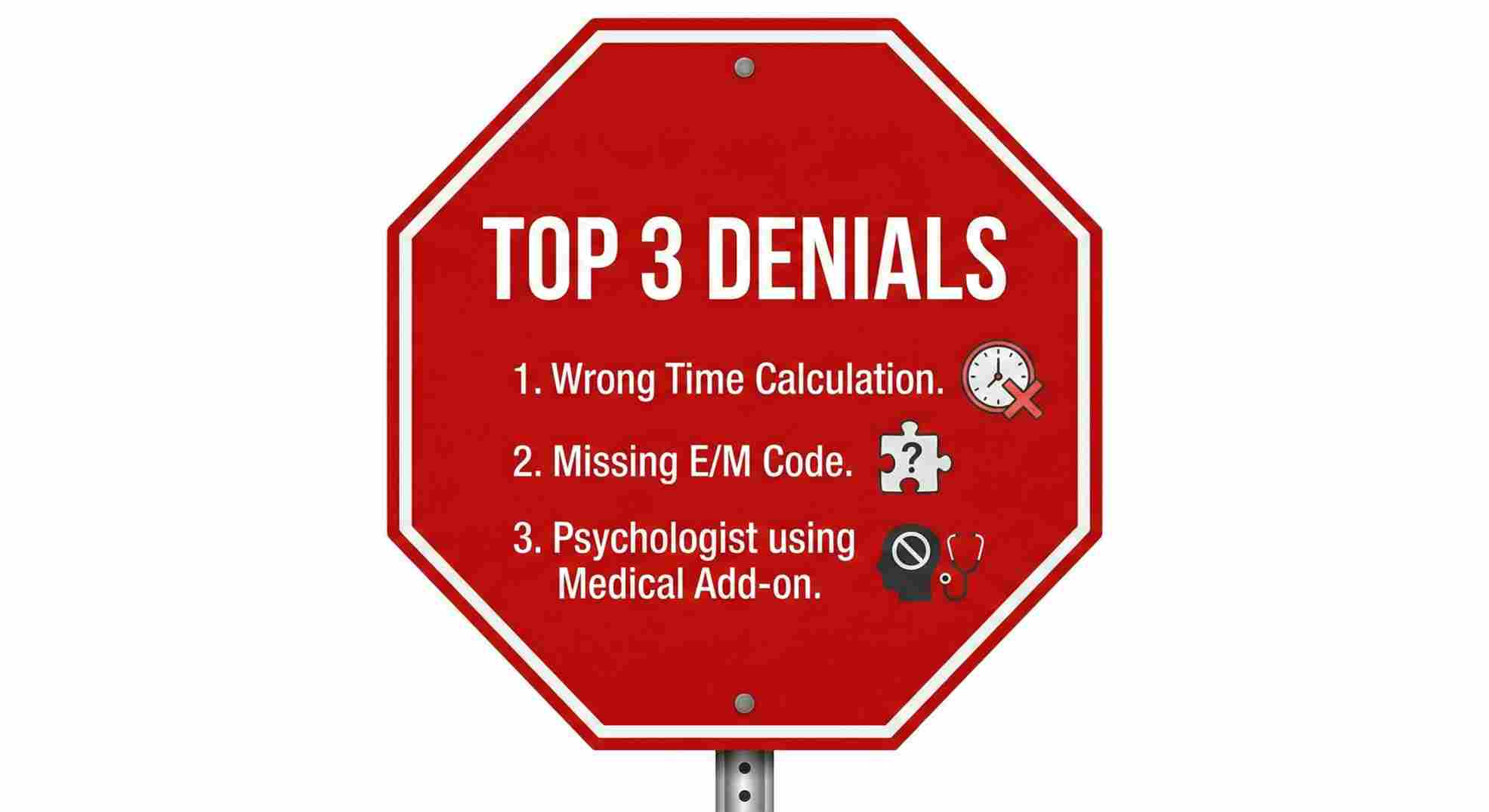
3 Ways You Will Get Denied (And How to Fix Them)
I have seen practices lose thousands of dollars because of simple clerical errors. Let’s avoid that.
1. The Diagnosis Disconnect
Your CMS-1500 claim form has “pointers”—little letters (A, B, C, D) that point a CPT code to a diagnosis code.
- The Error: Pointing the 90836 CPT code to a medical diagnosis like “Insomnia” or “Hypertension.”
- The Fix: Always point the psychotherapy code to the primary mental health diagnosis (e.g., F33.1 Major Depressive Disorder). Therapy treats the mind, not the blood pressure.
2. The “Time Creep”
You spend 10 minutes on meds and 30 minutes on therapy. You bill 90836 because the total time was 40 minutes.
- The Result: Denial or Audit.
- The Reality: Your therapy time was only 30 minutes. That is a 90833. Be honest with the clock.
3. The “Incident-to” Trap
If you are a therapist working in a doctor’s office, you can’t just bill this code under the doctor’s name unless strict supervision rules are met. Generally, this code is for the person doing the medical management. If you are a psychologist (PhD) or social worker (LCSW), you can’t use 90836 because you aren’t billing the medical E/M code. Stick to 90834.
Is It Worth The Effort?
You might be thinking, “This sounds like a lot of paperwork. Should I just bill the medical code and move on?”
Let’s look at the trade-off.
| The Good | The Bad |
|---|---|
| Revenue: It pays significantly more than an E/M code alone. | Scrutiny: It attracts more attention from insurance companies. |
| Quality: It supports a model where you actually listen to patients. | Labor: You have to write two distinct note sections. |
| Retention: Patients stay longer with providers who do both meds and therapy. | Complexity: You have to do math (time calculation) every visit. |
Final Thoughts
Billing the 90836 CPT code doesn’t have to be a gamble. It is a fair payment for hard work. You are handling the biology and the psychology of a patient in a single visit—that is efficient, high-quality care.
Don’t let the fear of rules stop you. Buy a stopwatch (or use the one on your phone), separate your notes into two clear chunks, and bill for the time you actually spend. You earned it. Now, go get your documentation in order so you can keep it.