

You are probably reading this because you just got a claim denied. Or maybe you are staring at a blinking cursor, wondering how to write a note for eight people at once without losing your mind. The 90853 CPT code description is supposed to be simple—group therapy—but in practice, it is a messy mix of payer rules, vague guidelines, and financial risk.
Let’s be real for a second. Most therapists love running groups. The energy is different, the breakthroughs are incredible, and patients often get better faster when they see they aren’t alone. But the billing? That part is a nightmare. You have Medicare saying one thing, private payers saying another, and the constant fear that an auditor might pull your files five years from now and decide you owe them $10,000. This is a core principle in The Real Truth About Coding and Billing for Mental Health Services, and nowhere is it more critical than in group work. In today’s medical billing environment, accuracy isn’t just a “nice to have”—it is the backbone of your business’s survival.
I am going to walk you through this. No fluff, no textbook definitions that don’t apply to the real world. We are going to look at exactly what the 90853 CPT code description means for your bottom line, how to stay out of trouble, and how to actually get paid for the work you do.
The “Quick Win” Insight
If you take nothing else from this article, take this: Group notes cannot be identical. I know it’s tempting. You just spent an hour with ten people discussing the same topic. It makes sense to copy and paste the session summary. Do not do it. Insurance companies use software to scan for “cloned documentation.” If Patient A’s note looks exactly like Patient B’s note, they will recoup the money. You have to write a specific line about how that specific person reacted.
What the 90853 CPT Code Description Actually Means
The official American Medical Association (AMA) definition for the 90853 CPT code description is “Psychotherapy, with patients other than multiple-family groups.”
That is dry, right? Here is the translation: You are in a room with unrelated people. You are using the interactions between them to treat their mental health conditions. You aren’t just teaching a class on stress; you are facilitating a psychological process.

The key word here is psychotherapy. If you are running a “Psycho-education” workshop where you stand at a whiteboard and lecture for an hour, that is technically not 90853. That is a class. To bill this code, there has to be processing. People need to talk to each other, not just listen to you.
The Rules of Engagement
To use this code without looking over your shoulder, check these boxes:
- Who is in the room? A mix of patients who don’t belong to the same family.
- Who is leading it? A licensed pro. If you are an intern, check your state laws three times before you bill this.
- How many people? The book doesn’t give a hard number, but if you go over 12, you are asking for an audit.
- How long? Aim for 45 to 60 minutes.
Confusion Control: 90853 vs. The Rest
I get asked this all the time: “What if I have a mom and a daughter in the group?” Or, “What if it’s a couple?”
Using the wrong code is the fastest way to get flagged. You need to know the difference between the 90853 CPT code description and its cousins.
The 90849 Trap
The 90849 CPT code is for “Multiple-family group psychotherapy.” This is rare for most private practices. It is mostly used in high-acuity settings, like eating disorder clinics where you have five teenagers and their parents all in one room. If you are running a standard anxiety group and two sisters happen to be in it, that is tricky, but generally, if the focus is on the group dynamic and not the family unit, you stick with 90853. But if the whole point is family dynamics, look at 90849.
The Family Codes (90846/90847)
These are for one family. If you see a husband and wife together, that is 90847. If you put five couples in a room to talk about marriage, that is 90849. If you put five married guys in a room to talk about depression, that is the 90853 CPT code description.
See the difference? It is about the relationship between the people in the room. For a full breakdown of these distinctions, you can reference the APA Services psychotherapy code list.
| CPT Code | Plain English Definition | The “Gotcha” Detail | When to Use It |
|---|---|---|---|
| 90853 | Group Therapy (No families) | Strangers or peers processing issues. | Grief groups, AA-style therapy, anger management. |
| 90849 | Multi-Family Group | Families treating families. | Rehab family weekends, eating disorder tracks. |
| 90847 | Family Therapy (Patient there) | Just one family unit. | Couples counseling, parenting help. |
Table 1: Breaking down the group and family codes
Let’s Talk Money: The 90853 Reimbursement Rate
This is why you are really here. Can you actually make a living doing groups?
Short answer: Yes.
Long answer: Yes, but only if you fill the seats.
The 90853 reimbursement rate is lower per head. If Blue Cross pays you $110 for an individual session, they might only pay you $35 for a group member.
If you only have three people show up, you just made $105 for the hour. You lost money compared to your individual rate. But if you get eight people to show up? Now you are looking at $280 for that same hour. That is how you scale a practice without burning out.

But here is the catch—deductibles. Since groups are often cheaper or secondary treatments, patients might not want to pay their full deductible for it. You need to have a very clear financial conversation with them before they sit in that circle.
The Income Breakdown (Estimates)
| Payer | What They Usually Pay (Per Person) | Group of 8 Total |
|---|---|---|
| Medicare | $25 – $35 | $200 – $280 |
| Medicaid | $18 – $25 | $144 – $200 |
| Private Insurance | $30 – $65 | $240 – $520 |
| Cash Pay | $50 – $75 (Your Choice) | $400 – $600 |
Table 2: What you can expect to earn
How Not to Get Sued: Compliance & Billing
I don’t want to scare you, but I want you to be safe. When you use the 90853 CPT code description, you are telling the insurance company that you provided medically necessary therapy to a group.
If an auditor looks at your notes and sees “We played a game and had snacks,” they are going to ask for their money back. To understand exactly what Medicare requires, review the CMS Billing and Coding: Psychiatry and Psychology Services article.
The Documentation Trap
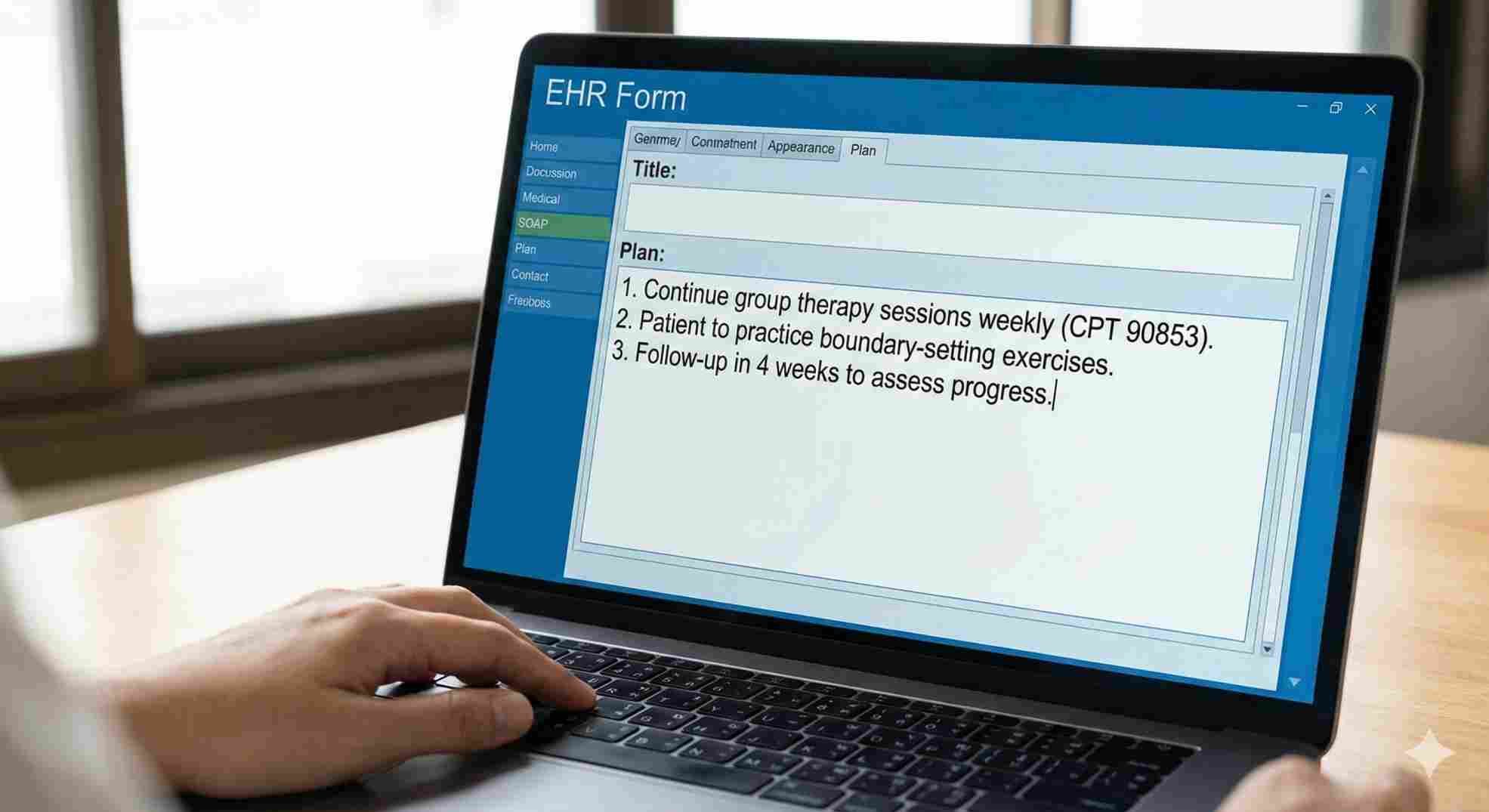
You need to write a note for every single person. I use a template, but I force myself to free-write the “Assessment” section.
- Don’t write: “Patient participated in group.”
- Write this instead: “Patient engaged in group discussion regarding boundary setting. Expressed difficulty saying ‘no’ to family members. Validated peer’s experience with similar issue.”
It takes more time. I know. But it is the only way to bulletproof your billing.
The Time Limit Myth
People think the 90853 CPT code description requires 60 minutes. Technically, the CPT manual doesn’t set a hard time floor like it does for other codes. But let’s use common sense. If you bill for a 15-minute group, you are going to get flagged. Stick to the standard 45-60 minute block. It is safe, it is clinically appropriate, and payers recognize it.
Is It Worth the Headache? (Pros vs. Cons)
Look, running groups isn’t for everyone. It is chaotic. You have to manage personalities. You have to deal with the one person who monopolizes the conversation. But from a business standpoint, it is a smart move.
| The Good Stuff | The Bad Stuff |
|---|---|
| Leverage: You earn more per hour. | Paperwork: 8 patients = 8 notes. It is tedious. |
| Community: Patients often stay longer because they bond with the group. | Scheduling Tetris: Finding a time that works for 8 adults is hard. |
| Stability: If one person cancels, you still get paid for the other seven. | Privacy: You can’t guarantee a patient won’t gossip outside the group. |
Table 3: The reality of running groups

What Usually Goes Wrong
I have helped a lot of practices clean up their billing, and the mistakes are almost always the same.
- The “Co-Therapy” Confusion: You and a colleague decide to run a group together. Great idea clinically. Terrible idea financially. Usually, only one of you can bill for the session. If you both bill for the same patients, it’s a duplicate claim. You have to split the group (you bill for half, they bill for half) or just accept that one of you is working pro bono.
- Location Errors: Did you run the group on Zoom? Did you use the “02” or “10” Place of Service code? Did you add the “95” or “GT” modifier? If you forget the modifier, the computer at the insurance company automatically rejects it.
- Diagnosis Mismatch: You can’t just slap any diagnosis on a group claim. The diagnosis has to justify why group therapy helps. Social anxiety? Perfect fit. Acute psychosis? Maybe harder to justify in a general outpatient group.

Final Thoughts
Understanding the 90853 CPT code description isn’t exactly the most thrilling part of your job. I get that. You became a therapist to help people, not to decode billing manuals.
But here is the truth: If you don’t get the billing right, you can’t keep the lights on. And if you can’t keep the lights on, you can’t help anyone.
Group therapy is one of the best tools we have. It breaks down isolation. It builds community. And yes, if you do it right, it is a solid revenue stream for your practice. Just follow the rules. Keep your notes specific. Watch your group size. And for the love of everything, don’t copy-paste your documentation.
You have got this. Now go fill those chairs.