Educational content, not coding, legal, or compliance advice. HCPCS codes, Medicare coverage articles, and individual payer policies change. Verify the current code set, your DME MAC’s coverage article, and each payer’s current policy before you or your billing team submit a claim.
Key Answer
L3000 is an HCPCS Level II code, not a CPT code, for a custom-molded foot insert with a heel cup of at least 10 mm, billed once per foot. Medicare covers it only as part of a covered leg brace.
Every other L3000 claim is denied as statutorily noncovered (CMS Article A52481, revised November 1, 2023) — and that coverage pathway is set the moment the order is written, not when the claim is submitted. For physicians, the practical cost isn’t just the write-off; it’s the hour spent untangling a denial after the fact, when a 30-second check at the time of the order would have caught it.
Industry-wide, 41% of providers now report denial rates of 10% or higher (Experian Health State of Claims, September 2025). On a Medicare L3000 line, a claim missing the KX or GY modifier is rejected before anyone reviews the clinical record. This guide covers what the code means, who pays, how to choose between L3000, L3010, L3020, and L3030, which modifiers apply, and how to prevent the denials physicians see most.
Consider an illustrative case: a physician orders a custom UCB-type insert for a patient with chronic plantar fasciitis, the practice casts and dispenses it, and three weeks later the remittance lists the line as noncovered. The coverage answer existed the day the order was written — it just wasn’t checked before the cast was taken.
Is L3000 a CPT code or an HCPCS code?
L3000 is an HCPCS Level II code, not a CPT code. CPT, maintained by the American Medical Association, describes procedures and services. HCPCS Level II, maintained by CMS, describes supplies, equipment, and orthotics. “L3000 CPT code” is common shorthand, but payers, fee schedules, and claim edits all treat it as an orthotics L-code.
The code sits in the Foot Inserts, Removable range (L3000–L3031), inside the broader orthotics section running L0112–L4631 (AAPC Codify). Medicare adjudicates it through the DME MACs under Article A52481.
You or your clinical staff may also assess and train the patient on the device, billed separately as CPT 97760, initial orthotic encounter, per 15 minutes. Whether a payer pays it alongside L3000 is payer-specific; confirm with your billing team. CPT 97762 was deleted in 2018; 97763 now covers subsequent encounters (CMS Transmittal R3924CP).
What does the L3000 CPT code description cover?
The official descriptor reads “Foot, insert, removable, molded to patient model, UCB type, Berkeley Shell, each.” In plain terms: a custom, removable insert built from a 3D model of your patient’s foot, with a molded heel cup of at least 10 mm, billed once per foot — not an over-the-counter or prefabricated insert.
A joint clarification from the American Podiatric Medical Association, the American Orthotic and Prosthetic Association, the Pedorthic Footcare Association, and AOFAS (May 11, 2018) defines the device: the model comes from a cast, foam impression, or 3D digital image, and the finished insert is rigid enough to control function, with posts directing corrective forces at the hindfoot and forefoot.
The code already bundles postings, padded top covers, soft tissue supplements, balance padding, and lesion accommodations — don’t let a lab or biller unbundle those onto a separate line. Aetna’s Clinical Policy Bulletin 0451 (reviewed July 16, 2026) repeats the same criteria. “UCB” refers to the University of California Biomechanics Laboratories, which developed the design (UHC Community Plan policy 2026R7103A). Keep the cast, impression, or scan file referenced in the chart note — that’s what an auditor asks for first.
Is CPT code L3000 covered by Medicare?
Not as a standalone item. Medicare covers L3000 only when the insert is on a shoe that is an integral part of a covered leg brace and is medically necessary for that brace to function; that line carries a KX modifier. Every other L3000 claim is denied as noncovered because coverage is statutorily excluded (CMS Article A52481).
The rule comes from the DME MACs’ policy article on Orthopedic Footwear (A52481), revised November 1, 2023. It names the qualifying leg-brace codes: L1900, L1920, L1980, L1990, and the L2000–L2090 series. L1970, a custom AFO patients often ask about alongside L3000, is not on that list — it follows its own AFO coverage policy.
Two details catch physicians who assume the brace exception is automatic: a shoe billed separately from the brace is denied even if later attached to one, and the same supplier must bill the shoe and brace together. For patients with diabetes, inserts and shoes are billed under the therapeutic shoes benefit with A-codes, never L3000.
For you as the ordering physician, the coverage pathway is effectively set the moment you write the order — and the self-pay conversation belongs before the cast is taken, not after the remittance arrives.
Free Practice Audit
Not sure how many of your practice’s foot-insert claims are landing on the noncovered path? The Free Practice Audit reviews your last 30 days of claims and maps exactly where revenue is leaking, before you change anything in your current workflow.
How common are orthotic claim denials, and what do payer limits look like?
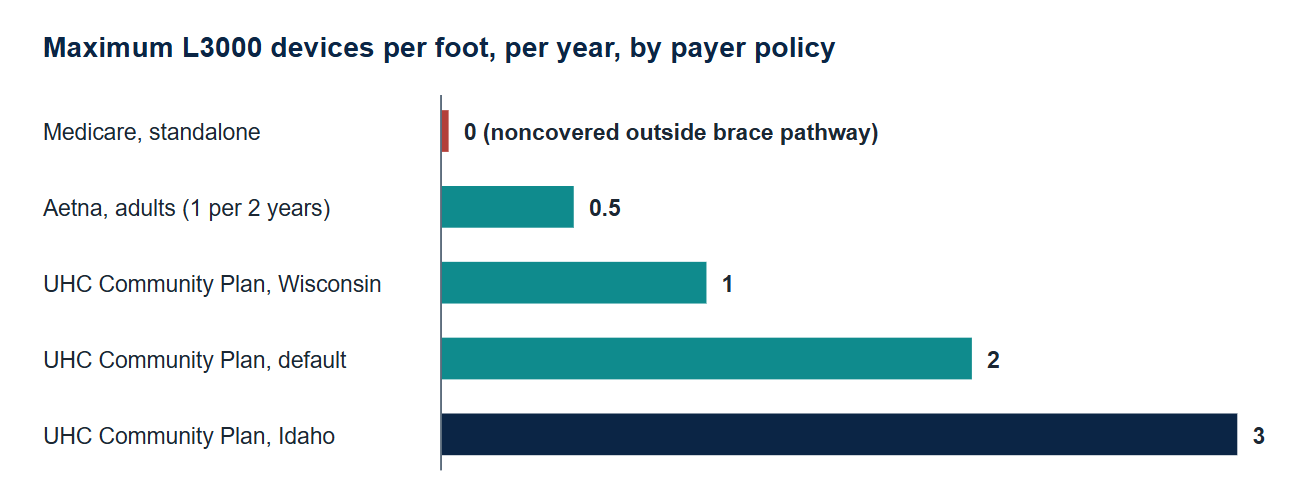
No source we reviewed publishes an L3000-specific denial rate, so treat industry-wide figures as the baseline your practice should benchmark against: 41% of providers report denial rates of 10% or higher, and 54% say claim errors are increasing (Experian Health, 2025). Payer frequency limits for L3000 range from a standalone denial under Medicare to as many as three devices per foot per year.
Experian’s 2025 State of Claims survey polled 250 healthcare finance and billing professionals in June and July 2025. Beyond the headline denial figure, 68% said submitting a clean claim is harder than it was a year earlier. These are survey-wide figures, not orthotics-specific data, but they describe the claims environment every L3000 order enters.
Frequency limits are where L3000 differs from most codes a physician orders. The chart below compares the published limits across three major payer policies.
Revenue Calculator
Run the same comparison against your own practice’s claim volume. The Revenue Calculator takes about two minutes, uses your monthly claim volume, average claim value, and current denial rate, and requires no account setup.
L3000 vs L3020: how do you choose between the foot-insert codes?
Choose by heel cup depth and fabrication method, never by price or lab terminology. L3000 requires a molded heel cup of at least 10 mm, while L3010 and L3020 use a shallower cup and L3030 is heat-formed directly onto the foot rather than molded from a model — the comparison below breaks out each code.
| Code | Descriptor (abbreviated) | How it is made | Heel cup | What it does |
|---|---|---|---|---|
| L3000 | Removable insert, molded to patient model, UCB type, Berkeley Shell, each | From a 3D model of the patient’s foot (cast, foam impression, or 3D digital image) | At least 10 mm | Functional device; directs medial and lateral forces at hindfoot and forefoot |
| L3010 | Removable insert, molded to patient model, longitudinal arch support, each | From a 3D model of the patient’s foot | Under 10 mm | Controls the forefoot through a longitudinal arch support |
| L3020 | Insert, molded to patient model, longitudinal/metatarsal support, each | From a 3D model of the patient’s foot | Under 10 mm | Adds metatarsal support to the longitudinal arch support |
| L3030 | Removable insert, formed to patient foot, each | Formed directly to the foot with an external heat source | Not specified in the 2018 clarification | Accommodative/functional device in continuous contact with the plantar surface |
| L3031 | Insert/plate, removable, addition to lower extremity orthosis, high strength, lightweight composite, each | Composite material added to an existing orthosis | Not applicable | Billed as an addition to an orthosis, not as a stand-alone foot orthotic |
Sources: AOFAS/APMA/AOPA/PFA L-code clarification (May 11, 2018); AAPC Codify descriptor for L3031; Aetna CPB 0451 (reviewed July 16, 2026).
The device your lab fabricates must match the code your billing team submits. A 6 mm heel cup is not L3000, however well the device fits. An insert formed directly on the foot with heat is L3030, not L3000.
The prescription is where a physician controls this outcome. Aetna’s policy notes that a properly written order states the desired function, material, and design — not just the device name. An order reading only “L3000” leaves the lab and biller guessing, and a wrong-code guess is exactly what surfaces on audit.
Two related codes come up often: L3260 (surgical boot/shoe) sits on A52481’s noncovered list outside the brace pathway, and L1970 (custom AFO) follows its own AFO coverage policy rather than this footwear article.
Which modifiers go on the L3000 CPT code?
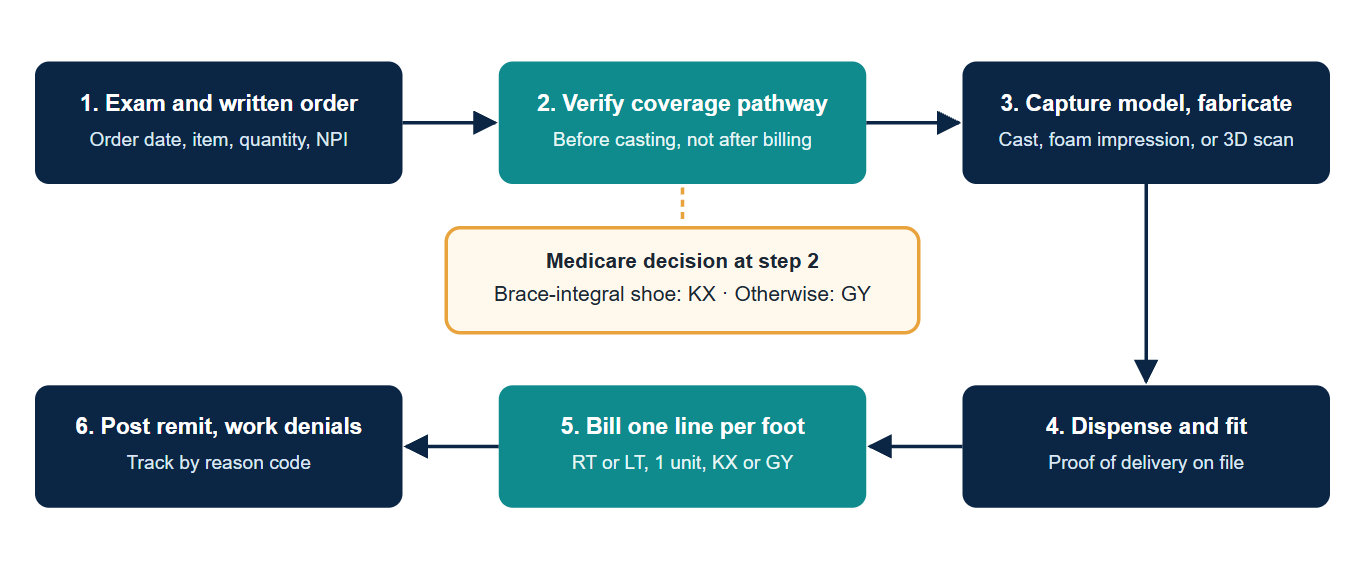
For Medicare, every line needs RT or LT, plus KX when the insert is on a shoe integral to a covered leg brace, or GY when it is not. Bill each foot on its own line with one unit; RTLT combined on one line with two units is rejected as incorrect coding (CMS Article A52481, effective for dates of service on or after March 1, 2019).
KX must be added only when the shoe or insert is integral to a leg brace; otherwise GY replaces it. A line with neither modifier is rejected as missing information. A line without RT or LT is rejected as incorrect coding, regardless of KX/GY status.
Individual payers layer on their own rules — UnitedHealthcare Community Plan in New York, for example, limits L3000 to two total units rather than a per-device count — so confirm the specific payer policy rather than assume the Medicare pattern applies everywhere.
What does L3000 reimburse, and what does it cost?
Medicare’s standalone payment for L3000 is zero, since the code is noncovered outside the brace pathway. Commercial and Medicaid payment follows the individual contract or state fee schedule, so no single national price applies. Confirm your locality’s allowed amount against the CMS January 2026 DMEPOS fee schedule file (DME26-A) before your practice commits to fabrication.
When a Medicare claim qualifies through the brace pathway, payment is the lesser of the supplier’s charge or the fee schedule amount (CMS MLN MM14326); the 2026 update raised most non-bid DMEPOS fees 2.0% (AOPA, December 2025). Fee-schedule amount for your locality: [VERIFY — pull L3000 from CMS DME26-A for your MAC jurisdiction].
The payer rules below show why the same device, ordered the same way, can pay differently across your patient panel.
| Payer / policy | Coverage rule | Frequency limit | Documentation rule |
|---|---|---|---|
| Medicare (CMS A52481, rev. 11/01/2023) | Covered only on a shoe integral to a covered leg brace (KX); otherwise noncovered (GY) | Not stated for L3000 in the article | General DME MAC documentation rules apply (Article A55426) |
| UHC Community Plan, Medicaid (2026R7103A, v. 02/08/2026) | Pays custom-made orthotics only, never over-the-counter inserts | 2 per foot per year; Idaho 3; Wisconsin 1; New York 2 units; Virginia exempt | Written prescription, or office-visit notes when the ordering provider is also the supplier; not required in Maryland or North Carolina |
| UHC Community Plan, Texas | Not payable to physicians | See policy | See policy |
| Aetna (CPB 0451, reviewed 07/16/2026) | Most plans exclude foot orthotics except when integral to a leg brace or part of post-surgical/post-traumatic casting care; plans without the exclusion apply medical necessity criteria | 1 per affected foot every 2 years, adults | Standard written order before the claim; records showing why a prefabricated device will not meet the need; proof of delivery |
Sources: CMS Article A52481; UnitedHealthcare Community Plan reimbursement policy 2026R7103A; Aetna Clinical Policy Bulletin 0451. Verify current versions before billing.
When the payer won’t cover the device, the patient pays directly — a conversation that belongs in the exam room before the cast is taken, not in a billing surprise weeks later.
Why do L3000 claims deny, and how do you prevent it?
Most L3000 denials trace back to decisions made before the claim was ever submitted: no coverage-pathway check at the time of the order, a missing or wrong modifier, no signed order on file, or a second device dispensed inside the payer’s frequency window. Each pattern has a documented rule and a check your team can run before submission — and several are set entirely by what the ordering physician writes on the prescription.
| Pattern | What the payer does | How to prevent it |
|---|---|---|
| No KX or GY on a Medicare line | Rejects the line as missing information (A52481) | Decide brace-integral or not at order entry; add KX or GY to every line |
| RTLT on one line, two units | Rejects as incorrect coding (A52481) | Bill two lines, one unit each, RT and LT |
| KX on a shoe not attached to a brace | Denies as noncovered; KX must not be used (A52481) | Use GY when the insert is not on a brace-integral shoe |
| L3000 billed for a diabetic patient’s insert | Wrong code family; A-codes apply under the therapeutic shoes policy (A52481) | Screen for the diabetic shoe benefit before choosing the code |
| No prescription or visit notes on file | UHC Community Plan denies the code | Attach the prescription, or office notes when the ordering physician is also the supplier |
| No standard written order before the claim | Aetna denies as not medically necessary | Order date, item and HCPCS code, quantity, NPI, and physician signature on file before billing |
| Second device inside the frequency window | Denied (UHC: over 2 per foot per year; Aetna: 1 per foot per 2 years) | Check prior dispense dates at scheduling, before the order is written |
Sources: CMS Article A52481; UHC Community Plan policy 2026R7103A; Aetna CPB 0451.
Aetna adds points that fall on the ordering physician directly: the treating practitioner must be an MD, DO, PA, NP, or clinical nurse specialist, not an orthotist or physical therapist; the order must list each HCPCS code and quantity; and a device fabricated the same day as an open cutting procedure, such as a bunionectomy, is not medically necessary regardless of coding.
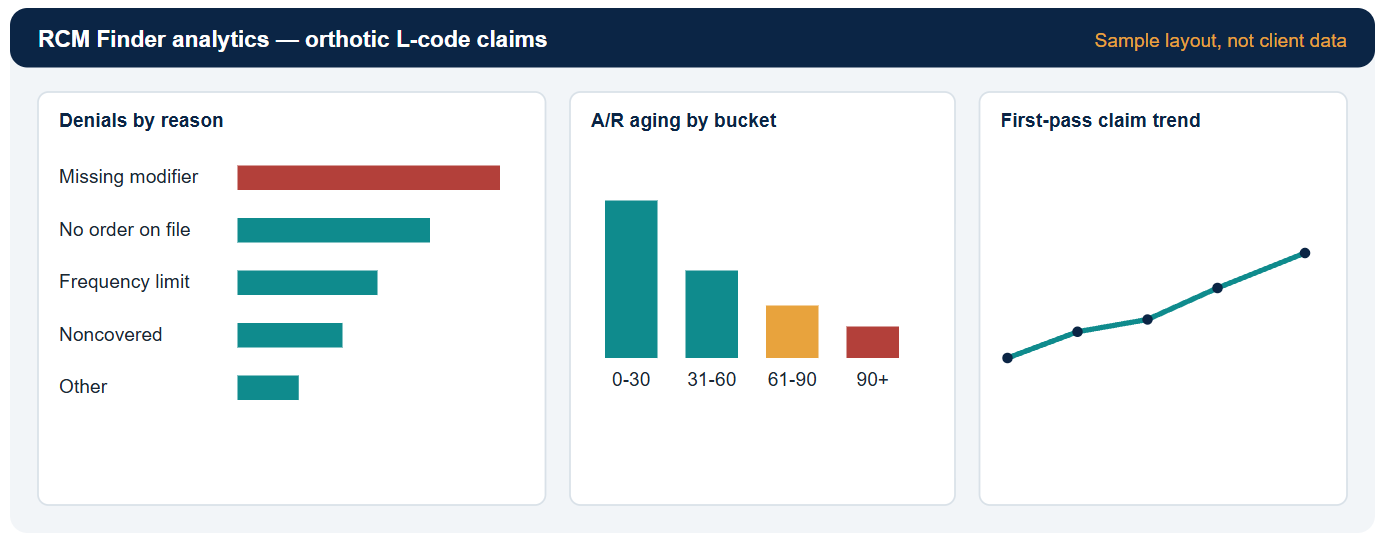
These patterns are easy to see once denials are grouped by reason and dollar volume — and hard to see in remittances reviewed one at a time between patients.
Free Practice Audit
If grouping your own practice’s remittances by denial reason surfaces a pattern like the ones above, that is exactly what the Free Practice Audit quantifies from your last 30 days of claims, at no cost or commitment.
Expert Recommendations for the L3000 CPT Code
Five habits prevent most L3000 problems physicians encounter, and four need no billing vendor at all: decide the coverage pathway on the order itself, bill one foot per line, keep the order and model on file before dispensing, and load frequency limits into scheduling. The fifth — a monthly denial report by reason — is where a dashboard earns its place. Each has a concrete cadence or threshold to apply starting this week.
- Decide who pays before the cast is taken. On every Medicare order, document whether the insert sits in a shoe integral to a covered leg brace; if not, plan for GY and tell the patient about self-pay before fabrication. Cadence: every order, no exceptions.
- Bill one foot per line. Confirm RT or LT with one unit per line. Review a sample of submitted claims weekly, or set a scrubber rule, to catch any RTLT line billed with two units.
- Complete the order before dispensing. The signed order lists the order date, each HCPCS code and quantity, your name and NPI. File the exam note and the cast, impression, or scan file. Threshold: no device dispensed without a signed order on file.
- Put frequency limits into scheduling. Flag a second device inside 12 months for UHC Community Plan patients, and inside 24 months for Aetna adults. Re-check each quarter and whenever a payer revises its policy.
- Run a monthly denial report by reason. Rank L-code denials by dollar volume, not frequency, and fix the top three causes first. RCM Finder’s dashboards in our own practice management system can produce this view if your billing software cannot.
“In claims we’ve audited, an L3000 denial almost always traces back to a decision made before the cast was taken — not a coding mistake made after. Fix the order, and the modifier and the payment usually follow.”
— Awais Afzal, Healthcare Operations Strategist, RCM Finder
Free Practice Audit
If checking your last quarter’s orthotic claims against these five steps reveals a gap, that is exactly what the Free Practice Audit quantifies — so you can get back to seeing patients instead of chasing remittances.
Should a physician practice keep L3000 billing in-house or move to a partner?
Keep it in-house if your team already checks the coverage pathway before casting, bills each foot on its own line, and tracks denials by reason without your involvement. Consider a partner if those checks depend on one person’s memory, or if orthotic claims are a small enough share of volume that nobody reviews them closely. The deciding number is your own practice’s denial rate, not a rule of thumb.
RCM Finder is a B2B healthcare SaaS and services platform for revenue cycle management, analytics, Virtual Medical Assistants, and patient growth marketing — an RCM Analytics and Workflow Automation Platform, not a claims clearinghouse. For a physician practice dispensing custom foot orthotics, the four service lines apply this way:
- Revenue Cycle Management: coding review, claim scrubbing, denial management, and compliant follow-up.
- Virtual Medical Assistants: remote staff under a Business Associate Agreement handling scheduling, prior authorizations, and front-desk administration, including the benefit check before casting.
- Advanced Practice Analytics: real-time dashboards in our own practice management system showing collections and the claim pipeline.
- Patient Growth Marketing: local SEO and reputation management to attract patients.
The Free Practice Audit covers your last 30 days of claims, billing leaks, digital footprint, and admin bottlenecks. Specialty-specific orthotics workflow details are confirmed during the audit itself, not assumed here.
Trust and security. RCM Finder signs a Business Associate Agreement before accessing patient data, encrypts patient data in transit and at rest, reports through our own practice management system, and integrates with PrognoCIS, eClinicalWorks, and Athenahealth. Reported outcomes below come from RCM Finder clients and are not guarantees for your practice.
Conclusion: settle the L3000 question on the order, not the remittance
The L3000 CPT code is an HCPCS Level II code for a custom-molded foot insert, and most billing problems physicians see with it trace back to decisions made before the claim was ever submitted. Medicare covers it only on a brace-integral shoe, every line needs RT or LT and KX or GY, and individual payers set their own frequency limits on top of that.
Summary & Next Steps
The steps that matter most are the ones a physician controls directly: write the order with the construction details, confirm the coverage pathway before casting, and keep the model and delivery record on file. If you want to see where your own practice’s foot-insert claims are landing, start with the Free Practice Audit. For a quick number first, use the Revenue Calculator. You can also browse RCM Finder’s services and specialties.
Sources: CMS Article A52481, Orthopedic Footwear (rev. 11/01/2023); AAPC Codify, HCPCS L3000; UnitedHealthcare Community Plan policy 2026R7103A; Aetna Clinical Policy Bulletin 0451 (reviewed 07/16/2026); AOFAS/APMA/AOPA/PFA L-code clarification (May 11, 2018); Experian Health State of Claims 2025; CMS MLN MM14326; AOPA 2026 fee schedule update; CMS Transmittal R3924CP.