Educational content, not coding, legal, or compliance advice. CPT codes, Medicare rules, and payer policies change. Verify current codes and rules with CMS, the AMA CPT code set, and your payer before you bill. CPT is a registered trademark of the American Medical Association.
There is no single CPT code for palliative care. Report each visit with the evaluation and management (E/M) code for its setting, add advance care planning codes 99497 and 99498 when that conversation is separately documented, and pair the claim with a diagnosis such as Z51.5. Documentation decides whether it pays.
If you spent 40 minutes on prognosis, symptom control, and code status and the claim still went out as a routine follow-up, the gap is usually coding and documentation, and it is fixable. This guide covers the palliative care CPT codes, the Medicare rules around them, and the notes that support payment.
Definition
Definition: Palliative care CPT codes are the E/M, advance care planning, and prolonged-service codes clinicians report for palliative visits, paired with ICD-10-CM diagnoses. CPT itself has no palliative care code.
Is there a single CPT code for palliative care?
No. CPT has no code for palliative care as a service line. A palliative visit is reported like any other physician encounter: an E/M code chosen by setting, patient status, and level, plus separately reportable services such as advance care planning, and an ICD-10-CM diagnosis.
The Palliative Care Network of Wisconsin’s Fast Fact #48 describes the same structure: each encounter carries a service code and a diagnosis code. Hospice is different. It is a distinct Medicare benefit that requires certification of a life expectancy of six months or less, according to Medicare.gov, and it changes who bills what.
What changed in palliative care CPT codes from 2024 to 2026?
The E/M framework was rebuilt in 2023, and most changes since then are on the payment side: the G2211 add-on in 2024, new caregiver training coding in 2025, and two conversion factors with a 2.5% efficiency adjustment in 2026. If you still work from a palliative care CPT codes 2024 or 2025 cheat sheet, update it with Table 1.
| Period | What changed | Source |
|---|---|---|
| 2023 | CPT revised hospital, nursing facility, and home or residence E/M codes and time rules, and deleted 99354–99357. Medicare added G0316, G0317, and G0318 for prolonged services. | AMA; AAPC |
| 2024 | CMS began paying add-on G2211 and created codes for caregiver training, community health integration, principal illness navigation, and SDOH risk assessment. | CMS CY 2024 fact sheet |
| 2025 | CMS finalized coding and payment for caregiver training services and added them to the telehealth list on a provisional basis. | CMS CY 2025 fact sheet |
| 2026 | Conversion factors of $33.57 (qualifying APM participants) and $33.40 (others). A 2.5% efficiency adjustment applies to most non-time-based services. | CMS CY 2026 fact sheet |
| Oct. 1, 2026 | The FY 2027 ICD-10-CM code set applies to encounters through September 30, 2027. | CMS ICD-10 page |
| 2027 (proposed) | Proposed conversion factors of $33.17 and $32.84, decreases of 1.19% and 1.68%, as the temporary 2.5% increase for 2026 expires. Comments closed September 14, 2026. | CMS CY 2027 proposed rule |
Specialty society summaries treat E/M and care management as exempt time-based services. Confirm each ACP and prolonged-service code you bill against CMS’s exempt list. A final CY 2027 rule is expected this fall, so treat the 2027 figures as proposals.
Revenue Calculator
Numbers like these matter at your volume. The Revenue Calculator takes about two minutes, needs no account, and estimates the effect of your denial rate on monthly revenue.
Which E/M codes apply to palliative care visits?
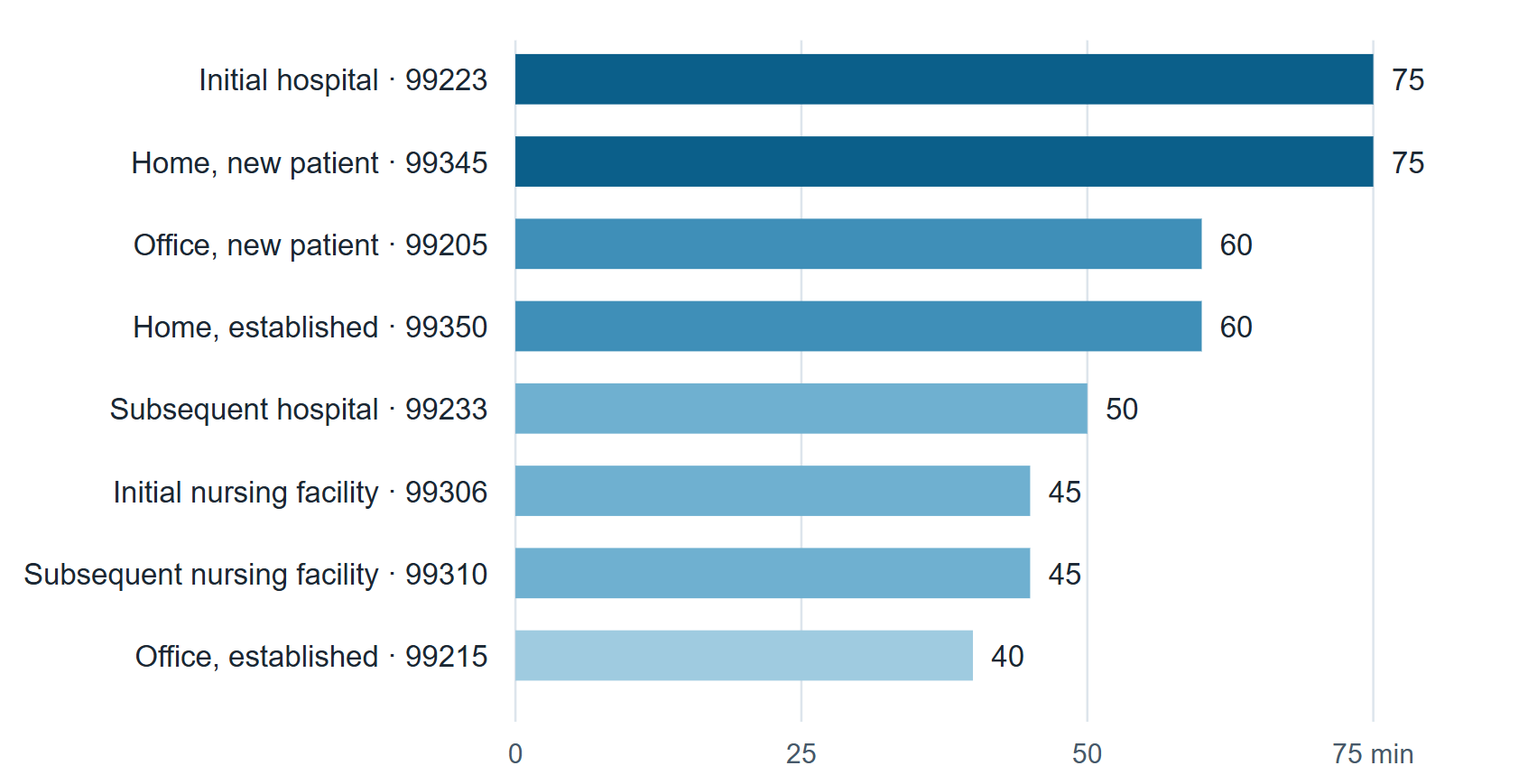
Pick the E/M family by where the visit happens: hospital, nursing facility, home or residence, or office. Then pick the level by medical decision making (MDM) or by total practitioner time on the date of the encounter. Table 2 lists the time thresholds behind palliative care CPT codes, as the AMA published them for its 2023 revision.
Total time counts what you personally do for that patient on the date: reviewing records, examining, counseling the family, ordering, documenting, and coordinating care that is not reported separately. It excludes travel, separately reported services, and general teaching, per the AMA’s E/M guidelines.
MDM requires two of three elements: problems addressed, data reviewed, and risk of management. The AMA’s high-risk examples include a decision not to resuscitate or to de-escalate care because of poor prognosis. The authors of Fast Fact #48 also note that MDM can enable a higher level than the clock in a goal-setting family gathering.
| Setting | Codes and minutes |
|---|---|
| Initial hospital inpatient or observation | 99221: 40 · 99222: 55 · 99223: 75 |
| Subsequent hospital inpatient or observation | 99231: 25 · 99232: 35 · 99233: 50 |
| Initial nursing facility | 99304: 25 · 99305: 35 · 99306: 45 |
| Subsequent nursing facility | 99307: 10 · 99308: 15 · 99309: 30 · 99310: 45 |
| Home or residence, new patient | 99341: 15 · 99342: 30 · 99344: 60 · 99345: 75 |
| Home or residence, established patient | 99347: 20 · 99348: 30 · 99349: 40 · 99350: 60 |
| Office, highest levels only | 99205: 60 · 99215: 40 |
Source: AMA, CPT E/M code and guideline changes effective January 1, 2023. Check against the current CPT code set.
Revenue Calculator
Time thresholds change what a visit is worth. Test your own volume and denial rate in the Revenue Calculator.
What is the CPT code for palliative care at home?
There is no separate CPT code for palliative care at home. Home and residence visits use 99341, 99342, 99344, and 99345 for new patients and 99347 through 99350 for established patients; 99343 was deleted in 2023. Home includes private residences, assisted living, and group homes, and travel time cannot count toward the level.
For long visits, CPT allows prolonged-service code 99417 with 99345 or 99350 once time passes the top level by 15 minutes. Medicare does not accept 99417, so Medicare claims use HCPCS G0318 with 99345 or 99350, as Noridian and AAPC describe. According to Fast Fact #48, Medicare counts longer home time from three days before the appointment to seven days after, so confirm the window with your Medicare Administrative Contractor (MAC).
CMS says add-on G2211 can apply to home or residence E/M visits when its longitudinal-relationship criteria are met. CMS’s G2211 FAQ also says it denies G2211 on an office visit that carries modifier 25 on the same date.
Free Practice Audit
Downcoded home visits and unpaid ACP time are easy to miss in a billing report. The Free Practice Audit reviews your last 30 days of claims and maps where revenue is leaking, without changing your current workflow first. Request the audit.
How do ACP codes 99497 and 99498 work?
Among palliative care CPT codes, 99497 covers the first 30 minutes of face-to-face advance care planning (ACP), and add-on 99498 covers each additional 30 minutes. Under CMS’s midpoint rule you can bill 99497 at 16 minutes and add 99498 at 46. Fifteen minutes or less is billed as an E/M visit, not ACP.
| ACP minutes | Codes and units |
|---|---|
| 15 or less | Do not bill ACP; bill an E/M service |
| 16–45 | 99497 × 1 |
| 46–75 | 99497 × 1 and 99498 × 1 |
| 76–105 | 99497 × 1 and 99498 × 2 |
Source: CMS MLN909289, Advance Care Planning, March 2026.
The same CMS fact sheet sets four documentation elements: the visit was voluntary, advance directives were explained, who was present, and the time spent on ACP. ACP can be billed on the same day as an E/M visit only if the minutes do not overlap active management of the patient’s conditions. There is no frequency limit, but repeat billing needs a documented change in health status or end-of-life wishes.
ACP is billable in any setting, including at home and by telehealth under the rules in effect on the date of service. No specific diagnosis is required. When ACP is provided with an Annual Wellness Visit (G0438 or G0439) by the same provider, on the same claim, with modifier 33, CMS waives the deductible and coinsurance. For hospice patients, Part B pays ACP only if the physician is not employed by the hospice.
What do Medicare palliative care billing guidelines require?
The CMS palliative care billing guidelines apply standard physician billing rules to palliative care CPT codes, and three points shape every claim. Medicare has not recognized consultation codes since 2010, requires hospice modifiers GV or GW after a hospice election, and uses its own HCPCS prolonged-service codes.
Consultations. A CMS Manual System transmittal removed consultation codes 99241–99255 from Part B payment effective January 1, 2010. Bill a new or established office visit, or initial hospital care 99221–99223 for an inpatient consult. Some commercial payers still accept consult codes, so check each policy.
Hospice. The attending physician who is not employed by or paid under arrangement with the hospice appends GV to terminal-illness-related services. GW marks services unrelated to the terminal condition. A CMS transmittal clarifies liability when GV or GW is missing during a hospice election, and other physicians’ terminal-illness services are billed to the hospice, not Part B.
Prolonged services. Medicare uses G2212 for office visits, G0316 for hospital care, G0317 for nursing facilities, and G0318 for home visits instead of 99417 or 99418. CMS corrected its G0316 time thresholds in 2023, so confirm current thresholds in the Medicare Claims Processing Manual, chapter 12, before billing.
Free Practice Audit
Hospice-modifier and consult-code denials are workflow problems, not one-off errors. If your denial queue shows them, the Free Practice Audit quantifies them at no cost or commitment.
What is the ICD-10 code for palliative care?
The ICD-10 code for palliative care is Z51.5, Encounter for palliative care. It is billable, but it describes the reason for the visit, not the illness. Report the serious illness and the symptoms you treated so the claim shows medical necessity, and check sequencing rules for your payer.
Coding references disagree on whether Z51.5 belongs first or second on a professional claim, and payer edits vary. Follow the ICD-10-CM Official Guidelines and your payer’s policy. Fast Fact #48 adds that “goals of care” is not a billable diagnosis, so code the conditions and symptoms behind the conversation.
Timing matters this week. CMS states the FY 2027 ICD-10-CM code set applies to encounters from October 1, 2026, through September 30, 2027. Check Z51.5 and your top palliative diagnoses against the FY 2027 addenda before that date.
What are the palliative care documentation requirements?
Document the reason for the encounter, the problems you addressed, and either total time or the MDM behind the level. For ACP, add that the discussion was voluntary, that advance directives were explained, who was present, and the minutes spent. The AMA says total time should be documented when it drives code selection.
- Problems addressed: a problem counts when you evaluate or treat it. Noting that another clinician manages it, without your own assessment, does not count.
- Time: record total minutes on the date, excluding travel and separately reported services. For shared or split visits, count distinct time only.
- Travel: record all total minutes spent travelling (excluding services and separately reported services).
- Data and risk: an interactive discussion with an external clinician counts toward data. Document decisions such as de-escalation of care.
- ACP: keep ACP minutes separate from E/M minutes, and note any change in wishes when you bill again.
- Hospice: record attending status and whether the condition is related to the terminal illness.
These palliative care coding guidelines draw on AMA and CMS sources; CAPC’s billing toolkit adds member resources.
Free Practice Audit
Documentation gaps show up as downcodes and denials before anyone notices. The Free Practice Audit shows where your notes and claims part ways.
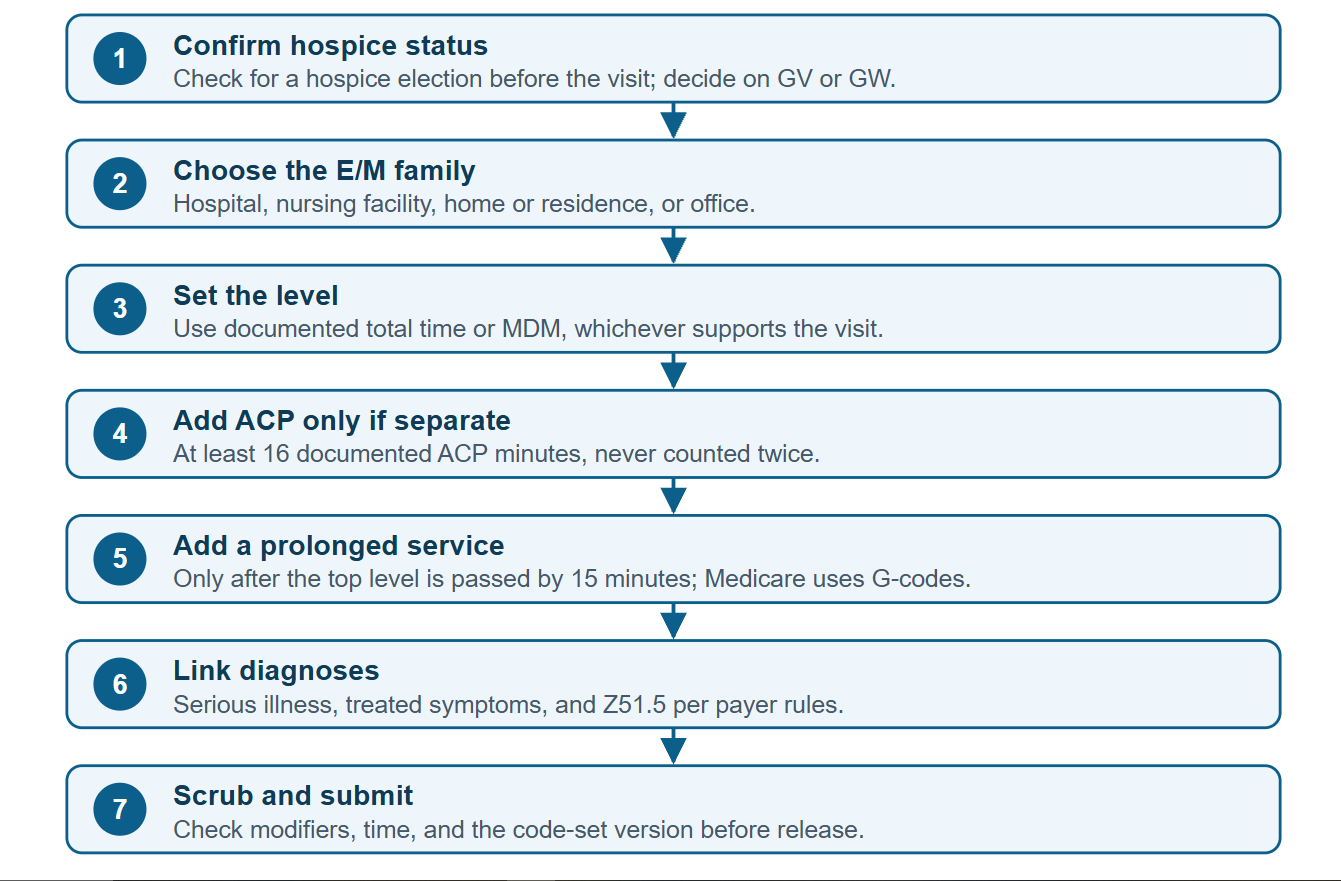
Palliative care billing and coding tip sheet for 2026
Use this quick reference to match the encounter to the palliative care CPT codes physicians most often report, then confirm each line with your payer. It reflects the sources cited above as of September 29, 2026, and should be rechecked after the CY 2027 final rule and each January code update.
| Scenario | Codes to consider | Watch for |
|---|---|---|
| Inpatient palliative consult | 99221–99223 initial; 99231–99233 subsequent | Medicare does not recognize 99252–99255 |
| Home visit, established patient | 99347–99350; G2211 if criteria are met; G0318 with 99350 for prolonged time | 99417 is not valid for Medicare |
| Separate advance directive discussion | 99497 at 16–45 minutes; add 99498 at 46–75 | 15 minutes or less is an E/M visit |
| Patient enrolled in hospice | E/M with GV (attending) or GW (unrelated condition) | Missing GV or GW risks denial |
| Diagnosis line | Serious illness, treated symptoms, and Z51.5 | FY 2027 code set starts October 1, 2026 |
Sources: AMA E/M guidelines; CMS MLN909289; CMS transmittals 1875 and 13074; Noridian; CMS G2211 FAQ.
Expert Recommendations for Palliative Care CPT Codes
Five habits protect palliative care CPT code claims: decide between time and MDM for each encounter, keep ACP minutes separate, verify hospice status before every visit, refresh code sets each October and January, and review denials by reason code every month. The first four need no software.
- Compare time and MDM before choosing the level. Record total minutes and the MDM level for each encounter, then report whichever is documented and supports the higher level. Audit 10 charts per clinician each quarter.
- Time-stamp ACP separately. Bill 99497 only at 16 or more documented minutes, and never count those minutes in the E/M level. Review every ACP claim for the four required elements during the first 30 days of a new workflow.
- Verify hospice election before each visit. Check status when the visit is scheduled and again the day before, then apply GV or GW. Review hospice-related denials monthly.
- Refresh code sets on a calendar. Update superbills and EHR favorites each October 1 (ICD-10-CM) and January 1 (CPT and fee schedule), and run a test batch of 10 to 20 claims in the first week.
- Track palliative claims in a dashboard. Follow denial rate by reason code, ACP claims per 100 palliative visits, and days in A/R by payer. RCM Finder builds dashboards in our own practice management system for this kind of reporting; review yours monthly.
“A palliative visit gets paid on what the note proves: the minutes, the people in the room, and why the encounter happened.”
Free Practice Audit
If comparing your claims against these five steps reveals a gap, the Free Practice Audit quantifies it at no cost or commitment.
How RCM Finder supports palliative care billing workflows
RCM Finder is an RCM Analytics and Workflow Automation Platform. It works on the billing, coding, denial management, claim scrubbing, and analytics layers of your revenue cycle. It signs a Business Associate Agreement before accessing patient data, reports through dashboards in our own practice management system, and integrates with PrognoCIS, eClinicalWorks, and Athenahealth. Learn more about its services and specialties.
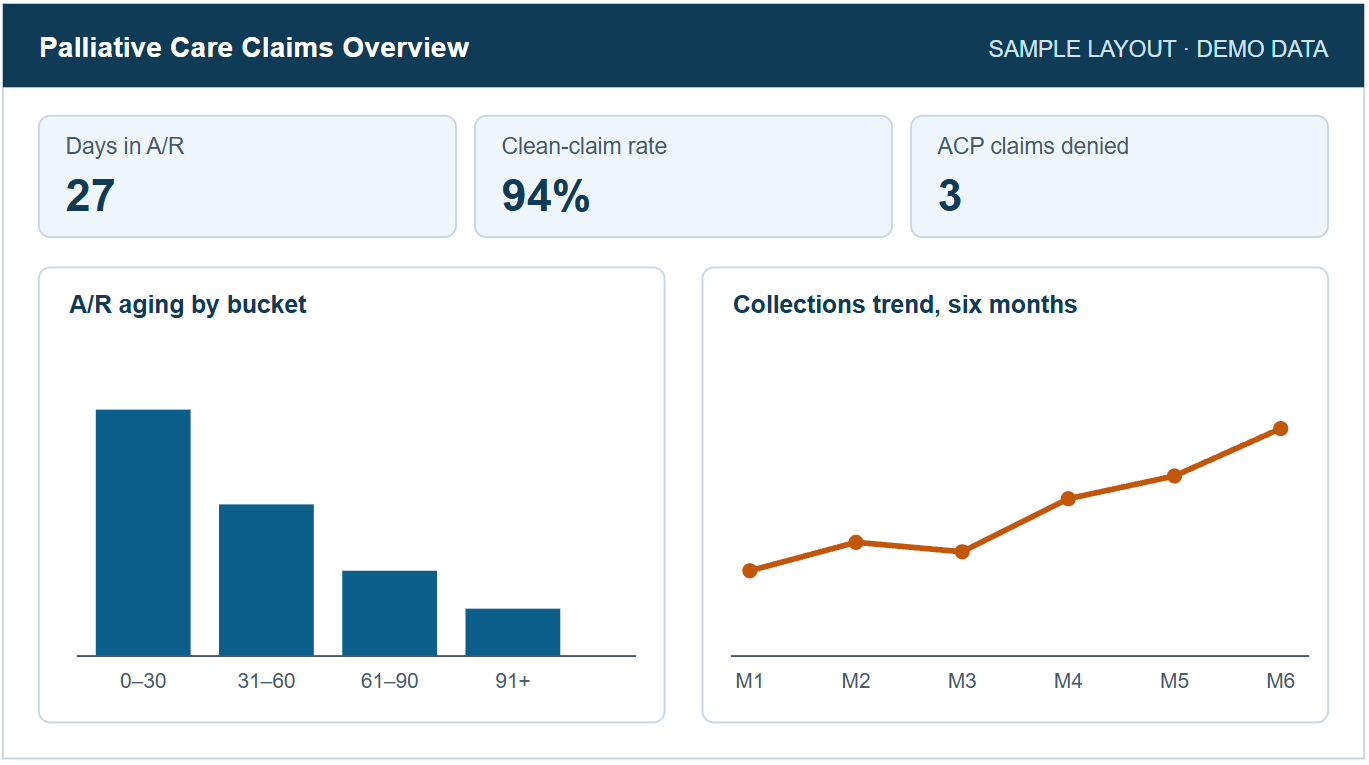
Two clients quoted on RCM Finder’s site describe their reported outcomes. These are not guarantees or palliative care benchmarks.