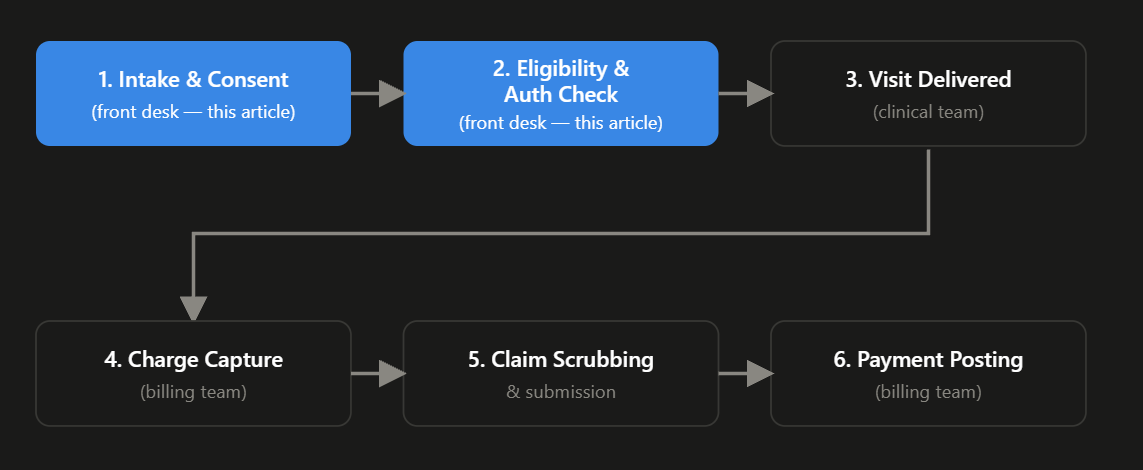
Behavioral health patient registration means verifying insurance, confirming session authorizations, and capturing consent at intake. It’s the single biggest lever on your clean-claim rate. Incomplete or missing registration data drives an estimated 32% of claim denials industry-wide (Experian Health, 2025–2026). Behavioral health’s session-based billing model multiplies the chances of a mistake at check-in.
Your front desk is verifying benefits between phone calls and rooming patients. A new intake for group therapy comes in. A substance-use authorization expires next week.
And nobody has confirmed whether Tuesday’s telehealth session needs a modifier before it reaches billing. None of it looks like a billing problem — until the denial lands three weeks later.
That’s what separates behavioral health registration from general medical intake. Session limits, per-modality authorizations, and consent rules vary by service line. The same patient can generate several registration events in a single month, not just one at the start of care.
Comprehensive RCM Overview
This article focuses on that front-end layer. For the full picture — coding, denial management, and payment posting — see RCM Finder’s behavioral health billing and RCM guide.
Educational content, not legal or compliance advice. This article explains general billing, registration, and regulatory-awareness practices for behavioral health revenue cycle operations. It does not constitute individualized legal, compliance, coding, or tax advice. Verify current CPT/HCPCS codes and payer policies with CMS and your payers. Confirm your 42 CFR Part 2 and HIPAA obligations with your own compliance counsel before changing your practice’s workflow.
Why Are Behavioral Health Registration Errors Rising Right Now?
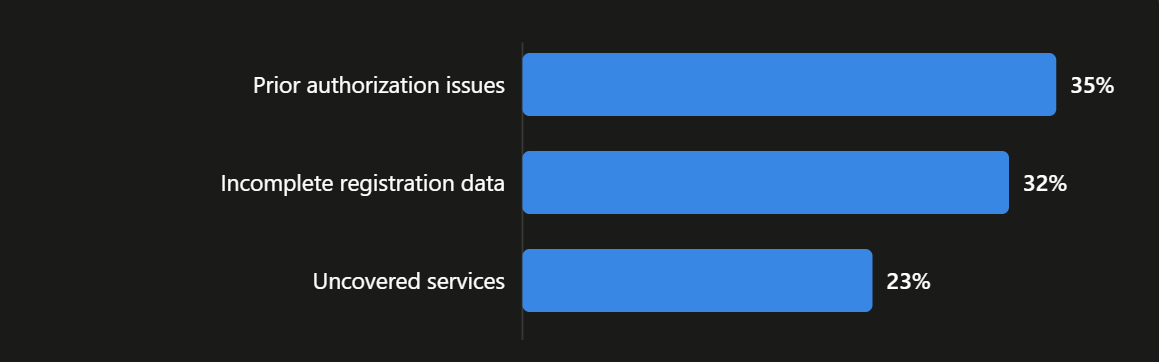
Behavioral health registration errors are rising because payer scrutiny is now outpacing front-desk capacity — and the specific causes are measurable. A follow-up Experian Health analysis found that incomplete or missing registration data drives an estimated 32% of claim denials, and prior-authorization problems another 35%.
That’s not a marginal share. In Experian Health’s 2025 State of Claims survey, 41% of providers said at least one in ten of their claims is denied, and 54% said denial rates are still rising year over year.
Services the payer considered uncovered — usually a benefit-verification miss — account for another 23% of denials. MGMA’s longer-running DataDive benchmark had put the industry’s aggregate first-submission denial rate at a steady 8% from 2019 through 2023. The newer numbers suggest that floor is no longer holding for a lot of practices.
| Denial cause | Share of denials | Prevention tactic |
|---|---|---|
| Prior authorization issues | 35% | Confirm authorization status and remaining session count at every visit, not just the first |
| Missing/incomplete registration data | 32% | Real-time eligibility verification at check-in, with a second data-entry check before the claim leaves registration |
| Uncovered services (benefit miss) | 23% | Verify the specific behavioral health benefit and modality coverage before the visit is scheduled, not after it happens |
Sources: Experian Health, 2025 State of Claims Report (Oct. 2025); Experian Health, “Common causes of eligibility-related claim denials” (June 2026); MGMA DataDive benchmark.
Curious what your own registration-error rate is actually costing you?
The Revenue Calculator turns your monthly claim volume and denial rate into a real number in about two minutes. No account required.
How Much Does a Registration Error Actually Cost a Behavioral Health Practice?
Reworking a single denied claim caused by a registration error costs an estimated $25 to $118 in staff time alone, before counting the revenue sitting delayed while it’s corrected (MGMA). The exact number for your practice depends on claim volume and denial rate — the scenario below sizes it out for a mid-sized group.
Consider a 12-provider outpatient behavioral health group processing 1,600 claims a month at a $110 average claim value. This is a hypothetical scenario, not a real client’s figures. At an 11% denial rate — the midpoint of providers reporting “at least one in ten” denied — and a 32% registration-attributable share, that group is looking at roughly 56 claims a month denied for registration reasons. None of those had anything to do with clinical coding.
| Variable | Illustrative value | Basis |
|---|---|---|
| Monthly claim volume | 1,600 | Hypothetical 12-provider group |
| Denial rate | 11% | Experian Health, 2025 (midpoint of “≥1 in 10 denied”) |
| Registration/eligibility share of denials | 32% | Experian Health, 2025–2026 |
| Claims denied for registration reasons/month | ~56 | 1,600 × 11% × 32% |
| Average claim value | $110 | Hypothetical mid-range behavioral health session rate |
| Revenue delayed pending rework/month | ~$6,160 | 56 × $110 |
| Added rework labor (low end) | ~$1,400+/month | MGMA per-claim rework-cost estimate, low end, × 56 claims |
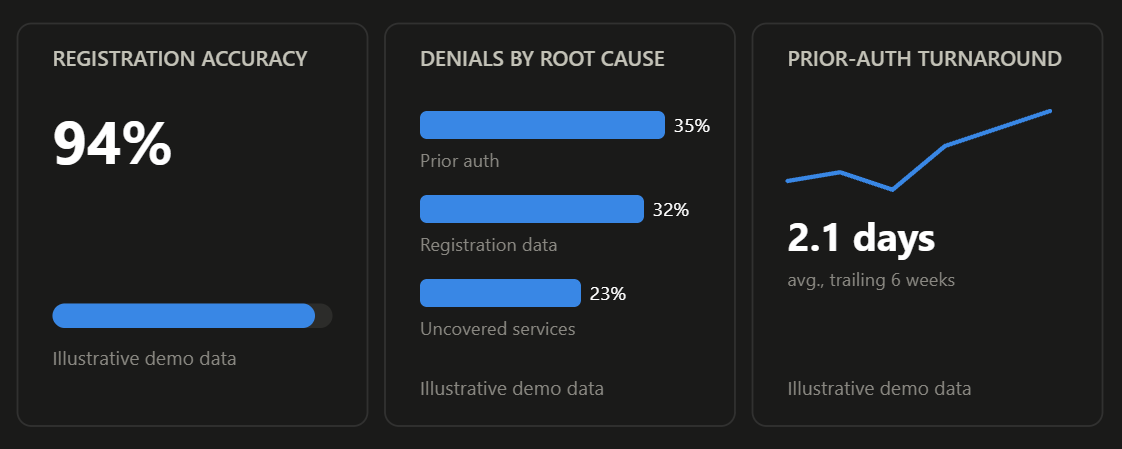
Mock-up of an RCM Finder our own practice management system practice-analytics view. Panel values are illustrative demo data, not a real client’s reported metrics, pending a live screenshot at publish time.
How Does Mental Health Parity Affect Prior Authorization at Intake?
Under the federal mental health parity final rule issued in September 2024, health plans cannot apply prior authorization more restrictively to behavioral health than to medical and surgical care. The same goes for other nonquantitative treatment limitations on substance use disorder benefits. Most group health plans had to comply starting January 1, 2025. The harder provisions, plus individual-market plans, came due January 1, 2026 — a requirement now fully in force as of this article’s publish date.
The diagnosis and service type captured at check-in determines which prior-authorization pathway a claim takes. Increasingly, it’s also what a payer has to justify if its behavioral health authorization requirements look stricter than its medical ones. A registration process that captures this data consistently gives your billing team real evidence. That’s what lets them push back on a payer whose prior-auth pattern doesn’t hold up.
What’s Different About Intake for Substance Use Disorder Patients?
Substance use disorder intake needs its own consent process, not the standard packet used for a general medical patient. It runs on a modernized, broader authorization under updated 42 CFR Part 2 rules that covers treatment, payment, and healthcare operations in one form. As of February 16, 2026, covered programs must fully comply with this regulation, which replaces the older requirement for separate written consent per disclosure.
Two disclosures still need separate written consent: legal proceedings, and SUD counseling notes. For a registration desk, that means one thing: the standard intake consent packet for a general medical patient isn’t sufficient for an SUD patient. The front-desk workflow needs a distinct, current consent form. Staff need to know which category a patient falls into before the first session is billed.
Outsourced vs. In-House Behavioral Health Registration: What Actually Changes?
Outsourcing doesn’t remove the registration function — it changes who’s accountable for doing it consistently, and whether that accuracy shows up on a dashboard or gets buried in a shared inbox.
In-house registration keeps the function close to your clinical team. But it comes with real costs: coverage gaps during PTO, and training time for a role with genuine payer-specific nuance. There’s also no dedicated specialist watching authorization expirations across every modality you bill.
RCM Finder’s Virtual Medical Assistants are remote staff under a Business Associate Agreement who handle scheduling, prior authorizations, and front-desk administration. They deploy alongside your existing EHR — PrognoCIS, eClinicalWorks, or Athenahealth — without downtime to your current workflow.
The distinction from a general billing vendor is data visibility. The registration data a VMA captures feeds directly into the same dashboard in our own practice management system your practice already uses for collections. A rising denial-cause pattern shows up before it becomes a backlog, not after.
| Dimension | In-house | Outsourced (RCM Finder VMA model) |
|---|---|---|
| Coverage during PTO/turnover | Gaps common; one trained person often covers it alone | Dedicated remote staff with built-in coverage |
| Authorization tracking across modalities | Manual, spreadsheet- or memory-dependent | Tracked centrally, tied to the same analytics dashboard as billing |
| EHR integration effort | None needed; already embedded | Deployed alongside PrognoCIS, eClinicalWorks, or Athenahealth with no downtime |
| Denial-cause visibility | Usually discovered after the fact, in the billing team’s denial queue | Visible in our own practice management system as a registration-stage metric, not just a billing outcome |
If your front desk is already juggling scheduling, intake, and insurance calls
the Free Practice Audit can help. It maps exactly where your registration data is breaking down, against your last 30 days of claims — at no cost or commitment.
Expert Recommendations for Behavioral Health Patient Registration Billing
- Re-verify eligibility and session authorization within 24 hours of every scheduled visit — not just at the first intake. Session limits and authorized visit counts change mid-course of care. That happens more often in behavioral health than in most other specialties.
- Track your prior-authorization denial rate by payer, monthly. Start renegotiating documentation requirements with whichever payer sits above the 35% industry problem-rate benchmark first.
- Build a one-page consent checklist for every SUD intake. Separate the broad treatment/payment/operations consent from the two disclosures that still need their own written consent — legal proceedings and counseling notes. Since February 2026, this is a compliance requirement, not a nice-to-have.
- Audit your no-show and reschedule-to-registration handoff quarterly. A rebooked session without a fresh eligibility check is one of the most common silent sources of behavioral health denials.
- If your front desk is already stretched across scheduling, intake, and billing follow-up, consider a dedicated Virtual Medical Assistant for registration and prior auth. Paired with visibility into denial data by cause, it usually pays for itself faster than a new full-time hire.
Why Do Practices Trust RCM Finder with Behavioral Health Registration?
Practices trust RCM Finder with sensitive behavioral health data because of concrete, verifiable safeguards: a signed Business Associate Agreement and role-based access. It also encrypts data in transit and at rest, integrates with PrognoCIS, eClinicalWorks, and Athenahealth, and reports registration and collections performance through one real-time reporting in our own practice management system dashboard.
These aren’t guarantees — results vary by practice, payer mix, and starting point. But they’re reported outcomes, not marketing copy. RCM Finder clients have reported days in A/R dropping from 45 to under 18. Registration accuracy, the focus of this article, is one of several inputs behind a number like that.
“Registration is where behavioral health revenue is won or lost — the mistake happens weeks before the denial does,” says Awais Afzal, Healthcare Operations Strategist.
RCM Finder · About our team · hello@rcmfinder.com · +1 (302) 556-2288 · 124 Broadkill Road, Milton, DE 19968
Our review standard
a named, credentialed byline; a sourced citation behind every statistic; a visible disclaimer on regulatory content; a scheduled re-review date. This article flags its mental-health-parity and 42 CFR Part 2 sections for your compliance counsel to verify — they’re not offered as legal advice. Spotted an error, or a change in one of the rules above? Reach out using the contact details above.
Getting Behavioral Health Registration Under Control
Registration is the part of behavioral health billing that rarely gets a dedicated fix. Most practices only address it after a denial pattern forces the conversation. Whether you keep it in-house or move it to a dedicated VMA, the goal is the same: catch the authorization gap or the missing consent before the visit happens — not three weeks after the claim comes back.
Ready to see where your own registration process is leaking revenue?
Start with the Free Practice Audit — it maps your last 30 days of claims against exactly these failure points. Prefer a self-serve estimate first? Run the Revenue Calculator.