
Neurology Specialty

Neurology Billing Services for EMG, EEG, Botox and Infusion Claims

Coding, prior authorization, front-desk support, patient growth and a claims portal for neurology practices, built on your Medicare contractor's articles and your payers' own policies.
  • Works inside your current EHR
  • US practice time zone, every shift
  • Weekly KPI reporting, or on your schedule
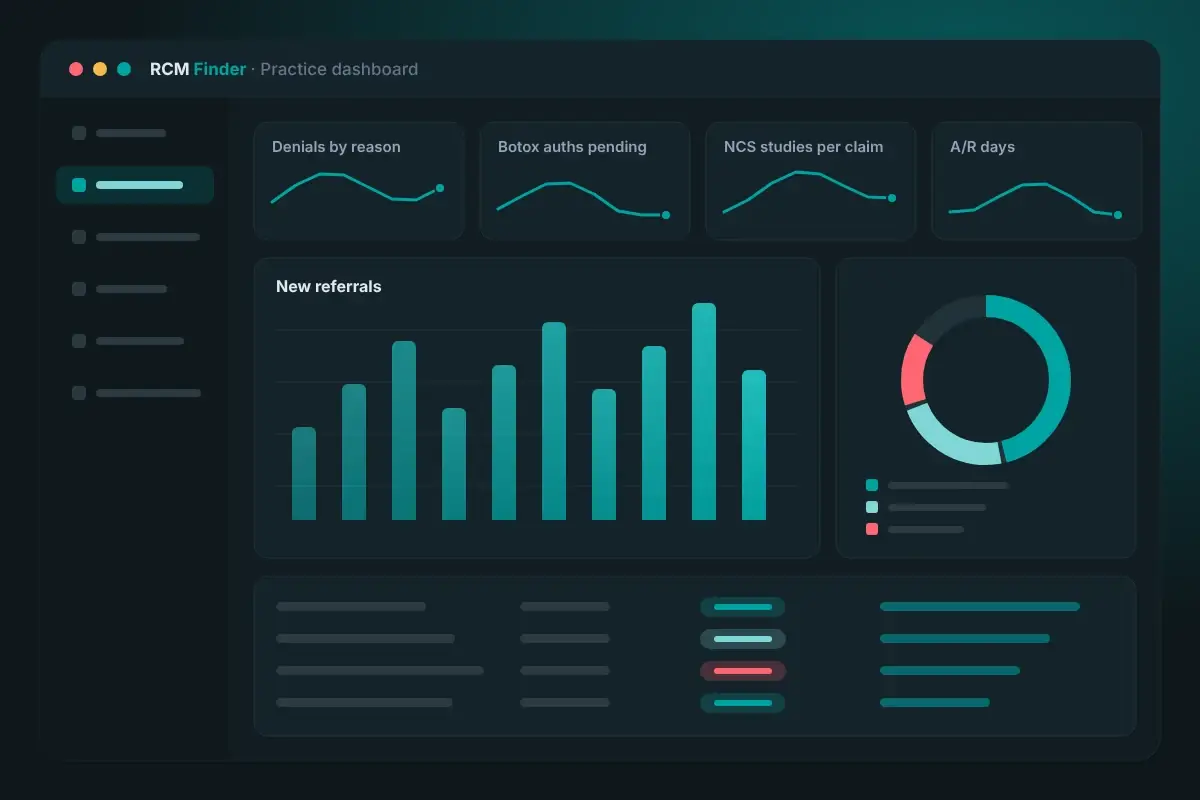
Neurology billing dashboard showing denials by reason, Botox authorizations, NCS study counts, A/R days and referrals

Quick answer

Neurology billing services code, submit and follow up on claims for office visits, nerve conduction studies and EMG, EEG monitoring, sleep testing, Botox injections and infused drugs. Each follows its own Medicare contractor rules on study counts, recording hours, headache diaries and prior authorization. RCM Finder pairs that billing with front-desk staff, patient marketing and a claims portal.

Disclaimer: This page is educational and is not legal, coding or compliance advice. Medicare LCDs, billing articles, telehealth rules and commercial payer policies change often and vary by contractor and plan. Verify every code, limit and rule against your MAC's current documents, your payer contracts and the current CPT and HCPCS code sets before billing.

Why neurology billing is different

Neurology billing is different because one practice runs three kinds of revenue at once: office visits, diagnostic testing and drug-based procedures. Each has its own Medicare contractor rules, counting logic and prior authorization path.

Diagnostic testing shows how specific this gets. Under the Wisconsin Physicians Service (WPS) nerve conduction and EMG LCD (L34594), which covers Indiana and Michigan, a nerve conduction study without needle EMG is usually not medically necessary, outside narrow carpal tunnel testing. Routine polyneuropathy testing in diabetes or end-stage renal disease is not covered. Its billing article A57478 lists a reasonable maximum number of studies for each diagnosis. Other contractors publish their own versions, such as CGS L35897 for Kentucky and Ohio.

CMS has also approved Recovery Audit reviews of hospital outpatient claims for nerve conduction studies billed with excessive units and for polysomnography medical necessity.

  • Counts matter. The nerve conduction code depends on the total number of studies.
  • Hours matter. Long-term EEG codes change with recording time, video and technologist monitoring.
  • Diaries matter. Botox for chronic migraine needs documented headache days, migraine days and prior drug trials.
  • Site matters. Hospital outpatient Botox needs Medicare prior authorization; office Botox does not under that program.

We build our billing pipeline around how claims actually move through a practice: registration, charge entry, submission, payment and follow-up. For the pain side of a combined group, see our pain management billing services page; for day-to-day problems, read common neurology billing challenges.

The four pillars, built for a neurology practice

A neurology practice needs referrals coming in, tests and drugs cleared before the visit, claims coded to the contractor's rules, and software that shows where each claim sits.

Revenue leaks at the handoffs, such as a Botox visit booked before the diary is complete. We run all four pillars against one set of payer rules.

Pillar 1 · Healthcare Marketing

Healthcare Marketing for neurology practices

Our healthcare digital marketing builds demand from referring offices and local patients seeking headache, neuropathy, epilepsy, sleep or memory care. HHS guidance on online tracking says tracking on appointment pages can collect patient data, so we keep it off those pages unless the vendor signs a BAA.

  • Referring-physician pages with a simple referral path
  • Condition pages written for patients and caregivers
  • Location pages and a Google Business Profile per office
  • KPI: new referrals and booked consults by source
Explore Healthcare Marketing
Pillar 2 · Virtual Medical Assistants

Virtual Medical Assistants for neurology front desks

Our virtual medical assistants work your front desk on your practice's time zone. They verify eligibility, gather outside records, send headache diaries and sleep questionnaires, and start prior authorizations for Botox, infusions and sleep studies.

  • Headache diaries collected before injection visits
  • Botox and infusion authorizations tracked to a decision
  • Re-injection and registry follow-up dates on one calendar
  • KPI: procedures cleared before the date of service
Explore Virtual Medical Assistants
Pillar 3 · End-to-End RCM

End-to-End RCM for neurology claims

Our end-to-end revenue cycle management covers coding support, claim scrubbing, denial management and A/R follow-up, with added checks on study counts, EEG hours, drug units and wastage, and same-day visits.

  • Nerve studies counted per nerve and study type
  • Needle EMG code family matched to same-day NCS
  • JW or JZ checked on every single-dose drug line
  • KPI: denials by reason and A/R days
Explore End-to-End RCM
Pillar 4 · Practice Management System

Practice Management System for neurology billing

Our practice management system portal tracks every claim by stage, applies specialty-aware billing logic per claim, checks completeness before submission and flags underpayments.

  • Workflow rules that flag, hold or assign a claim
  • Role-based permissions and an audit log
  • Client portal for practices and billing companies
  • Coming next: real-time eligibility inside the portal
Explore Practice Management System

Find where your neurology claims stall

We review recent test, Botox and infusion claims and denial reasons, then show what to fix first. Pricing is quoted after the audit.

Get a Free Practice Audit

Neurology services, codes and denial triggers

Most neurology denials trace to a few causes: too many studies for the diagnosis, the wrong code family for the day, EEG time or monitoring the record does not support, and drug claims missing criteria, units or a wastage modifier.

Codes are examples in our own words (the AMA owns CPT descriptors). Indiana examples use WPS documents; other MACs may differ.

Neurology services: code families, payer requirements and denial triggers
ServiceCode examples (our wording)What the payer asks to seeCommon error or denial trigger
NCS with same-day needle EMG95907–95913 (NCS, by total studies: 1–2 up to 13+); 95885, 95886, 95887 (EMG with NCS: limited limb, complete limb, non-limb)Clinical history from the referring provider; NCS numbers (amplitude, latency, velocity); a diagnostic impressionOver the diagnosis maximum without added notes; NCS alone outside carpal tunnel testing; routine diabetic or ESRD neuropathy testing
Needle EMG without NCS95860–95864, 95867–95870Muscles tested and findings for eachStandalone codes billed with a same-day NCS; repeat EMG at one site to guide Botox
Routine EEG95816 (awake and drowsy); 95819 (awake and asleep)Which states were recorded (the code depends on it)Billed with long-term EEG codes, or with polysomnography without a separate complete EEG
Long-term and video EEG95700 (setup); 95705–95716 (technical, by hours, video and monitoring level); 95717–95726 (professional read)Total hours, video use and monitoring levelContinuous monitoring billed for more than 4 concurrent patients; daily and whole-study reads billed together
Botox for chronic migraine64615 (both sides, head and neck muscles); J0585 (onabotulinumtoxinA, per unit)15+ headache and 8+ migraine days a month; two preventive drug classes tried; baseline on a set scaleRepeat within 12 weeks or without 50% improvement; OPD claim without a tracking number; no JW or JZ
Sleep testing95810 (in-lab study); 95811 (in-lab with PAP titration); G0398–G0400 (home tests, types II–IV)Treating practitioner's order; credentialed staff and facility; a comprehensive sleep evaluation with any home testHome test outside OSA or with listed comorbidities; insomnia-only studies; over 2 nights without justification

Sources: CMS Medicare Coverage Database (WPS L34594, A57478, L36839 and L39909; Wellpoint L39832 and Noridian L35170, 2026; NCD 240.4.1); CMS OPD and JW/JZ FAQs; NCCI manual ch. 11 (2026); NAEC (2019); AASM (2024); AAPC and VUMC. Rules vary by MAC and payer.
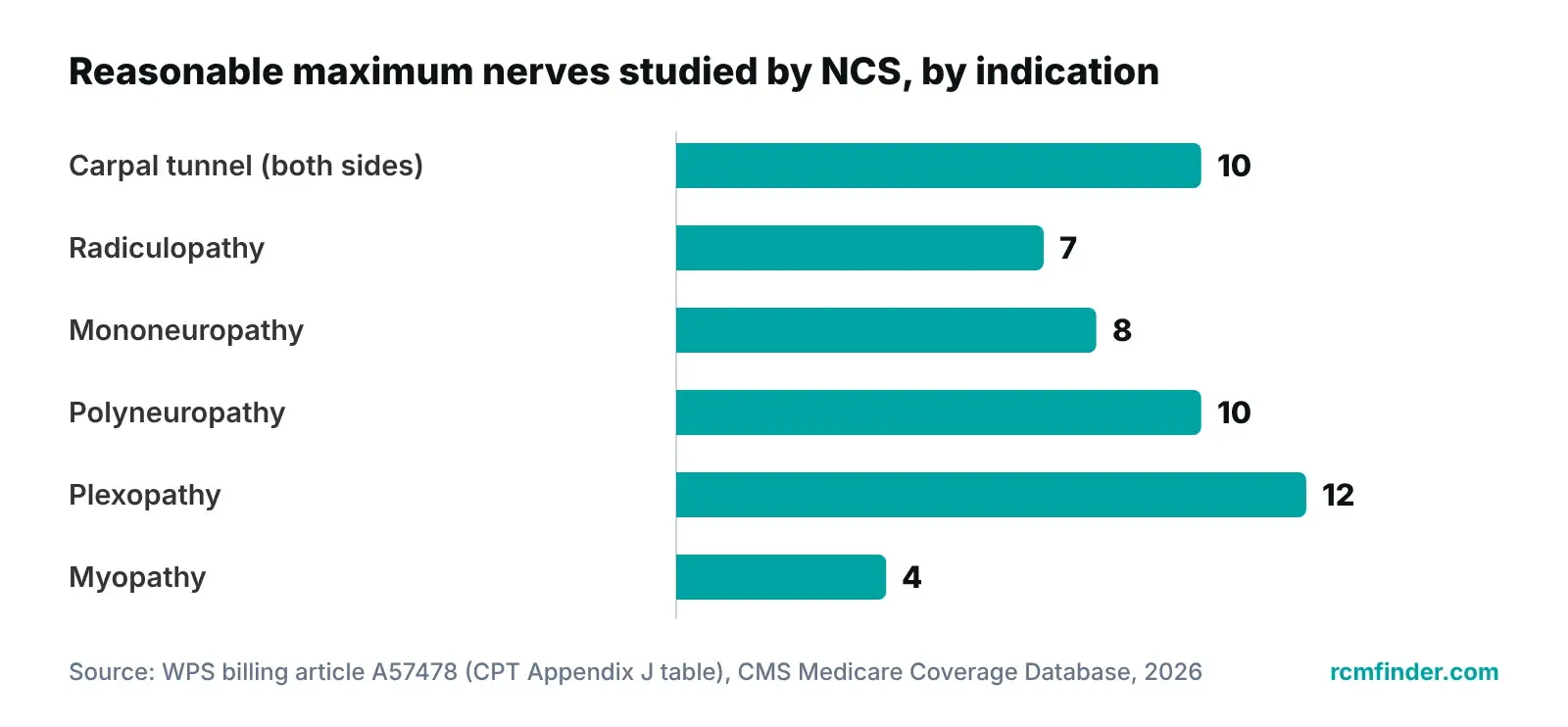
Bar chart of the maximum nerves studied by nerve conduction testing that WPS treats as reasonable, by diagnosis
Nerve counts WPS article A57478 treats as a reasonable maximum for 90% of patients. Other MACs may differ.

Nerve conduction studies and needle EMG

Under WPS A57478, sensory, motor and H-reflex testing on one nerve are separate studies, each counted once however many sites are stimulated. Standalone needle EMG codes apply only when no nerve study is done that day; with one, use 95885, 95886 or 95887. A separate office visit on the test day needs its own documentation and modifier 25 (see our modifier 25 vs 59 explainer). Testing beyond a diagnosis maximum, or testing an opposite limb without symptoms, needs added documentation.

Routine and long-term EEG

The National Association of Epilepsy Centers' guide to the 2020 code changes says routine EEG codes are not reported with the long-term set, which splits setup, technical monitoring and the professional read. Continuous real-time monitoring allows up to 4 patients at once; intermittent monitoring needs a documented review every 2 hours, with up to 12 patients.

Sleep testing

NCD 240.4.1 covers in-lab and several home test types for suspected obstructive sleep apnea when a treating practitioner orders them. WPS L36839 adds credentials for physicians, technologists and facilities, covers home testing only for likely moderate to severe OSA and only with a comprehensive sleep evaluation, and excludes chronic insomnia. The 2026 NCCI policy manual bars billing a sleep study and polysomnography for the same encounter. For diagnosis coding, see our guides to headache ICD-10 codes and obstructive sleep apnea ICD-10 coding.

Prior authorization for Botox, infusions and sleep studies

Start prior authorization at scheduling, and check the site of service first. For Original Medicare, Botox needs prior authorization only in a hospital outpatient department. Medicare Advantage and commercial plans keep their own lists.

CMS added botulinum toxin injections to its hospital outpatient prior authorization program on July 1, 2020. The CMS OPD FAQ says it applies only when J0585, J0586, J0587 or J0588 is billed with 64612 or 64615 in a hospital outpatient department, not an office or ASC. Physicians may submit for the hospital. If a request is not affirmed, related physician services are denied, and each tracking number covers one claim.

Chronic migraine criteria in the 2026 LCDs

New botulinum toxin LCDs took effect February 22, 2026, including WPS L39909 for Indiana and Michigan, Wellpoint L39832 and Noridian L35170. A first injection needs 15 or more headache days a month, 8 or more migraine days lasting 4 hours or more, symptoms for at least 3 months, and 2-month trials from two preventive drug classes (or a contraindication). Repeats need at least 50% fewer monthly migraine days and episodes, plus less disability, and no dose within 12 weeks of the last. In April 2026, several MACs released new draft LCDs, WPS among them, so check your contractor's current version.

Infused and injected drugs

CMS's JW and JZ modifier policy requires JW for the discarded amount of a single-dose container drug and JZ when nothing was discarded; claims without them may be returned as unprocessable. Since 2019, Medicare Advantage plans may apply step therapy to Part B drugs for new starts. Medicare covers anti-amyloid antibodies for Alzheimer's disease only under coverage with evidence development, with registry data due at the first treatment and every six months for up to 24 months. See our guide to infusion and IVIG billing.

Since January 1, 2026, CMS-0057-F has required Medicare Advantage, Medicaid and CHIP plans to decide expedited requests within 72 hours and standard ones within 7 calendar days, with a specific reason for any denial; drug requests are excluded. In KFF's January 2026 analysis, Medicare Advantage insurers denied 7.7% of 52.8 million prior authorization determinations in 2024; just 11.5% of denials were appealed, and 80.7% of appeals were overturned in part or in full. Our prior authorization guide covers the general process.

Pre-visit checklist: neurology payer rules our VMAs check before scheduling
Payer ruleSourceWhat the front desk or VMA checks
Hospital OPD Botox (J0585–J0588 with 64612 or 64615) needs Medicare prior authorization; offices and ASCs excludedCMS OPD program and FAQSite of service; for OPD cases, a tracking number for that claim
First chronic migraine injection: 15+ headache days, 8+ migraine days, 4+ hours, 3+ months; two drug classes triedWPS L39909; Wellpoint L39832; Noridian L35170Headache diary and drug trial history charted before booking
Repeat injection: 50%+ fewer migraine days and episodes; 12 weeks since the lastWPS L39909; Wellpoint L39832; Noridian L35170Last injection date; response on the baseline scale
Medicare Advantage may require step therapy for Part B drugs (new starts only)CMS fact sheet (2018); 42 CFR 422.136Plan's preferred-drug step; exception request if needed
Anti-amyloid antibodies: covered only under CED; data at first treatment, then every 6 monthsCMS CED page; NCD 200.3Registry enrollment confirmed; follow-up dates calendared
Home sleep test: likely moderate to severe OSA, done with a comprehensive sleep evaluationWPS L36839Evaluation note, order and comorbidity screen before the device ships

Sources: CMS OPD program page (2026) and FAQ (2024); WPS L39909, Wellpoint L39832 and Noridian L35170 (2026); WPS L36839 (2025); CMS step therapy fact sheet (2018) and 42 CFR 422.136; CMS CED page and NCD 200.3. Your MAC may differ.
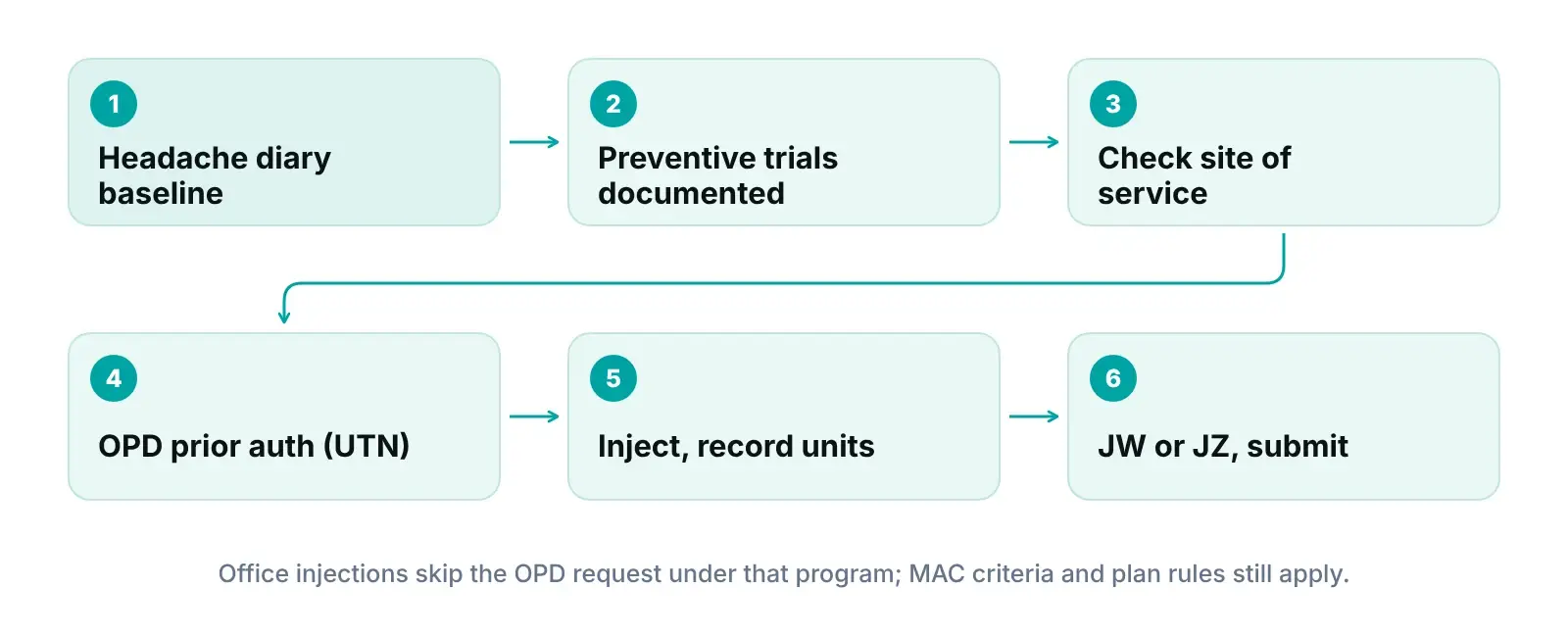
Flow diagram clearing a chronic migraine Botox injection from headache diary to prior authorization and claim submission
How a chronic migraine Botox visit is cleared before the injection and checked again before the claim goes out.

Estimate what denied tests and injections cost you

Model how denials and slow A/R affect a testing-heavy neurology practice, then bring the numbers to your audit.

Open the Revenue Calculator

Telehealth for neurology visits: Medicare rules through 2027

Medicare's telehealth flexibilities now run through December 31, 2027, according to CMS's telehealth FAQ updated February 26, 2026. Until then, beneficiaries can receive telehealth anywhere in the United States, including at home. From January 1, 2028, most non-behavioral telehealth again requires the patient to be in a medical facility in a rural area.

CMS says the extension applies retroactively to the lapse that began October 1, 2025. Bill POS 10 when the patient is at home and POS 02 when the patient is elsewhere; home telehealth has been paid at the non-facility rate since January 1, 2024. Under current law, audio-only visits to the home continue through the same date. Acute stroke care outlasts the flexibilities: 42 CFR 410.78 has exempted it from geographic limits since January 1, 2019, with no end date, and CMS's telehealth booklet (December 2025) says geographic limits do not apply to diagnosing and treating acute stroke and lists mobile stroke units as originating sites. See our telehealth billing guide.

In-house team, billing-only vendor or four-pillar partner?

Choose based on where claims break. If denials start with missing diaries or unapproved injections, a billing-only vendor sees them too late. If your front desk and documentation are strong, outsourced billing alone may be enough.

In-house team, billing-only vendor or four-pillar partner: who covers each neurology-practice task
QuestionIn-house teamBilling-only vendorFour-pillar partner
Who collects headache diaries before Botox?Clinical staff, between visitsUsually left to the practiceVirtual medical assistants, using billing's checklist
Who handles hospital OPD Botox and plan infusion authorizations?Your staff or the hospital'sDepends on the contractVMA team requests and logs each decision
Who checks NCS counts, EMG code family and EEG hours?Your coder, if neurology-experiencedVendor coders and scrubberRCM team plus portal completeness checks
Who connects referrals to paid claims?Rarely anyoneNot in scopeShared KPIs from referral to paid claim
Strongest fit whenStaff are trained and turnover is lowFront end is strong; you need claims work onlyGaps span scheduling, prior auth, billing and growth

If you need only one pillar, the audit will say so. Our revenue cycle management services and virtual medical assistant services can be contracted separately.

How it works

We start with a free audit, put a Business Associate Agreement in place, then take over the parts you choose inside your existing EHR.

  1. 1

    Free practice audit

    We review recent EMG, EEG, sleep, Botox and infusion claims, denial reasons and how they are booked. You get a prioritized fix list.

  2. 2

    BAA and access setup

    We put a Business Associate Agreement in place before accessing patient data, then set role-based access in your EHR (for example PrognoCIS, eClinicalWorks or athenahealth) and our portal.

  3. 3

    Payer-rule map

    We map your MAC's articles and main plans: study limits, EEG rules, Botox criteria and authorization lists.

  4. 4

    Front desk and billing go live

    Virtual medical assistants start pre-visit checks on your time zone. The RCM team codes, scrubs, submits and works denials and A/R.

  5. 5

    Weekly KPI review

    You see denial reasons, authorization turnaround, A/R days and underpayments each week, and we adjust rules where claims stall.

Talk through your neurology workflow

Call to walk through your test mix, your MAC and where claims stall. We will tell you which pillars you need.

Call +1 (302) 556-2288

Compliance: what to ask any neurology billing company

Any vendor that handles your claims is a HIPAA business associate and must sign a Business Associate Agreement before seeing patient data. Also ask how it limits access, logs activity and tracks LCD changes.

HHS guidance lists billing, claims processing and practice management as business associate work, and subcontractors need their own agreement. The minimum necessary standard limits each use to what the task needs. The Security Rule's technical safeguards cover access control, audit controls, integrity, person or entity authentication and transmission security. For your own side, use our HIPAA compliance checklist for medical practices.

Questions to ask before you sign

  1. Will you and your subcontractors sign a BAA before any access?
  2. Which MACs, LCDs and billing articles do you track, and how do you catch revisions?
  3. Do your coders hold a credential such as the CPC, and who reviews neurology coding?
  4. How do you count nerve conduction studies and check them against the diagnosis?
  5. Who requests hospital OPD Botox and plan infusion authorizations?
  6. Can we see an audit log of who accessed our claims?

For RCM Finder: role-based access, an audit log, encrypted (HTTPS) connections, and we put a Business Associate Agreement in place before accessing patient data.

Who this is for, and who it is not for

We would rather tell you now than after you sign. Here is where we fit and where we do not.

A good fit if you are

  • Neurology practices billing EMG, nerve studies, EEG and office visits
  • Headache practices giving Botox for chronic migraine
  • Groups with in-office infusion or sleep testing services
  • Combined pain management and neurology groups
  • Billing companies serving several neurology clients from one portal

Probably not a fit if you are

  • Hospital-employed neurologists whose billing the hospital controls
  • Practices that want a fixed price before any audit
  • Groups needing a credentialing module or in-portal real-time eligibility today (coming next)
  • Practices unwilling to give the team EHR access

Expert recommendations from our operations team

What we would do first if we were running your practice's revenue cycle tomorrow.

  1. 01

    Read your contractor's NCS and EMG article first

    Pull your MAC's billing article and its maximum-studies table. We set study-count checks from that document.

  2. 02

    Treat the headache diary as a billing document

    Botox coverage rests on headache days, migraine days and response on one scale. We collect diaries before injection visits.

  3. 03

    Confirm the site before the Botox request

    Hospital OPD injections need a Medicare tracking number; office injections do not under that program. We check the site, then the plan.

  4. 04

    Record units and wastage on every vial

    Document the dose given and amount discarded, then bill JW or JZ. We check each single-dose drug line.

  5. 05

    Match EEG codes to staffing

    Bill the monitoring level your technologist coverage supports, and log hours and video use. We flag claims where record and code disagree.

  6. 06

    Pair every home sleep test with an evaluation

    Under WPS rules, a home sleep test is covered only with a comprehensive sleep evaluation and for likely moderate to severe OSA without listed comorbidities. We screen before the device ships.

Frequently asked questions

What do neurology billing services include?

They cover coding support, claim scrubbing, submission, denial management and A/R follow-up for neurology visits and tests: nerve conduction studies and EMG, routine and long-term EEG, sleep testing, Botox injections and infused drugs. A good service also checks eligibility and payer criteria before the visit. RCM Finder adds front-desk staff, patient marketing and a claims portal, so the same rules apply from referral to payment.

How are nerve conduction studies and EMG billed on the same day?

Choose the nerve conduction code by the total number of studies, from 95907 for one or two up to 95913 for 13 or more. Each study type on each nerve counts once. When needle EMG is done the same day, use 95885, 95886 or 95887 instead of the standalone EMG codes. WPS also lists a reasonable maximum number of studies per diagnosis, and going over it needs added documentation.

Does Medicare require prior authorization for Botox for chronic migraine?

Only in one setting under the national program. Since July 1, 2020, CMS has required prior authorization for botulinum toxin injections in hospital outpatient departments when the drug is billed with 64612 or 64615. Offices and ASCs are outside that program. Coverage still depends on your MAC's LCD, such as 15 or more headache days a month and documented preventive drug trials. Medicare Advantage plans set their own rules.

Can neurologists still bill Medicare for telehealth visits to patients at home?

Yes, through December 31, 2027. CMS's February 2026 FAQ says beneficiaries can receive telehealth anywhere in the United States until then. Use POS 10 when the patient is at home and POS 02 elsewhere. From January 1, 2028, most non-behavioral telehealth again requires a medical facility in a rural area, although acute stroke care is exempt from geographic limits.

Why do neurology claims get denied?

Common triggers in Medicare articles include nerve studies above the diagnosis maximum without added notes, standalone EMG codes billed with a same-day nerve study, EEG codes that do not match recording time or monitoring, Botox without diary data or given sooner than 12 weeks, missing JW or JZ modifiers, and home sleep tests outside covered indications. Most can be caught before the visit or before the claim goes out.

Should we outsource neurology billing, and how is pricing set?

Outsource when denials, authorizations or A/R outrun your staff. Look for neurology coding experience, a signed BAA, MAC-specific rule tracking and reporting by denial reason. Our team works inside your existing EHR, for example PrognoCIS, eClinicalWorks or athenahealth, and we put a Business Associate Agreement in place before accessing patient data. Pricing depends on your test mix, claim volume and pillars, so we quote it after a free audit.

No cost, no commitment

Get your free practice audit

Tell us about your practice. A member of our operations team replies within one business day.

  • A review of your recent claims, denials and A/R aging
  • Where your front desk and prior authorizations slow payment
  • A prioritized fix list you keep, whether or not you hire us

Pricing is quoted after the audit, based on your volume and the services you choose. Prefer to talk? Call +1 (302) 556-2288.

Tell us about your practice

RCMFinder Master Intake Form
AA

About the author: Awais Afzal

Healthcare Operations & Data Analyst, RCM Finder

Awais has spent more than 16 years in healthcare digital marketing and clinical operations management. He builds data-driven revenue cycle blueprints for high-ticket medical practices and leads product development of the RCM Finder portal. More about our team.

How we write: every figure, code and rule on this page was checked against the primary source listed below and independently fact-checked before publishing. We re-review this page every six months. Last reviewed October 12, 2026; next review April 12, 2027.

Sources

  1. LCD L34594: Nerve Conduction Studies and Electromyography (WPS, J-05/J-08 incl. Indiana and Michigan) — CMS Medicare Coverage Database (2025 (revision effective 05/29/2025))
  2. Article A57478: Billing and Coding: Nerve Conduction Studies and Electromyography (WPS) — CMS Medicare Coverage Database (2026 (revision effective 10/01/2026))
  3. LCD L35897: Nerve Conduction Studies and Electromyography (CGS, J-15 Kentucky and Ohio) — CMS Medicare Coverage Database (2026 (revision effective 05/07/2026))
  4. RAC topic 0187: Nerve Conduction Studies: Excessive Units — CMS Recovery Audit Program (2020 (approved 09/08/2020))
  5. RAC topic 0191: Polysomnography: Medical Necessity and Documentation Requirements — CMS Recovery Audit Program (2020 (approved 09/08/2020))
  6. Medicare NCCI Policy Manual 2026, Chapter XI (Medicine) — CMS (2026)
  7. 2020 Coding Changes for Long-Term EEG/VEEG Services (webinar slides) — National Association of Epilepsy Centers (2019)
  8. LCD L36839: Polysomnography and Other Sleep Studies (WPS, J-05/J-08) — CMS Medicare Coverage Database (2025 (revision effective 06/26/2025))
  9. NCD 240.4.1: Sleep Testing for Obstructive Sleep Apnea (OSA) — CMS Medicare Coverage Database (2009 (effective 03/03/2009))
  10. Sleep Medicine Codes — American Academy of Sleep Medicine (2024 (updated 09/20/2024))
  11. LCD L39832: Botulinum Toxin Injections (Wellpoint Federal, J-06/J-K) — CMS Medicare Coverage Database (2026 (revision effective 02/22/2026))
  12. LCD L35170: Botulinum Toxin Injections (Noridian, J-E) — CMS Medicare Coverage Database (2026 (revision effective 02/22/2026))
  13. LCD L39909: Botulinum Toxin Injections (WPS, J-05/J-08 incl. Indiana and Michigan) — CMS Medicare Coverage Database (2026 (original effective 02/22/2026; revision effective 04/02/2026))
  14. Botulinum Toxin Injections Final LCD - Effective February 22, 2026 — Noridian Healthcare Solutions (2026)
  15. MACs Release Draft Local Coverage Determinations for Botulinum Toxin Injections — American Academy of Physical Medicine and Rehabilitation (2026 (April 3, 2026))
  16. AAN comment letter on WPS proposed LCD DL39909, Botulinum Toxin Injections — American Academy of Neurology (2026 (May 8, 2026))
  17. Updated Botulinum Toxin A Local Coverage Determination Policy — American Headache Society (2026 (February 22, 2026))
  18. Botulinum Toxin Injections (OPD prior authorization) — Noridian Healthcare Solutions (2026 (updated 02/23/2026))
  19. Prior Authorization for Certain Hospital Outpatient Department (OPD) Services — CMS (2026 (page modified 09/25/2026))
  20. OPD Prior Authorization Frequently Asked Questions — CMS (2024 (November 14, 2024))
  21. Discarded Drugs and Biologicals: JW Modifier and JZ Modifier Policy FAQs — CMS (undated (reflects CY 2026 rules; accessed 2026-10-09))
  22. Medicare Advantage Prior Authorization and Step Therapy for Part B Drugs (fact sheet) — CMS (2018 (August 7, 2018))
  23. 42 CFR 422.136 Medicare Advantage step therapy for Part B drugs — eCFR (current (accessed 2026-10-09))
  24. CMS Interoperability and Prior Authorization Final Rule (CMS-0057-F) fact sheet — CMS (2024 (January 17, 2024))
  25. Medicare Advantage Insurers Made Nearly 53 Million Prior Authorization Determinations in 2024 — KFF (2026 (January 28, 2026))
  26. Monoclonal Antibodies Directed Against Amyloid for the Treatment of Alzheimer's Disease (AD) — CMS Coverage with Evidence Development (2026 (page modified 03/10/2026))
  27. NCD 200.3: Monoclonal Antibodies Directed Against Amyloid for the Treatment of Alzheimer's Disease (AD) — CMS Medicare Coverage Database (2022 (effective 04/07/2022))
  28. Medicare Telehealth FAQ (updated 02/26/2026) — CMS (2026)
  29. Telehealth & Remote Patient Monitoring (MLN901705) — CMS Medicare Learning Network (2025 (December 2025))
  30. 42 CFR 410.78 Telehealth services — eCFR (current (accessed 2026-10-09))
  31. Use of Online Tracking Technologies by HIPAA Covered Entities and Business Associates — HHS Office for Civil Rights (2024 (reviewed June 26, 2024))
  32. Business Associates — HHS Office for Civil Rights (2026 (last reviewed July 30, 2026))
  33. Minimum Necessary Requirement — HHS Office for Civil Rights (2013 (content last reviewed July 26, 2013))
  34. 45 CFR 164.312 Technical safeguards — eCFR (current (accessed 2026-10-09))
  35. Coding and Billing for Needle Electromyography with and without Nerve Conduction Study — Vanderbilt University Medical Center, Department of Neurology (secondary) (undated (accessed 2026-10-09))
  36. CPT 95907 code summary — AAPC (secondary; plain-language code meaning only) (accessed 2026-10-09)
  37. CPT 95913 code summary — AAPC (secondary; plain-language code meaning only) (accessed 2026-10-09)
  38. CPT 95886 code summary — AAPC (secondary; plain-language code meaning only) (accessed 2026-10-09)
  39. CPT 95816 code summary — AAPC (secondary; plain-language code meaning only) (accessed 2026-10-09)
  40. CPT 95819 code summary — AAPC (secondary; plain-language code meaning only) (accessed 2026-10-09)
  41. CPT 95700 code summary — AAPC (secondary; plain-language code meaning only) (accessed 2026-10-09)
  42. HCPCS J0585 code summary — AAPC (secondary; plain-language code meaning only) (accessed 2026-10-09)
  43. CPT 95900 (deleted) and CPT 99201 (deleted) code pages — AAPC (secondary) (accessed 2026-10-09)