
Anesthesia Specialty

Anesthesia Billing Services for Anesthesiology Groups and CRNA Practices

Time units, medical direction modifiers, postoperative block claims and payer follow-up, built on Medicare rules and your own contracts, with pre-case checks and a claims portal.
  • Works inside your current EHR
  • US practice time zone, every shift
  • Weekly KPI reporting, or on your schedule
Anesthesia billing dashboard with cases by modifier, a concurrency log, denials by reason, A/R days and unbilled cases

Quick answer

Anesthesia billing services turn each anesthesia record into a payable claim: base units plus time units, the right pricing modifier for who performed or directed the case (AA, QY, QK, QX, QZ or AD), postoperative blocks billed only when allowed, and payer follow-up. RCM Finder adds pre-case coverage checks, facility-facing marketing and a claims portal.

Disclaimer: This page is educational and is not legal, coding or compliance advice. Medicare rules, contractor guidance, NCCI policies and commercial payer anesthesia policies change often and vary by contractor, plan and state. Verify every code, modifier, conversion factor and limit against your Medicare contractor's current documents, your payer contracts and the current CPT and HCPCS code sets before billing.

Why anesthesia billing is different

Anesthesia is paid on units and minutes, not a fixed fee per code. Each claim carries base units, minutes of anesthesia time and a modifier that says who performed or directed the case. One wrong modifier can halve a payment.

Under 42 CFR 414.46, Medicare pays base units plus time units, multiplied by an anesthesia conversion factor. Base units cover work other than time, such as usual pre- and post-operative visits. One time unit is 15 minutes, and no extra modifier units are allowed. Several procedures in one session use the highest base unit and the total time. CMS's billing instructions sit in section 50 of chapter 12 of its claims manual. For a primer, read our anesthesia billing guide.

The 2026 anesthesia conversion factor

CMS posted its 2026 conversion factor files on its Anesthesiologists Center page in December 2025; base units did not change. The American Society of Anesthesiologists' summary of the CY 2026 final rule (October 31, 2025) lists a national factor of $20.4976 for most clinicians and $20.5998 for qualifying APM participants, up from $20.3178 in 2025. Contractors adjust it by locality: Noridian's 2026 table lists $20.21 per unit for participating clinicians in Arizona and $21.74 in Seattle (King County).

An illustrative case: 5 base units and 72 minutes. 72 ÷ 15 = 4.8 time units, so 9.8 units in all. At Arizona's 2026 rate, the allowed amount is 9.8 × $20.21 = $198.06 if an anesthesiologist personally performs it. If the case is medically directed, the anesthesiologist and the CRNA are each allowed 50%, or $99.03.

Time is reported in minutes

Anesthesia time runs from when the practitioner starts preparing the patient until the patient can safely go to postoperative care. Claims carry actual minutes; Noridian turns 321 minutes into 21.4 time units. A break comes off the total, but continuous blocks on either side still count. The 2026 NCCI policy manual excludes recovery time. When two anesthesiologists share a case, Noridian expects one claim with all time combined.

The four pillars, built for an anesthesia group

An anesthesia group needs facilities and surgeons who trust it, complete case data, claims coded to the minute and the modifier, and software that shows where every case sits.

Revenue leaks at the handoffs: a face sheet with the wrong plan, a record without a stop time, a block billed when it was the anesthetic. We run all four pillars on one set of rules.

Pillar 1 · Healthcare Marketing

Healthcare Marketing for anesthesia groups

Anesthesia cases come from facilities and surgeons, not patient ads. Our healthcare digital marketing builds what facility leaders, surgeons and job candidates check: coverage pages, partner pages, recruiting pages and reputation work.

  • Facility and surgeon partner pages
  • Recruiting pages for CRNAs and anesthesiologists
  • Review replies that never confirm someone is a patient
  • KPI: partner inquiries and qualified applicants
Explore Healthcare Marketing
Pillar 2 · Virtual Medical Assistants

Virtual Medical Assistants for anesthesia pre-case work

Our virtual medical assistants for anesthesia groups work on your practice's time zone. Before cases, they check coverage, the surgery's authorization and network status. After cases, they chase missing records and answer patient billing calls.

  • Coverage and network status checked per scheduled case
  • Surgeon's authorization number noted on the case
  • Missing records chased with each facility
  • KPI: cases billed with complete records
Explore Virtual Medical Assistants
Pillar 3 · End-to-End RCM

End-to-End RCM for anesthesia claims

Our end-to-end anesthesia revenue cycle management covers charge entry, coding support, claim scrubbing, payment posting, denials and A/R follow-up, with extra checks on minutes, ratios, modifiers and block claims.

  • Minutes reconciled with the anesthesia record
  • Pricing modifier matched to the concurrency log
  • Block claims checked against NCCI rules
  • KPI: denials by reason and A/R days
Explore End-to-End RCM
Pillar 4 · Practice Management System

Practice Management System for anesthesia billing

Our practice management system tracks every case by claim stage, applies specialty-aware billing logic per claim, checks data completeness before submission and flags underpayments. Billing companies serving several groups get a client portal.

  • Workflow rules that hold a case missing times or NPIs
  • Underpayment flags against expected amounts
  • Role-based permissions and an audit log
  • Coming next: a provider credentialing module
Explore Practice Management System

Find where your anesthesia claims leak

We review recent cases, remittances and denials, then show where minutes, modifiers or block claims cost you.

Get a Free Practice Audit

Medical direction, modifiers and denial triggers

The pricing modifier tells the payer who did the work and how many cases the anesthesiologist directed at once. Medicare allows 100% for a personally performed case and 50% to each side of a directed one.

Pricing modifiers go first and informational ones second, per Noridian's modifier guidance. Codes are described in our own words; check the current code set and your contractor's guidance.

Anesthesia pricing modifiers, Medicare rules and denial triggers
Billing situationCode or modifier (our wording)Medicare ruleTypical denial or underpayment trigger
Anesthesiologist aloneAA100% of the allowancePricing modifier missing or not first
Anesthesiologist directs one CRNAQY with QX (CRNA)50% to each side; physician documents the seven 415.110 conditionsOne side not billed; no record of presence at induction and emergence
Two to four overlapping casesQK with QX (each CRNA)50% to each side; four cases at mostConcurrency not in the record; real ratio higher than billed
More than four overlapping casesAD (medical supervision)Three base units (42 CFR 414.46(f)), plus one time unit if presence at induction is documentedQK billed when the ratio was five or more
CRNA without medical directionQZ100%; paid to the CRNA or an employer, on assignment onlyQZ used while an anesthesiologist was directing
Monitored anesthesia careQS; G8 (deep or complex surgery); G9 (severe heart or lung history)Informational; reported after the pricing modifierInformational modifier first; need for MAC not documented
Physical statusP1 to P6Not used by Medicare; no modifier unitsPosting expects extra units Medicare does not pay
Sedation for a spine injection01992 (anesthesia for a block or injection another clinician performs, patient prone)LCDs treat sedation as rarely needed or not reasonableSame-day 01992 with facet, denervation or epidural procedures (RAC topic 0229)

Sources: eCFR 42 CFR 414.46, 414.60, 415.110 (2026); CMS claims manual ch. 12 s. 50 via Transmittal 3747 (2017); First Coast (2026); Noridian JF (2025, 2026); CMS RAC topic 0229 and NCCI manual ch. II (2026); AAPC (01992). Rules vary by payer.
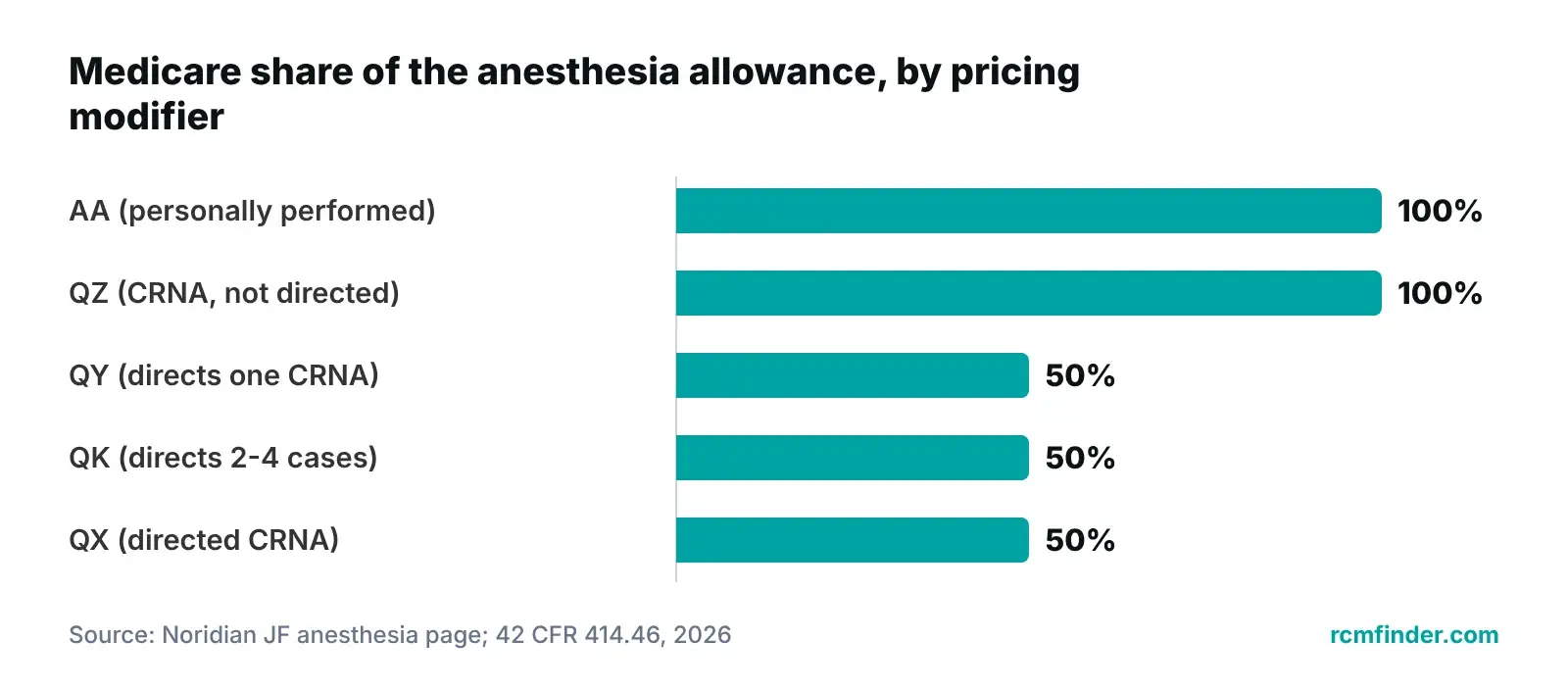
Bar chart of Medicare anesthesia payment share by pricing modifier: AA and QZ at 100%, QY, QK and QX at 50%
Medicare's allowed share by pricing modifier. AD uses a three-base-unit formula; commercial contracts differ.

The seven conditions for medical direction

Under 42 CFR 415.110, for each case the anesthesiologist must perform the pre-anesthetic exam, prescribe the anesthesia plan, take part in the most demanding parts (including induction and emergence when they apply), ensure a qualified individual does any part they do not, monitor at frequent intervals, stay physically present and available for emergencies, and provide indicated post-anesthesia care. Only the physician can document that these were met.

Concurrency decides the modifier

Concurrency is how many cases one anesthesiologist directs at once, and it sets QY, QK or AD. Noridian asks that records clearly show that number. For AD, Medicare adds one time unit when the physician documents presence at induction, per section 50 of the claims manual (CMS Transmittal 3747) and First Coast, a Medicare contractor. UnitedHealthcare's commercial policy does the same. A teaching anesthesiologist with one resident case, or two concurrent ones, is paid in full under 42 CFR 414.46(e).

Physical status modifiers are informational for Medicare

P1 to P6 describe the patient's physical status. Noridian lists them as not used by Medicare. UnitedHealthcare's 2026 commercial policy and the North Dakota Medicaid manual (January 2026) also treat them as informational. Code them accurately, but confirm each contract before expecting extra units.

What changes for CRNA practices

A CRNA working without medical direction bills QZ, which Noridian pays at 100%; UnitedHealthcare's commercial policy pays 85%. Under 42 CFR 414.60, Medicare pays the CRNA or an employer, on assignment only. 42 CFR 482.52 requires hospital CRNAs to be supervised by the operating practitioner or an immediately available anesthesiologist, unless the state's governor opted out. That is a hospital condition, not medical direction.

When postoperative pain blocks are billed separately

A postoperative pain block is billed separately only when the surgeon asked for pain help and the block was not the anesthetic. If it was the anesthetic, it is part of the anesthesia service.

The 2026 NCCI policy manual, chapter 2, sets the conditions. An epidural qualifies only under general anesthesia; a peripheral nerve block qualifies under general, spinal or epidural anesthesia. The intraoperative anesthesia must not depend on the block. A block is not separate when the mode was monitored anesthesia care, moderate sedation or a nerve block, and a block placed for intraoperative pain stays included. Append 59 or XU to the block code; a nerve block on the day of surgery needs its own procedure note.

Time matters too. Under the NCCI manual, separately reportable work done before anesthesia time starts or after it ends is not anesthesia time, and UnitedHealthcare's commercial policy does not add block placement time before induction or after emergence. For continuous epidural infusions, 01996 (daily management) is reported only on days after the catheter goes in, one unit per day.

CMS's April 2026 MLN booklet says to use 59 only when no more specific X modifier fits, never just to bypass an edit; see our explainer on modifiers 25 vs 59. Blocks often accompany joint and abdominal surgery, so we coordinate with the surgeon's billing; see our orthopedic billing services and general surgery billing services pages.

Checks to run before the case: coverage, authorization and network status

Catch problems before the patient reaches the operating room: coverage on the date of service, the surgery's authorization, network status and payer limits.

Anesthesia often rides on the surgeon's authorization. North Dakota Medicaid, for example, requires no separate authorization for anesthesia and matches out-of-state anesthesia claims to the surgical approval. Other plans set their own rules. Our prior authorization guide covers the general process, and our insurance verification guide covers eligibility.

Network status matters under the No Surprises Act. Under 45 CFR 149.420, anesthesiology is an ancillary service: for patients with group or individual coverage, an out-of-network anesthesia clinician at an in-network facility cannot use notice and consent to bill more than the plan's cost sharing. See our out-of-network billing guide.

Pre-case and pre-claim checklist for each anesthesia case
CheckWhy it mattersSourceWhat the VMA or biller does
Coverage on the date of serviceAnesthesia is not covered when the procedure is notNoridian JF (2026)Eligibility checked; plan matched to the face sheet
Surgery authorization on fileSome payers tie anesthesia to the surgical approvalNorth Dakota Medicaid (2026), exampleSurgeon's authorization number noted on the case
Network status at the facilityAncillary service: no notice-and-consent balance billing45 CFR 149.420Status recorded; patient billed no more than cost sharing
Screening or diagnostic colonoscopy00812 for screening; 00811 with PT when screening becomes diagnosticNoridian JF (2026)Visit type flagged; coding follows the final procedure
Sedation for a spine injectionLCDs: rarely needed or not reasonable; RAC 0229 denies same-day 01992Noridian (2025); CMS RAC 0229 (2026)Anesthesiologist documents need before booking
Labor epidural (01967) time caps435 minutes (UnitedHealthcare commercial) vs 75 (North Dakota Medicaid)UHC 2026R0032A; ND MedicaidEach payer's cap loaded into expected payments
Pre-anesthesia evaluationHospital rule: within 48 hours before surgery; medical direction needs the physician's exam42 CFR 482.52; 415.110Missing evaluation flagged before billing

Sources: Noridian JF (2025, 2026); North Dakota Medicaid manual (January 2026); UnitedHealthcare policy 2026R0032A; CMS RAC topic 0229 (2026); eCFR 45 CFR 149.420, 42 CFR 482.52 and 415.110. Check each member's current plan.
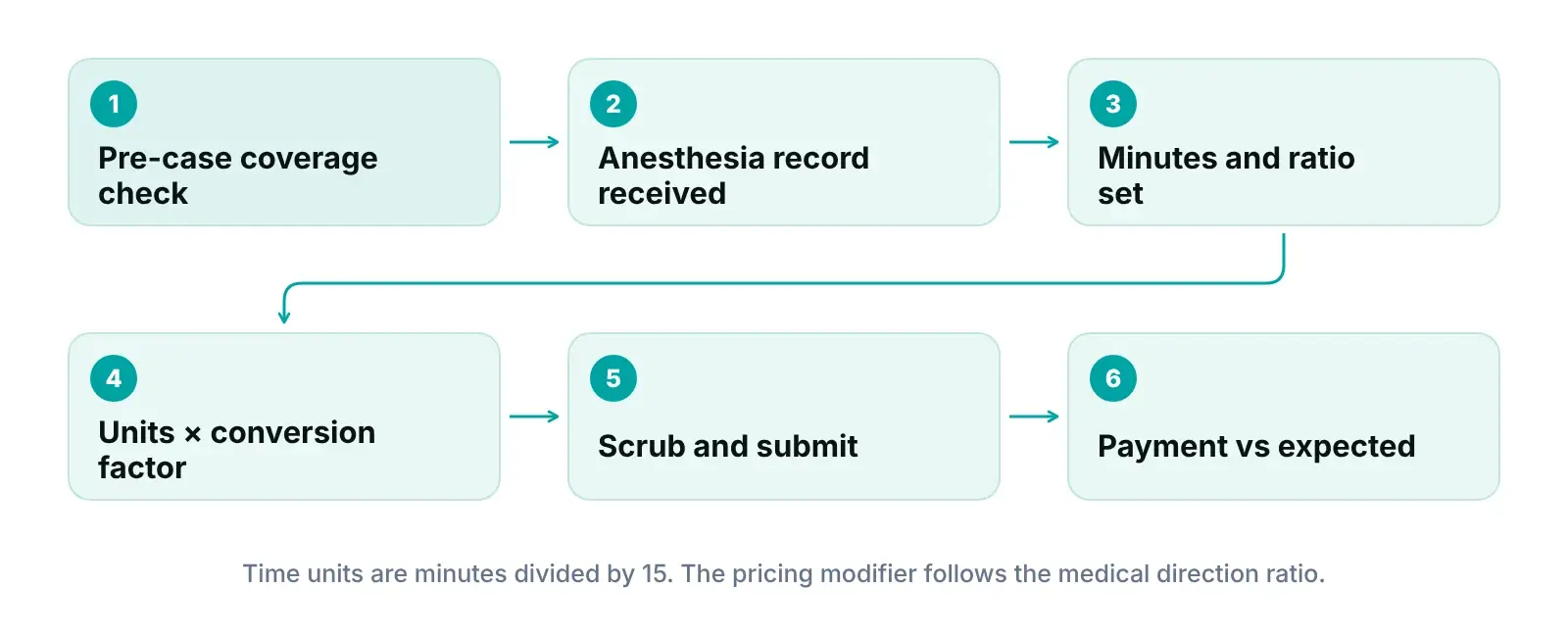
Diagram of an anesthesia case moving from pre-case checks to minutes, modifiers, unit math, submission and payment review
How one anesthesia case becomes a claim.

See what denials and underpayments cost you

Enter your volume and denial rate to estimate what your anesthesia group is losing.

Open the Revenue Calculator

In-house team, billing-only vendor or four-pillar partner?

Keep billing in-house if you have an experienced anesthesia coder and records arrive reliably from every facility. Use a billing-only vendor if claims are your only gap. Choose a combined partner when problems start before the case.

Decision table: which billing model fits an anesthesia group or CRNA practice?
JobIn-house teamBilling-only vendorFour-pillar partner (RCM Finder)
Pre-case coverage and network checksFacility front desks, if anyoneUsually left to the groupVMA checks each scheduled case
Collecting records from facilitiesStaff chase paper and portalsBills what the group sendsVMA chases gaps; portal holds incomplete cases
Minutes, ratios and pricing modifiersDepends on one experienced coderVendor coders, after the factChecked against the concurrency log before submission
Postoperative block claimsEasy to miss or over-billBilled if the record is clearRequest, mode of anesthesia and 59 or XU checked
Facility, surgeon and recruiting presenceRarely anyoneNot includedMarketing pillar for partners and recruits
Cost structureSalaries, benefits, turnoverVaries; ask how fees are setQuoted after a free practice audit

Whichever model you choose, track denials by reason and underpayments by payer, every month.

How it works

We start with a free audit and change nothing until you see the findings. We build our billing pipeline around how claims actually move through a practice: registration, charge entry, submission, payment and follow-up. For anesthesia, we add the time, ratio and modifier checks on this page.

  1. 1

    Free practice audit

    We compare recent cases, remittances and denials with your anesthesia records.

  2. 2

    Business Associate Agreement and access

    We put a Business Associate Agreement in place before accessing patient data. Then our team works inside your existing EHR (for example PrognoCIS, eClinicalWorks or athenahealth) and our portal.

  3. 3

    Payer and facility map

    We list each facility's face-sheet source and each contract's anesthesia terms: conversion factor, QZ rate, physical status and labor caps.

  4. 4

    Pre-case checks and billing go live

    VMAs check coverage and network status before cases. Claims are coded from the record, scrubbed, submitted and worked to payment.

  5. 5

    Weekly KPI review

    Each week we review denials by reason, A/R days, unbilled cases and underpayments, and adjust rules where cases stall.

Talk to us about your anesthesia group

Tell us your facilities, your CRNA model and your hardest payer. We will tell you honestly whether we fit.

Call +1 (302) 556-2288

Compliance: what to ask any anesthesia billing company

Any billing vendor that handles your patients' data is a HIPAA business associate. Get a Business Associate Agreement before any access, and ask how access is limited and logged.

HHS guidance names billing, claims processing and practice management as business associate work, and subcontractors need their own agreement. The minimum necessary standard limits use to what each task needs. The Security Rule's technical safeguards require access control, audit controls, integrity controls, person or entity authentication and transmission security.

Questions to ask before you sign

  1. Will you and your subcontractors sign a Business Associate Agreement before any access?
  2. How do you limit each person's access, and can we see the audit log?
  3. Who codes our cases, and what coding credential and anesthesia experience do they hold?
  4. How do you build the concurrency log and choose AA, QY, QK, QX, QZ or AD?
  5. How do you handle out-of-network cases under the No Surprises Act?
  6. Can we export our data if we leave?

We use role-based access, audit logging and encrypted (HTTPS) connections, and we put a Business Associate Agreement in place before accessing patient data. For your own side, use our HIPAA compliance checklist for medical practices.

Who this is for, and who it is not for

We would rather tell you now than after you sign. Here is where we fit and where we do not.

A good fit if you are

  • Anesthesiology groups covering hospitals, ASCs or office-based cases with CRNAs
  • CRNA practices billing under their own NPIs, with or without medical direction
  • Groups whose cases arrive from many facilities with incomplete records
  • Groups that bill postoperative blocks, labor epidurals or GI endoscopy anesthesia
  • Billing companies serving several anesthesia groups from one portal

Probably not a fit if you are

  • Hospital-employed anesthesia staff whose billing the hospital controls
  • Groups unwilling to share anesthesia records and face sheets
  • Practices looking for promised collection rates; we report measured KPIs instead
  • Groups that need a credentialing module in the portal today (coming next, not live)

Expert recommendations from our operations team

What we would do first if we were running your practice's revenue cycle tomorrow.

  1. 01

    Build the concurrency log first

    Before we touch a denial, we line up each anesthesiologist's overlapping cases by the minute. That log decides QY, QK or AD, and reviewers ask for it first.

  2. 02

    Put medical direction into the record template

    Only the physician can document the seven conditions. We ask groups to add induction, emergence and availability fields to the record, so the attestation is never an afterthought.

  3. 03

    Report minutes, never rounded units

    Payers convert minutes themselves. We reconcile start and stop times with the record, so the claim's minutes match the chart.

  4. 04

    Decide the block claim before the case closes

    We check the surgeon's request, the mode of anesthesia and a separate block note. If any is missing, the block stays inside the anesthesia service.

  5. 05

    Load each contract's anesthesia terms

    Conversion factor, QZ rate, physical status handling and labor caps differ by payer. We load them into expected-payment rules so underpayments surface at posting.

  6. 06

    Treat sedation for spine injections as the exception

    When a pain physician asks for sedation on a facet or epidural case, the anesthesiologist documents the need before booking.

Frequently asked questions

What do anesthesia billing services include?

They cover charge entry from the anesthesia record, coding, claim scrubbing, submission, payment posting, denial management and A/R follow-up. For anesthesia, that also means converting minutes to time units, choosing the right pricing modifier for who performed or directed each case, and billing postoperative blocks only when the rules allow. RCM Finder adds pre-case coverage checks, facility-facing marketing and a claims portal.

How does Medicare calculate payment for an anesthesia claim?

Medicare adds the procedure's base units to the time units, then multiplies the total by an anesthesia conversion factor adjusted for your locality. One time unit is 15 minutes, and claims report actual minutes. The ASA's summary of the 2026 final rule lists a national anesthesia conversion factor of $20.4976 for most clinicians. In a medically directed case, each side is allowed 50%.

What is the difference between medical direction and medical supervision?

Medical direction means an anesthesiologist meets seven conditions in 42 CFR 415.110, including the pre-anesthetic exam, presence at induction and emergence, and staying available for emergencies, for one case or up to four concurrent cases. The anesthesiologist bills QY or QK and the CRNA bills QX, each allowed 50% by Medicare. Directing more than four cases at once is medical supervision (AD), paid on three base units, plus one time unit if the physician documents presence at induction.

Can a CRNA bill Medicare without an anesthesiologist?

Yes. A CRNA who is not medically directed bills with modifier QZ, and Medicare allows 100% of the fee schedule amount, the same share as an anesthesiologist working alone. Payment can go to the CRNA or to an employer such as a hospital, group or ASC, and only on assignment. Hospital rules still require CRNA supervision unless the state has opted out. Commercial rates can differ.

Can we bill a nerve block for postoperative pain separately?

Sometimes. Under the 2026 NCCI policy manual, a block for postoperative pain is separately reportable when the surgeon asks for pain help and the block was not the anesthetic. An epidural qualifies only with general anesthesia; a peripheral nerve block qualifies with general, spinal or epidural anesthesia. Add modifier 59 or XU to the block code and keep a separate procedure note.

Does Medicare pay extra for physical status modifiers like P3 or P4?

No. Noridian lists P1 to P6 as not used by Medicare, and the federal anesthesia payment rule allows no modifier units. UnitedHealthcare's 2026 commercial policy also treats them as informational, and North Dakota Medicaid says they do not affect payment. Report them accurately anyway, and check how each of your contracts treats them.

No cost, no commitment

Get your free practice audit

Tell us about your practice. A member of our operations team replies within one business day.

  • A review of your recent claims, denials and A/R aging
  • Where your front desk and prior authorizations slow payment
  • A prioritized fix list you keep, whether or not you hire us

Pricing is quoted after the audit, based on your volume and the services you choose. Prefer to talk? Call +1 (302) 556-2288.

Tell us about your practice

RCMFinder Master Intake Form
AA

About the author: Awais Afzal

Healthcare Operations & Data Analyst, RCM Finder

Awais has spent more than 16 years in healthcare digital marketing and clinical operations management. He builds data-driven revenue cycle blueprints for high-ticket medical practices and leads product development of the RCM Finder portal. More about our team.

How we write: every figure, code and rule on this page was checked against the primary source listed below and independently fact-checked before publishing. We re-review this page every six months. Last reviewed October 12, 2026; next review April 12, 2027.

Sources

  1. Medicare Claims Processing Manual, Chapter 12: Physicians/Nonphysician Practitioners (Rev. 13753, issued 05-07-26) — CMS (2026)
  2. Transmittal 3747: Payment for Moderate Sedation Services (revises Claims Processing Manual ch. 12, sections 50 and 140) — CMS (2017 (April 14, 2017; effective January 1, 2017))
  3. How anesthesia reimbursement is calculated — First Coast Service Options (Medicare contractor) (2026 (dated August 25, 2026))
  4. 42 CFR 414.46 Additional rules for payment of anesthesia services — eCFR (current (up to date as of 10/07/2026))
  5. 42 CFR 415.110 Conditions for payment: Medically directed anesthesia services — eCFR (current (up to date as of 10/06/2026))
  6. 42 CFR 414.60 Payment for the services of CRNAs — eCFR (current (up to date as of 9/25/2026))
  7. 42 CFR 482.52 Condition of participation: Anesthesia services — eCFR (current (up to date as of 10/05/2026))
  8. Anesthesiologists Center — CMS (accessed 2026-10-10 (2026 file updated 12/29/2025))
  9. Anesthesia and Pain Management (JF Part B) — Noridian Healthcare Solutions (Medicare contractor) (2026 (last updated July 28, 2026))
  10. Modifiers (JF Part B), anesthesia section — Noridian Healthcare Solutions (Medicare contractor) (2026 (last updated July 6, 2026))
  11. Anesthesia Conversion Factors (JF Part B) — Noridian Healthcare Solutions (Medicare contractor) (2026 (last updated July 17, 2026))
  12. CMS finalizes policies undermining anesthesia payments (Washington Alert) — American Society of Anesthesiologists (2025 (October 31, 2025))
  13. Medicare and Medicaid Programs; CY 2026 Payment Policies Under the Physician Fee Schedule (CMS-1832-F), 90 FR 49266 — Federal Register (CMS final rule) (2025 (published November 5, 2025))
  14. Medicare NCCI Policy Manual, Chapter II: Anesthesia Services (revision 1/1/2026) — CMS (2026)
  15. Medicare NCCI Policy Manual (2026 chapters) — CMS (2026 (effective January 1, 2026))
  16. Proper Use of Modifiers 59, XE, XP, XS & XU (MLN1783722) — CMS Medicare Learning Network (2026 (April 2026))
  17. Anesthesia Policy, Professional (Commercial and Individual Exchange Reimbursement Policy 2026R0032A) — UnitedHealthcare (2026 (version change 2/15/2026))
  18. Anesthesia Services, North Dakota Medicaid Billing and Policy Manual (updated January 2026) — North Dakota Health and Human Services (2026)
  19. 45 CFR 149.420 Preventing surprise medical bills for non-emergency services performed by nonparticipating providers at certain participating facilities — eCFR (current (up to date as of 10/07/2026))
  20. Inappropriate Anesthesia Services Billed During Spinal Pain Procedures — Noridian Healthcare Solutions (Medicare contractor) (2025 (updated December 8, 2025))
  21. RAC topic 0229: Anesthesia During Spine Pain Management Procedures — CMS Recovery Audit Program (2026 (dated 2026-07-15))
  22. Calendar Year (CY) 2027 Medicare Physician Fee Schedule Proposed Rule fact sheet — CMS (2026 (July 14, 2026))
  23. Business Associates — HHS Office for Civil Rights (2026 (content last reviewed July 30, 2026))
  24. Minimum Necessary Requirement — HHS Office for Civil Rights (2013 (content last reviewed July 26, 2013))
  25. 45 CFR 164.312 Technical safeguards — eCFR (current (up to date as of 10/07/2026))
  26. CPT 01992 code summary — AAPC (secondary; plain-language code meaning only) (accessed 2026-10-10)
  27. CPT 01967 code summary — AAPC (secondary; plain-language code meaning only) (accessed 2026-10-10)
  28. CPT 01996 code summary — AAPC (secondary; plain-language code meaning only) (accessed 2026-10-10)