
Rehabilitation Specialty

Physical Therapy Billing Services, Plus Occupational and Speech Therapy RCM

Timed units, plan-of-care certification, KX and assistant modifiers, and payer visit limits handled for PT, OT and SLP practices, with front-desk help, patient marketing and a claims portal.
  • Works inside your current EHR
  • US practice time zone, every shift
  • Weekly KPI reporting, or on your schedule
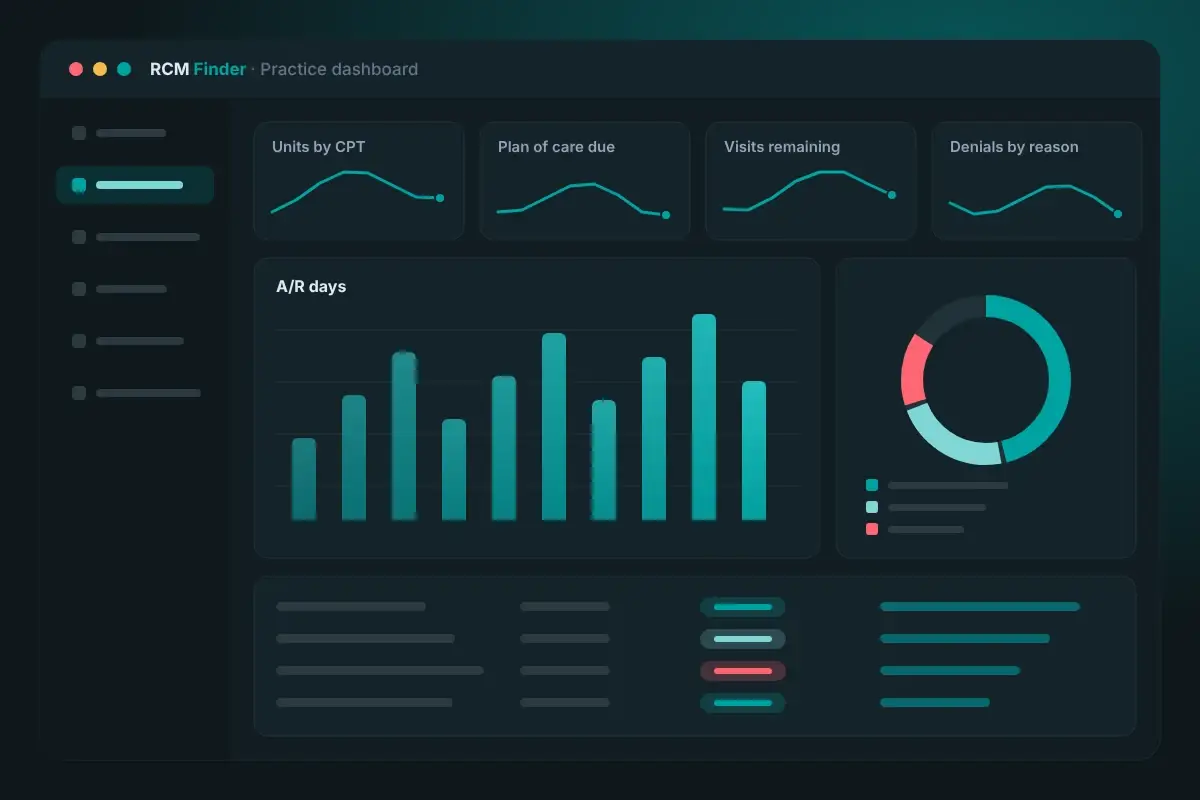
Physical therapy billing dashboard showing units by CPT code, plan of care due dates, visits remaining, denials and A/R days

Quick answer

Physical therapy billing services turn each visit into a correct claim: timed units counted from total minutes, GP, GO or GN modifiers, KX and assistant modifiers when they apply, and a certified plan of care behind every claim. Occupational and speech therapy follow similar rules. RCM Finder adds front-desk assistants, marketing and a claims portal.

Disclaimer: This page is educational and is not legal, coding or compliance advice. Medicare manuals, contractor policies, fee schedule rules and commercial and Medicare Advantage plan policies change often and vary by contractor, state and plan. Verify every code, modifier, threshold and rule against current CMS documents, your Medicare contractor’s guidance, your payer contracts, state law and the current CPT and HCPCS code sets before billing.

Why physical therapy billing is different

Therapy billing is different because payment depends on minutes, plans and thresholds, not only on the visit. A claim can be coded correctly and still be denied because the plan of care was never certified or the units do not match the documented minutes.

Medicare’s rules are a useful baseline. CMS’s MLN905365 fact sheet (May 2022) says every outpatient therapy claim needs a GP, GO or GN modifier and documentation of total timed minutes for each date. Commercial and Medicare Advantage plans add visit limits and prior authorization.

  • Minutes. Units on timed codes come from total timed minutes for the day, not from the number of exercises.
  • Paper. A physician or nonphysician practitioner must certify the plan of care.
  • Limits. Medicare has a KX threshold. Other plans cap visits or ask for approval of the whole plan of care.

If your practice mainly bills surgery or injections, our orthopedic billing and pain management billing pages fit better.

What changed for 2026 and what is proposed for 2027

The CMS Therapy Services page (modified March 2026) lists the CY 2026 KX threshold at $2,480 for PT and speech-language pathology combined and $2,480 for OT. It also says telehealth authority for PT, OT and SLP runs through December 31, 2027. Since 2025, CMS allows general supervision of assistants by therapists in private practice.

Therapy is paid under the fee schedule. The CY 2026 final rule set the non-qualifying conversion factor at $33.40. The CY 2027 proposal (July 14, 2026) projects $32.84. Check the final rule before you budget.

The four pillars, built for a rehabilitation practice

A therapy practice needs patients and referrers who find you, a front desk that tracks visits and signatures, billing that counts minutes correctly, and software that shows each claim. Revenue leaks at the handoffs, so we run all four on one set of payer rules.

Pillar 1 · Healthcare Marketing

Healthcare Marketing for therapy practices

Our healthcare digital marketing reaches patients searching for care, referring physicians, surgeons and employers, through local SEO, Google Ads and reputation work, with tracking kept off forms that collect health information.

  • Condition and service pages for direct-access patients
  • A referral page for physicians and surgeons
  • Review requests and replies that never confirm a patient
  • KPI: new evaluations booked by source
Explore Healthcare Marketing
Pillar 2 · Virtual Medical Assistants

Virtual Medical Assistants for therapy front desks

Our virtual medical assistants for therapy practices work on your practice’s time zone. They check benefits and visit limits, request authorizations, book evaluations and track the signature dates that Medicare needs.

  • Plan type, visit limit and visits used checked before the evaluation
  • Authorization dates and visit counts logged
  • Plan-of-care signature and recertification dates tracked
  • KPI: evaluations cleared before the first visit
Explore Virtual Medical Assistants
Pillar 3 · End-to-End RCM

End-to-End RCM for therapy claims

Our end-to-end rehabilitation revenue cycle management covers coding support, claim scrubbing, denial management and A/R follow-up, with extra checks for units, discipline modifiers, KX, CQ and CO, and NCCI pairs.

  • Units checked against total timed minutes
  • GP, GO and GN matched to the discipline
  • Assistant minutes checked before CQ or CO
  • KPI: denials by reason and A/R days
Explore End-to-End RCM
Pillar 4 · Practice Management System

Practice Management System for therapy billing

Our practice management system tracks every claim by stage, applies specialty-aware billing logic per claim, checks data completeness before submission and flags underpayments.

  • Claims tracked by stage, per claim
  • Workflow rules that flag claims missing a certifier or modifier
  • Client portal for practices and billing companies
  • Early access: appointment booking with a calendar view
Explore Practice Management System

Find where your therapy claims leak

We review recent claims, denials and authorization logs, then show what to fix first.

Get a Free Practice Audit

Therapy billing rules: codes, modifiers and denial triggers

Each therapy rule has a deadline, a threshold or a pairing limit. Codes are described in our own words (the AMA owns CPT descriptors); check the current code set and your Medicare contractor. For basics, see our physical therapy CPT codes guide and evaluation and treatment codes post.

Rehabilitation billing rules: code examples, the rule to know and typical denial triggers
TopicCode or modifier examples (our wording)Rule to knowTypical denial trigger
Timed treatment97110 (exercise); 97140 (manual therapy); 97530 (activities)Units follow total timed minutes: 8 to 22 is 1 unit, 23 to 37 is 2Units above documented minutes; no total timed minutes
Untimed and group97150 (group); supervised modalities 97010 to 97028Untimed codes bill 1 unit; supervised modalities may share a 15-minute periodGroup billed as individual; two timed services in the same 15 minutes
Evaluations and re-evaluationsPT 97161 to 97164; OT 97165 to 97168One evaluation or re-evaluation per date per practitioner; routine re-evaluations are not billableRe-evaluation billed to update the plan
Discipline modifierGP (PT); GO (OT); GN (speech)Required on listed therapy codesMissing or mismatched modifier
Medicare KX thresholdKXCY 2026: $2,480 for PT and SLP combined; $2,480 for OT. KX attests necessityKX added by habit, or missing above the threshold
Assistant servicesCQ (PT assistant); CO (OT assistant)Assistant furnishes over 10% of a service’s minutes; paid at 85%CQ without GP; CO without GO
Plan of careCertifier’s NPI on the claimCertify within 30 days; recertify every 90 days; progress report every 10 treatment daysUnsigned or late plan; no certifier on the claim
NCCI pairsModifiers 59, XU, XSOnly with documented separate intervals or sites; indicator 0 edits cannot be bypassed59 added with no documentation

Sources: Medicare Claims Processing Manual ch. 5 (§§10.7, 20.1, 20.2); CMS Therapy Services page (2026); CMS MLN905365 (2022); CMS CQ/CO billing examples (2026); CGS LCD L34049 fact sheet (2025–2026); Medicare NCCI Policy Manual ch. 1 and 11 (2026); AAPC code pages (plain-language meanings only). Rules vary by contractor and payer.

Timed codes, untimed codes and the 8-minute rule

The Medicare Claims Processing Manual, chapter 5 says an untimed code is billed as one unit. Timed codes follow a table: 8 to 22 total timed minutes is one unit, 23 to 37 is two, 38 to 52 is three. Minutes are summed across timed services for the day; three 7-minute services (21 minutes) support one unit. Time per intervention need not be in the note, but total timed minutes must be. Our billing units guide gives the general idea; use this table for Medicare and check each commercial payer’s method.
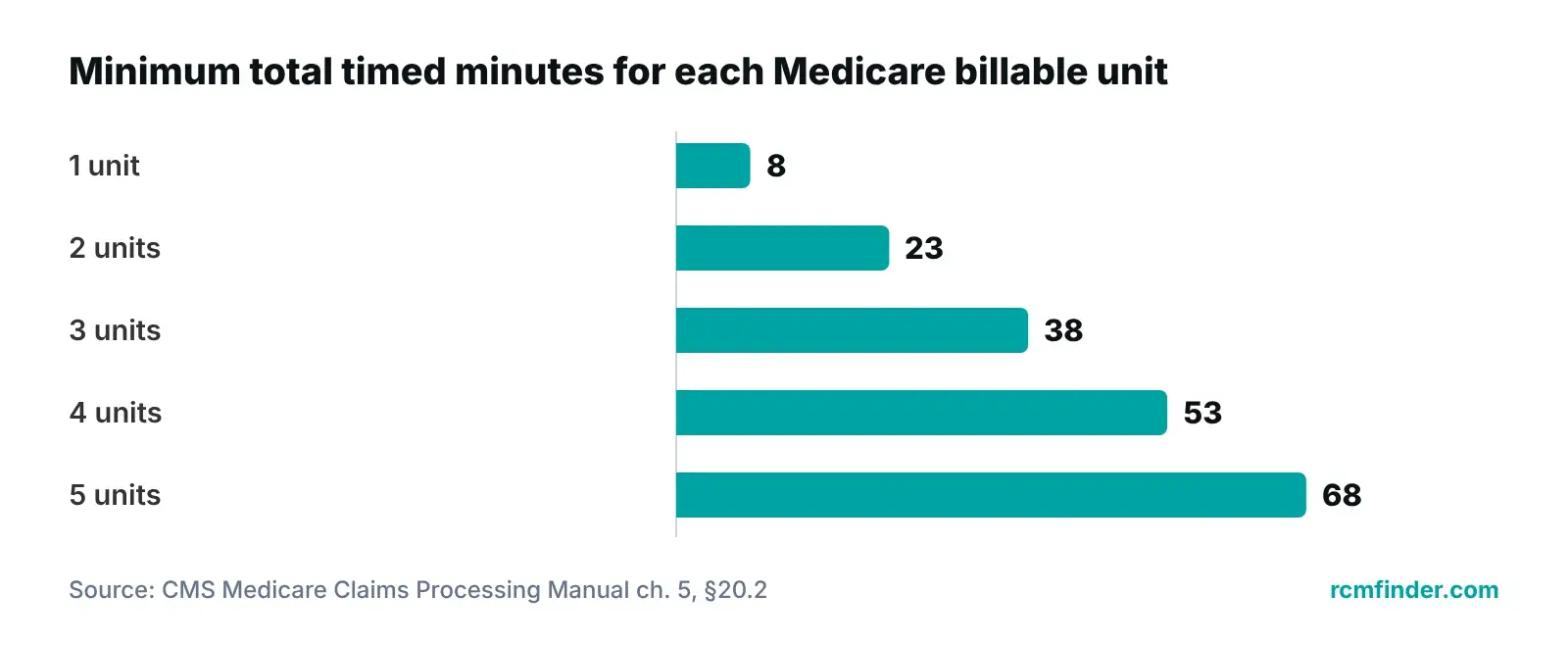
Bar chart of Medicare minimum total timed minutes needed for one to five billable units of 15-minute therapy codes
Medicare’s table: the smallest number of total timed minutes that supports each unit count.

The same chapter reduces the practice expense part of payment for multiple procedures: full work and malpractice payment, but 50% of practice expense for later units and services on the same day.

Discipline modifiers, the KX threshold and assistants

The manual requires GP, GO or GN on listed therapy codes, with CQ paired to GP and CO to GO. KX attests that services are reasonable, necessary and documented; the CMS Therapy Services page also sets a separate $3,000 targeted medical review threshold.

The CMS CQ/CO billing examples (February 2026) explain the test: full units an assistant furnished get CQ or CO, then the remainder does when the assistant’s share is above 10%. If the therapist gave 8 or more minutes of the final unit, it is billed without the modifier.

Plan of care, certification and progress reports

CMS’s MLN905365 lists the plan elements: diagnoses, long-term goals, service type, treatment, and its amount, frequency and duration. A physician or nonphysician practitioner certifies it with a dated signature within 30 days of the first treatment day, or signs a verbal order within 14 days. Recertify at least every 90 days; write a progress report at least every 10 treatment days. Noridian adds that recertification needs no visit and is not billable, while a re-evaluation is payable for a significant change.

CGS, the contractor for Kentucky and Ohio, summarizes LCD L34049: from January 1, 2025, a referral-based initial certification can be met by a signed, dated order plus one-time transmission of the plan to the referring provider within 30 days. Missing certification is a technical denial. Other contractors may differ.
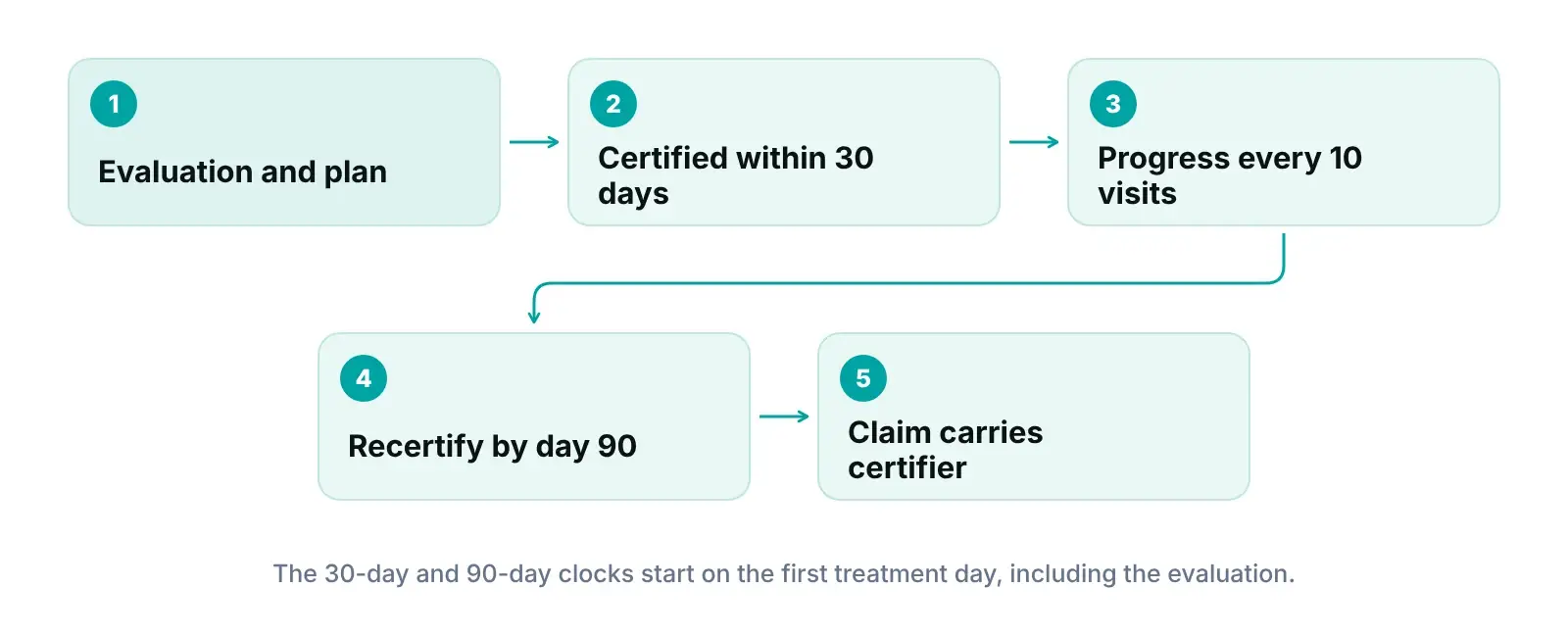
Diagram of Medicare therapy plan of care steps from evaluation and certification to progress reports and recertification
How a Medicare therapy plan of care stays certified from the first visit.

Modifiers 59 and XU, and NCCI edits

The NCCI Policy Manual, chapter 1 (2026) calls modifier 59 a last resort and says X modifiers such as XU and XS should replace it where possible. A modifier cannot bypass an edit with indicator 0, and the record must support whichever modifier you use. In chapter 11, some PT and OT pairs can be bypassed with 59 or XU when the services occur in different timed intervals, and a routine re-evaluation is not reported. Our modifier 25 vs 59 guide covers the general rule.

Occupational and speech therapy differences

Chapter 11 bars one speech-language pathologist from billing 92507 or 92508 on the same date as 97129, 97130 or 97533, and says SLPs do not bill 97110, 97112, 97150 or 97530. One practitioner reports one PT or OT evaluation per date. CMS defers to state licensure for who may furnish speech services. Under the Jimmo settlement, Medicare also covers skilled maintenance therapy, so “no progress” alone is not a valid denial.

Direct access, referrals and who must sign

Most states let patients see a physical therapist without a referral, but Medicare still needs a physician or nonphysician practitioner to certify the plan of care, and some plans have their own referral rules.

The American Physical Therapy Association’s September 2023 state summary says 48 states allow evaluation and treatment without a referral, unrestricted or with provisions; Alabama and Mississippi are limited. Provisions include visit or day limits, such as Georgia (21 days or 8 visits) and California (45 days or 12 visits). Georgia and New York require notice that a plan may not cover care without a referral. The summary does not address Medicare.

State law changes, so confirm yours. A patient may walk in, but Medicare still needs a certifier, and a commercial plan may ask for a referral anyway. Our VMAs record both before the first visit.

Visit limits, prior authorization, Medicare Advantage and self-pay

Check coverage before the evaluation, then again when visits run low. Rules differ by plan, state and benefit year.

For Medicare Advantage, CMS’s 2024 final rule fact sheet (April 2023) says plans must follow Medicare coverage criteria for basic benefits and keep approvals valid as long as treatment is reasonable and necessary. Coordinated care plans must give a 90-day transition to members switching plans mid-treatment. Since January 1, 2026, the CMS-0057-F rule requires Medicare Advantage, Medicaid and CHIP plans to decide urgent requests in 72 hours and standard ones in seven calendar days, with a specific reason for any denial.

Plans still set their own process. UnitedHealthcare’s January 2025 notice says its Medicare Advantage authorization for physical, occupational and speech therapy covers the entire plan of care. The first 6 visits within 8 weeks skip clinical review for members new to the office, with a new condition or a gap of 90 or more days, and evaluations need no authorization. Other payers differ.

For commercial plans, the essential health benefits rule (45 CFR 156.115) says plans must not set habilitative limits less favorable than rehabilitative limits, and must not combine the two. Ask each plan how it counts visits, evaluations and each discipline. For the general approval workflow, read our prior authorization guide for providers.

Pre-visit checklist: coverage, authorization and signature checks our VMAs make for therapy patients
CheckWhy it matters (source)What the VMA records
Plan typeMedicare Advantage plans may require prior authorization (UnitedHealthcare example)Plan type and its rule
Visit limit and visits usedPlans may cap visits; the federal essential health benefits rule bars combined habilitative and rehabilitative limitsLimit, visits used, benefit year start
AuthorizationUnitedHealthcare’s MA notice covers the whole plan of care; first 6 visits in 8 weeks skip clinical reviewRequest date, approved visits, expiry, due date
Referral or direct accessState rules vary; some require notice that a plan may not pay without a referral (APTA, 2023)State; referral or notice on file
Medicare certifierA physician or nonphysician practitioner certifies; the NPI goes on the claim (Manual ch. 5)Certifier and NPI; 30-day clock
KX statusCY 2026 KX threshold is $2,480 for PT and SLP combined, and $2,480 for OT (CMS)Year-to-date amount from your eligibility source
Self-pay estimateSelf-pay patients scheduled 3+ business days ahead generally get a good faith estimate (CMS)Estimate given and filed

Sources: CMS Therapy Services page (2026); Medicare Claims Processing Manual ch. 5; APTA direct access summary (2023); UnitedHealthcare provider notice (January 2025); 45 CFR 156.115 (current 2026); CMS No Surprises Act consumer page (2026). Always check the member’s current plan.

Self-pay and cash-pay patients

Self-pay patients sit outside payer rules but still need clear pricing. CMS’s No Surprises Act page says uninsured and self-pay patients generally get a good faith estimate when they ask or schedule care at least 3 business days ahead, and may dispute a bill at least $400 above it. For Medicare patients likely to pass the threshold, CGS encourages an Advance Beneficiary Notice; see our ABN guide.

See what denials and missed visits cost you

Enter your claim volume and denial rate to estimate what your therapy practice is losing.

Open the Revenue Calculator

Growing a therapy practice through patients and referrers

Therapy growth comes from patients searching for care and from physicians, surgeons and employers who refer. Your site still has to respect HIPAA.

We build condition and service pages, a plain referral page for physicians, and review requests that never confirm anyone is a patient. See our physical therapy practice growth guide and healthcare SEO guide. HHS guidance on online tracking says tools on appointment pages may collect protected health information and vendors that handle it need a Business Associate Agreement. A 2024 court order vacated part of that guidance; we still keep tracking off forms unless the vendor signs a BAA.

  • Patient KPIs: new-evaluation calls by source; evaluations booked and attended.
  • Referral KPIs: referrals by physician or employer; days from referral to first visit.

In-house team, billing-only vendor or four-pillar partner?

Stay in-house if your staff already count minutes and track signatures well. Use a billing-only vendor if claims are your only gap. Choose a combined partner when problems start at the front desk and end as denials.

Decision table: which model fits a rehabilitation practice?
JobIn-house teamBilling-only vendorFour-pillar partner (RCM Finder)
Timed units from total minutesRounded by habitCoded from the note after the visitChecked against documented minutes
Plan-of-care signaturesWhoever remembersOften left to the practiceVMA tracks the due dates
Visit limits and authorizationsFront desk, between callsNot includedVMA checks and logs before the evaluation
Assistant services (CQ, CO)Depends on the notesBilled as reportedAssistant minutes checked first
Patient and referral growthA separate agency, or nobodyNot includedMarketing tied to booked evaluations
Cost structureSalaries, benefits, turnoverVaries; ask how fees are setQuoted after a free practice audit

How it works

We start with a free audit and change nothing until you see the findings. We build our billing pipeline around how claims actually move through a practice: registration, charge entry, submission, payment and follow-up. For rehabilitation, we add the checks on this page.

  1. 1

    Free practice audit

    We review recent therapy claims, denials, authorization logs and plan-of-care dates.

  2. 2

    Business Associate Agreement and access

    We put a Business Associate Agreement in place before accessing patient data. Then we work inside your existing EHR (for example PrognoCIS, eClinicalWorks or athenahealth).

  3. 3

    Payer-rule map

    Your main plans and your Medicare contractor’s guidance become a pre-visit checklist and portal rules.

  4. 4

    Front desk and billing go live

    VMAs check coverage, request approvals and track signatures. Claims are scrubbed, submitted and worked through denials and A/R.

  5. 5

    Weekly KPI review

    We review denials by reason, A/R days, visits per authorization and plan-of-care deadlines.

Talk to us about your therapy practice

Tell us your disciplines and your hardest plan. We will tell you honestly whether we fit.

Call +1 (302) 556-2288

Compliance: what to ask any therapy billing company

Any billing vendor that handles patient data is a HIPAA business associate. Get a Business Associate Agreement before access, and ask how access is limited and logged.

HHS guidance lists billing and claims processing as business associate work, and says subcontractors need their own agreement. The minimum necessary standard limits each use to what the task needs. The Security Rule’s technical safeguards cover access control, audit controls, integrity, person or entity authentication and transmission security.

  1. Will you and your subcontractors sign a Business Associate Agreement before any access?
  2. How do you limit access, and can we see the audit log?
  3. What coding credential and therapy experience do your coders have?
  4. How do you calculate timed units, and where is the minutes check recorded?
  5. How do you track plan-of-care signatures, KX and assistant modifiers?
  6. Can we export our data if we leave?

We use role-based access, audit logging and encrypted (HTTPS) connections, and we put a Business Associate Agreement in place before accessing patient data. For your own side, use our HIPAA compliance checklist for medical practices.

Who this is for, and who it is not for

We would rather tell you now than after you sign. Here is where we fit and where we do not.

A good fit if you are

  • Outpatient physical, occupational and speech therapy practices billing Medicare, Medicare Advantage and commercial plans
  • Multi-location groups that struggle to track plan-of-care dates and authorizations
  • Practices that employ assistants and need CQ or CO billed correctly
  • Therapy owners who want front-desk help and patient marketing alongside billing
  • Billing companies serving therapy clients that want a shared claims portal

Probably not a fit if you are

  • Hospital- or facility-employed therapists whose employer controls billing
  • Practices that want claims billed without changing any front-desk step
  • Practices looking for promised collection rates; we report measured KPIs
  • Groups that need a credentialing module or in-portal real-time eligibility today (coming next)

Expert recommendations from our operations team

What we would do first if we were running your practice's revenue cycle tomorrow.

  1. 01

    Count total timed minutes first

    Units follow the day’s total timed minutes. We check each claim against them.

  2. 02

    Put the signature dates on a calendar

    The 30-day, 10-visit and 90-day marks are easy to miss. We track them from the evaluation.

  3. 03

    Ask for the whole plan of care, not a few visits

    We request the visits and weeks that match the plan, then log the expiry.

  4. 04

    Record assistant minutes by name

    CQ and CO depend on who gave how many minutes. We keep the split on the charge.

  5. 05

    Use 59 and XU only with a note behind them

    A modifier cannot rescue an undocumented pair. We check the intervals first.

  6. 06

    Check coverage again when visits run low

    Limits run out mid-plan. We flag the last approved visit before it is used.

Frequently asked questions

What do physical therapy billing services include?

They cover coding support, units from documented minutes, claim scrubbing, submission, denial management and A/R follow-up for therapy visits. A good partner also tracks plan-of-care signatures, authorizations and visit limits, and handles KX, CQ and CO. We add front-desk assistants, referral and patient marketing and a claims portal, so one team owns the process from the first call to payment, and we cover occupational and speech therapy the same way.

What is the 8-minute rule in physical therapy billing?

It is the common name for Medicare’s timed-unit table. In the Claims Processing Manual, 8 to 22 total timed minutes supports one unit, 23 to 37 supports two, and 38 to 52 supports three. Minutes are added across timed services for the day, and total timed minutes must be documented. Some commercial payers count units differently, so check each payer’s policy before applying the Medicare table.

When do I need the KX modifier?

For Medicare, the KX threshold for CY 2026 is $2,480 for PT and speech-language pathology combined and $2,480 for OT. Once a patient’s covered therapy passes it, claims need KX, which attests the services are reasonable, necessary and documented. Do not add KX automatically. Medicare also has a separate $3,000 targeted medical review threshold. Your Medicare contractor’s guidance may add detail.

How do CQ and CO modifiers change payment?

CQ marks physical therapy furnished in whole or part by a physical therapist assistant. CO does the same for an occupational therapy assistant. Under CMS’s 10% test, the modifier applies when the assistant furnishes more than 10% of a service’s minutes. Medicare pays 85% of the otherwise applicable amount for those services, applied after the multiple procedure reduction. CQ must pair with GP and CO with GO.

Does a patient need a referral for physical therapy?

It depends on the state and the payer. APTA’s September 2023 summary says 48 states allow evaluation and treatment without a referral, some with visit or day limits, while Alabama and Mississippi are limited. Medicare still requires a physician or nonphysician practitioner to certify the plan of care. Some commercial plans also want a referral, so verify the plan before the first visit.

Can a Medicare Advantage plan require prior authorization for therapy?

Yes. Plans can set their own approval process, while following Medicare coverage criteria for basic benefits. UnitedHealthcare’s January 2025 notice, for example, asks for authorization of the whole plan of care for physical, occupational and speech therapy, and lets the first 6 visits in 8 weeks skip clinical review. Since 2026, CMS-0057-F requires Medicare Advantage plans to decide urgent requests within 72 hours and standard ones within seven calendar days.

No cost, no commitment

Get your free practice audit

Tell us about your practice. A member of our operations team replies within one business day.

  • A review of your recent claims, denials and A/R aging
  • Where your front desk and prior authorizations slow payment
  • A prioritized fix list you keep, whether or not you hire us

Pricing is quoted after the audit, based on your volume and the services you choose. Prefer to talk? Call +1 (302) 556-2288.

Tell us about your practice

RCMFinder Master Intake Form
AA

About the author: Awais Afzal

Healthcare Operations & Data Analyst, RCM Finder

Awais has spent more than 16 years in healthcare digital marketing and clinical operations management. He builds data-driven revenue cycle blueprints for high-ticket medical practices and leads product development of the RCM Finder portal. More about our team.

How we write: every figure, code and rule on this page was checked against the primary source listed below and independently fact-checked before publishing. We re-review this page every six months. Last reviewed October 12, 2026; next review April 12, 2027.

Sources

  1. Therapy Services — CMS (2026 (page modified 03/10/2026))
  2. Medicare Claims Processing Manual, Chapter 5: Part B Outpatient Rehabilitation and CORF/OPT Services — CMS (Rev. 11129 (issued 11-22-21), as posted on CMS.gov)
  3. Complying with Outpatient Rehabilitation Therapy Documentation Requirements (MLN905365) — CMS Medicare Learning Network (2022 (May 2022))
  4. The Difference Between Outpatient Therapy Recertifications and Re-evaluations — Noridian Healthcare Solutions (Medicare contractor, JF Part B) (2026 (updated April 21, 2026))
  5. Outpatient Physical and Occupational Therapy Services: LCD L34049 fact sheet — CGS Administrators (Medicare contractor, J15 Kentucky and Ohio) (2025 (updated 2025-12-17; reviewed 2026-08-19))
  6. Billing Examples Using CQ/CO Modifiers for Services Furnished In Whole or In Part by PTAs and OTAs — CMS (2026 (page modified 02/26/2026))
  7. National Correct Coding Initiative Policy Manual for Medicare Services, Chapter 1 (2026) — CMS (2026 (effective January 1, 2026))
  8. National Correct Coding Initiative Policy Manual for Medicare Services, Chapter 11 (2026) — CMS (2026 (effective January 1, 2026))
  9. Medicare Physician Fee Schedule Final Rule Summary CY 2025 (MM13887) — CMS (2024)
  10. CY 2026 Medicare Physician Fee Schedule Final Rule (CMS-1832-F) fact sheet — CMS (2025 (October 31, 2025))
  11. CY 2027 Medicare Physician Fee Schedule Proposed Rule fact sheet — CMS (2026 (July 14, 2026))
  12. SLP Qualifications Clarified for Part B Outpatient Therapy Services — CMS (2026 (page modified 05/29/2026))
  13. Jimmo Settlement — CMS (undated (settlement approved January 24, 2013; accessed 2026-10-11))
  14. Direct Access by State — American Physical Therapy Association (2023 (September 2023))
  15. Prior authorization for outpatient therapy (Medicare Advantage) — UnitedHealthcare Provider (2025 (January 8, 2025))
  16. 2024 Medicare Advantage and Part D Final Rule (CMS-4201-F) fact sheet — CMS (2023 (April 5, 2023))
  17. CMS Interoperability and Prior Authorization Final Rule (CMS-0057-F) fact sheet — CMS (2024 (January 17, 2024))
  18. 45 CFR 156.115 Provision of essential health benefits — eCFR (current (up to date as of 10/07/2026))
  19. Understanding costs in advance (good faith estimates) — CMS No Surprises Act (2026 (page modified 10/05/2026))
  20. Use of Online Tracking Technologies by HIPAA Covered Entities and Business Associates — HHS Office for Civil Rights (2024 (content last reviewed June 26, 2024))
  21. Business Associates — HHS Office for Civil Rights (undated (accessed 2026-10-11))
  22. Minimum Necessary Requirement — HHS Office for Civil Rights (undated (accessed 2026-10-11))
  23. 45 CFR 164.312 Technical safeguards — eCFR (current (up to date as of 10/07/2026))
  24. CPT 97110 code summary — AAPC (secondary; used for plain-language code meaning only) (accessed 2026-10-11)
  25. CPT 97140 code summary — AAPC (secondary; used for plain-language code meaning only) (accessed 2026-10-11)
  26. CPT 97530 code summary — AAPC (secondary; used for plain-language code meaning only) (accessed 2026-10-11)
  27. CPT 97161 code summary — AAPC (secondary; used for plain-language code meaning only) (accessed 2026-10-11)
  28. CPT 97165 code summary — AAPC (secondary; used for plain-language code meaning only) (accessed 2026-10-11)
  29. CPT 92507 code summary — AAPC (secondary; used for plain-language code meaning only) (accessed 2026-10-11)