
Wellness visits, care management, house calls and nursing facility claims, plus Medicare Advantage, dual-eligible and hospice checks, patient marketing and a claims portal for geriatric practices.
By Awais Afzal | Healthcare Operations & Data Analyst
Published October 12, 2026 · Last reviewed October 12, 2026 · Next review April 12, 2027
Quick answer
Geriatric billing services manage the claims an older-adult practice creates: Annual Wellness Visits, cognitive assessments, advance care planning, home and nursing facility visits, monthly care management and post-discharge care. They also check Medicare Advantage, Medicaid and hospice status before each visit. RCM Finder adds front-desk assistants, marketing and a claims portal.
On this page
Geriatric billing is different because nearly every patient is on Medicare, much of the care happens outside the office, and many services are paid by the minute or the month. One missing time log, consent or plan check can sink a claim.
In KFF’s 2026 enrollment update (June 2026), 35.2 million of the 64.2 million people with Medicare Parts A and B (55%) were in Medicare Advantage. Of the nearly 8.2 million in special needs plans, 78% were in plans for people with both Medicare and Medicaid.
If most of your patients are working-age adults on commercial plans, our internal medicine billing and family practice billing pages fit better.
CMS’s CY 2026 Physician Fee Schedule final rule fact sheet (October 31, 2025) set the conversion factor at $33.40 for clinicians who are not qualifying APM participants, up from $32.35. Its -2.5% efficiency adjustment skips time-based services such as E/M visits and care management. CMS’s E/M services booklet (May 2026) allows the G2211 add-on with home or residence visits from January 1, 2026. For virtual visits, see our telehealth billing guide.
The CY 2027 proposed rule fact sheet (July 14, 2026) projects $32.84 for the same group, proposes advance care planning codes for clinical staff and would turn G2211 into a payment modifier. Check the final rule before budgeting.
A geriatric practice needs families and referrers who find you, a front desk that checks coverage and logs consents, billing that counts minutes and settings, and software that shows every claim.
Revenue leaks at handoffs, such as a late discharge call or a care management month with no consent. We run all four pillars on one set of payer rules.
Our healthcare digital marketing reaches older adults, their adult children and referring discharge planners through local SEO, Google Ads and reputation work, with tracking kept off forms that collect health information.
Our virtual medical assistants for geriatric practices work on your practice’s time zone. They confirm coverage before every visit, book wellness visits on eligible dates, make discharge calls and file care management consents.
Our end-to-end geriatric revenue cycle management covers coding support, claim scrubbing, denial management and A/R follow-up, with extra checks for place of service, same-day rules, modifier 33 and hospice modifiers.
Our practice management system tracks every claim by stage, applies specialty-aware billing logic per claim, checks data completeness before submission and flags underpayments.
Find where your geriatric claims leak
We review recent wellness, care management, home and facility claims and denials, then show what to fix first.
Each geriatric service family has its own timing, overlap or setting rule. Codes are described in our own words (the AMA owns CPT descriptors); check the current code set and your Medicare contractor before billing.
| Service family | Code examples (our wording) | Billing rule to know | Typical denial trigger |
|---|---|---|---|
| Annual Wellness Visit | G0438 (first AWV); G0439 (later AWVs) | Once in 12 months; not within 12 months of the IPPE; includes a cognitive check | Booked too early; billed as a routine physical, which Medicare does not cover |
| Cognitive assessment and care plan | 99483 | Independent historian present; billable with an AWV using modifier 25 | Same day as advance care planning, an office visit or a home visit |
| Advance care planning | 99497 (first 30 minutes); 99498 (each added 30) | From 16 minutes; voluntary; cost sharing waived with a same-day AWV by the same provider and modifier 33 | 15 minutes or less; no note of who attended or that it was voluntary |
| Home or residence visits | 99341, 99342, 99344, 99345 (new); 99347–99350 (established) | Homes, assisted living, group homes (POS 12, 13, 14); G0318 for prolonged time | Removed domiciliary codes (99324–99337); wrong place of service |
| Nursing facility visits | 99304–99306 (initial); 99307–99310 (subsequent); 99315, 99316 (discharge) | POS 31 for SNF Part A; POS 32 for nursing facility or SNF Part B; G0317 for prolonged time | Another same-day E/M with the initial visit; split or shared billing on nursing facility visits |
| Care management | 99490, 99491, 99487 (CCM); 99424–99427 (PCM); G0556–G0558 (APCM) | Documented consent; one practitioner per month; APCM is monthly, not timed | No consent on file; another office billed the month; time counted twice |
| Transitional care management | 99495 (visit within 14 days); 99496 (visit within 7 days) | Contact within 2 business days; medications reconciled by the visit; one practitioner per 30 days | Late visit; no contact attempts logged |
| Patients who elected hospice | Modifiers GV and GW | GV: attending physician not employed or paid under agreement by the hospice. GW: unrelated to the terminal condition | Hospice election missed at check-in |
Sources: CMS Annual Wellness Visit, Medicare Wellness Visits and Cognitive Assessment pages (2026); CMS MLN909289 and MLN006764 (2026); Medicare Claims Processing Manual ch. 12, §20.4.2; CMS MLN909188 and MLN908628 (2025); CMS APCM page (2026); Noridian (2025); AAPC. Rules vary by contractor and payer.
The CMS Annual Wellness Visit page allows G0438 or G0439 once in 12 months, never within 12 months of the IPPE, and every AWV includes a check for cognitive impairment. A separate problem visit that day takes modifier 25. Medicare does not cover routine physicals, per CMS’s wellness visits page; our ABN guide covers written notices.
The CMS cognitive assessment page describes 99483 as a full assessment and care plan, typically about 60 minutes with the patient and an independent historian. Per the CMS advance care planning fact sheet (March 2026), 99497 starts at 16 minutes and has no frequency limit. The deductible and coinsurance are waived once a year when it is billed with modifier 33 on the same claim as a same-day AWV by the same provider. See our palliative care CPT codes guide.
CMS’s E/M booklet confirms that since 2023 one home or residence code family covers homes, assisted living and group homes, replacing the domiciliary codes. Medicare’s own prolonged-time codes are G0318 at home and G0317 in a nursing facility. Skilled nursing facility (SNF) visits can be split or shared if they meet the rules; nursing facility visits cannot.
The Medicare Claims Processing Manual uses POS 31 for SNF Part A residents and POS 32 for nursing facility and SNF Part B residents. Under 42 CFR 483.30, a physician sees each resident at least every 30 days for the first 90 days, then every 60 days; in SNFs, later visits may alternate with an NP, PA or clinical nurse specialist.
The CMS chronic care management booklet (June 2025) requires two or more chronic conditions expected to last at least 12 months or until death; 99490 covers the first 20 minutes of clinical staff time in a month. Consent must be documented, and one practitioner bills CCM per month. Advanced Primary Care Management (G0556–G0558) pays monthly without counting minutes. See our chronic care management coding guide.
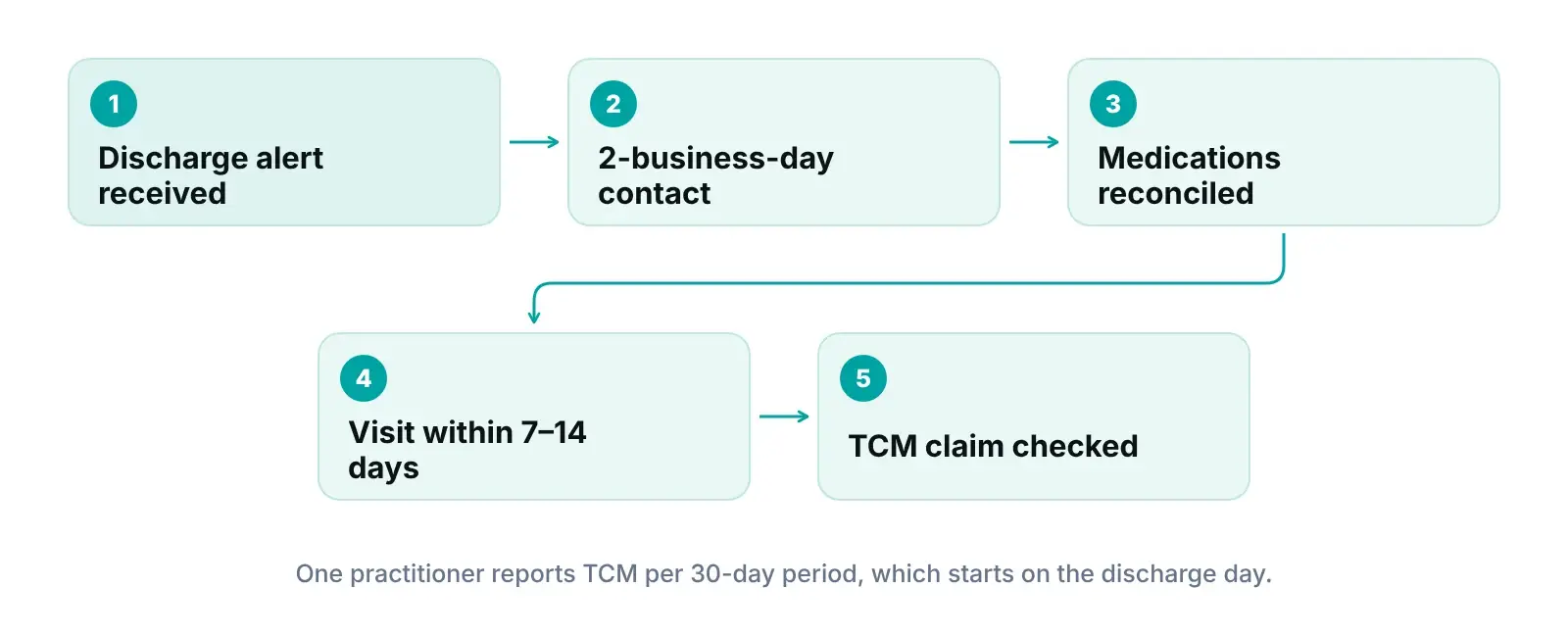
Transitional care management needs contact within 2 business days of discharge, per CMS’s transitional care management booklet (August 2025). The visit must happen within 14 days for 99495, or 7 days for the high-complexity 99496, with medications reconciled by then. One practitioner reports TCM per 30-day period.
A hospice election waives Part B payment for care of the terminal illness, except the attending physician’s professional services, per Chapter 11 of the Claims Processing Manual. Noridian, a Medicare contractor, uses GV for an attending physician not employed or paid under agreement by the hospice and GW for unrelated services; other contractors may differ. See our hospice modifiers GV and GW guide.
Check coverage at every visit, not once a year. Older adults switch plans, gain Medicaid or elect hospice, and each change moves who pays and what needs approval.
Medicare.gov explains the timing. Open Enrollment changes (October 15 to December 7) start January 1, and from January 1 to March 31 Medicare Advantage members can switch plans or return to Original Medicare.
CMS’s 2024 Medicare Advantage final rule fact sheet (April 2023) says plans must follow Original Medicare’s coverage decisions for basic benefits and keep approvals valid while treatment is medically necessary. Coordinated care plans must give members who switch plans mid-treatment at least 90 days before requiring new approval for that course. Since January 1, 2026, the CMS-0057-F rule has required MA, Medicaid and CHIP plans to decide standard requests within seven calendar days and expedited ones within 72 hours.
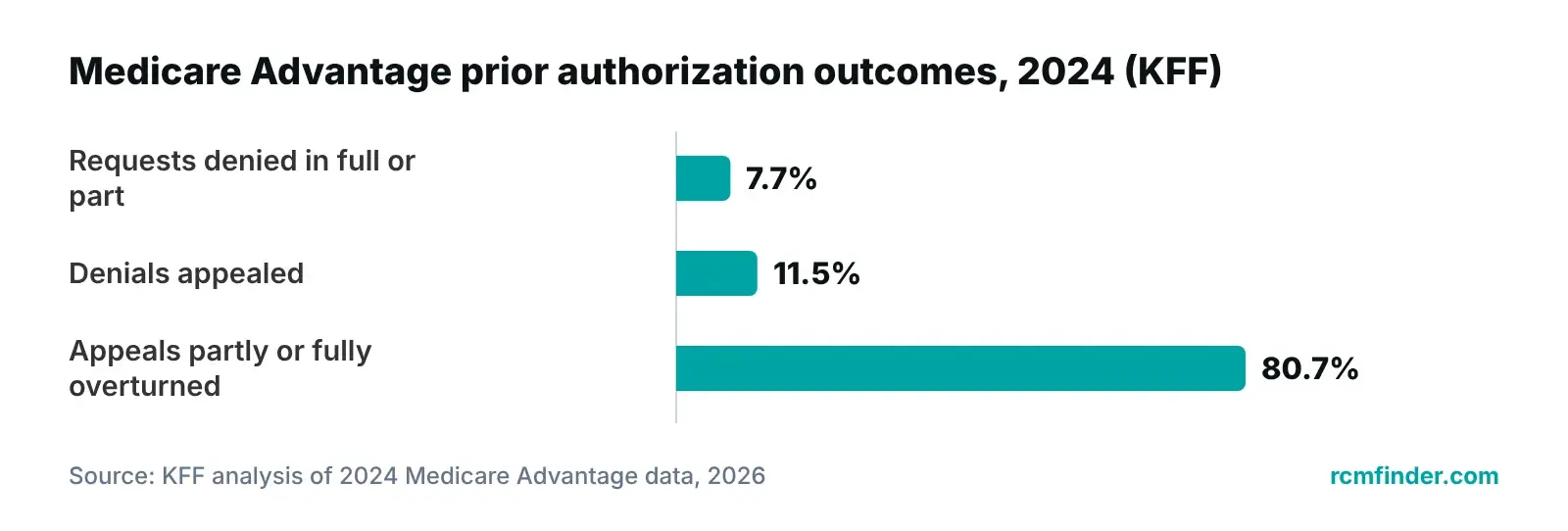
Denials are worth appealing. In KFF’s analysis of 2024 data (January 2026), MA insurers denied 7.7% of 52.8 million prior authorization determinations in full or in part. Only 11.5% of denials were appealed, and 80.7% of appeals were partly or fully overturned.
CMS’s QMB billing fact sheet (September 2025) says no Medicare or Medicare Advantage provider may bill a Qualified Medicare Beneficiary for Medicare deductibles, coinsurance or copayments, even when Medicaid pays nothing. You may bill the state Medicaid program, and nearly all states use an electronic crossover system.
When family members join the visit, HHS treats a person with a health care power of attorney as the patient’s personal representative. Our VMAs note who that is.
| Rule | Source | What the VMA checks before the visit |
|---|---|---|
| Open Enrollment changes start January 1; MA members can switch or leave January 1 to March 31 | Medicare.gov | Plan type re-checked at every visit, especially in the first quarter |
| MA plans follow Original Medicare coverage decisions; 90-day transition for new members in treatment | CMS-4201-F fact sheet (2023) | The plan’s approval list; plan start date |
| MA, Medicaid and CHIP plans decide in 72 hours (expedited) or 7 calendar days (standard) | CMS-0057-F; in effect January 1, 2026 | Request and due dates logged; follow-up on the due date |
| QMB patients may not be billed Medicare cost sharing | CMS MLN7936176 (2025) | QMB status flagged; statements held |
| CCM and APCM need documented consent; one practitioner bills per month | CMS MLN909188 (2025); CMS APCM page (2026) | Consent on file; patient asked whether another office manages their care |
| TCM needs contact within 2 business days of discharge | CMS MLN908628 (2025) | Discharge date, call attempts and contact recorded |
| Hospice election changes who pays for care of the terminal illness | Claims Processing Manual ch. 11 | Hospice election and attending physician noted |
Sources: Medicare.gov (2026); CMS-4201-F (2023) and CMS-0057-F (2024) fact sheets; CMS MLN7936176, MLN909188 and MLN908628 (2025); CMS APCM page (2026); Medicare Claims Processing Manual ch. 11. Always check the member’s current plan.
For the general approval workflow, read our prior authorization guide for providers.
See what missed visits and denials cost you
Enter your claim volume and denial rate to estimate what your geriatric practice is losing.
Geriatric growth comes from adult children searching for a doctor and from hospitals, facilities and home health agencies that refer. Tracking on your site still has to respect HIPAA.
We build pages for your house call areas and facilities, plain pages on wellness visits and memory concerns, and a referral path for discharge planners. Review replies never confirm anyone is a patient.
HHS guidance on online tracking says tools on appointment pages may collect protected health information, tracking vendors that handle that information need a Business Associate Agreement, and cookie banners are not HIPAA authorizations. A 2024 court order vacated part of that guidance; we still keep tracking off forms unless the vendor signs a BAA.
Stay in-house if your staff already track care management time, discharge calls and plan changes well. Use a billing-only vendor if claims are your only gap. Choose a combined partner when problems start at the front desk and end as denials.
| Job | In-house team | Billing-only vendor | Four-pillar partner (RCM Finder) |
|---|---|---|---|
| Coverage checks (MA, Medicaid, hospice) | Front desk, between calls | Often left to the practice | VMA checks before every visit |
| Care management time and consent | Nurse logs, often incomplete | Billed from what the practice reports | Claims held if time or consent is missing |
| Discharge calls for TCM | Whoever sees the alert | Not included | VMA logs contact within 2 business days |
| House call and facility charges | Paper notes, late entry | Coded after the fact | Checked by setting and place of service |
| Family and referral growth | A separate agency, or nobody | Not included | Marketing tied to booked first visits |
| Cost structure | Salaries, benefits, turnover | Varies; ask how fees are set | Quoted after a free practice audit |
We start with a free audit and change nothing until you see the findings. We build our billing pipeline around how claims actually move through a practice: registration, charge entry, submission, payment and follow-up. For geriatrics, we add the checks on this page.
We review recent wellness, care management, home and facility claims, denials and eligibility logs.
We put a Business Associate Agreement in place before accessing patient data. Then we work inside your existing EHR (for example PrognoCIS, eClinicalWorks or athenahealth).
Your main plans and your Medicare contractor’s guidance become a pre-visit checklist and portal rules.
VMAs check coverage, log consents and make discharge calls. Claims are scrubbed, submitted and worked through denials, crossovers and A/R.
We review denials by reason, A/R days, wellness visits and on-time discharge contacts.
Talk to us about your geriatric practice
Tell us where you see patients and your hardest plan. We will tell you honestly whether we fit.
Any billing vendor that handles your patients’ data is a HIPAA business associate. Get a Business Associate Agreement before access, and ask how access is limited and logged.
HHS guidance lists billing and claims processing as business associate work; subcontractors need their own agreement. The minimum necessary standard limits each use to what the task needs. The Security Rule’s technical safeguards cover access control, audit controls, integrity, person or entity authentication and transmission security.
We use role-based access, audit logging and encrypted (HTTPS) connections, and we put a Business Associate Agreement in place before accessing patient data. For your own side, use our HIPAA compliance checklist for medical practices.
We would rather tell you now than after you sign. Here is where we fit and where we do not.
A good fit if you are
Probably not a fit if you are
What we would do first if we were running your practice's revenue cycle tomorrow.
Plan type, Medicaid status and hospice election change mid-year. We re-check each one before every visit.
Transitional care management fails without timely contact. We build the call list from discharge alerts the day they arrive.
Care management claims need documented consent and time counted once. We keep both where billing can see them.
The AWV, cognitive assessment and advance care planning each have same-day limits. We decide what fits before the visit is booked.
Home, assisted living, SNF and nursing facility visits use different codes and places of service. We map each provider’s sites first.
We flag QMB patients so no statement goes out for Medicare cost sharing, and we follow the Medicaid crossover instead.
They cover coding support, claim scrubbing, submission, denial management and A/R follow-up for the services older adults use most: Annual Wellness Visits, cognitive assessments, advance care planning, home and nursing facility visits, care management and transitional care. A good partner also checks Medicare Advantage, Medicaid and hospice status before each visit. We add front-desk assistants, family-focused marketing and a claims portal, so one team owns the process from first call to payment.
Yes. CMS waives the patient’s deductible and coinsurance for advance care planning once a year when it happens on the same day, by the same provider, as a covered AWV and is billed with modifier 33 on the same claim. The first code needs at least 16 minutes. If the AWV is denied for falling inside the once-a-year limit, cost sharing applies to the planning service.
It can be billed with an Annual Wellness Visit using modifier 25. CMS lists services that cannot be billed on the same day as 99483, including office visits (99202–99215), home or residence visits (99341–99350) and advance care planning (99497, 99498). An independent historian must be present, and Part B cost sharing applies.
Since 2023, Medicare uses one family of home or residence codes for visits in a patient’s home, an assisted living facility, a group home or a custodial care facility. The old domiciliary and rest home codes were removed. Use the place of service that matches the setting, such as 12 for a home or 13 for assisted living, and G0318 for Medicare prolonged time.
For basic benefits, yes. CMS’s 2024 Medicare Advantage rule requires plans to follow Original Medicare’s national and local coverage decisions, and an approval must stay valid as long as the treatment is medically necessary. Since January 1, 2026, MA plans must decide standard prior authorization requests within seven calendar days and expedited ones within 72 hours. Plans still keep their own approval lists and networks, so check each plan.
No. CMS says no Medicare or Medicare Advantage provider may bill a Qualified Medicare Beneficiary for Medicare deductibles, coinsurance or copayments, even if Medicaid pays nothing and even if you do not accept Medicaid. The patient cannot choose to pay. You may bill the state Medicaid program, and nearly all states take part in an electronic crossover system.
Tell us about your practice. A member of our operations team replies within one business day.
Pricing is quoted after the audit, based on your volume and the services you choose. Prefer to talk? Call +1 (302) 556-2288.
Tell us about your practice
About the author: Awais Afzal
Healthcare Operations & Data Analyst, RCM Finder
Awais has spent more than 16 years in healthcare digital marketing and clinical operations management. He builds data-driven revenue cycle blueprints for high-ticket medical practices and leads product development of the RCM Finder portal. More about our team.
How we write: every figure, code and rule on this page was checked against the primary source listed below and independently fact-checked before publishing. We re-review this page every six months. Last reviewed October 12, 2026; next review April 12, 2027.
We use cookies to understand how our site is used and to measure our advertising. You can accept or reject non-essential cookies. See our Privacy Policy.