
Trained remote staff book, confirm and recall patients inside your EHR, and check eligibility and authorization before the visit is on the calendar.
By Awais Afzal | Healthcare Operations & Data Analyst
Published October 12, 2026 · Last reviewed October 12, 2026 · Next review April 12, 2027
Quick answer
Medical appointment scheduling services put trained remote staff in charge of your appointment book. Our virtual medical assistants book, confirm and recall patients inside your EHR, checking eligibility, prior authorization and referral requirements before a visit is final, so fewer slots go empty and fewer visits arrive unpaid.
On this page
An empty slot cannot be billed, and a booked visit with the wrong insurance or a missing authorization may not be paid. Scheduling is where both problems start, and it is usually squeezed between phones, check-ins and checkouts.
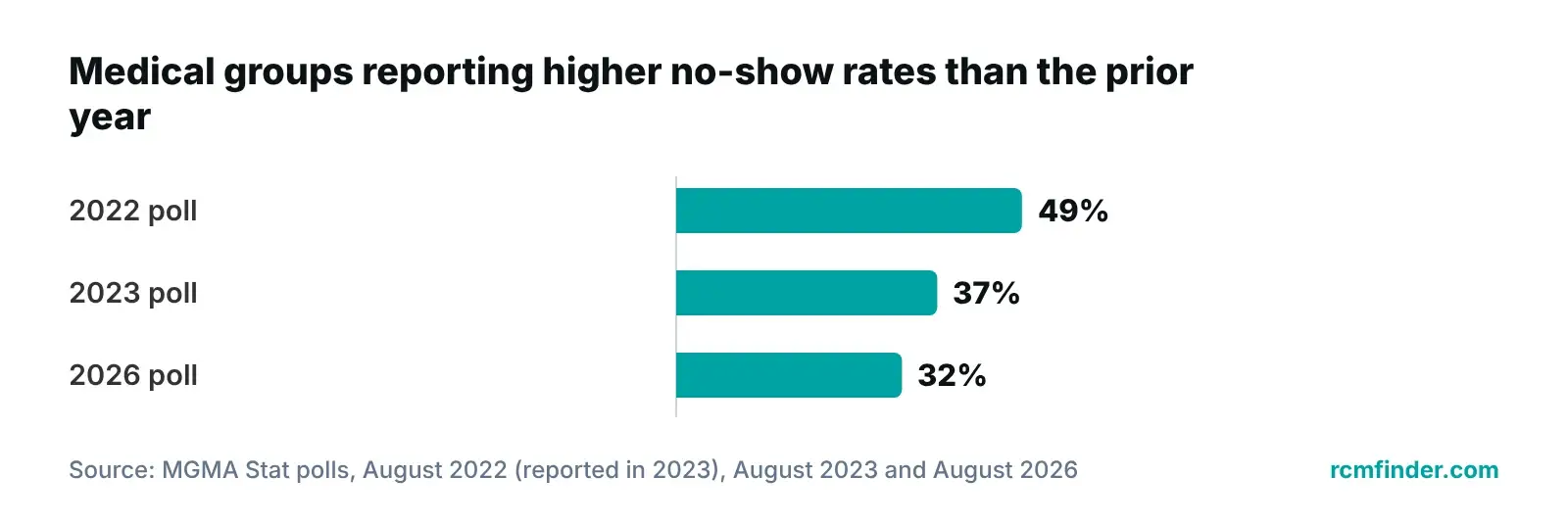
No-shows are the visible part. In an MGMA Stat poll published in August 2026, 32% of medical groups reported higher patient no-show rates year to date than in 2025, up 5 percentage points from the same poll a year earlier (190 responses). In MGMA's August 2023 poll, 37% reported an increase over 2022 (380 responses), and the 2022 poll had found 49%.
Booking choices matter too. A 2024 systematic review in Health Science Reports of no-shows in clinics using open-access scheduling reported, from one included study, no-show rates of 8%, 16% and 22% for lead times of 0-3, 4-6 and 28-30 days. The lead-time figures come from a 2013 before-and-after study. The authors also state that reminders reduce no-shows, but they note that most included studies used before-and-after designs, which are weak evidence of cause, and that some did not evaluate reminders at all.
The other leak is the authorization. The AMA's 2025 survey of 1,000 physicians, released in May 2026, found physicians complete an average of 40 prior authorizations a week, taking about 13 hours of physician and staff time. If nobody checks authorization before the visit is booked, that time is spent after the patient is already on the calendar.
Estimate what an empty slot costs you
Enter your visit volume and average collection into our revenue calculator. It gives you a number to bring to the audit.
Outsourced medical scheduling means trained remote staff, called virtual medical assistants, run your appointment book for you inside your own EHR. They follow your templates, your rules for each visit type and your escalation steps, and they work on your practice's time zone.
Assistants do not give clinical advice or triage symptoms. Anything clinical goes to your staff under a script your clinical lead approves. The wider service is described on our virtual medical assistant services page.
This page covers a done-for-you service delivered by named assistants. If you are looking for software that books, reminds and collects intake with little staff involvement, see our automated patient scheduling and intake page. Some practices use both: automation for routine requests, and an assistant for the calls that need judgment.
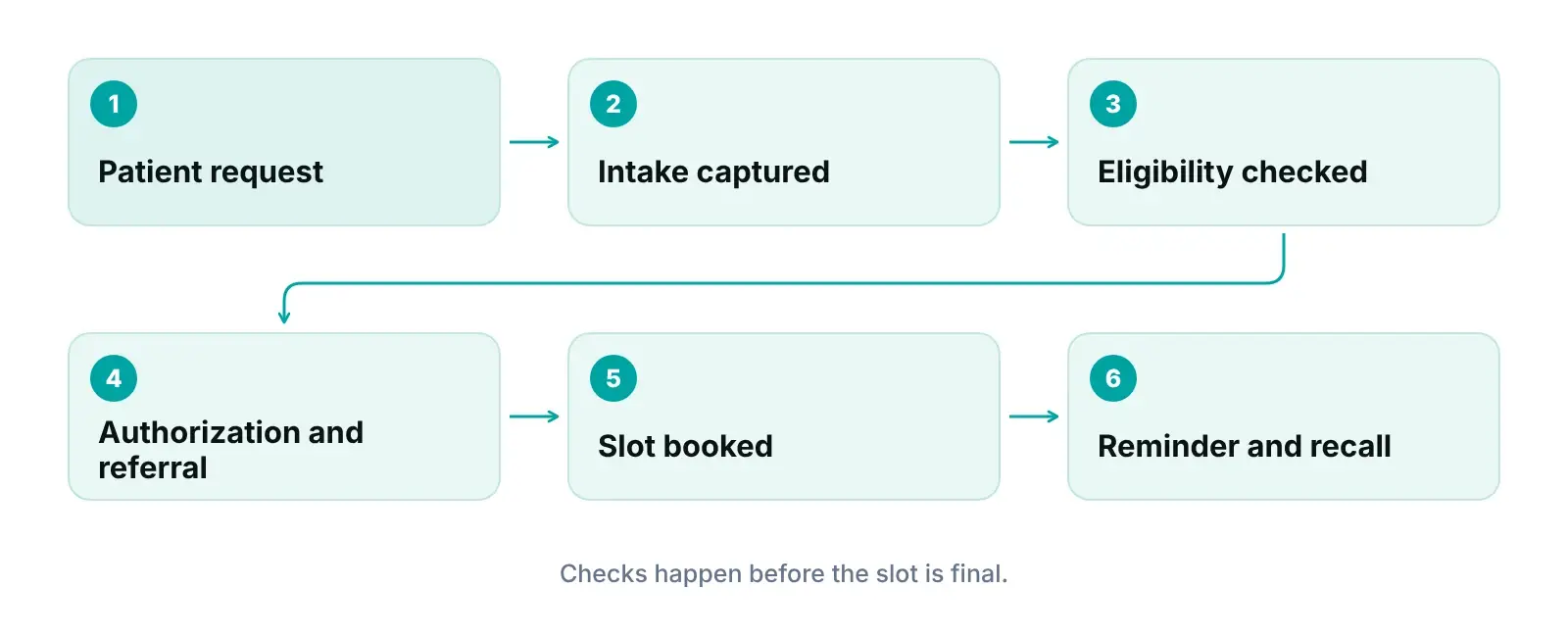
Each booking passes through the same checks, so problems surface while the patient is still on the phone. The table shows the steps and what each one rests on.
| Step | What the assistant does | What it is based on |
|---|---|---|
| Capture intake | Records demographics, insurance card details and the reason for the visit before the appointment | RCM Finder process |
| Check eligibility | Confirms active coverage and plan type for the date of service | RCM Finder process |
| Check authorization | Flags visits that need prior approval and starts the request before the date is final | AMA 2025 physician survey: 40 authorizations and 13 hours a week on average |
| Check referral | Asks for the referral when the plan requires one | HealthCare.gov and CMS MLN (July 2026): many HMO plans require referrals |
| Choose the slot | Applies your visit type, provider and slot rules, and avoids very long lead times where your calendar allows | 2024 systematic review: one study found higher no-shows at longer lead times |
| Confirm and remind | Contacts the patient before the visit and logs the answer | 2024 systematic review: authors state reminders reduce no-shows (weak before-after evidence) |
| Handle no-shows and recall | Follows up on misses, offers the waitlist and recalls overdue patients | RCM Finder process |
Sources: AMA 2025 Prior Authorization Physician Survey (released May 2026); HealthCare.gov glossary; CMS MLN8659122 (July 2026); Health Science Reports systematic review (2024). Other cells describe RCM Finder's process.
On referrals, HealthCare.gov defines a referral as a written order from your primary care doctor to see a specialist, and notes that in many HMOs, if you do not get one first, the plan may not pay. CMS says patients in HMO-type Medicare Advantage plans also need a referral from their doctor to see a specialist. Plans differ, so we check each one.
Our team keeps one note per visit: what was checked, what is pending and who owns it. Billing sees that note later, which is where the link to front-desk impact on the revenue cycle becomes real.
A visit is not the same unit in every specialty. What changes is the length of the slot, the work that must happen before the date and the visits that follow. Slot lengths are set by your clinicians; we follow your templates.
| Specialty | What changes at booking | What we check first |
|---|---|---|
| Pain management | Procedure visits such as injections differ from consults, and some need approval before the date. | Authorization status before the procedure slot is held |
| Orthopedics | New injury visits come with imaging, then pre-operative and post-operative visits tied to a surgery date. | Referral, imaging history and the surgery date for follow-ups |
| Cardiology | A consult is often paired with testing, so two bookings must line up. | Referral and plan rules for the test, not only the visit |
| Behavioral health | Recurring sessions, detailed intake and telehealth visits where the clinician's license must cover the patient's state. | Patient location and clinician license, per HHS guidance |
| Neurology | New patients arrive with records and imaging, and need a longer first slot. | Referral, outside records and imaging on file |
| Pediatrics | A parent or guardian books, and siblings are often seen together. | Guardian contact and consent details |
| Ophthalmology | A single visit can include testing and dilation, so the sequence in one visit matters. | Visit type and any testing that needs a separate slot |
Sources: HHS Telehealth.HHS.gov licensure pages (2025) for patient-location licensure; HealthCare.gov and CMS MLN (2026) for referral rules. Other rows are operational logic and vary by practice.
Browse the specialties hub for the billing patterns that sit behind each specialty's front desk.
For telehealth, HHS states that a telehealth appointment occurs in the state where the patient is located at that time. HHS's behavioral health guidance advises checking both states' licensing boards. Our assistants ask for patient location at booking and pass it to your team.
The right model depends on call volume, visit complexity and how much judgment a booking needs. The table compares four common choices honestly, including where our own service is not the answer.
| Question | In-house front desk | Outsourced assistants (VMAs) | Scheduling automation | Answering service |
|---|---|---|---|---|
| Best for | Small practices with calm phones | Practices whose phones and checks outrun staff | High volume of routine bookings | After-hours message taking |
| Handles judgment calls | Yes | Yes, within your scripts | Limited | Limited |
| Checks eligibility and authorization | If staff have time | Yes, part of the workflow | Depends on the build | Usually no |
| Works in your EHR | Yes | Yes | Depends on integration | Usually no |
| Main trade-off | Staff time and turnover | Needs clear scripts and scope | Rare cases still need a person | Messages, not booked visits |
It starts with a free practice audit of your schedule, then written scripts, a Business Associate Agreement and a staged go-live. Pricing is quoted after the audit, based on volume and scope.
We review your schedule templates, no-show and cancellation patterns, call handling and how eligibility and authorization are checked today. You get a list of gaps.
We document the visit types, rules and escalation steps. Your clinical lead approves anything touching symptoms or urgency.
We put a Business Associate Agreement in place before accessing patient data. Each assistant gets an individual login to your EHR, limited to the scheduling queues.
Assistants learn your providers, visit types and payer mix, then shadow your front desk before taking calls alone.
We begin with one queue, such as new-patient booking or recall, and add the next when it runs steadily.
Each week you see bookings, reschedules, no-show follow-ups and open authorizations, and we adjust rules with you.
Start with a free practice audit
We review your templates, no-show patterns and front-desk checks, then show where bookings are leaking.
Appointment scheduling with a calendar and day view in our practice management portal is in early access. It is not live for daily use, and we do not promise a release date.
Scheduling connects marketing and billing. It turns a new patient inquiry into a visit that can be billed cleanly.
Campaigns fill the phones. Scheduling decides how many of those calls become booked visits.
Scheduling, eligibility checks, prior authorizations and intake, done by named remote staff in your EHR.
Clean intake and authorization notes mean fewer avoidable denials downstream.
The portal tracks claims today. Scheduling with a calendar and day view is in early access.
Ask for a Business Associate Agreement first, then how staff access is limited and how calls are reviewed. Appointment details are protected health information, so a vendor handling them is generally a business associate.
HHS guidance lists billing and practice management among business associate activities, and its examples include a third-party AI chatbot on a provider's patient portal that handles appointment scheduling. It requires satisfactory assurances, in the form of a contract, before protected health information is shared. HHS's minimum necessary guidance asks practices to define who needs access to which information. Be wary of any "HIPAA certified" claim: HHS does not endorse or recognize private Security Rule certifications.
At RCM Finder, we put a Business Associate Agreement in place before accessing patient data. Our team works inside your existing EHR, for example PrognoCIS, eClinicalWorks or athenahealth, with role-based access and audit logging. We claim no certifications or EHR partnerships.
Talk through your front desk with our team
Tell us how your phones and schedule run today. We will say what an assistant can take on and what should stay with your staff.
We would rather tell you now than after you sign. Here is where we fit and where we do not.
A good fit if you are
Probably not a fit if you are
What we would do first if we were running your practice's revenue cycle tomorrow.
If an approval is needed, start it first. We flag those visits at booking so billing does not discover the gap after the visit.
Your clinical lead should sign off on what assistants say about symptoms or urgency. We build that into scope.
One average hides the problem. We report by visit type, provider and booking lead time.
A waitlist only fills a cancellation if someone calls the right patient quickly. We work the list daily.
Because a telehealth visit takes place where the patient is, we capture location at booking.
Pick the queue that hurts most, such as new-patient booking or recall, and add the next once it runs steadily.
They are services where trained remote staff manage a practice's appointment book: booking, rescheduling, cancellations, reminders, recall and intake. Ours are delivered by virtual medical assistants who work inside your EHR, check eligibility and authorization at booking and follow your scripts. They do not give clinical advice. Pricing is quoted after a free practice audit.
This is a done-for-you service delivered by people who handle calls, checks and follow-up. Our automated patient scheduling page covers software that books, reminds and collects intake with less staff involvement. Many practices pair them, using automation for routine requests and assistants for judgment calls. We help you choose during the free audit.
Yes, eligibility checks and prior authorization checks are part of our assistant service. They confirm coverage, flag visits that need approval and start the request before the date is final. Payers differ, and authorization decisions stay with the payer. We record what was checked so billing sees it later.
We make no outcome promises. A 2024 systematic review's authors state that reminders reduce no-shows, though most studies it covered were before-and-after designs and some did not evaluate reminders, and one study found no-shows rose with longer lead times. We use reminders, lead-time awareness, waitlists and recall, and report no-shows weekly so you can judge the effect.
Not yet. Appointment scheduling with a calendar and day view is in early access and is not live for daily use. Today our assistants schedule inside the EHR you already use. You can join the early-access list through the free audit form, and we do not promise release dates.
Our team works inside your existing EHR, for example PrognoCIS, eClinicalWorks or athenahealth, using individual logins limited to scheduling queues. We do not claim an official partnership with any EHR vendor. During the free audit we confirm how your EHR handles templates, reminders and inbox queues, and which of those tasks our assistants take first.
Guides from our operations team on topics covered on this page.
Tell us about your practice. A member of our operations team replies within one business day.
Pricing is quoted after the audit, based on your volume and the services you choose. Prefer to talk? Call +1 (302) 556-2288.
Tell us about your practice
About the author: Awais Afzal
Healthcare Operations & Data Analyst, RCM Finder
Awais has spent more than 16 years in healthcare digital marketing and clinical operations management. He builds data-driven revenue cycle blueprints for high-ticket medical practices and leads product development of the RCM Finder portal. More about our team.
How we write: every figure, code and rule on this page was checked against the primary source listed below and independently fact-checked before publishing. We re-review this page every six months. Last reviewed October 12, 2026; next review April 12, 2027.
We use cookies to understand how our site is used and to measure our advertising. You can accept or reject non-essential cookies. See our Privacy Policy.