The January deductible reset makes it the riskiest month at the front desk: deductibles restart and many patients arrive on new plans. Re-verify each patient's eligibility and benefits at the first visit of the year, update cards and coordination of benefits, estimate the patient's share, give self-pay patients a Good Faith Estimate and collect at check-in.
In December, a patient may owe only a copay. On January 2, the same visit can cost the full allowed amount, because the deductible started over. Plan changes take effect, new cards arrive and Medicaid renewals change in 2027. Work from last year’s benefits and the claim denies, or the balance lands on a surprise statement.
Our guide to patient insurance verification covers verification all year. This post is the January-specific checklist: what changes, what to re-check, how to estimate and collect the patient’s share, and the federal rules for self-pay patients.
Key takeaways
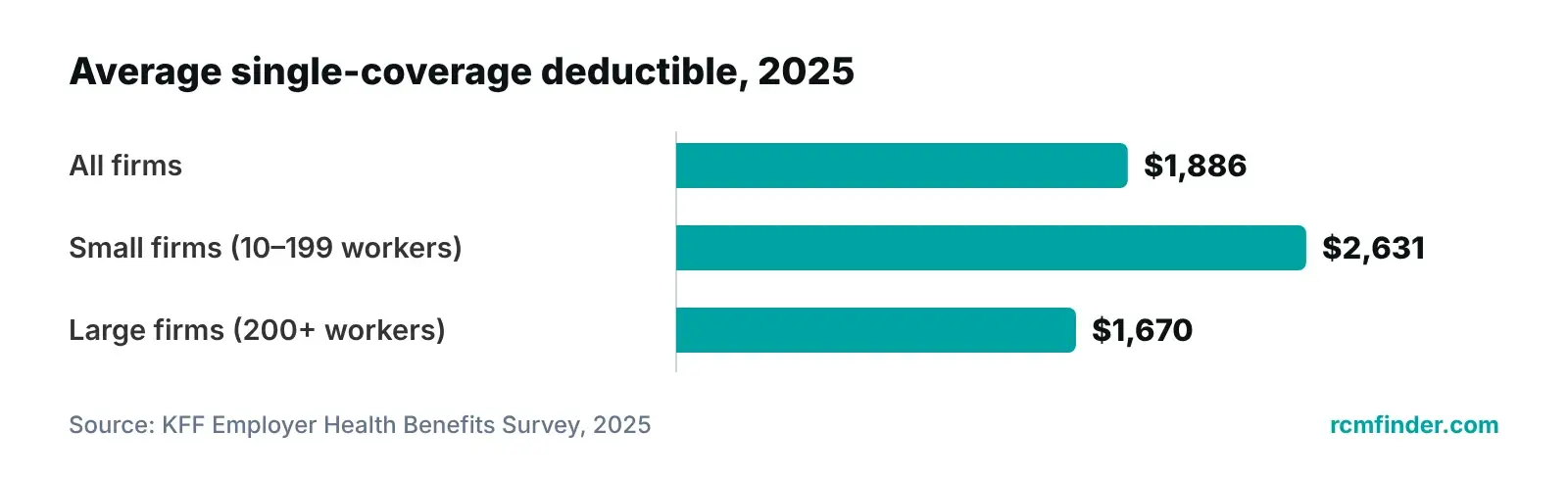
- Calendar-year deductibles restart January 1; KFF’s 2025 average single-coverage deductible was $1,886.
- Original Medicare’s Part B deductible is $283 in 2026; check CMS for the 2027 amount before January.
- Medicare Advantage members can switch plans once from January 1 to March 31; re-verify them at every visit through April.
- Self-pay services booked at least 3 business days ahead need a Good Faith Estimate within 1 or 3 business days.
- A written collection policy, payment plans and clear statements keep January balances from aging.
Why is January the riskiest month for eligibility and collections?
Almost everything the front desk relies on changes overnight: deductibles restart, fall plan changes take effect and patients bring new cards. Each change can turn a routine visit into a denial or a surprise balance.
Deductibles are large enough to matter. In KFF‘s 2025 Employer Health Benefits Survey, 88% of workers with single coverage had a general annual deductible, averaging $1,886. At small firms (10 to 199 workers) the average was $2,631, and 53% of covered workers at those firms were in plans with a single deductible of $2,000 or more. The average rose 17% over five years and 43% over ten.
Medicare patients start over too. CMS set the 2026 Part B deductible at $283, up from $257 in 2025, and released those amounts on November 14, 2025. Check CMS’s newsroom for the 2027 figure before the first January visit.
| Payer or plan type | What changes | When it takes effect | Front-desk action |
|---|---|---|---|
| Employer plans | Deductible and out-of-pocket maximum restart (2025 average single deductible: $1,886) | January 1 for calendar-year plans | Check plan year and deductible met |
| Original Medicare (Part B) | Deductible restarts: $283 in 2026 ($257 in 2025) | January 1 | Apply early visits to the deductible |
| Medicare Advantage (fall enrollment) | Switches made October 15 to December 7 | January 1 | Re-verify plan, network and referrals |
| Medicare Advantage (MA Open Enrollment) | One switch allowed January 1 to March 31 | First of the month after the request | Re-verify at every visit through April |
| Marketplace (HealthCare.gov) | Enrollments by December 15 start January 1; December 16 to January 15 start February 1 | January 1 or February 1 | Check the effective date |
| Medicaid adult group | Six-month renewals and community engagement checks | Renewals scheduled on or after January 1, 2027 | Check eligibility at every visit |
Sources: KFF (2025); CMS Part B fact sheet (November 2025); Medicare.gov and 42 CFR 422.62, HealthCare.gov (read October 2026); CMS SMD #26-001 (2026), CMCS bulletin (2025) and Federal Register interim final rule (June 2026). State dates can differ.
Not every plan resets on January 1
KFF notes that many employer plan years do not follow the calendar. Check the plan-year dates in each eligibility response.
Which plan changes take effect for Medicare Advantage, marketplace and Medicaid patients?
Fall Medicare Advantage switches start January 1, marketplace plans start January 1 or February 1, and Medicaid adult-group renewals change in 2027. The card on file may not match the plan the patient has today.
Medicare Advantage: two windows, not one
On Medicare.gov, changes made from October 15 to December 7 take effect January 1. Then, from January 1 to March 31, people already in a Medicare Advantage plan can make one switch, to another MA plan or to Original Medicare (42 CFR 422.62). Coverage starts the first of the month after the plan gets the request, so a patient verified on January 5 can be on a new plan by February 1.
Marketplace plans: check the effective date
HealthCare.gov lists December 15 as the last day to enroll for coverage starting January 1, 2027. Open Enrollment ends January 15, and coverage for enrollments from December 16 to January 15 starts February 1, once the first premium is paid. A patient who signs up January 10 and books for January 20 may not be covered yet.
Medicaid: more frequent renewals in 2027
CMS guidance (SMD #26-001, March 2026) says states must renew most people in the Medicaid adult group every six months, starting with renewals scheduled on or after January 1, 2027, and check community engagement at each renewal. A December 2025 CMS bulletin says that requirement, generally 80 hours a month of work or qualifying activity, begins January 1, 2027 unless a state starts sooner; temporary good-faith exemptions for states must end by December 31, 2028. CMS’s June 2026 interim final rule keeps the January 1, 2027 deadline. Last month’s active Medicaid card is not proof of coverage today.
What should you re-verify at each patient's first visit of the year?
Re-verify everything that drives payment: coverage on the date of service, payer and plan, member ID, deductible and out-of-pocket amounts met, visit cost sharing, network and authorization rules, and the order of benefits. Verify before the visit, then confirm the card at check-in.
| Check | What to confirm | What goes wrong if you skip it |
|---|---|---|
| Coverage on the date of service | Active coverage and the plan’s effective date | No-coverage denial; the balance shifts to the patient |
| Payer and plan type | Original Medicare or Medicare Advantage, marketplace, Medicaid managed care | Claim sent to last year’s payer |
| Member ID and card | New ID, group number and claims address, front and back | Rejection for an invalid ID |
| Deductible and out-of-pocket maximum | Annual amounts, amount met and plan-year start | Estimate too low; surprise statement |
| Visit cost sharing | Copay or coinsurance for this visit type, and whether the copay applies before the deductible | Wrong amount collected |
| Network, referral and authorization | In-network status; referral or prior authorization rules on the new plan | Out-of-network or no-authorization denial |
| Coordination of benefits | Other coverage and which plan pays first | Denial, or recoupment after the wrong payer pays |
Operational checklist based on common front-desk practice; no sourced statistics.
Update cards and coordination of benefits
Scan both sides of every card at the first visit of the year, even when the patient says nothing changed. Re-ask the coordination of benefits questions: a new job, a spouse’s plan, Medicare plus work coverage. A wrong primary payer can pay and take the money back months later. Our guide to coordination of benefits explains why it matters for billing.
Verify a few business days before the visit so there is time to fix problems, and re-check Medicare Advantage and new marketplace patients at each visit through April. Our post on eligibility and benefits verification practices goes deeper on data collection.
How do you estimate patient responsibility after the deductible resets?
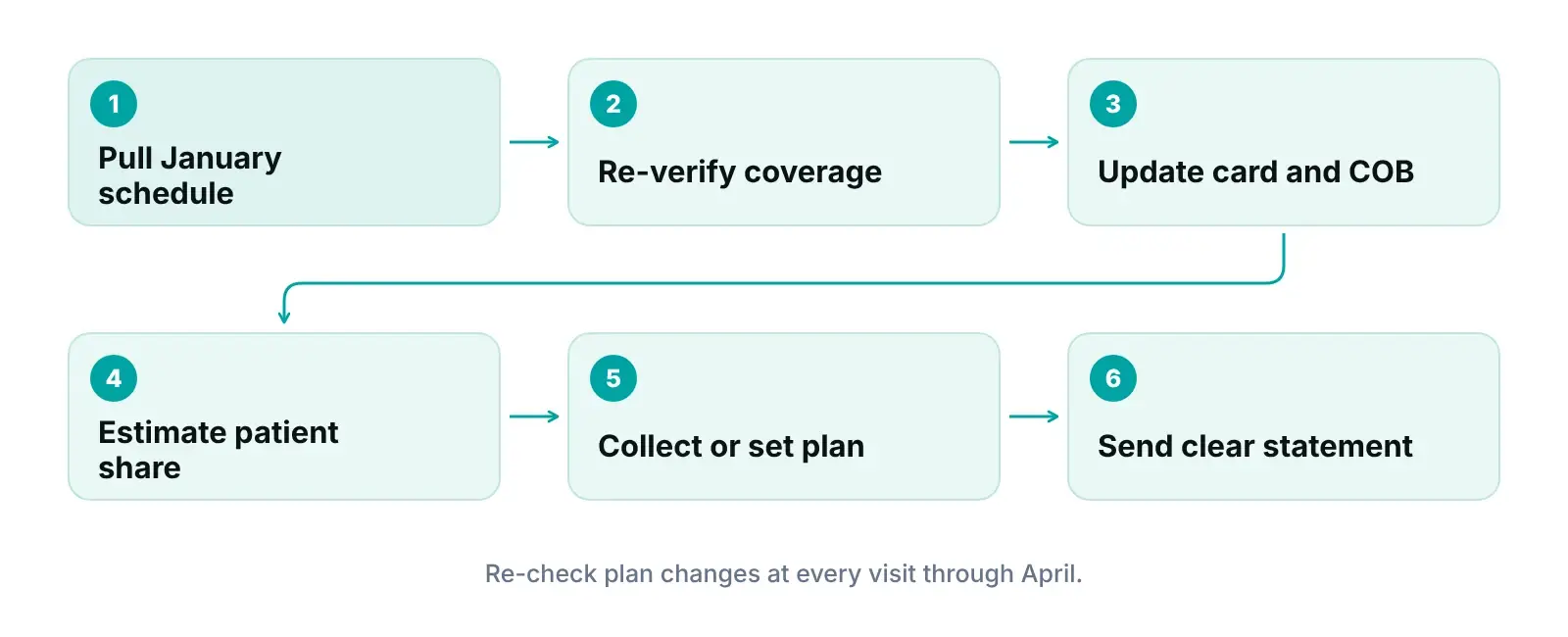
Start from the allowed amount, not your charge. Apply the remaining deductible first, then the copay or coinsurance, and stop at the out-of-pocket maximum. In January most patients have met little of their deductible, so the estimate is often the full allowed amount.
- Find the allowed amount in your fee schedule or payer contract.
- Check the remaining deductible in this year’s eligibility response.
- Apply the copay or coinsurance under the plan’s rules for this visit type.
- Cap the total at the remaining out-of-pocket maximum.
- Record it and tell the patient, noting that the payer’s processing sets the final amount.
In KFF‘s 2025 survey, the average primary care copay was $27 and average coinsurance for primary care and specialist visits was 19%. An illustration with made-up numbers: with a $200 allowed amount and none of a $1,500 deductible met, the patient owes $200. Later in the year, with the deductible met and 20% coinsurance, the same visit costs the patient $40.
Estimates can still miss, because another provider’s claim may use the deductible first. Say so when you give the estimate. See our guides to calculating patient responsibility and patient responsibility in medical billing.
Find where January eligibility errors cost you
Our free practice audit reviews a sample of your claims, denials and A/R aging, plus how registration and eligibility work today, and shows which front-desk step to fix first.
Get a Free Practice AuditWhen do uninsured or self-pay patients need a Good Faith Estimate?
Under the No Surprises Act rules at 45 CFR 149.610, a provider must give an uninsured or self-pay patient a Good Faith Estimate when a service is scheduled at least 3 business days ahead or when the patient asks. January adds patients whose coverage ended at year end and patients who choose not to bill their plan.
| Situation | Requirement | Rule |
|---|---|---|
| Service scheduled at least 3 business days ahead | Estimate within 1 business day of scheduling | 45 CFR 149.610 |
| Service scheduled at least 10 business days ahead | Estimate within 3 business days of scheduling | 45 CFR 149.610 |
| Patient asks about cost | Estimate within 3 business days of the request | 45 CFR 149.610 |
| Recurring services | One estimate may cover up to 12 months | 45 CFR 149.610 |
| Bill at least $400 above the estimate | Patient may start dispute resolution within 120 calendar days of the first bill | 45 CFR 149.620 |
| Dispute pending | No collections; pause late fees | 45 CFR 149.620 |
Source: eCFR, 45 CFR 149.610 and 149.620 (read October 2026); CMS No Surprises Act pages (updated 2026).
The estimate lists expected services with diagnosis and service codes, expected charges, each provider’s NPI and TIN, and required disclaimers. Tell self-pay patients estimates are available: on your website, in the office and out loud when scheduling. The estimate is part of the medical record.
Two January tasks for self-pay patients
- Flag patients whose coverage ended on December 31. When they schedule as self-pay, the estimate clock starts.
- Review recurring-service estimates issued in early 2026. None can cover more than 12 months.
$400 is the dispute threshold, not the trigger
Self-pay services booked at least 3 business days ahead need an estimate regardless of price, and so does any self-pay patient who asks. The $400 figure only decides whether a patient can dispute a higher bill (CMS).
Estimates for insured patients sent through their plans, and the Advanced Explanation of Benefits, have been under enforcement deferral since an August 2021 federal FAQ, pending rulemaking; CMS’s consumer page still describes estimates only for uninsured or self-pay patients. See also our self-pay patient billing guidelines.
What should a January time-of-service collection policy say?
It should say what the front desk collects, when, and what happens if a patient cannot pay today. Write it down, train everyone on one script and share it before the visit, so January conversations are routine, not personal.
- At check-in: copays, plus the estimated deductible amount or a deposit where payer contracts allow it.
- Advance notice: mention the reset deductible in the appointment reminder.
- Payment methods: what you accept, and card-on-file rules with written consent.
- After the claim: statement timing, refunds of overpayments and when an account goes to collections.
- Hardship: a written process for individual review.
Be careful with discounts. The HHS Office of Inspector General warns that routinely waiving Medicare or Medicaid copays could implicate the Anti-Kickback Statute and that practices may not advertise forgiving copayments. A waiver is allowed after an individual determination that the patient cannot afford to pay, or after reasonable collection efforts fail. Document each one.
“January is when patients are most surprised by a bill. I would rather the front desk have a short, honest conversation at check-in than send a statement nobody expected.”
— Awais Afzal, Healthcare Operations & Data Analyst
Payment plans and clear statements
- Offer a payment plan at the visit when the estimate is large, with written terms: amount, due dates and what happens after a missed payment.
- Send the first statement soon after the remittance posts, showing what insurance paid and what went to the deductible.
More in our posts on improving patient collections, patient payment plans and patient-friendly billing statements.
Who should run January re-verification, and when should it start?
Start in mid-December with January’s schedule and give one person or team ownership of the queue. Electronic checks handle routine cases; trained staff work the exceptions, such as plan changes, missing secondary coverage and large estimates.
Electronic checks cost less than phone calls. The 2024 CAQH Index (calendar-year 2023 data) put a medical provider’s labor cost for a manual eligibility check at $8.57, against $2.00 electronically, with 12 minutes saved per check. Our post on automating insurance eligibility verification compares manual and automated checks.
Our virtual medical assistants run eligibility checks, follow up on prior authorizations and handle intake inside your existing EHR (for example PrognoCIS, eClinicalWorks or athenahealth), in your practice’s time zone. When problems reach denials and A/R, our revenue cycle management team works the claim.
Coming next in the RCM Finder portal (early access)
Automated real-time eligibility verification inside our portal is in early access. Today, our team runs eligibility checks in your EHR as part of the service.
Need extra hands for the January rush?
Our virtual medical assistants re-verify eligibility and benefits and work the exceptions before the visit, inside your EHR and on your hours.
See Virtual Medical Assistant ServicesOur recommendations
- Start re-verification in December. We verify the first weeks of January’s schedule in mid-December, so the first busy week is not spent on hold.
- Treat the first visit of the year as a new registration. We scan both sides of every card and re-ask the coordination of benefits questions, even for long-time patients.
- Re-check Medicare Advantage and new marketplace patients through April. Medicare Advantage members can switch by March 31 and late marketplace enrollees start February 1, so we re-verify them at every visit.
- Give the estimate before the visit. We share the estimated patient share in the appointment reminder, so check-in confirms a number the patient already heard.
- Tie self-pay estimates to scheduling. Good Faith Estimate deadlines count business days from scheduling, so we make the estimate a scheduling step, not a task left to memory.
- Review January's results weekly. We track eligibility denials and new patient balances weekly through February and fix the step that caused them.
Bottom line
January eligibility is a checklist, not a mystery: re-verify every patient at the first visit of the year, re-check plan changes through April, estimate from the reset deductible, send self-pay estimates on time and collect under a written policy. For help with the January rush, see our virtual medical assistant services and end-to-end revenue cycle management, or start with a free practice audit.
Frequently asked questions
When do insurance deductibles reset?
Plans with a calendar plan year reset the deductible and out-of-pocket maximum on January 1. Not every plan does: KFF notes that many employers use plan years that do not follow the calendar. Original Medicare’s Part B deductible restarts every January and was $283 in 2026. Read the plan-year dates in each eligibility response rather than assuming.
Do we need to re-verify insurance for established patients in January?
Yes. Re-verify at each patient’s first visit of the year, even if nothing seems to have changed. Plan switches, new member IDs, new deductibles and new referral rules usually take effect on January 1. Medicare Advantage members can switch again through March 31, so re-check them at every visit through April.
What is the Medicare Part B deductible for 2027?
CMS had not released the 2027 amount when this post was written in October 2026; it usually announces the next year’s figures in the fall. It released the 2026 amounts on November 14, 2025, with a deductible of $283, up from $257 in 2025. Check CMS’s newsroom for the 2027 figure, then update your estimate tool and front-desk scripts before the first January visit.
Can we collect the deductible at the time of service?
Many practices collect copays and an estimated deductible amount at check-in under a written financial policy patients see in advance. Base the estimate on the allowed amount and the remaining deductible from the eligibility response, refund any overpayment promptly after the claim processes, and offer a payment plan for large amounts. Check your payer contracts for limits.
Does the Good Faith Estimate rule apply to insured patients?
Only when they are self-pay. The current requirement covers uninsured patients and insured patients who choose not to bill their plan. The separate estimate for insured patients, sent through their plans, and the Advanced Explanation of Benefits have been under enforcement deferral since August 2021, until federal rulemaking is complete. Watch CMS for updates.
Can we waive a patient's copay if they cannot pay?
Yes, after an individual review. The HHS Office of Inspector General warns that routinely waiving Medicare or Medicaid copays could implicate the Anti-Kickback Statute, and practices may not advertise forgiving them. Waiving a copay after you decide a specific patient cannot afford it, or after reasonable collection efforts fail, is allowed. Record each decision under a written hardship policy.
Get your free practice audit
Tell us about your practice. A member of our operations team replies within one business day.
- A review of your recent claims, denials and A/R aging
- Where your front desk and prior authorizations slow payment
- A prioritized fix list you keep, whether or not you hire us
Pricing is quoted after the audit, based on your volume and the services you choose. Prefer to talk? Call +1 (302) 556-2288.
Sources
- 2026 Medicare Parts A & B Premiums and Deductibles (fact sheet) — CMS (2025)
- 2025 Employer Health Benefits Survey — KFF (2025)
- Joining a plan (enrollment periods) — Medicare.gov (CMS) (2026)
- 42 CFR 422.62 — Election of coverage under an MA plan — eCFR (National Archives) (2026)
- Dates and deadlines for 2027 coverage — HealthCare.gov (CMS) (2026)
- SMD #26-001: Implementation of Eligibility Redeterminations, Section 71107 (Public Law 119-21) — CMS / Medicaid.gov (2026)
- CMCS Informational Bulletin: Community engagement requirements (December 8, 2025) — CMS / Medicaid.gov (2025)
- Medicaid Program; Community Engagement Requirement for Certain Individuals (interim final rule, 2026-11094) — Federal Register (CMS) (2026)
- 45 CFR 149.610 — Good faith estimates for uninsured (or self-pay) individuals — eCFR (National Archives) (2026)
- 45 CFR 149.620 — Patient-provider dispute resolution — eCFR (National Archives) (2026)
- Providers: payment resolution with patients — CMS (2026)
- Understanding costs in advance — CMS (2026)
- FAQs About Affordable Care Act and Consolidated Appropriations Act, 2021 Implementation Part 49 — U.S. Departments of Labor, HHS and the Treasury (2021)
- Fraud & Abuse Laws (physician education) — HHS Office of Inspector General (2021)
- 2024 CAQH Index Report — CAQH (2024)
Disclaimer: This article is general educational information about front-desk and revenue cycle operations. It is not legal, billing-compliance or financial advice. Plan rules, enrollment dates, Medicaid requirements and payer contracts vary by plan, payer and state and change often. Confirm requirements with the payer, your contracts and qualified advisors before acting.