
Medicare AT and ABN checks, commercial visit limits and authorizations, patient marketing and a claims portal for chiropractic practices.
By Awais Afzal | Healthcare Operations & Data Analyst
Published October 12, 2026 · Last reviewed October 12, 2026 · Next review April 12, 2027
Quick answer
Chiropractic billing services manage the claims a chiropractic practice creates: spinal manipulation codes 98940–98942, Medicare AT, GA and GZ modifiers, the initial treatment date and commercial visit limits and authorizations. They also check benefits before the first visit. RCM Finder adds front-desk assistants, marketing and a claims portal.
On this page
Chiropractic billing is different because Medicare pays for one narrow service, and almost every claim depends on how the visit is documented and labeled. A missing modifier or vague note can turn covered care into a denial.
Under 42 CFR 410.21 (current as of September 2026), Medicare Part B covers a chiropractor’s manual manipulation of the spine to correct a subluxation. It does not cover X-rays or other diagnostic or therapeutic services a chiropractor furnishes or orders. Medicare.gov adds that the patient pays 20% of the Medicare-approved amount after the Part B deductible.
That narrow rule has been a long-running audit target. In its 2015 report on 2013 claims, the HHS Office of Inspector General found $76 million in questionable chiropractic payments, almost half tied to claims that suggested maintenance therapy. The figures are old and national, but they show where reviewers look.
This page is the service overview. For code-level detail, see our guides to chiropractic CPT codes and modifiers and Medicare billing for chiropractors. For injections and procedures, see our pain management billing and orthopedic billing pages.
A chiropractic practice needs patients who find you, a front desk that checks benefits and visit limits, billing that reads Medicare and commercial rules correctly, and software that shows each claim.
Revenue leaks at handoffs: a plan of care that never reaches billing, an uncounted visit limit, a Medicare visit with no AT modifier. We run all four pillars on one set of payer rules.
Our healthcare digital marketing covers local search, Google Ads and reviews, with pages that describe Medicare coverage accurately.
Our virtual medical assistants for chiropractic practices work on your practice’s time zone. They verify benefits, count visits against plan limits and request authorizations.
Our end-to-end revenue cycle management covers coding support, claim scrubbing, denial management and A/R follow-up, with extra checks for modifiers, region counts and the initial treatment date.
Our practice management system tracks every claim by stage, applies specialty-aware billing logic per claim, checks data completeness and flags underpayments.
Find where your chiropractic claims leak
We review recent Medicare and commercial claims and denials, then show what to fix first.
Most chiropractic denials trace to a few items: region count, the AT modifier, diagnosis order, the initial treatment date and same-day services. Codes are described in our own words; the AMA owns CPT descriptors.
| Item | Code or modifier (our wording) | Rule to know | Typical denial trigger |
|---|---|---|---|
| Spinal manipulation | 98940 (one to two regions); 98941 (three to four); 98942 (five) | Medicare covers manual spinal manipulation only; no separate payment for hand-held devices | Region count not supported by the note |
| Extraspinal manipulation | 98943 | Medicare covers the spine only, so extraspinal care is not payable | 98943 sent to Medicare as a covered service |
| Active treatment | Modifier AT on 98940–98942 | Required for active care; without it Noridian treats the claim as maintenance and denies it | AT missing, or AT on a maintenance visit |
| Maintenance care | GA (signed ABN on file) or GZ (no ABN) | Do not add AT; GA and GZ tell Medicare a denial is expected | AT and GA on the same line |
| Excluded services | GY | Statutorily excluded items, such as an exam, deny and the patient is liable | GY or ABN used out of habit |
| Diagnosis order | Subluxation level first; neuromusculoskeletal condition second | Noridian says the claim allows up to four diagnosis codes, so report the most significant primary and secondary pairs | General “back pain” with no spinal level |
| Initial treatment date | CMS-1500 Item 14 (and Item 19 when an X-ray is used) | Item 14 carries the date the course of treatment began | Item 14 blank or not matching the plan of care |
| Same-day exam and therapies (commercial) | 99202–99205, 99212–99215 with modifier 25; 97112, 97124, 97140 with XS or 59 | Pre-manipulation work is included in the CMT; a separate exam must be significant | Routine visit billed with an exam; therapy on the same region |
Sources: 42 CFR 410.21 (2026); CMS MLN1232664 (2021); Noridian JF Part B pages (2024–2026); CHIRO-001 guide (2015); Premera policy (Feb. 2026); AAPC (secondary). Rules vary by contractor and payer.
The Medicare Benefit Policy Manual, chapter 15 (§30.5) says coverage extends only to manual manipulation of the spine to correct a subluxation, and all other services a chiropractor furnishes or orders are not covered. Noridian, the contractor for Jurisdiction F, lists excluded services such as acupuncture, counseling, tests, physical therapies, office visits, supplies and X-rays. Noridian says providers may bill patients directly for those services without billing Medicare.
The CMS documentation job aid for chiropractors (March 2021) says subluxation can be shown by X-ray or by physical exam. For an exam, the record needs at least two of four findings: pain or tenderness, asymmetry or misalignment, range-of-motion abnormality and tissue or tone changes (PART). One must be asymmetry or range of motion. The primary diagnosis must name the subluxation level.
Noridian’s documentation page (October 2026) adds the plan: duration, frequency, goals, objective measures and the date of the initial treatment. Each visit note should name the segment manipulated, not only the region. Retroactive signatures are not acceptable. Noridian’s coverage page says an X-ray is optional, a chiropractor cannot order one, and one that is used should fall within 12 months before or 3 months after treatment starts.
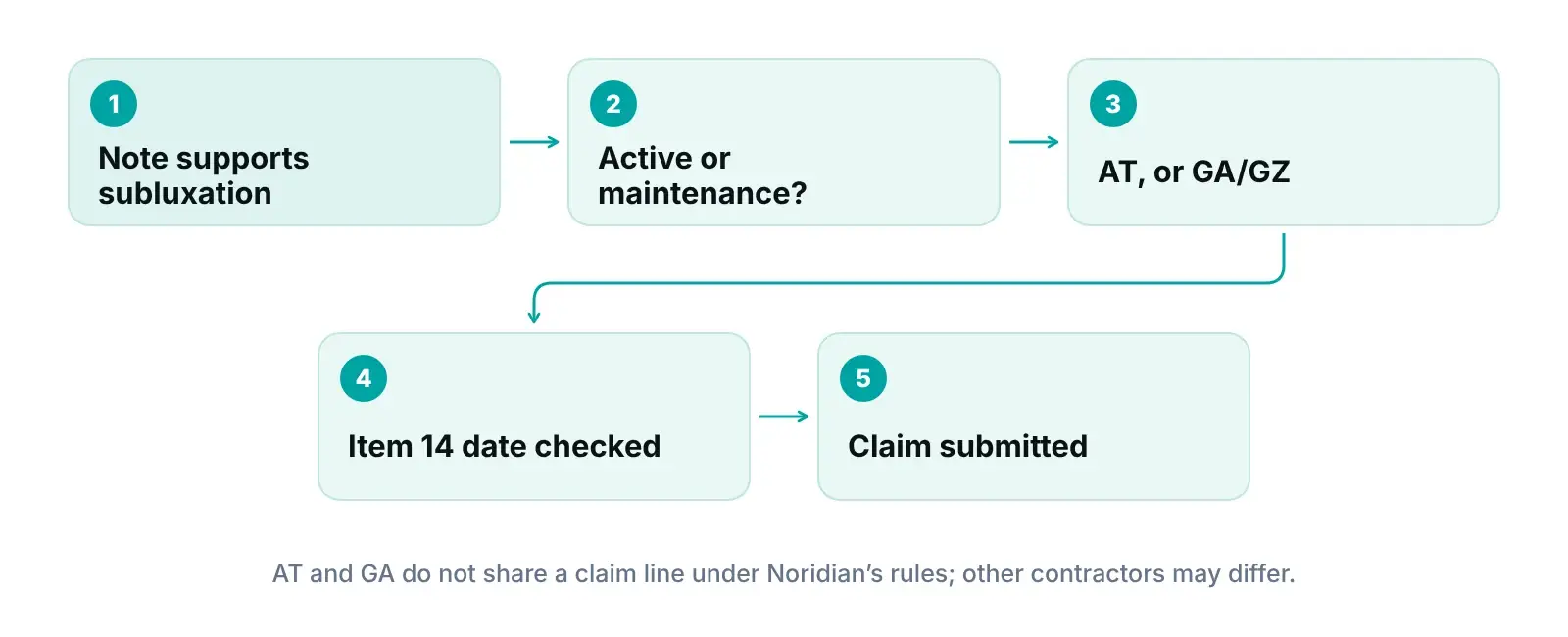
The Benefit Policy Manual says maintenance therapy is not payable: care becomes maintenance when further improvement cannot reasonably be expected and treatment is supportive. Noridian’s AT page (May 2025) says AT applies only to 98940–98942, that documentation must support active or corrective treatment, and that AT should not appear on the same line as GA, GX, GY or GZ. Noridian’s claim submission page warns that AT does not, in all instances, show that a service is reasonable and necessary.
An Advance Beneficiary Notice (ABN) lets a patient choose care Medicare may deny and agree to pay for it. Per Noridian’s ABN page (March 2026), an ABN is required when Medicare may not pay for medical necessity or frequency reasons; without a valid one, the patient cannot be billed. For chiropractic, every service except manipulation is non-covered, so an ABN for those is voluntary. Providers should not issue ABNs routinely.
GA means an ABN was given and a denial is expected. GZ means a denial is expected and no ABN was given, so the line denies as provider-liable. GY marks a statutorily excluded service, where an ABN is not required. See our ABN billing guide.
Per Noridian’s claim form instructions (August 2026), Item 14 holds the date the course of treatment began, and an X-ray date goes in Item 19 when an X-ray, not the exam, showed the subluxation. An older contractor guide said not to enter an X-ray date, so confirm your own contractor’s rule.
Commercial plans set their own visit limits, and commercial and Medicare Advantage plans set their own authorization rules, so check both before the first visit.
One plan’s chiropractic policy (January 2026) needs no authorization for visits 1–20 and requires it from visit 21 for commercial and Medicare Advantage members. It also excludes maintenance therapy. Treat it as an example of the pattern, not a rule for your payers.
Authorization can also come through a benefit manager. UnitedHealthcare’s Medicare Advantage notice for Arizona and California says that, for certain plans, services starting February 1, 2026 need a request for the entire plan of care, with chiropractic limited to traditional Medicare services identified by AT. The first 6 visits within 8 weeks need no clinical review, but a request is still required. Longer plans go to medical necessity review, and the request can follow the first visit by up to 10 business days. Benefit managers such as American Specialty Health, which runs contracted practitioner networks for health plans, add their own rules.
CMS’s E/M services booklet (May 2026) defines a new patient as someone who has not received professional services from the physician, or a same-specialty physician in the same group, in the past 3 years. A payer policy such as Mass General Brigham’s lists 99202–99205 for new office visits and 99211–99215 for established ones. Original Medicare does not cover a chiropractor’s exam, so this applies to commercial plans.
Premera’s manipulation payment policy (approved February 2026) treats the pre- and post-manipulation work as part of the CMT code and pays a separate exam only when the patient’s condition needs care beyond that work, reported with modifier 25. A Blue Cross Vermont tip sheet gives a payable example (new complaints after a car accident) and a denied one (a routine weekly visit). See our modifier 25 vs 59 guide.
Premera pays 97112, 97124 or 97140 on the same date as a CMT only when the therapy is on a different anatomic region and carries modifier XS or 59. On the same region, the therapy is denied as included. It also allows one spinal CMT code per provider, per patient, per day. Your payers may differ, so we load each payer’s policy into the claim rules.
| Check before the visit | Why it matters | Rule or source |
|---|---|---|
| Plan type: Original Medicare, Medicare Advantage or commercial | Decides whether AT, ABN and authorization rules apply | Noridian (2024–2026); UnitedHealthcare notice (2025) |
| Chiropractic benefit, visit count and limit | A cap or threshold changes what the patient owes | Mass General Brigham Health Plan policy (Jan. 2026) |
| Authorization for the whole plan of care | Some Medicare Advantage plans want it, even for early visits | UnitedHealthcare notice (effective Feb. 1, 2026) |
| Plan of care with duration, frequency, goals and start date | Supports the claim and the Item 14 date | Noridian documentation page (Oct. 2026) |
| Subluxation evidence: PART exam or dated X-ray | Shows the covered condition | CMS MLN1232664 (2021) |
| ABN decision for care Medicare may deny | Without a valid ABN, the patient cannot be billed for required cases | Noridian ABN page (Mar. 2026) |
Sources: Noridian JF Part B (2024–2026); CMS MLN1232664 (2021); UnitedHealthcare (2025); Mass General Brigham Health Plan (Jan. 2026). Confirm the member’s current plan.
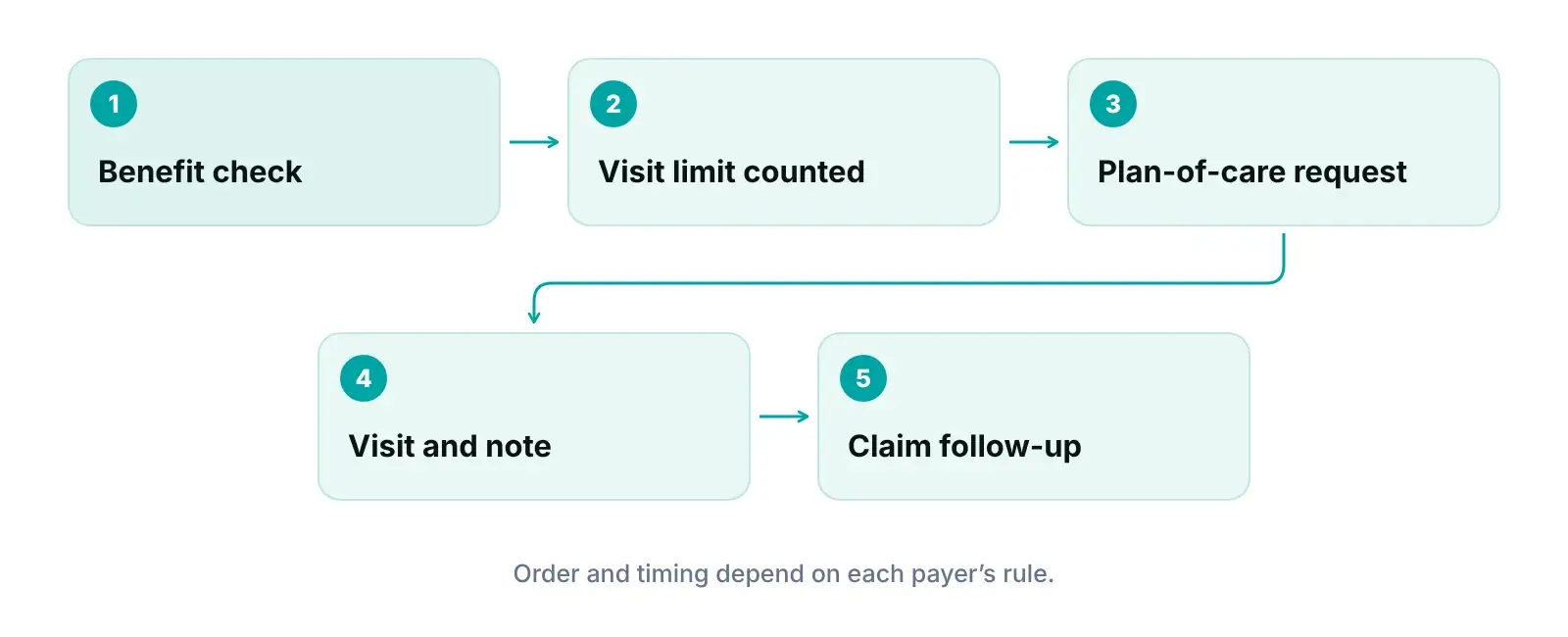
For the general workflow, see our prior authorization guide.
See what denials and lost visits cost you
Enter your claim volume and denial rate to estimate what you are losing.
Chiropractic growth comes from local search and reviews. The risks are a site that implies Medicare pays for more than it does, and tracking that collects health details.
Our service pages match the rules above: Medicare covers manual spinal manipulation, not every visit or therapy. Review replies never confirm a patient.
HHS guidance on online tracking says tools on appointment pages can collect protected health information, tracking vendors that handle it need a Business Associate Agreement, and cookie banners are not HIPAA authorizations. A 2024 court order vacated part of that guidance; we still keep tracking off booking forms unless the vendor signs a BAA.
Stay in-house if your staff already know each payer’s chiropractic rules. Use a billing-only vendor if claims are your only gap. Choose a combined partner when denials start at the front desk.
| Job | In-house team | Billing-only vendor | Four-pillar partner (RCM Finder) |
|---|---|---|---|
| Benefit and visit-limit checks | Front desk, between patients | Often left to the practice | VMA checks before the first visit |
| Authorization requests | Whoever has time | Often not included | VMA submits and follows up |
| AT, GA, GZ and GY decisions | Biller memory, varies by contractor | Coded from the note after the fact | Checked against the note before submission |
| Plan-of-care and start-date tracking | Paper or EHR note | Not visible to the biller | Claims held if key fields are missing |
| Patient growth | Separate agency, or nobody | Not included | Marketing tied to booked first visits |
| Cost structure | Salaries, benefits, turnover | Varies; ask how fees are set | Quoted after a free practice audit |
We start with a free audit and change nothing until you see the findings. We build our billing pipeline around how claims actually move through a practice: registration, charge entry, submission, payment and follow-up. For chiropractic, we add the checks on this page.
We review recent Medicare and commercial claims, denials and treatment plans.
We put a Business Associate Agreement in place before accessing patient data. Then we work inside your existing EHR (for example PrognoCIS, eClinicalWorks or athenahealth).
Your Medicare contractor’s guidance and main plan policies become a pre-visit checklist and portal rules.
VMAs verify benefits and request authorizations. Claims are scrubbed, submitted and worked through denials and A/R.
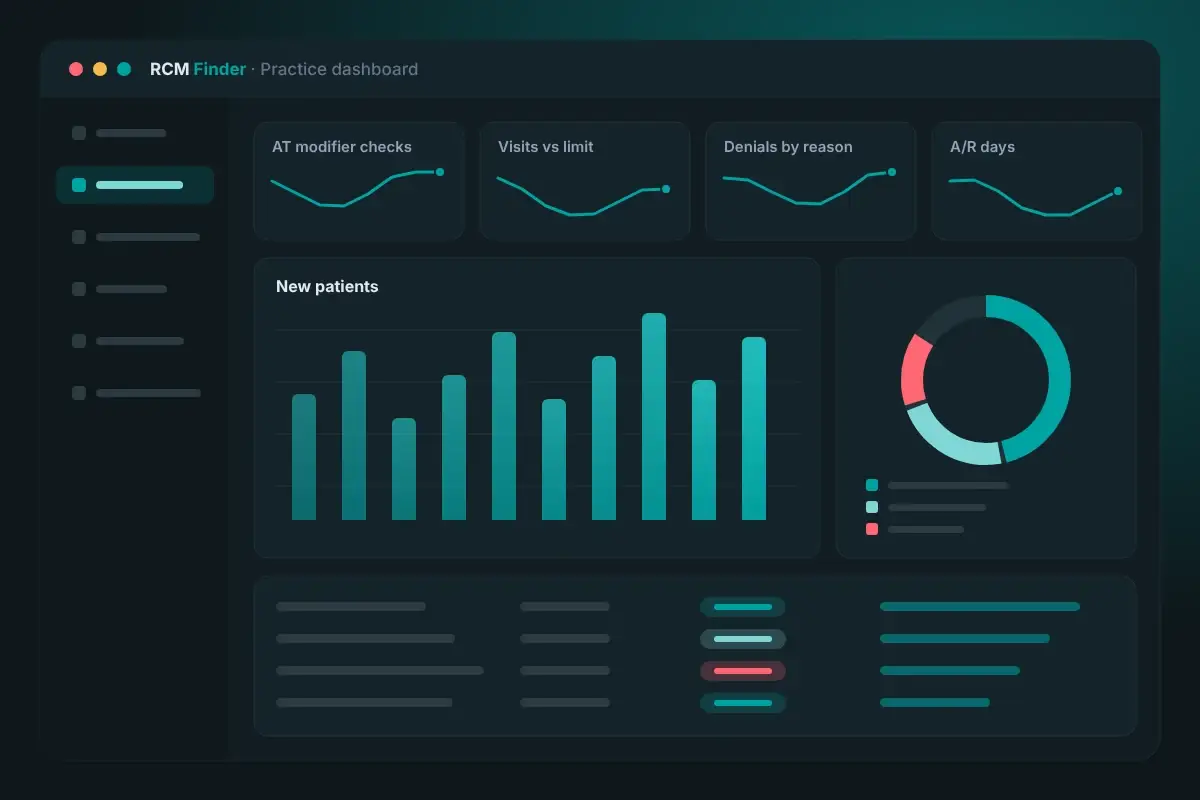
We review denials by reason, A/R days, visits against limits and new patients.
Talk to us about your chiropractic practice
Tell us your payer mix and hardest denials. We will say honestly whether we fit.
Any billing vendor that handles your patients’ data is a HIPAA business associate. Get a Business Associate Agreement before access, and ask how access is limited and logged.
HHS guidance lists billing and claims processing as business associate work; subcontractors need their own agreement. The minimum necessary standard limits each use of data to what the task needs. The Security Rule’s technical safeguards cover access control, audit controls, integrity, person or entity authentication and transmission security.
We use role-based access, audit logging and encrypted (HTTPS) connections, and we put a Business Associate Agreement in place before accessing patient data. For your own side, use our HIPAA compliance checklist for medical practices.
We would rather tell you now than after you sign. Here is where we fit and where we do not.
A good fit if you are
Probably not a fit if you are
What we would do first if we were running your practice's revenue cycle tomorrow.
The AT, GA and GZ choice depends on the note, not habit. We make that call at charge entry and hold doubtful visits.
Duration, frequency, goals and the start date feed Item 14 and the audit file. We keep them where billing can see them.
A cap or an authorization threshold is easy to miss. We track visits used and remaining for each patient.
Medicare reviewers look for the level and the supporting findings. We ask for them before the claim leaves.
A routine visit with manipulation is usually one service. We check the note before adding an exam with modifier 25.
An ABN is for care Medicare may deny, not a form for every visit. We flag the visits that need one and the ones that do not.
They cover coding support, claim scrubbing, submission, denial management and A/R follow-up. For chiropractic, that means choosing the manipulation code by region count, applying Medicare modifiers such as AT, GA and GZ, carrying the initial treatment date, and handling commercial rules on exams and therapies. A good partner also checks benefits and authorizations first. We add front-desk assistants, marketing and a claims portal.
Medicare Part B covers manual manipulation of the spine to correct a subluxation. Under 42 CFR 410.21, it does not cover X-rays or other diagnostic or therapeutic services a chiropractor furnishes or orders. Medicare.gov says the patient pays 20% of the approved amount after the Part B deductible. Exams, therapies and supplements are patient-pay, so the practice should tell patients before care.
AT marks active or corrective treatment on spinal manipulation codes 98940–98942. Noridian says claims without it are treated as maintenance and denied, and that documentation must support active care. AT does not by itself show the care is medically necessary, and Noridian says not to put it on the same line as GA, GX, GY or GZ. Other Medicare contractors may differ, so check yours.
An ABN is needed when Medicare may not pay for care for medical necessity or frequency reasons, such as expected maintenance care. Without a valid ABN, the provider cannot bill the patient in those cases. For services Medicare never covers, such as exams or X-rays from a chiropractor, an ABN is voluntary. Providers should not issue ABNs routinely.
Not under Original Medicare, which does not cover a chiropractor’s exam. On many commercial plans, a separate exam is payable only when the patient’s condition needs significant, separately identifiable work beyond the pre-manipulation assessment, reported with modifier 25. A routine visit for a known complaint usually does not qualify. Check each payer’s policy.
It depends on the plan. Some commercial and Medicare Advantage plans require authorization after a set number of visits, and some, such as certain UnitedHealthcare Medicare Advantage plans, want a request for the whole plan of care. Others have no requirement. Check the member’s plan before the first visit and record the visit count and any limit.
Tell us about your practice. A member of our operations team replies within one business day.
Pricing is quoted after the audit, based on your volume and the services you choose. Prefer to talk? Call +1 (302) 556-2288.
Tell us about your practice
About the author: Awais Afzal
Healthcare Operations & Data Analyst, RCM Finder
Awais has spent more than 16 years in healthcare digital marketing and clinical operations management. He builds data-driven revenue cycle blueprints for high-ticket medical practices and leads product development of the RCM Finder portal. More about our team.
How we write: every figure, code and rule on this page was checked against the primary source listed below and independently fact-checked before publishing. We re-review this page every six months. Last reviewed October 12, 2026; next review April 12, 2027.
We use cookies to understand how our site is used and to measure our advertising. You can accept or reject non-essential cookies. See our Privacy Policy.