
Chiropractic CPT codes center on three spinal manipulation codes, 98940, 98941 and 98942, chosen by how many spinal regions are treated. Modifiers then decide payment: AT marks active treatment on Medicare claims, GA and GZ mark expected denials, and 25 marks a separate exam. Payer rules differ, so check each policy.
Most chiropractic claims go wrong in two places: the code does not match the regions documented, or the modifier does not match the payer. This guide covers both, with Medicare and commercial rules kept apart so you can see which one applies to the claim in front of you.
It replaces a shorter list of five codes that mixed chiropractic and physical therapy services and printed fee ranges without a source. Payment amounts vary by payer, contract and region, so look them up in your own fee schedules. For the Medicare-specific rules in depth, see our guide to Medicare billing for chiropractors.
Key takeaways
- 98940, 98941 and 98942 are chosen by treated spinal regions (1 to 2, 3 to 4, 5), and only one is reported per visit.
- Medicare needs AT on those codes for active treatment; maintenance care is expected to deny, with GA or GZ by ABN status.
- Modifier 25 requires a significant, separately identifiable exam, not a routine pre-manipulation assessment.
- Medicare’s chiropractic benefit centers on spinal manipulation, so decide the payer before the code.
- Do not rely on fee ranges: use your own remittances and fee schedules.
Which CPT codes do chiropractors bill most?
The core set is the chiropractic manipulative treatment (CMT) family: 98940, 98941 and 98942 for the spine, plus 98943 for extraspinal regions. The code you report depends on how many regions you treated and documented, not on how long the visit took. CPT is owned by the AMA, so check your current CPT book for exact descriptors. The summaries here are our own.
| CPT code | What it reports (our summary) | Medicare status |
|---|---|---|
| 98940 | Spinal manipulation, 1 to 2 regions | Covered when criteria are met, with AT modifier |
| 98941 | Spinal manipulation, 3 to 4 regions | Covered when criteria are met, with AT modifier |
| 98942 | Spinal manipulation, 5 regions | Covered when criteria are met, with AT modifier |
| 98943 | Extraspinal manipulation | Non-covered service under the First Coast policy reviewed |
Source: UnitedHealthcare Medicare Advantage chiropractic clinical guideline 496 (effective 2026-02-11); First Coast Service Options LCD code guide (Medicare Coverage Database).
The five spinal regions in the UnitedHealthcare guideline are cervical, thoracic, lumbar, sacral and pelvic. A First Coast code guide adds a point that trips up new billers: these codes are not add-ons, so a five-region visit is reported with 98942 alone, not 98940 plus 98941.
If a visit also includes exercises, ultrasound or other therapy, those lines follow different rules, and many payers treat them as separate from CMT. Our 97035 ultrasound billing guide shows how a timed therapy code is counted, which is the main reason it is not a simple add-on to a CMT line.
Does Medicare cover the same chiropractic services as commercial plans?
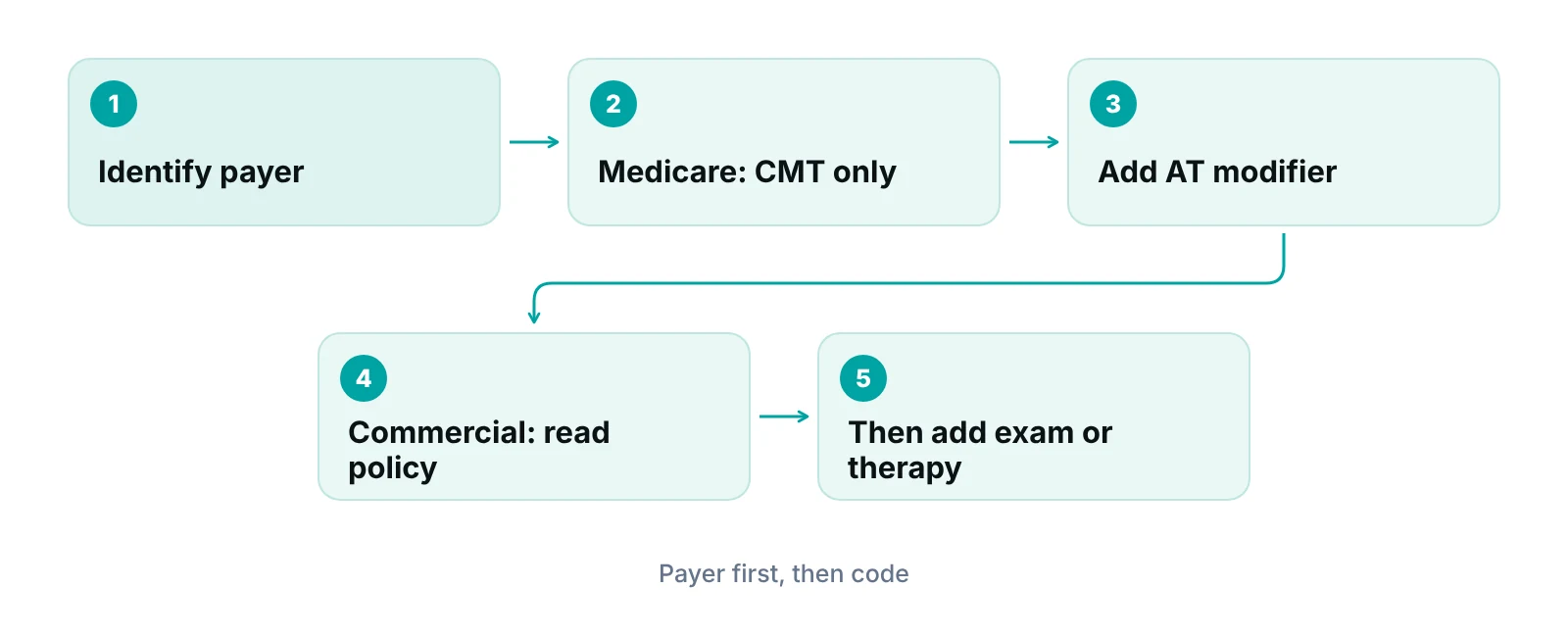
No. Medicare’s chiropractic benefit is narrow, and commercial plans set their own, wider or narrower, lists. Decide the payer first, then pick the codes.
A CMS presentation to chiropractors describes current Medicare coverage as limited to manual manipulation of the spine to correct subluxation, CPT 98940 to 98942, and lists prevention and maintenance care as not covered. It also states that E/M services, x-rays and therapies are not on the covered list. The same presentation is from 2005, so treat it as background and confirm today’s wording in the Medicare Benefit Policy Manual, Chapter 15, before you set policy. A First Coast code guide gives the same practical result: it lists diagnostic or therapeutic services beyond manual manipulation, furnished by or under the order of a chiropractor, as a denial reason.
For commercial and Medicare Advantage plans, read the plan’s own chiropractic policy. Plans may allow an exam on the first visit, limit visits per year or require authorization. Our chiropractic reimbursement guide covers the revenue side of those differences.
Which modifiers matter most on chiropractic claims?
Four modifiers cause most of the chiropractic questions: AT, GA, GZ and 25. AT is Medicare-specific. Modifier 25 applies to commercial claims and any other payer that pays a separate exam.
| Modifier | Meaning | How it is used |
|---|---|---|
| AT | Acute or active treatment | Required on 98940, 98941 and 98942 for Medicare; documentation must support active or corrective treatment |
| GA | Signed ABN on file | Used when a service is expected to be denied as not reasonable and necessary, such as maintenance care, and the patient signed an Advance Beneficiary Notice |
| GZ | No ABN on file | Used when a denial is expected and no signed ABN exists |
| 25 | Significant, separately identifiable E/M | Added to the E/M code when a real exam is done on the same day as CMT and the payer allows it |
Source: Noridian Medicare, Modifier AT (updated May 2025); First Coast Service Options LCD code guide; Blue Cross and Blue Shield of Vermont chiropractic E/M tip sheet.
How the AT modifier works
Noridian states that AT tells Medicare the treatment should be covered as acute or active treatment, applies to 98940, 98941 and 98942 only, and must be supported by documentation. Do not put AT on the same line as a denial modifier (GA, GX, GY or GZ). The First Coast guide adds that a Medicare claim for these codes without AT is treated as maintenance therapy and denied, and that AT alone does not prove medical necessity.
Maintenance care is billed differently. Under the First Coast policy, no AT is used for maintenance, and the claim is expected to deny. If the patient chooses to continue, GA or GZ follows the ABN status above.
When modifier 25 is allowed with an exam
A chiropractic manipulation code already includes a pre-manipulation assessment. The Blue Cross and Blue Shield of Vermont tip sheet says a separate E/M with modifier 25 is allowed only when the condition requires a significant, separately identifiable service beyond that usual pre-service work. Its examples: a patient with new complaints after a car accident who gets a thorough exam supports a separate E/M, while a routine weekly visit for ongoing neck pain with only manipulation does not.
For a full comparison of 25 and 59, see our modifier 25 vs 59 guide and the modifier 59 explainer. Use 59 on chiropractic claims only where the payer’s policy tells you to.
How should a new-patient exam be coded alongside CMT?
If the payer allows a separate exam, choose the E/M level on medical decision making or total time on the date of the encounter, then add modifier 25. The old habit of reporting 99203 for every first visit is a coding error, because the level has to be supported by the note.
For reference, the American Academy of Family Physicians publishes the office-visit thresholds. For a new patient, 99203 is the low-complexity level and needs 30 minutes, 99204 needs 45 and 99205 needs 60. The thresholds are minimums that must be met or exceeded. They are not time ranges. Time spent on the manipulation itself should not be counted toward the exam.
Medicare is different. Because Medicare’s covered benefit is the manipulation itself, an exam billed to Medicare under a chiropractor’s number is unlikely to be paid, so check the current policy first. Our 99213 code guide shows the established-patient E/M logic if you want to see how level selection works in another specialty.
Do not let the template choose the code
A template that always fills in the same exam level creates a coding pattern an auditor can see. Pick the E/M level from what that visit actually required, and leave it off when the visit was manipulation only.
What documentation supports the codes and modifiers?
The note must show why the visit was active treatment and why the number of regions billed was treated. Missing pieces are the usual reason that a clean-looking claim is denied or later recouped. The table below uses one Medicare Advantage guideline as the model, so check it against each payer you bill.
| Visit type | What the record needs |
|---|---|
| Initial course of treatment | Subluxation shown by x-ray or exam; history; present illness; exam of the musculoskeletal and nervous systems; primary diagnosis naming the subluxation level; treatment plan with duration, frequency, goals, measures of effectiveness and start date |
| Later visits | Chief complaint review and changes since last visit; exam of the involved area; treatment effectiveness; treatment given that day |
| More than two regions on 98941 or 98942 | A note explaining why each additional region was treated, even though the claim lists two diagnoses |
| Medicare claim form | Date of initial treatment, or of exacerbation or reinjury, in Item 14 of the CMS-1500; x-ray date in Item 19 if used to find the subluxation level |
Source: UnitedHealthcare Medicare Advantage chiropractic clinical guideline 496 (2026); CMS Medicare Coverage Database chiropractic coding guidelines; First Coast Service Options LCD code guide.
The CMS-hosted coding guideline also states that the diagnosis should be coded to the highest specificity, with the subluxation level as the primary diagnosis and the neuromusculoskeletal condition second. Our back pain ICD-10 guide helps with the second diagnosis.
How do you catch chiropractic coding errors before submission?
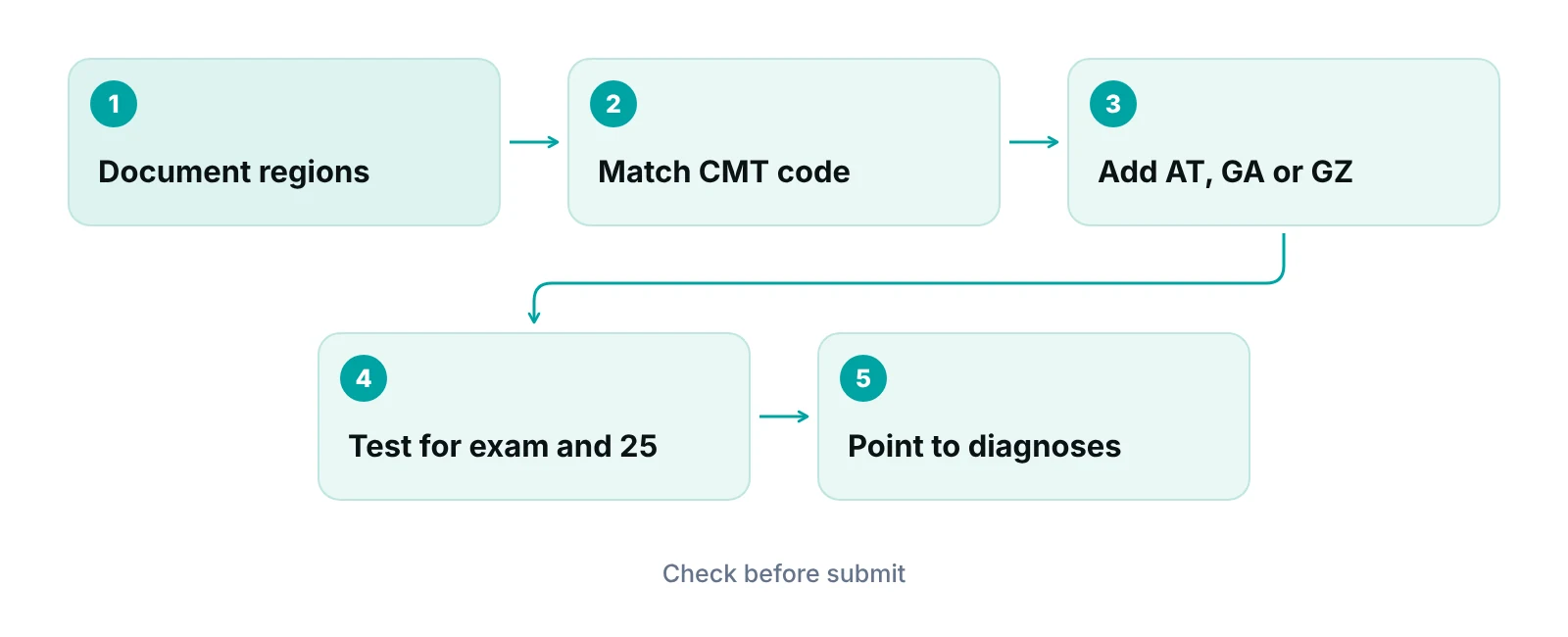
Check each claim against the note before it leaves the building, not after the denial. Most errors are visible in the claim itself: a Medicare CMT line without AT, an exam without a matching reason for modifier 25, or a region count that does not match the note.
Our clean claims guide explains how front-end edits work, and our denial management guide covers what to do after a rejection. If you do not have time for either, medical billing services can take over charge entry and coding review, and chiropractic billing support is set up around CMT, AT and the payer differences above.
A claim system can also hold the work in order. For example, a practice management system that tracks claims by stage can run data-completeness checks before submission and assign an owner to each claim. The coding choice stays with your clinician and coder.
Have your chiropractic claims reviewed
Send a sample of denied or delayed claims for a free practice audit. We look at coding, modifier use and payer rules and tell you what we find. Pricing, if you want help, is quoted after the audit.
Our recommendations
- Split your claims by payer first. We recommend a separate coding rule sheet for Medicare, Medicare Advantage and each large commercial payer. One list for all payers is how AT, 25 and exam rules get mixed up.
- Make AT a required field on Medicare CMT lines. Set your system to stop a Medicare 98940, 98941 or 98942 line that has no modifier. Then check that documentation supports active treatment.
- Tie the region count to the note. Have the provider mark treated regions in the note, and let the code be selected from that. This prevents 98942 appearing on a note that lists two regions.
- Reserve modifier 25 for real exams. Add a short reason line in the note for every separate exam. If you cannot write one, bill the manipulation only.
- Use an ABN process for maintenance care. Decide as a practice how to explain maintenance care, when to collect an ABN and how to apply GA or GZ, and train the front desk on it.
- Audit a small sample every quarter. Pull ten claims per provider and compare note, code, modifier and diagnosis. Fix the pattern, not just the claim.
Track chiropractic claims by stage with an owner on each.
Our portal tracks each claim by stage with an assigned owner, runs data-completeness checks before submission and lets workflow rules hold a claim for review. Code and modifier decisions stay with your clinicians and coders.
See how the RCM Finder portal works · Create a portal account
Disclosure: RCM Finder builds and sells this portal. It is a practice management system, not an EHR.
Bottom line
Bottom line: match the code to the documented regions, add AT on Medicare CMT lines, and use modifier 25 only for a real, separate exam. Then check each payer’s policy for what else it pays. If you want a second pair of eyes on a batch of claims, our denial management services and chiropractic billing support start with a free practice audit.
Frequently asked questions
What are the main CPT codes for chiropractic billing?
The main codes are 98940, 98941 and 98942, which report spinal manipulation of 1 to 2, 3 to 4 and 5 regions. Code 98943 reports extraspinal manipulation. Exams, x-rays and therapy codes may be allowed by some payers, but Medicare’s chiropractic benefit centers on the spinal manipulation codes.
Which modifier does Medicare require on chiropractic claims?
The AT modifier is required on 98940, 98941 and 98942 when treatment is active or corrective. Without it, Medicare treats the claim as maintenance and denies it, according to the First Coast code guide. AT should not appear on the same line as GA, GX, GY or GZ.
Can I bill an exam and a manipulation on the same day?
Sometimes. Commercial payers may pay a separate E/M with modifier 25 when the exam is significant and separately identifiable from the pre-manipulation assessment. A routine visit with manipulation only does not qualify. Medicare does not list E/M services among the services it covers for chiropractors, so read the payer policy.
What is the difference between GA and GZ?
Both signal that a denial is expected. GA means the patient signed an Advance Beneficiary Notice. GZ means no ABN is on file. They are used for services such as maintenance care that Medicare does not consider reasonable and necessary. Never place them on the same line as AT.
How do I choose between 98940, 98941 and 98942?
Count the spinal regions that were treated and documented: cervical, thoracic, lumbar, sacral and pelvic. One to two regions is 98940, three to four is 98941 and five is 98942. Report only one of them for the visit, since the codes are not add-ons.
Why are chiropractic fee ranges not listed here?
Reimbursement depends on the payer’s contract, the fee schedule and the region, so a single range is not reliable. Pull allowed amounts from your own remittances or fee schedules. A free audit can compare what each payer actually paid for 98940 to 98942 against what you expected.
Get your free practice audit
Tell us about your practice. We will contact you using the details you give.
- A review of your recent claims, denials and A/R aging
- Where your front desk and prior authorizations slow payment
- A prioritized fix list you keep, whether or not you hire us
Pricing is quoted after the audit, based on your volume and the services you choose. Prefer to talk? Call +1 (302) 556-2288.
Sources
- Modifier AT — Noridian Healthcare Solutions (Medicare) (2025)
- Coding Guidelines for Chiropractic Services — CMS Medicare Coverage Database (LCD attachment) (n.d.)
- LCD 98940 Chiropractic Services code guide — First Coast Service Options via CMS Medicare Coverage Database (n.d.)
- MMA 651 chiropractor presentation — CMS (2005)
- Medicare Chiropractic Services clinical guideline 496 — UnitedHealthcare (2026)
- Evaluation and management with chiropractic manipulation tip sheet — Blue Cross and Blue Shield of Vermont (n.d.)
- Time and medical decision making levels for E/M — American Academy of Family Physicians (2026)
Disclaimer: This article is educational and is not legal, coding, billing or compliance advice. CPT is a trademark of the American Medical Association, and the code descriptions here are our own summaries. Payer rules and contracts vary, and policies change. Check current CMS, AMA and payer sources before you bill.