Denial root cause analysis is a monthly review that turns remittance data into fixes. Pull every denied line from your 835 files, group the lines by CARC and RARC and by the step where the error began, give each top group one owner and one upstream fix, then check next month whether it stopped.
Many practices work denials: correct, resubmit, appeal, repeat. That recovers money, and our denial management guide covers how. Root cause analysis asks a different question: why did the same denial come back this month, and which step in your office has to change so it does not come back next month?
This guide gives you a six-step workflow you can run once a month with a spreadsheet or a BI tool. It uses the X12 code lists, CMS guidance and HFMA definitions, so your numbers mean the same thing every month. The steps below reflect how our team reads claim and remittance data.
Key takeaways
- Start from the 835: group codes, CARCs and RARCs are standard X12 lists, so every payer’s denials sort the same way.
- The code says what the payer saw; tag each denial with the step where it started.
- Rank groups by denied dollars and repeat count, and work only the top few.
- Give each group one named owner, one upstream fix and one measure for next month.
- Track HFMA’s remittance denial rate (AR-5) and a repeat count per group.
What is denial root cause analysis, and how is it different from working denials?
Denial root cause analysis finds the internal step that caused a group of denials, so you can change that step. Working denials fixes one claim at a time. You need both, but only root cause analysis lowers next month’s volume.
HFMA separates three layers: the payer’s reason code, the denial issue (such as coding or documentation) and the root cause, the internal failure behind it. Finding that cause means reviewing the record, the charges and the claim as billed, not only the remittance code.
| Question | Working denials (daily) | Root cause analysis (monthly) |
|---|---|---|
| Goal | Get this claim paid | Stop this denial repeating |
| Unit of work | One claim or line | A group of similar denials |
| Main input | Remittance and patient record | A month of 835 data plus sample records |
| Who does it | Billers and A/R staff | Billing lead with front desk, coding and providers |
| Output | Corrected claim, reopening or appeal | A named owner and an upstream fix |
| Proof it worked | The claim is paid | The group shrinks next month |
Comparison based on common operating practice; no sourced statistics.
Related reading: common causes of denied claims, avoiding common insurance denials, setting up a denial management program and denial management across the revenue cycle.
Why is a monthly denial review worth the time?
Denials are common and costly to rework, and many start with errors a practice can prevent. Recent data shows the scale.
In a Premier survey published in February 2025, 280 hospitals reported an average initial denial rate of nearly 15% on 2023 claims. The cost of fighting a denial rose from $43.84 per claim in 2022 to $57.23 in 2023, and about 70% of denials were eventually overturned and paid. Premier surveyed hospitals, not physician practices, so treat these figures as direction, not a benchmark.
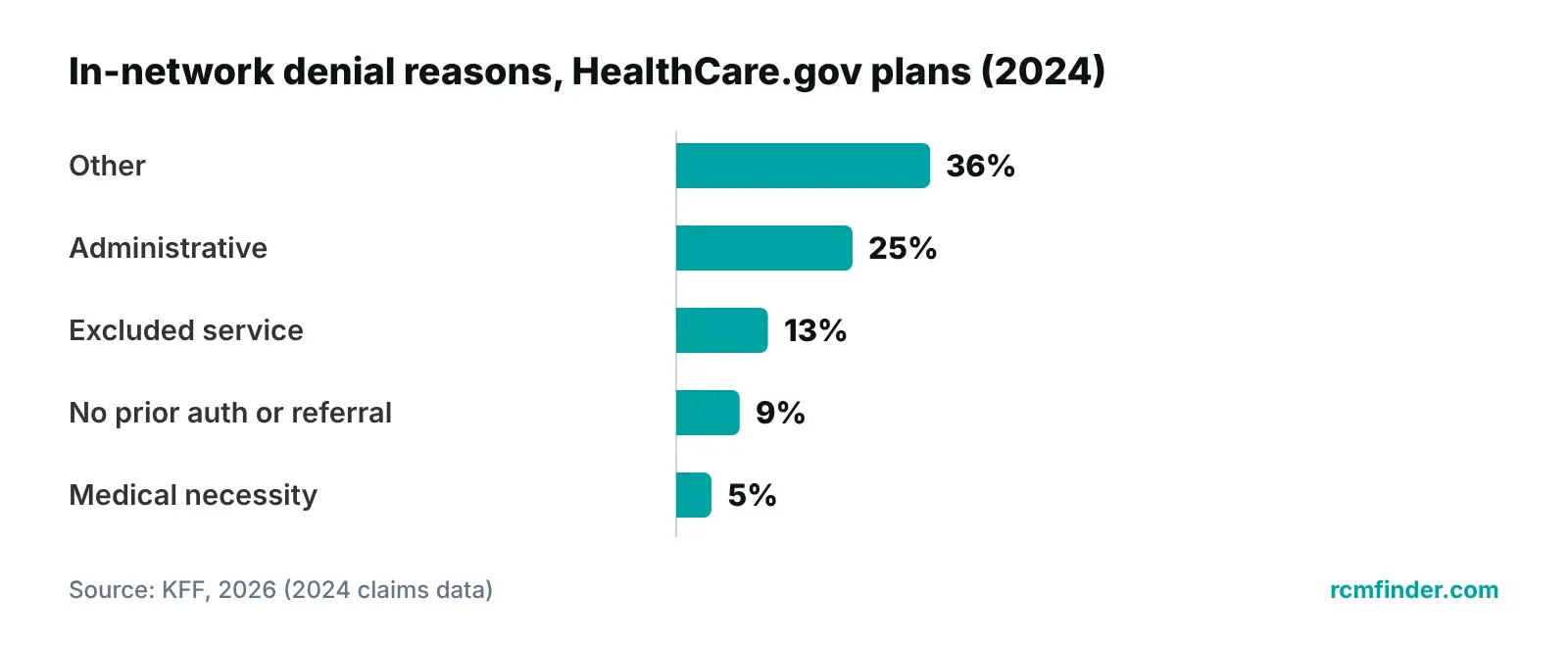
KFF‘s analysis of 2024 HealthCare.gov claims, published in March 2026, found that insurers denied 19% of in-network claims. Administrative reasons made up 25% of denial reasons and missing prior authorization or referral 9%, while 36% were listed only as “other.” Fewer than 1% of denied claims were appealed.
Practices see it too. In an MGMA Stat poll on March 5, 2024, 60% of medical group leaders said denials had risen versus the same period in 2023, about 29% saw no change and 11% saw a drop. Causes named included insufficient documentation, eligibility and ID errors, untimely filing and modifier errors.
Why "other" matters for your own review
KFF notes that reasons are not tied to specific services, one claim can count under several reasons and 36% fell under “other.” Summaries like this cannot show where your process broke. Your own 835 data can.
Not sure where your denials start?
Our free practice audit reviews a sample of your remittances and denials and shows which step causes the most rework.
Get a Free Practice AuditStep 1: Pull one month of remittance data and rejections
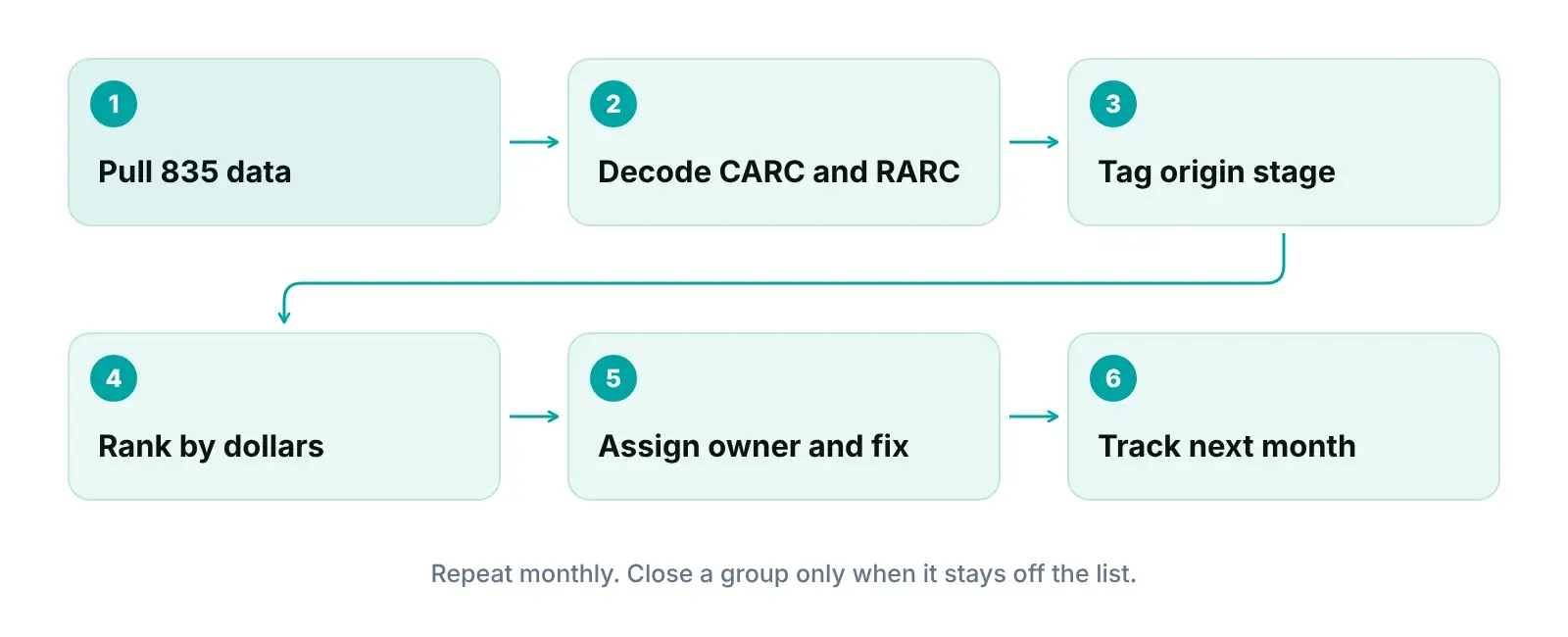
Export every denied or partly denied line from last month’s 835 electronic remittance advice files, then add the claims your clearinghouse rejected. Select by remittance date, not date of service, so each month’s set is complete and does not overlap.
The CMS remittance advice booklet names the ASC X12N 835 (version 5010) as the adopted HIPAA standard, so every payer’s ERA has the same structure (our guide to electronic remittance advice covers the basics). Rejected claims never reached adjudication, so pull them from clearinghouse reports (see our clearinghouse rejection codes guide).
Fields to export for each denied line
- Claim number, patient account, date of service and remittance date
- Payer and plan, rendering provider and location
- CPT/HCPCS code, modifiers, units and diagnosis pointers
- Billed, allowed and paid amounts, plus the adjustment amount
- Group code, CARC and every RARC on the line
- Whether an authorization number was on file
Leave routine adjustments out of the count
Contractual write-downs (often CO-45, charge above the fee schedule or contracted amount) and patient cost sharing (PR-1 deductible, PR-2 coinsurance, PR-3 copay) are adjustments, not denials. Keep them on a separate tab.
Step 2: Decode each denial with its group code, CARC and RARC
Read the three codes together. The group code says who owns the amount, the Claim Adjustment Reason Code (CARC) says why it was adjusted, and the Remittance Advice Remark Code (RARC) adds the detail you need to act.
- Group codes: X12 lists CO (Contractual Obligation), OA (Other Adjustment), PI (Payor Initiated Reduction) and PR (Patient Responsibility). CMS explains that CO assigns the amount to the provider; Medicare patients can be billed only for PR amounts.
- CARCs: the X12 CARC list explains why a line was paid differently from how it was billed. Codes such as 16, 96 and 252 require a remark code.
- RARCs: the X12 RARC list has supplemental codes that explain a CARC and informational “Alert:” codes that do not. Group by the supplemental ones.
Combinations are also more consistent now. A June 2025 CMS transmittal (CR 14106) requires Medicare contractors to use only CAQH CORE-listed combinations for four business scenarios, and says all health plans must comply with the CORE 360 rule. CAQH CORE defines them as missing documentation, missing or invalid claim data, a service not covered and a benefit not separately payable.
| Code (example remark) | X12 meaning, in short | Where it usually starts | Likely owner |
|---|---|---|---|
| CO-27 | Expenses after coverage ended | Eligibility not re-checked before the visit | Front desk lead |
| CO-31 | Patient not identified as the payer’s insured | Registration: member ID, name, birth date | Front desk lead |
| CO-22 | Another payer may cover it (COB) | Other coverage missed at intake | Front desk lead |
| CO-197 (N54) | Authorization absent | No approval, or billed codes differ from it | Authorization coordinator |
| CO-16 (M51, MA120, MA130) | Missing information or billing error | Charge entry and claim build | Billing lead |
| CO-4, CO-11, CO-97 | Modifier or diagnosis mismatch; service bundled | Coding and charge entry | Coding lead |
| CO-50 (N115) | Not medically necessary per payer | Documentation vs payer policy or LCD | Provider and coding lead |
| CO-29 | Filing time limit expired | Claim held, lost or sent late | Billing lead |
Source: code meanings paraphrased from the X12 CARC, RARC and group code lists (x12.org, 2026). The last two columns are a working map, not a rule; payers may use other group codes.
On secondary claims, MA04 or N4 means the primary payer’s details were missing. MA130 means the claim was unprocessable with no appeal rights, so send a new, corrected claim. More in our CO-16 denial code guide.
Keep your code table current
CMS has its contractors load CARC and RARC updates three times a year, around March 1, July 1 and November 1 (CMS Transmittal 13791, May 2026). Refresh your lookup table from X12 after each cycle.
Step 3: Tag each denial with the stage where it started
Add one column that names the step in your own workflow where the error began. The code tells you what the payer saw; the stage tells you who can stop it.
- Front desk: registration, eligibility, coordination of benefits.
- Authorization and referrals: approval missing, expired or for other codes or units.
- Documentation: the note does not support the service or its necessity.
- Coding and charge entry: wrong code, modifier, diagnosis link or units.
- Billing: missing claim data, late filing, attachments not sent.
- Payer: the claim was right and the payer processed it wrongly.
Do not tag by code alone. A CO-197 can start at scheduling, or it can be a payer error; leaders in MGMA’s 2024 poll described payers citing missing prior authorization that was already on file. Check a few records per large group against the note and the approval before choosing the stage, and tag a denial as payer-caused only with evidence, such as the authorization number or the policy.
Give documentation its own stage. In the CMS fiscal year 2025 improper payments fact sheet (January 2026), most improper payments across CMS programs were cases where reviewers could not confirm payment because documentation was insufficient. CMS stresses this is not a measure of fraud.
Step 4: Rank denial groups by dollars and repeat count
Build a pivot by origin stage and code group, then sort by denied dollars and by claim count. Work the top groups only: a short list that gets fixed is worth more than a long list that gets read.
- Denied dollars: the sum of adjustment amounts in the group.
- Claim count: how many claims, and how many distinct patients, providers and locations.
- Repeat flag: whether the group was on last month’s list.
- Payer concentration: whether one payer drives most of the group, which points to a payer-specific rule or a payer error.
Ranking is for prevention. Recoverable claims still go to the daily work queue right away, because appeal clocks keep running. For Medicare, CMS allows 120 days from receipt of the initial determination to request a redetermination, with receipt presumed 5 calendar days after the notice date; minor errors and omissions go through a reopening instead.
Timely filing denials are hard to recover. Under 42 CFR 424.44, a Medicare claim must be filed within 1 calendar year after the date of service, with limited exceptions. For CO-29, prevention is the only real fix.
Step 5: Give each group one owner and one upstream fix
Each top group gets one named person, one specific root cause, one upstream change and one measure for next month. A department is not an owner, and “staff education” is not a fix unless it says what changes.
| Denial group | Specific root cause | Owner | Upstream fix | Measure next month |
|---|---|---|---|---|
| CO-27, one location | Coverage checked at booking, not before the visit | Front desk lead | Re-verify eligibility before every visit | CO-27 count there |
| CO-197 with N54 | Approval for different codes or units than billed | Authorization coordinator | Match approval to scheduled codes and units | CO-197 count |
| CO-4, one procedure | Payer-required modifier left off | Coding lead | Add the payer’s rule to the claim scrubber | CO-4 count for it |
| CO-50 with N115 | Diagnosis outside the LCD’s covered indications | Provider and coding lead | Check the LCD before scheduling | CO-50 count for that LCD |
| CO-29 | Held claims with no age alert | Billing lead | Alert on claims not sent within your limit | Unsent claims past limit |
Illustrative examples of actionable root causes; not data from any practice. Code meanings: X12 code lists (2026).
“A root cause that only names a department is not finished. Name the step, the missing check and the person who will add it.”
— Awais Afzal, Healthcare Operations & Data Analyst
Take payer-side groups to payer representatives with claim examples; MGMA’s 2024 article also suggests regular check-ins with top payers. In the RCM Finder portal, automation rules can flag a claim for review, hold or advance a stage, or assign an owner, so a recurring check becomes a rule instead of a memo.
Step 6: Track whether the fix worked
Open each review with last month’s action log. Compare each group’s count and dollars with the month before; keep it open until it stays off the top list, and reopen it if it returns.
For the overall trend, use published definitions. HFMA’s MAP Keys (2023 edition), which apply to physician organizations as well as hospitals, define two monthly measures:
- Remittance denial rate (AR-5): claims denied ÷ claims remitted in the month, counting only actionable denials and leaving out patient-responsibility and duplicate-claim denials.
- Denial write-offs (AR-6): net denial write-offs in the month, after recoveries, ÷ average monthly net patient service revenue for the latest three months.
Add a repeat rate: the share of this month’s denials that fall into a group already on your log. If it falls, your fixes are working. Our revenue cycle KPI guide covers the wider scorecard, and our dashboards in our own practice management system for medical practices can show denials by payer, code and provider on one page.
Put a dollar figure on repeat denials
Enter your monthly claim volume, average claim value and denial rate in our revenue calculator to estimate what denials cost you each month.
Open the Revenue CalculatorHow to run the monthly denial review meeting
Keep the same agenda and the same people every month. The billing lead runs it, with the front desk lead, the authorization coordinator, the coding lead and one provider.
- Review last month’s action log: done, not done, and what the numbers show.
- Walk the top groups by dollars and repeat count, with two or three example claims each.
- Agree on the stage and specific root cause for each new group.
- Assign one owner, one fix and one date, and log them.
- List payer-side items to raise with payer representatives.
- Note code-list or payer-policy changes for next month.
Our RCM team reviews denial reasons and root causes with clients as part of our revenue cycle management services. The same agenda works for an in-house team.
Our recommendations
- Start with one month and one spreadsheet. We would rather see a simple review run every month than a dashboard nobody opens. Add tooling once the habit holds.
- Keep the claim queue and the cause list apart. Appeals and fixes have different deadlines. We keep appeals in the daily queue and causes in the monthly log, so neither waits.
- Read the claim before you choose the stage. We check a few records per group before tagging it. The code alone can mislead, especially for authorization and medical necessity.
- Turn each fix into a check, not a reminder. A fix that depends on memory fades. We make it a checklist step, a scrubber edit or a work-queue rule.
- Use published definitions for the trend. We report the remittance denial rate as HFMA defines it, so the number means the same thing every month.
- Bring evidence to payers. For payer-caused groups, we bring claim examples, authorization numbers and policy references. Evidence is harder to dismiss than a complaint.
Bottom line
Appeals recover money that has already gone wrong; root cause analysis keeps it from going wrong again. A monthly review turns your 835 data into a short list of upstream fixes, each with an owner. If you want a team to run that loop alongside billing, coding and A/R follow-up, see our end-to-end revenue cycle management services or start with a free practice audit.
Frequently asked questions
What is the difference between a claim denial and a rejection?
A rejection happens before the payer processes the claim, usually at the clearinghouse or the payer’s front-end edits, because data is missing or invalid. The claim never reaches adjudication, so it does not appear on an 835. A denial comes back on the remittance after the payer has processed the claim. Track both, but count them separately.
What are CARC and RARC codes?
Claim Adjustment Reason Codes (CARCs) explain why a claim or service line was paid differently from how it was billed. Remittance Advice Remark Codes (RARCs) add detail, such as which item was missing. Both are X12 code lists and appear on the 835 electronic remittance advice next to a group code such as CO or PR.
How often should a practice do denial root cause analysis?
Monthly works for most practices. It gives enough volume to see patterns and enough time to test a fix. Work individual denials daily, because appeal deadlines keep running. Larger groups, or practices switching EHRs, may also want a short weekly look at their top denial groups.
Who should own denial prevention in a small practice?
One person should run the review, usually the billing lead or practice manager. Each denial group then gets its own owner in the step where it starts: the front desk for eligibility, the authorization coordinator for approvals, the coder for code and modifier issues and providers for documentation.
What denial rate should we aim for?
There is no single published target that fits every specialty and payer mix. HFMA’s MAP Keys define how to calculate the remittance denial rate but do not set a universal goal. Track your own rate monthly with the same definition, and judge progress by the trend and by whether your top groups shrink.
Does root cause analysis help with denials already on our books?
Indirectly. The review is for prevention, but it often shows which open denials share a fix, such as a corrected registration field. Work those claims in your daily queue before their deadlines. For Medicare, a redetermination request is due within 120 days of receiving the initial determination.
Get your free practice audit
Tell us about your practice. A member of our operations team replies within one business day.
- A review of your recent claims, denials and A/R aging
- Where your front desk and prior authorizations slow payment
- A prioritized fix list you keep, whether or not you hire us
Pricing is quoted after the audit, based on your volume and the services you choose. Prefer to talk? Call +1 (302) 556-2288.
Sources
- Claim Adjustment Reason Codes — X12 (2026)
- Remittance Advice Remark Codes — X12 (2026)
- Claim Adjustment Group Codes — X12 (2026)
- Remittance Advice Resources and FAQs (MLN booklet) — CMS Medicare Learning Network (Undated (read 2026))
- Transmittal 13791 (CR 14492): CARC, RARC, MREP and PC Print Update — CMS (2026)
- Transmittal 13253 (CR 14106): Implement Operating Rules, Phase III ERA/EFT, CORE 360 Uniform Use of CARC, RARC and CAGC Rule — CMS (hosted by HHS) (2025)
- CAQH CORE Uniform Use of CARCs and RARCs (national webinar) — CAQH CORE (2014)
- Claims Denials and Appeals in ACA Marketplace Plans in 2024 — KFF (2026)
- Claims Adjudication Costs Providers $25.7 Billion – $18 Billion is Potentially Unnecessary Expense — Premier Inc. (2025)
- Strategic improvements in your RCM to reduce your practice's claim denials (MGMA Stat) — MGMA (2024)
- MAP Keys, 2023 Edition — HFMA (2023)
- Getting to the root causes of denials — HFMA (2022 (first published 2019))
- First Level of Appeal: Redetermination by a Medicare Contractor — CMS (2026)
- 42 CFR 424.44 — Time limits for filing claims — eCFR (National Archives) (2026)
- Fiscal Year 2025 Improper Payments Fact Sheet — CMS (2026)
Disclaimer: This article is general educational information about revenue cycle operations. It is not legal, coding, billing-compliance or financial advice. Code lists, payer rules, filing limits and appeal deadlines vary by payer and plan and change over time. Confirm requirements with the payer, your contracts and qualified advisors before acting.