
Neonatology Specialty

Neonatology Billing Services for NICU and Hospital-Based Neonatal Groups

Daily critical and intensive care codes, delivery-room claims and newborn Medicaid follow-up, built on CMS rules and your payer contracts, with coverage checks and a claims portal.
  • Works inside your current EHR
  • US practice time zone, every shift
  • Weekly KPI reporting, or on your schedule
Neonatology billing dashboard with babies by care level, held newborn claims, denials by reason, A/R days and unbilled days

Quick answer

Neonatology billing services manage daily NICU charges: delivery-room attendance and resuscitation, critical care (99468, 99469), intensive care (99477 to 99480, later days set by weight) and discharge. Accurate claims also depend on newborn coverage, because a baby often has no Medicaid ID when care starts. A good partner tracks level of care, weight and enrollment every day.

Disclaimer: This page is educational and is not legal, coding or compliance advice. CPT and HCPCS code sets, Medicare and NCCI rules, state Medicaid policies and payer contracts change often and differ by state and plan. Verify every code, limit and rule against the current CPT book, CMS documents, your payer manuals and your contracts before billing.

Why neonatology billing is different

A neonatology claim is a daily claim for one baby whose condition, weight and coverage can change overnight. The code depends on how sick the baby is that day. The payer may not yet have the baby in its system.

Neonatal critical and intensive care codes are per diem codes. The 2026 NCCI Policy Manual, chapter 11 says codes 99468 to 99480 are generally reported by one provider on each day of service: the one directing the baby's inpatient critical or intensive care. For a hospital-based group, charges are captured by baby and by day, not by physician or by shift. A missed day is lost revenue; two physicians billing one day can trigger a denial.

Payer mix adds a second layer. In CDC data for 2021, Medicaid paid for 41.0% of births, and CDC lists 40.2% for 2024. A baby's own Medicaid number often arrives after the NICU stay begins, so claims wait on enrollment.

Where neonatal claims usually go wrong

  • The level of care changes and the charge does not.
  • The weight behind the intensive care code is stale.
  • The baby passes day 28 and the age-based code is not switched.
  • A claim goes out before the newborn's ID or authorization is linked.
  • The discharge day carries both a daily code and a discharge code.

A 2023 NICU coding review in the Journal of Perinatology cites a national survey showing limited coding knowledge among neonatal clinicians, and links coding training to higher accuracy. We add a coder-level check before the claim.

For adult and hourly critical care, see our critical care billing guide. For general pediatric practices, see our pediatric billing post.

The four pillars, built for a neonatology group

A hospital-based neonatology group needs hospitals that trust it, daily NICU data, claims built on the right level of care and a view of every baby's account.

Revenue leaks at the handoffs: a missed transfer, a weight that never reaches the biller, an ID nobody chased. We run all four pillars on one set of rules.

Pillar 1 · Healthcare Marketing

Healthcare Marketing for neonatology groups

Parents do not shop for a NICU group; hospitals choose who covers their units. Our healthcare digital marketing builds what they and job candidates check.

  • Coverage and hospital partner pages
  • Recruiting pages for neonatologists and nurse practitioners
  • Follow-up clinic pages, if you run one
  • Review replies that never confirm someone is a patient
Explore Healthcare Marketing
Pillar 2 · Virtual Medical Assistants

Virtual Medical Assistants for NICU coverage checks

Our virtual medical assistants for neonatology work on your practice's time zone. They confirm the mother's plan, watch for the baby's ID and handle authorization notices and parent calls.

  • Mother's coverage confirmed at birth
  • Newborn ID checked on a fixed schedule
  • Payer notification and authorization follow-up
  • Parent calls about statements
Explore Virtual Medical Assistants
Pillar 3 · End-to-End RCM

End-to-End RCM for neonatal claims

Our end-to-end revenue cycle management covers daily charge capture, coding support, claim scrubbing, payment posting, denials and A/R follow-up, with extra checks on level of care, weight and transfers.

  • Charges built from the daily census
  • Weight and level of care matched to the code
  • Claims for babies without an ID held and tracked
  • KPI: denials by reason and A/R days
Explore End-to-End RCM
Pillar 4 · Practice Management System

Practice Management System for neonatal billing

Our practice management system tracks each claim by stage, applies specialty-aware billing logic per claim, checks data completeness before submission and flags underpayments. Billing companies get a client portal.

  • Workflow rules that hold claims missing key fields
  • Underpayment flags against expected amounts
  • Role-based permissions and an audit log
  • Coming next: provider credentialing module
Explore Practice Management System

Find where your NICU claims leak

We review recent daily charges, remittances and denials, then show where level of care, weight or newborn coverage cost you.

Get a Free Practice Audit

Neonatal service families: codes, rules and denial triggers

The table groups the services a neonatology group reports most. Codes are described in our own words; check the current CPT book and each payer's policy.

Neonatal service families: codes, rules and denial triggers
ServiceCodes (our wording)Rule to knowTypical denial trigger
Attendance at a delivery99464: standby and first stabilization when the delivering clinician asksHighmark pays one per newborn per deliveryNo record of who requested attendance
Delivery-room resuscitation99465: resuscitation of a newborn who needs itHighmark combines 99464 and 99465 from one clinician and pays 99465 onlyBoth lines billed and both expected to pay
Normal or sick but stable newborn99460 and 99463 (same-day admit and discharge); 99221 to 99223AAFP: babies who need no intensive services use hospital care codesIntensive level billed from a stable-baby note
First intensive care day99477: baby 28 days or younger, not critically illBaby 28 days or younger, any weight (J Perinatol 2023); once per day, one physician (AAFP)A baby over 28 days billed with 99477, or two physicians on one day
Later intensive care days99478 under 1,500 g; 99479 1,500 to 2,500 g; 99480 2,501 to 5,000 gPresent weight each day; can continue past day 28Weight not recorded or copied forward
Neonatal critical care99468 first day; 99469 later days; baby 28 days or youngerPer diem; one directing provider per day (NCCI 2026)Note lacks organ failure or high-complexity decisions
Critical care, 29 days to 24 months99471 first day; 99472 later daysDay of birth is day 0; day 29 starts this rangeNeonatal code billed after day 28
Discharge day99238 (30 minutes or less); 99239 (more than 30)Record exact minutes; NCCI says discharge codes include other E/M that dayDaily code plus discharge code, or '>30 min' only

Sources: CMS NCCI Policy Manual ch. 11 (2026); Lakshminrusimha et al., J Perinatol (2023); AAFP newborn care coding page; UT Health Houston coding guide; Highmark RP-023 (2023). Payer policies differ.
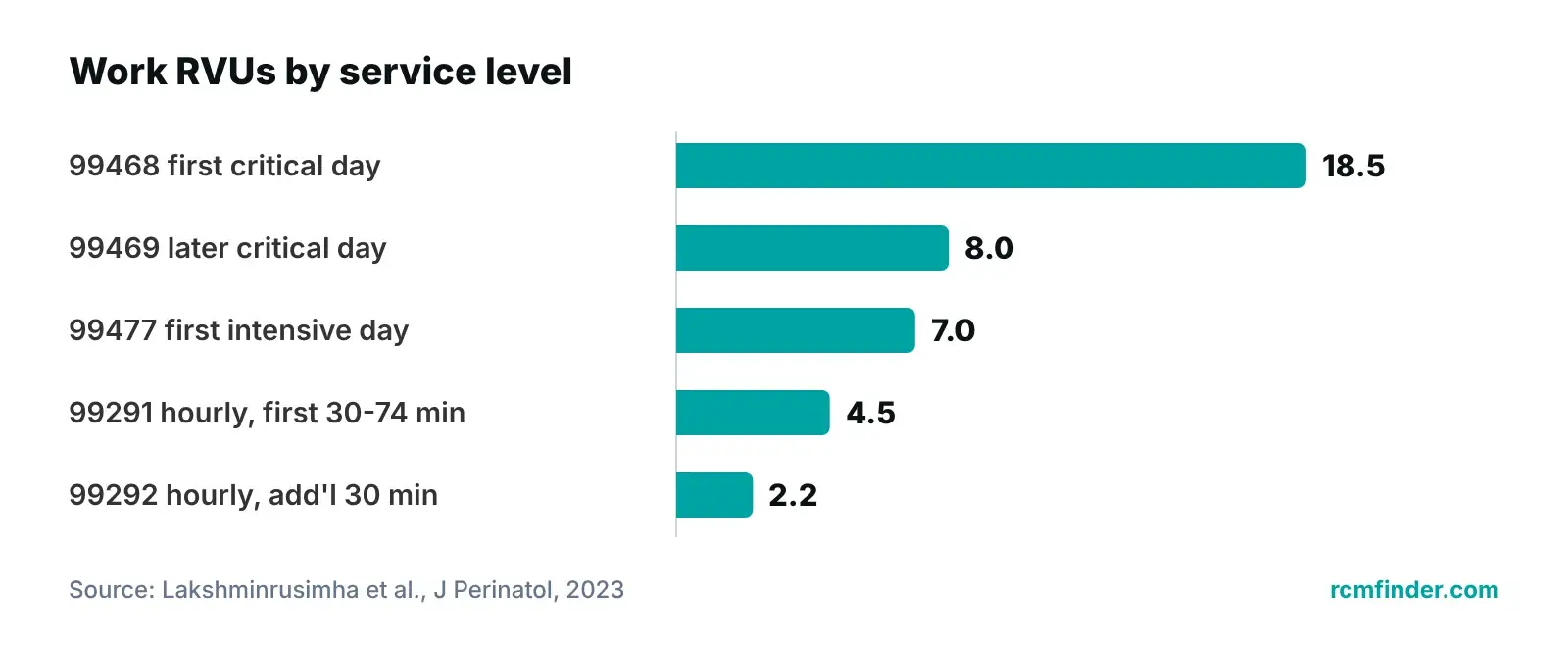
Bar chart of work RVUs: 99468 at 18.46, 99469 at 7.99, 99477 at 7.00, 99291 at 4.50 and 99292 at 2.25
Physician work RVUs show why level of care matters. They are not payment amounts, which depend on the conversion factor and contract.

The first day sets the level

Initial codes are not admission codes. Per the Journal of Perinatology review, 99468 is used once during a hospital stay, and a baby who becomes critically ill later can receive 99468 that day. The review limits 99477 to babies 28 days or younger, whatever the weight; AAFP says it is reported once per day by one physician. For a baby admitted at 29 days or older, the review points to a hospital admission code, such as 99223 when decision making is complex.

Present weight picks the intensive care code

AAFP and the same review agree: 99478, 99479 and 99480 follow present body weight. A baby at 1,500 g on Tuesday is 99479, and at 1,499 g on Wednesday is 99478. Above 5,000 g there is no subsequent intensive code, so a subsequent hospital care code applies. Birth weight alone is not enough; weight must be recorded daily.

Delivery-room attendance and resuscitation

Highmark's newborn care policy (reviewed July 2023) lets a clinician other than the delivering one be paid for attending a high-risk delivery, and treats intubation (31500) as separate from resuscitation. Other payers may differ.

Daily charge capture: dates, same-day services and documentation

Each baby gets one level-of-care decision per day, supported by that day's note.

Admission, transfer and discharge dates

The Journal of Perinatology review sets out transfer scenarios. Within one facility and group, one daily code is billed. If a baby moves between two facilities covered by the same group, the review says the daily code is billed at only one of them. When a critically ill baby moves up to a different group, the sending physician uses hourly critical care (99291 and 99292) and the accepting physician uses a daily code. The NCCI manual adds that when a baby on an intensive care day becomes critically ill and moves to a different physician in a different group, the second provider may report a per diem critical care code. Some insurers deny same-day daily codes from two groups.

On the discharge day, 99238 and 99239 depend on total minutes that calendar day. The review advises writing a number, such as 45 minutes, not a range.

Same-day procedures and add-ons

Umbilical vein or artery catheters, intubation and surfactant are bundled into the daily critical care code, according to the same review. NCCI says practitioners may not separately report services included in critical care or the extra neonatal services listed in CPT. Payers draw the line differently. Neighborhood Health Plan of Rhode Island’s guideline lists transfusions and lumbar puncture as bundled, while the review lists exchange transfusions, ECMO, cooling start (99184), PICC placement (36568), CPR (92950) and chest tubes as separately reportable. UnitedHealthcare follows NCCI on when modifier 59, XE, XS or XU may be used.

Our guide to modifiers 25 and 59 explains the basics. Set a payer rule per procedure.

What the daily note needs

  • Critical care: organ failure, the care given and high-complexity decisions. Respiratory failure should follow an established definition, such as blood gas or saturation values needing active treatment.
  • Intensive care: the condition, a need for continuous or frequent monitoring or therapy changes, and constant team observation.
  • Weight: present weight on every intensive care day, and birth weight in the admission note.
  • Time: daily codes are not time-based. Minutes matter for discharge codes and hourly critical care, which excludes time spent on separately billable procedures.
  • Supervision: a statement that care was delivered under the clinician's supervision.

UT Health Houston’s coding guide shows the logic with low blood sugar: steady glucose fits a hospital care code, frequent rate changes can support intensive care, and a high infusion need with added drugs can support critical care. The facts in the note decide the level.

Newborn coverage: Medicaid enrollment, birth-date eligibility and the mother/baby claim problem

A baby's coverage usually starts on the birth date, but the ID that proves it can arrive days or weeks later. Until it does, a claim can go out under the mother's ID, wait in suspense or deny, depending on the payer.

Medicaid: deemed eligibility from birth

Under 42 CFR 435.117, a child whose mother was eligible for Medicaid and received covered services on the birth date is deemed eligible from birth to the first birthday, with no application. The mother's ID can be used until the state issues the baby's own number, which it must do before the mother's eligibility ends or the first birthday, whichever is first. Babies of mothers with emergency-only coverage, CHIP-covered babies and babies with Medicaid in another state on the birth date need their own number.

Plans and states set their own mechanics

A December 2025 notice from Blue Cross Blue Shield of Texas says providers may use the mother's Medicaid ID for newborn claims until the baby has a separate one, citing 2025 House Bill 3940. A February 2024 notice from CountyCare, a Cook County Medicaid plan, tells hospitals to notify its NICU utilization manager within 45 days of birth once enrollment is confirmed. It requires a prior authorization before claims, and claims sent before it moves to the newborn's ID may deny. A January 2024 CareSource notice for Ohio Medicaid says a claim billed above the well-newborn DRG with no authorization is paid at the well-newborn rate. That notice covers hospital DRG claims, so ask each plan how it treats professional claims.

Commercial and marketplace plans

For group health plans, 29 CFR 2590.701-6 requires at least 30 days after a birth to request enrollment, with coverage beginning on the date of birth. For marketplace plans, 45 CFR 155.420 gives 60 days and requires coverage effective on the date of birth (a later start can be chosen). Once the baby is added, coverage reaches back to birth, so held claims can be released.

Newborn coverage and authorization checklist
CheckWhenWhat to confirmWhy it matters
Mother's coverageDay of birthPlan type, ID, covered services that dayDeemed eligibility depends on her status at birth
Baby added to a planWithin the plan's windowEnrollment requested (30 days minimum, group; 60, marketplace)An unenrolled baby has no claim to bill
Newborn Medicaid IDOn a fixed scheduleID assigned; mother's ID accepted meanwhile?Rules differ by state and plan
Payer notificationPer payerNotice sent; authorization on the baby's IDClaims can deny or pay lower without it
Daily level and weightEvery dayLevel of care, present weight, transfersCode selection depends on them
Multiple birthsAt charge entrySeparate record and charge per babySome payers pay attendance per baby
Other coverageAt charge entryDifferent plans for mother and babyCoordination of benefits decides the primary payer

Sources: 42 CFR 435.117; 29 CFR 2590.701-6; 45 CFR 155.420; BCBSTX (2025); CountyCare (2024); CareSource (2024); Highmark RP-023 (2023). Confirm with each payer.
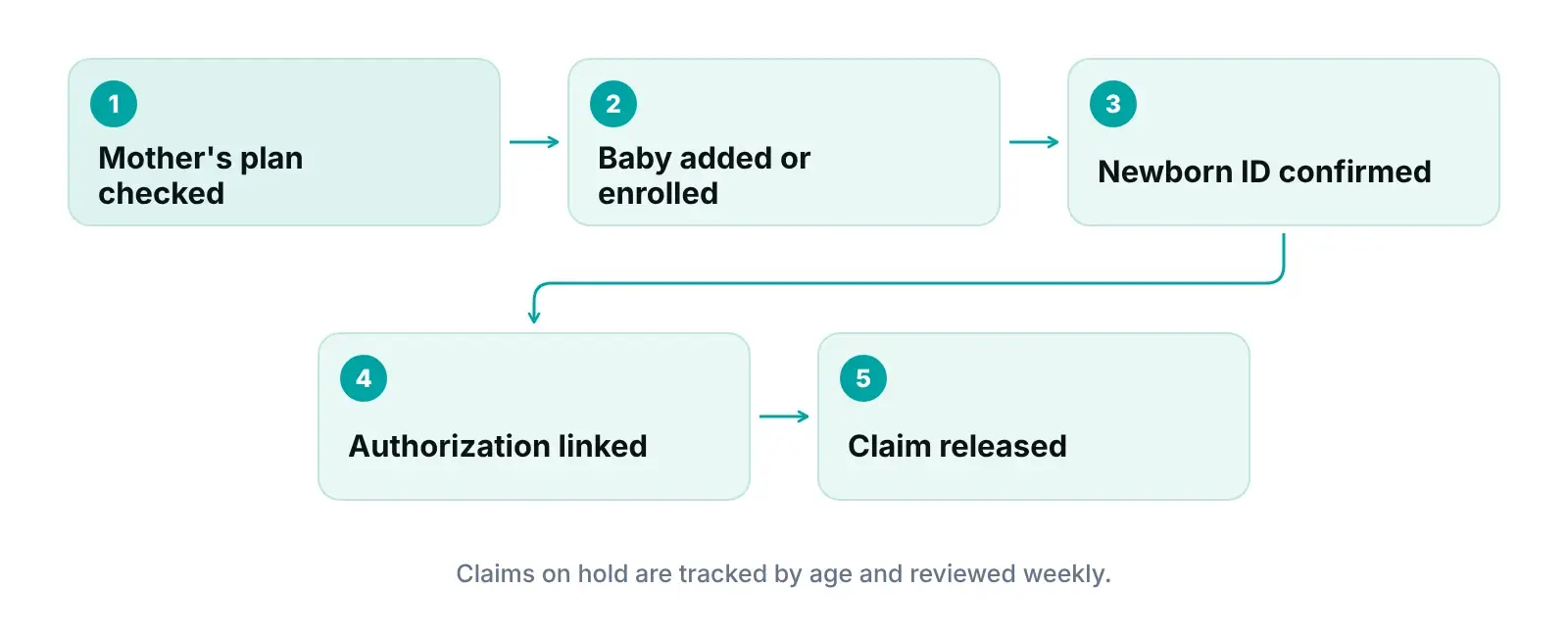
Diagram of newborn coverage steps from mother's plan check to newborn ID, authorization and claim release
How a NICU day becomes a payable claim when the baby's own ID is not yet in the system.

For general steps, see our posts on coordination of benefits, prior authorization and insurance verification.

See what held newborn claims cost you

Enter your claim volume and denial rate to estimate what delays and denials cost your group.

Open the Revenue Calculator

Hospital-based group billing: in-house team, billing-only vendor or four-pillar partner?

Most neonatology groups bill professional claims for physicians in a hospital's NICU, while the hospital bills facility claims. Our hospital vs professional billing guide explains the split.

Group billing brings three jobs: one daily code per baby, even when several neonatologists share a day; a daily feed of census, transfers, weight and discharge times from the hospital; and credentialing of every clinician with each payer and hospital. Our guides on group credentialing and Medicaid credentialing cover that work. When cardiology or pulmonology consults in your unit, NCCI says a second physician of a different specialty may report hourly critical care (99291, 99292).

In-house team, billing-only vendor or four-pillar partner for a neonatology group
QuestionIn-house teamBilling-only vendorFour-pillar partner
Daily charge capture from the censusYour staff, often by handDepends on the feedBuilt in, with a missing-day check
Level of care and weight checksYour coder's NICU trainingVaries; ask who reviewsCoder-level check before each claim
Newborn ID and authorization follow-upBillers with other workOften outside the contract; askVirtual medical assistants, fixed schedule
Denials and A/RIn-house teamIncludedIncluded, reasons reported weekly
Software and reportingYour EHR and reportsThe vendor's toolsPortal with stages, rules, dashboards
Hospital marketing and recruitingYour own staffNot usually offeredHealthcare marketing pillar
Staffing and coverage gapsYour riskVendor's riskShared team, your time zone

Source: RCM Finder's assessment. Scope varies by vendor and contract; ask for it in writing.

How it works

We start with a free audit, then build rules around your payers. We build our billing pipeline around how claims actually move through a practice: registration, charge entry, submission, payment and follow-up. For neonatology, we add the checks on this page.

  1. 1

    Free practice audit

    We review recent daily charges, remittances, denials and held newborn claims.

  2. 2

    Business Associate Agreement and access

    We put a Business Associate Agreement in place before accessing patient data. Then we work inside your existing EHR (for example PrognoCIS, eClinicalWorks or athenahealth) and agree how the census reaches us.

  3. 3

    Payer-rule map

    Your main payers' newborn, authorization and bundling policies become portal rules.

  4. 4

    Daily capture and coverage checks go live

    Charges are built from the census, weight and level are checked, and newborn IDs are chased on schedule.

  5. 5

    Weekly KPI review

    We report denials by reason, held-claim age and A/R days.

Talk to us about your neonatology group

Tell us which hospitals you cover and which payer is hardest. We will say honestly whether we fit.

Call +1 (302) 556-2288

Compliance: what to ask any neonatology billing company

Any vendor handling claims must sign a Business Associate Agreement before touching protected health information. HHS says that contract must set permitted uses, require safeguards and breach reporting, bind subcontractors and address return or destruction of data.

The minimum necessary standard asks for reasonable efforts to limit PHI to what a purpose requires; HHS exempts treatment disclosures, and billing is not treatment. A baby's chart and the mother's are separate records. Ask any vendor:

  1. Will you sign a Business Associate Agreement before accessing patient data, and do your subcontractors sign one?
  2. Who can see the mother's records and who can see the baby's, and how is that enforced?
  3. Is access role-based, and is every view or change logged?
  4. Are connections to your systems encrypted?
  5. Who reviews level of care and weight before a claim goes out?
  6. Which time zone does the team work in?

For RCM Finder, we use role-based staff permissions, an audit log and encrypted (HTTPS) connections, and we put a Business Associate Agreement in place before accessing patient data. See our HIPAA compliance checklist.

Who this is for, and who it is not for

We would rather tell you now than after you sign. Here is where we fit and where we do not.

A good fit if you are

  • Hospital-based neonatology groups covering one or several NICUs
  • Groups with a high share of Medicaid babies
  • Groups that track census, weight and level of care by hand
  • Groups with held or aging claims for babies without an ID
  • Billing companies serving neonatal clients that want a shared claims portal

Probably not a fit if you are

  • Hospital-employed neonatologists whose employer controls billing
  • Groups wanting promised collection rates; we report measured KPIs
  • Groups unwilling to change how census data reaches billing
  • Groups that need a credentialing module or in-portal real-time eligibility today (coming next)

Expert recommendations from our operations team

What we would do first if we were running your practice's revenue cycle tomorrow.

  1. 01

    Build charges from the census every morning

    A daily code is easy to miss. We compare the census with posted charges each day.

  2. 02

    Record weight on every intensive care day

    The code follows present weight. We ask for it daily and flag days that cross 1,500 g or 2,500 g.

  3. 03

    Put the level-of-care reason in one sentence

    A note naming the organ failure, or the frequent monitoring and therapy changes, supports the code. We offer a short template.

  4. 04

    Chase the newborn ID on a fixed schedule

    We set check dates for each baby and watch payer deadlines, such as notification windows, that start at birth.

  5. 05

    Hold claims for babies without an ID, but track them

    Held claims need an age, an owner and a weekly review, or they age out unseen.

  6. 06

    Review transfers and the day-28 line weekly

    Transfers between groups and the move to older-infant codes cause same-day conflicts. We read each one.

Frequently asked questions

What do neonatology billing services include?

They cover daily charge capture, coding support for delivery-room, intensive and critical care services, claim scrubbing, submission, denial management and A/R follow-up. A good partner also checks a newborn's coverage, follows up on the baby's ID and payer notification, and reconciles each day's level of care and weight with the note. We add front-desk assistants, referral-hospital marketing and a claims portal.

What is the difference between 99468 and 99477?

99468 is the first day of critical care for a critically ill baby 28 days old or younger. 99477 is the first day of intensive care for a baby 28 days or younger who is not critically ill but needs intensive observation and frequent interventions. The note must show which level the baby needed. The review says 99468 is used once per hospital stay.

How is the intensive care code chosen after the first day?

After the first day, 99478, 99479 and 99480 are chosen by the baby's present weight that day: under 1,500 g, 1,500 to 2,500 g, or 2,501 to 5,000 g. The code can change from one day to the next as the baby grows. Weight is not age-based here, so these codes can continue past day 28 for smaller infants.

Can we bill under the mother's Medicaid ID?

Under federal Medicaid rules, the mother's ID serves as a deemed newborn's ID for claims until the state issues the baby's own number. Plans and states set the mechanics. One Texas Medicaid plan announced this in December 2025, while others require the newborn's ID or an authorization first. Check each payer's manual and notices before submitting.

Who bills neonatal critical care when a baby is transferred?

CMS's NCCI manual says per diem neonatal codes are generally reported by one provider per day, the one directing the baby's care. If a baby on an intensive care day becomes critically ill and moves to a different physician in a different group, the second provider may report a per diem critical care code. Some payers deny same-day codes from two groups.

What does neonatology billing cost with RCM Finder?

We quote pricing after a free practice audit, because the work depends on your NICU volume, payer mix and the data feed from your hospital. The audit reviews recent charges, denials and held claims, then shows where revenue leaks. You get the findings whether or not you work with us.

No cost, no commitment

Get your free practice audit

Tell us about your practice. A member of our operations team replies within one business day.

  • A review of your recent claims, denials and A/R aging
  • Where your front desk and prior authorizations slow payment
  • A prioritized fix list you keep, whether or not you hire us

Pricing is quoted after the audit, based on your volume and the services you choose. Prefer to talk? Call +1 (302) 556-2288.

Tell us about your practice

RCMFinder Master Intake Form
AA

About the author: Awais Afzal

Healthcare Operations & Data Analyst, RCM Finder

Awais has spent more than 16 years in healthcare digital marketing and clinical operations management. He builds data-driven revenue cycle blueprints for high-ticket medical practices and leads product development of the RCM Finder portal. More about our team.

How we write: every figure, code and rule on this page was checked against the primary source listed below and independently fact-checked before publishing. We re-review this page every six months. Last reviewed October 12, 2026; next review April 12, 2027.

Sources

  1. NCCI Policy Manual for Medicare Services, Chapter 11 (Medicine, Evaluation and Management) — CMS (2026)
  2. Controversies in CPT coding in the neonatal intensive care unit: critical vs. intensive care — Journal of Perinatology (Lakshminrusimha et al.) (2023)
  3. Coding for newborn care services — AAFP (n.d.)
  4. Newborn Care Services 101 — UT Health Houston (McGovern Medical School) (n.d.)
  5. Reimbursement Policy RP-023: Newborn Care, Obstetrical Delivery and Associated Services — Highmark (2023 (reviewed July 24, 2023))
  6. Pediatric and Neonatal Critical and Intensive Care Services Policy (Professional) 2026R0126A — UnitedHealthcare (2026 (version dated Aug 1, 2026))
  7. Billing and Reimbursement Guideline: Inpatient Neonatal and Pediatric Critical Care — Neighborhood Health Plan of Rhode Island (2013 revision)
  8. 42 CFR 435.117 Deemed newborn children — eCFR via Cornell Legal Information Institute (current)
  9. 29 CFR 2590.701-6 Special enrollment periods — eCFR (current)
  10. 45 CFR 155.420 Special enrollment periods — eCFR via Cornell Legal Information Institute (current)
  11. Characteristics of Mothers by Source of Payment for the Delivery: United States, 2021 (NCHS Data Brief 468) — CDC / NCHS (2021 data)
  12. Birth Data — CDC / NCHS (2026)
  13. Providers May Use Mother's Medicaid ID When Submitting Claims for Newborns — Blue Cross Blue Shield of Texas (Dec 17, 2025)
  14. Newborn Eligibility and Authorizations Update — CountyCare Health Plan (Feb 14, 2024)
  15. Newborn and NICU Authorization Update (OH-MED-P-2320993) — CareSource (Jan 9, 2024)
  16. Business Associate Contracts — HHS (2013 (reviewed 2017))
  17. Minimum Necessary Requirement — HHS (2026 (modified Mar 18, 2026))