
Test units, immunotherapy vials and doses, biologic prior authorization and immune globulin claims for allergy and immunology practices, plus front-desk staff, patient marketing and a claims portal.
By Awais Afzal | Healthcare Operations & Data Analyst
Published October 12, 2026 · Last reviewed October 12, 2026 · Next review April 12, 2027
Quick answer
Allergy billing services handle the claims an allergy and immunology practice creates: skin and patch tests billed per test, immunotherapy vials billed per dose, injection visits, biologic prior authorizations and immune globulin claims. RCM Finder pairs that billing with front-desk assistants, patient marketing and a claims portal, starting with a free practice audit.
On this page
Allergy billing is a counting job. Tests are billed per test, extract per dose and shots per visit, often for the same patient every week for years. One counting error repeats on every claim.
Medicare testing rules also changed this fall. WPS, the contractor for Indiana, Michigan, Iowa, Kansas, Missouri and Nebraska, applies its Allergy Diagnostic Testing LCD (L40341) to services on or after September 27, 2026. CGS, Noridian, Palmetto and Wellpoint list LCDs with the same title (L40326, L40324, L40328, L40330). Other MACs and commercial plans may differ.
We build our billing pipeline around how claims actually move through a practice: registration, charge entry, submission, payment and follow-up. For allergy, we add the counting, dose and drug checks below. Diagnosis codes are in our guide to ICD-10 codes for allergic reactions.
An allergy practice needs new patients finding you, approvals cleared before the first shot or dose, claims counted correctly and software that shows every claim. Each pillar handles one.
Revenue leaks at the handoffs: testing before benefits are checked, a vial billed as 15 doses, a biologic given before approval. All four pillars run on one set of payer rules.
Our healthcare digital marketing brings in patients searching for allergy testing, allergy shots, asthma and eczema care, through local SEO, Google Ads and reputation work.
Our virtual medical assistants for allergy practices run your front desk on your practice's time zone. They verify benefits, start biologic prior authorizations and keep shot schedules and renewal dates current.
Our end-to-end allergy and immunology revenue cycle management covers coding support, claim scrubbing, denial management and A/R follow-up, with extra checks on test counts, doses per vial, same-day visits and drug units.
Our practice management system tracks every claim by stage, applies specialty-aware billing logic per claim, checks data completeness before submission and flags underpayments.
Find where your allergy claims leak
We review recent testing, immunotherapy and drug claims, denials and authorization logs, then show where counting, dose or approval errors cost you. Pricing is quoted after the audit.
The documents we reviewed point to four denial triggers: test counts, dose counts, same-day visits and drug approvals. Codes are in our own words (the AMA owns CPT descriptors); check current code sets and your MAC's documents before billing.
| Service family | Code examples (our wording) | Billing nuance | Typical denial trigger |
|---|---|---|---|
| Prick (percutaneous) tests | 95004 (prick tests read for an immediate reaction) | Units = separate tests; controls not counted. WPS: up to 70 for inhalants | Units above the documented count; routine repeat testing |
| Intradermal tests | 95024 (intradermal); 95027 (sequential and incremental, airborne allergens) | Units = separate tests. WPS: up to 40 when prick tests are negative | Single and sequential codes for the same dilution; potency testing billed as testing |
| Patch tests | 95044 (patch tests) | One unit per test. WPS: up to 80 to 90 | More than 90 tests |
| Oral (ingestion) challenge | 95076 (first 120 minutes); 95079 (each added 60 minutes) | Office supervision; WPS: once per encounter, however many items | Home challenge; food challenge to diagnose rheumatoid arthritis, depression or respiratory disorders |
| Serum IgE tests | 86003 (allergen-specific IgE, per extract); 82785 (total IgE) | CLIA-certified lab; specific IgE when skin testing is contraindicated | Same-antigen IgE with skin tests (except latex, insect venom, nut or peanut); 82785 in a general workup |
| Antigen preparation | 95165 (non-venom extract mixed in multidose vials) | 1 cc per dose; 10 doses per vial at most; up to a 12-month supply | Over 10 doses per vial; doses counted by smaller aliquots |
| Immunotherapy injections | 95115 (one injection); 95117 (two or more) | Extract billed separately; visit only for a separate service (modifier 25); Wellpoint: EJ on maintenance | Visit billed for a routine shot; testing and shots on one date |
| Biologics and immune globulin | J2357 (omalizumab, 5 mg); J2182, J0517 (mepolizumab, benralizumab, 1 mg); 96372 (injection); Q2052 (home IVIG services) | Prior authorization; JW or JZ on single-dose drugs; home IVIG billed to the DME MAC | Drug on the MAC's self-administered list; no approval; two Q2052 units on one date |
Sources: CMS Medicare Coverage Database: WPS LCD L40341 (2026); Wellpoint articles A60377 (2026) and A59973 (2026); DME MAC article A52509 (2026); Wellpoint SAD list A53021 (2026). CMS NCCI Policy Manual 2026, chapter XI; CMS JW/JZ modifier FAQ; UnitedHealthcare policies 2025D0033AC and 2026D0055AA; AAPC code summaries. Rules vary by contractor and payer.
The CMS NCCI Policy Manual (2026, chapter XI) counts units as separate tests. A single test and a sequential test can share a date only for different allergens or different dilutions. A same-day visit needs a separately identifiable service and modifier 25, and testing is generally not done on a shot day. Wellpoint's A60377 adds that controls are not counted, every unit needs documentation, and potency testing is not billed as allergy testing.
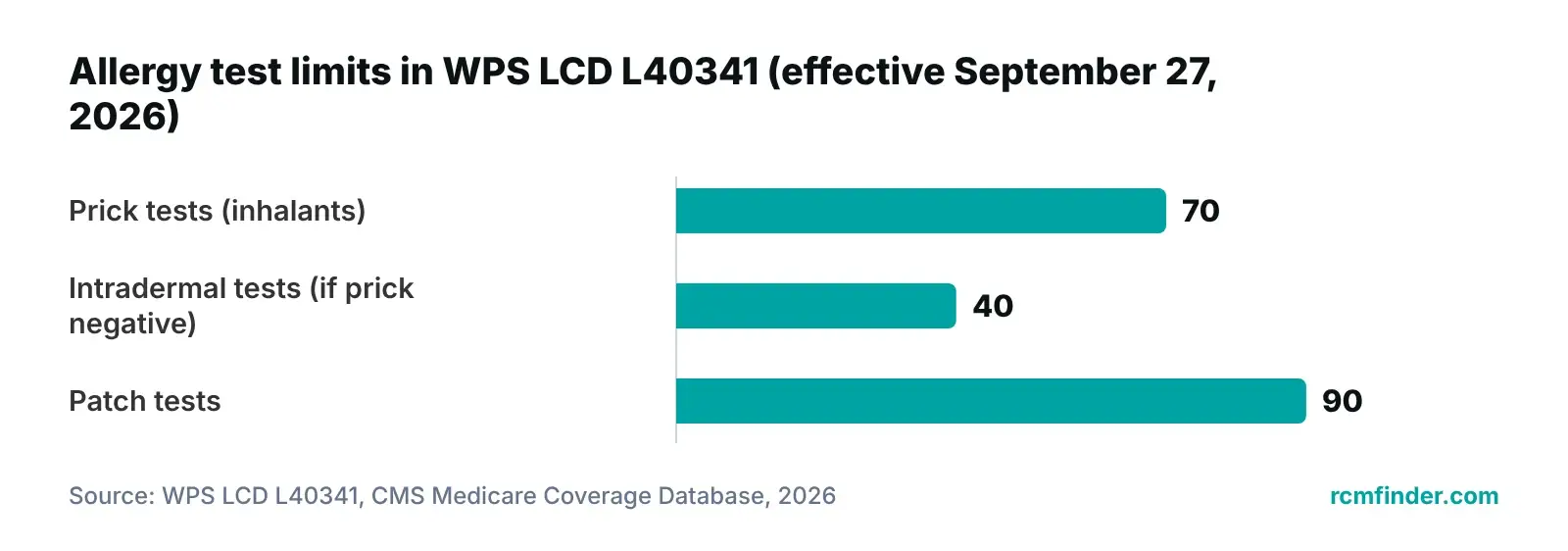
Under WPS L40341, routine repeat testing needs documented support. The record should show the history and exam, likely exposure to each allergen, controls, and results tied to symptoms. Qualitative multiallergen screening tests are not covered.
If you expect Original Medicare to deny a test, for example a count above the LCD limit, give an Advance Beneficiary Notice (CMS-R-131) first. CMS's ABN booklet (MLN006266, May 2025) says to issue it early enough for the patient to decide, and generally not as a routine notice. Bill GA with a required ABN on file and GZ when you gave none. ABNs do not apply to Medicare Advantage patients. See our ABN billing guide.
Bill immunotherapy in two parts: the extract you prepare (95165, counted in doses) and the shots you give (95115 or 95117), and add a visit only for a separate problem.
Wellpoint's billing article A59973 (revision effective April 1, 2026) bases the dose on a 10 cc vial drawn in 1 cc aliquots, with no more than 10 doses billed per vial. A vial filled to 6 cc supports 6 doses; half-cc draws do not raise the count. Prepare no more than 12 months of antigen at once. Wellpoint also requires the EJ modifier on maintenance claims; other MACs may differ.
The article adds that an MD or DO who examined the patient and set the plan and dosage must prepare the extract. Visits are not billed with 95115 or 95117 unless separately identifiable. The vial record should list each extract, manufacturer, lot, volumes, diluent, preparer and date.
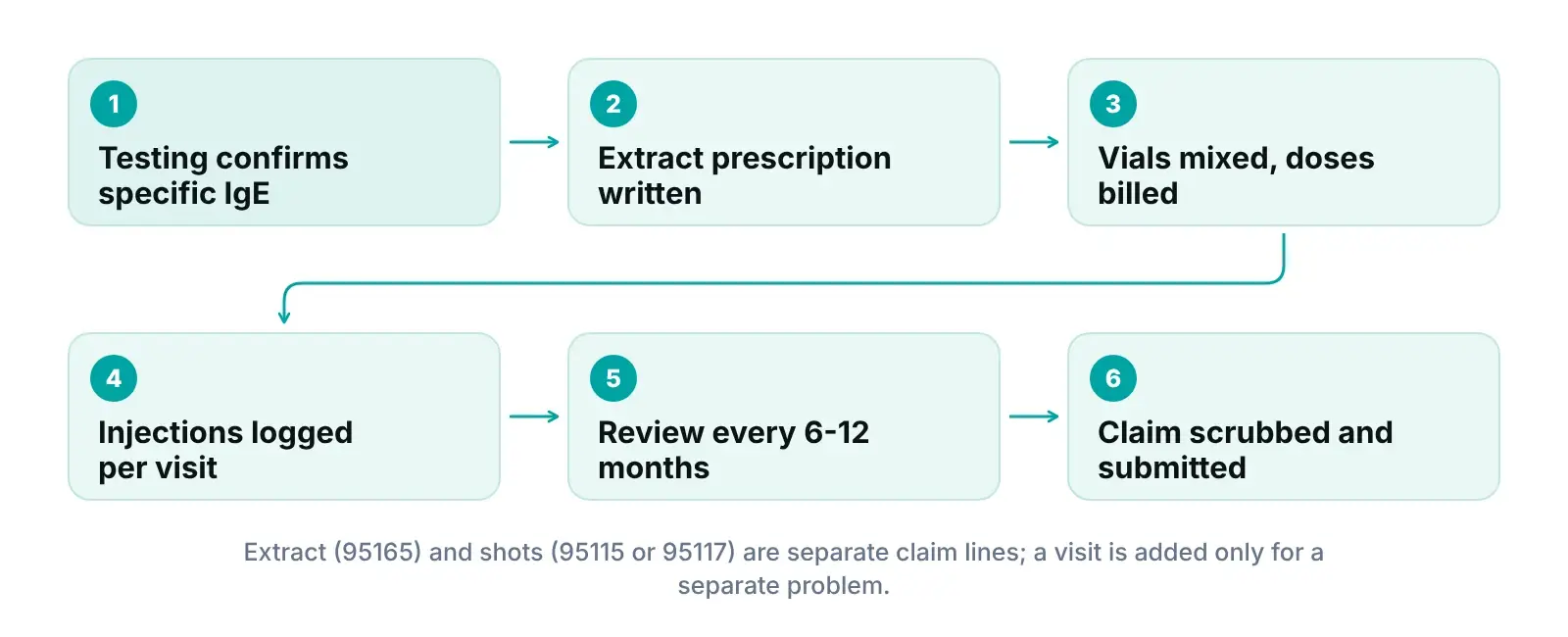
Wellpoint, the contractor for Illinois, Minnesota, Wisconsin, New York and New England, covers allergy shots under LCD L40048 for allergic rhinitis or conjunctivitis, allergic asthma and moderate to severe dust-mite atopic dermatitis, with symptoms after exposure and relevant specific IgE. Rhinitis and asthma need one more reason, such as a poor response to at least 28 consecutive days of medication or avoidance. Review at least every 6 to 12 months; payment ends after 2 years without benefit. Sublingual immunotherapy is excluded under NCD 110.9.
Before a biologic or immune globulin is given, confirm the approval, which benefit pays (medical or pharmacy), and whether Medicare treats the drug as self-administered. Miss one and the practice can absorb the drug cost.
UnitedHealthcare's commercial omalizumab policy (effective October 1, 2025) is one example. For allergic asthma it asks for total IgE of 30 to 1,300 IU/mL, a positive perennial aeroallergen test and poor control on maximal inhaled therapy. Approvals last up to 12 months; self-injected Xolair goes to the pharmacy benefit. The plan's IL-5 inhibitor policy (effective October 1, 2026) sets an eosinophil floor of 150 cells/μL for asthma with mepolizumab and benralizumab. See also our pulmonology billing page.
For Original Medicare, check your MAC's self-administered drug exclusion list. Wellpoint's list (A53021) includes dupilumab, so Part B does not pay for it as an office drug there; see our dermatology billing page. For single-dose drugs Part B does pay, the CMS JW/JZ FAQ requires JW for any amount discarded and JZ when none was.
Since January 1, 2026, the CMS-0057-F rule has required Medicare Advantage, Medicaid and CHIP plans to decide standard requests in seven calendar days and expedited ones in 72 hours, but drug prior authorizations are excluded. In the AMA's 2025 survey of 1,000 physicians (released May 13, 2026), physicians averaged 40 prior authorizations and 13 hours of staff and physician time a week. See our guide to speeding up medication prior authorization.
Home immune globulin claims go to the DME MAC. The IVIG policy article A52509 (revision effective July 1, 2026) covers IVIG at home for a listed primary immune deficiency when the treating practitioner finds home use appropriate. Supplies and services are billed with Q2052, one unit per infusion date. CMS says in-home IVIG coverage became permanent on January 1, 2024. Subcutaneous immune globulin falls under the External Infusion Pumps LCD (L33794) for a primary immune deficiency, or for CIDP that has responded to IVIG. See our home infusion and IVIG coding guide.
| Rule | Source | What the VMA checks |
|---|---|---|
| Omalizumab, allergic asthma: total IgE 30 to 1,300 IU/mL; perennial aeroallergen test; up to 12 months | UHC 2025D0033AC (Oct 1, 2025) | IgE and test results on file; renewal date logged |
| IL-5 biologics: eosinophils 150 cells/μL or more; up to 12 months | UHC 2026D0055AA (Oct 1, 2026) | Eosinophil result and inhalers; renewal date |
| Self-injected Xolair, Fasenra and Nucala go to the pharmacy benefit | UHC policies above | Benefit confirmed before the drug is ordered |
| Drugs on the MAC's self-administered list are not paid by Part B | Wellpoint A53021 (example) | Drug checked against your MAC's current list |
| MA, Medicaid and CHIP decide in 72 hours or 7 days; drugs excluded | CMS-0057-F (from Jan 1, 2026) | Request date logged; follow-up on each plan's timeline |
| Home IVIG: listed primary immune deficiency; practitioner decision | DME MAC A52509 (2026) | Diagnosis on the list; home use documented |
| Over 70 prick, 40 intradermal or 90 patch tests; routine repeats | WPS L40341 (2026) | Prior test dates and counts; ABN if over a limit |
| Shots reviewed every 6 to 12 months; no payment after 2 years without benefit | Wellpoint L40048 (2026) | Last review date; next review booked |
Sources: UnitedHealthcare policies 2025D0033AC (2025) and 2026D0055AA (2026); CMS Medicare Coverage Database: Wellpoint A53021 and L40048, DME MAC A52509, WPS L40341 (2026); CMS-0057-F fact sheet (2024). Always check the member's current plan and your MAC.
For the full process, read our prior authorization guide for providers.
See what lapsed approvals and denials cost you
Enter your claim volume and denial rate to estimate what your allergy practice is losing.
Allergy growth comes from local search, referrals and reviews. Ads should name conditions, not drugs, and tracking must respect HIPAA.
Google's healthcare and medicines policy restricts prescription drug terms in ads, keywords and landing pages, so we promote care, not biologic brands. HHS guidance on online tracking says tracking on login and some scheduling pages can collect protected health information, vendors that receive it need a BAA, and a cookie banner is not a HIPAA authorization. A June 20, 2024 court order vacated part of it; we still keep tracking off appointment forms without a BAA. For children, see our pediatric billing page.
Stay in-house if your staff count tests and doses correctly and have time for approvals. Use a billing-only vendor if claims are the only gap. Choose a combined partner when problems start at the front desk.
| Job | In-house team | Billing-only vendor | Four-pillar partner (RCM Finder) |
|---|---|---|---|
| Biologic prior authorization and renewals | Front desk, between shot visits | Usually left to the practice | VMA tracks each request to a decision and renewal date |
| Test units and dose counts | Depends on one experienced biller | Corrected after a denial | Checked against the report and vial log before submission |
| Medical or pharmacy benefit for drugs | Often checked late | Not in scope | VMA confirms before the drug is ordered |
| New patients and reviews | A separate agency, or nobody | Not included | Marketing pillar tied to booked visits |
| Cost structure | Salaries, benefits, turnover | Varies; ask how fees are set | Quoted after a free practice audit |
If you need only one pillar, the audit will say so.
We start with a free audit and change nothing until you see the findings.
We review recent claims, denials and authorization logs, and compare billed test units and doses with your records.
We put a Business Associate Agreement in place before accessing patient data. Then we work inside your existing EHR (for example PrognoCIS, eClinicalWorks or athenahealth).
Your MAC's allergy documents, its self-administered drug list and your plans' drug policies become a checklist and portal rules.
VMAs check benefits, start drug approvals and keep shot calendars. Claims are scrubbed, submitted and worked through denials and A/R.
Each week we review denials by reason, A/R days, first doses cleared in advance and new patients.
Talk to us about your allergy practice
Tell us your test mix, shot volume and biologic payers. We will tell you honestly whether we fit.
Any billing vendor that handles your patients' data is a HIPAA business associate. Get a Business Associate Agreement before they have any access, and check how they limit and log that access.
HHS guidance names billing, claims processing and practice management as business associate work; subcontractors need their own agreement. The minimum necessary standard limits use to what each task needs. The Security Rule's technical safeguards require access control, audit controls, integrity controls, person or entity authentication and transmission security.
We use role-based access, audit logging and encrypted (HTTPS) connections, and we put a Business Associate Agreement in place before accessing patient data. For your own side, use our HIPAA compliance checklist for medical practices.
We would rather tell you now than after you sign. Here is where we fit and where we do not.
A good fit if you are
Probably not a fit if you are
What we would do first if we were running your practice's revenue cycle tomorrow.
We bill units from the documented number of separate tests, without controls. No count in the report, no claim.
Each vial record shows volume, contents and doses. We bill 95165 from that log, never above 10 doses per vial.
We bill a visit with injections only when the note shows a separate problem, with modifier 25.
We confirm the approval, the paying benefit and your MAC's self-administered list before a biologic is ordered or given.
Immunotherapy reviews and 12-month drug approvals run on separate clocks. One calendar per patient keeps both current.
When a Medicare test may exceed an LCD limit, we give the ABN first, based on that patient's history, not as a blanket form.
They cover coding support, claim scrubbing, submission, denial management and A/R follow-up for allergy tests, immunotherapy extract and injections, office visits, biologics and immune globulin. A good service also checks units and doses against the record and clears drug approvals before the first dose. RCM Finder adds front-desk assistants, patient marketing and a claims portal, so one team owns the process from booking to payment.
Bill one unit per separate test, and leave positive and negative controls out of the count. A single test and a sequential test for the same dilution are not billed together. Under the WPS Allergy Diagnostic Testing LCD, more than 70 prick tests and 40 intradermal tests for inhalants, or more than 90 patch tests, would not be reasonable and necessary. Other MACs and commercial plans may set different limits.
In the Wellpoint billing article we reviewed, a dose is a 1 cc aliquot from a multidose vial, and a physician may not bill more than 10 doses per vial. A vial filled to 6 cc supports 6 doses, even if it is drawn in smaller amounts. No more than a 12-month supply should be prepared at once. The injections are billed separately with 95115 or 95117.
Only when the visit is a significant, separately identifiable service, such as treating a new problem. Then the visit is reported with modifier 25. A routine shot visit, including informed consent, is part of the immunotherapy service. CMS's NCCI manual also notes that allergy testing is generally not done on the same day as immunotherapy.
Often, yes. Commercial plans such as UnitedHealthcare set IgE or eosinophil thresholds, require a specialist prescriber and approve up to 12 months at a time. Self-injected products often go to the pharmacy benefit. For Original Medicare, check your MAC's self-administered drug list, because Part B does not pay for drugs on it.
Yes, when the patient has a listed primary immune deficiency diagnosis and the treating practitioner decides home administration is medically appropriate. Claims go to the DME MAC, and home IVIG supplies and services are billed with Q2052, one unit per infusion date. CMS says this in-home coverage became permanent on January 1, 2024. Subcutaneous immune globulin is covered under the External Infusion Pumps LCD.
Tell us about your practice. A member of our operations team replies within one business day.
Pricing is quoted after the audit, based on your volume and the services you choose. Prefer to talk? Call +1 (302) 556-2288.
Tell us about your practice
About the author: Awais Afzal
Healthcare Operations & Data Analyst, RCM Finder
Awais has spent more than 16 years in healthcare digital marketing and clinical operations management. He builds data-driven revenue cycle blueprints for high-ticket medical practices and leads product development of the RCM Finder portal. More about our team.
How we write: every figure, code and rule on this page was checked against the primary source listed below and independently fact-checked before publishing. We re-review this page every six months. Last reviewed October 12, 2026; next review April 12, 2027.
We use cookies to understand how our site is used and to measure our advertising. You can accept or reject non-essential cookies. See our Privacy Policy.