Medicare enrollment for new providers follows a set order: get an individual NPI in NPPES, set up an I&A login for PECOS, file the CMS-855I with reassignment to the group, answer any MAC requests quickly, then complete CAQH and each payer. File before the first visit, because Medicare pays from the effective date.
If a new physician or non-physician practitioner (NPP) starts in January, the Medicare paperwork has to move now. The clinician can see patients on day one, but Medicare pays only from the enrollment effective date, with a short, conditional look-back.
This guide puts the steps in order for a clinician joining an existing group, with the rule behind each date. For the general picture, see our provider credentialing guide.
Key takeaways
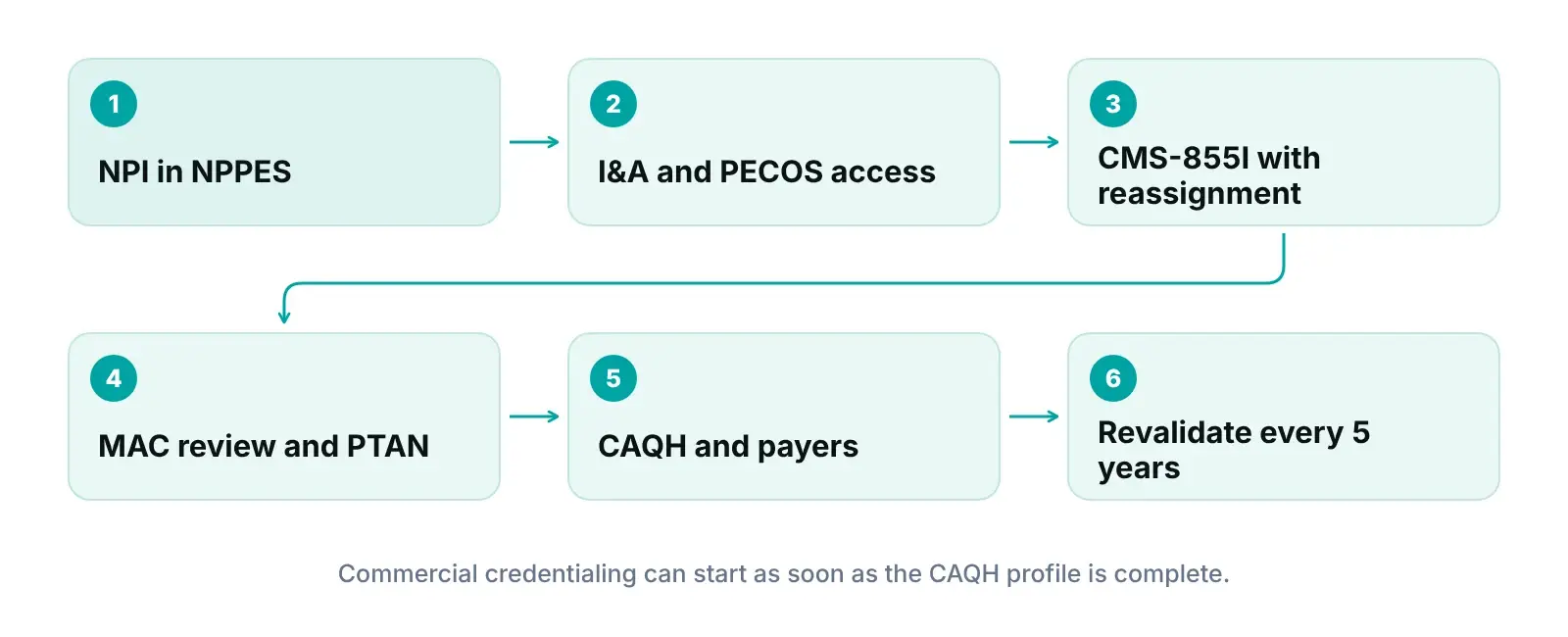
- Order matters: NPI, PECOS access, CMS-855I with reassignment, MAC review, then CAQH and payers.
- The CMS-855R was discontinued in 2023; reassignment now goes on the CMS-855I.
- The effective date is the later of the filing date or the first day of service; the normal look-back is 30 days, and only conditionally.
- Physicians, NPPs and their groups pay no Medicare application fee ($750 in CY 2026 for institutional providers).
- Revalidate every 5 years; re-attest CAQH every 120 days (180 in Illinois).
What is the right order for Medicare enrollment as a new provider?
Enroll in this order: NPI, PECOS access, the CMS-855I with reassignment to the group, a CMS-855B only if the group is not enrolled, then MAC review. Commercial credentialing runs alongside.
CMS‘s enrollment guide (updated June 2026) lists four steps: get an NPI, apply in PECOS, pay the application fee if one applies, and work with your Medicare Administrative Contractor (MAC). For a clinician joining a group, the application covers both the clinician’s enrollment and the reassignment of benefits.
| Step | What happens | Who acts | Rule or source |
|---|---|---|---|
| 1. NPI | Individual NPI in NPPES, kept current | Clinician | 45 CFR 162.410 (changes within 30 days) |
| 2. I&A and PECOS | Logins for the clinician and staff | Clinician; group official | PECOS login page (CMS) |
| 3. CMS-855I | Individual enrollment | Clinician signs; cannot delegate | 42 CFR 424.510 |
| 4. Reassignment | Section 4F or PECOS Reassignment topic | Clinician (15B); group official (15C) | CMS bulletin (2023): CMS-855R discontinued |
| 5. CMS-855B | Only if the group is not yet enrolled | Group’s authorized official | CMS enrollment applications (2026) |
| 6. MAC review | Development letters, then approval and PTAN | MAC; practice answers | First Coast Service Options (2026) |
| 7. Commercial | CAQH profile attested and authorized | Clinician and staff | DataSpring guide (2026) |
Sources: eCFR (current as of October 2026); CMS enrollment and PECOS pages (2023–2026); CMS Program Integrity Manual ch. 10 (PTAN); First Coast Service Options (2026); DataSpring (2026).
Steps 1 and 2: the NPI and PECOS access through I&A
A new clinician needs an individual NPI and an Identity & Access (I&A) login before anything can be filed in PECOS. Get the data to match before you start.
Under 45 CFR 162.410, a covered provider must obtain an NPI, use it on standard transactions and report NPPES data changes within 30 days. Our guide to NPI Type 1 vs Type 2 explains individual and group NPIs.
PECOS uses the I&A user ID and password. The PECOS login page lets individual practitioners, authorized or delegated officials, and people working on behalf of providers register. Give credentialing staff their own access: the I&A terms prohibit sharing logins.
Match the data first
CMS’s PECOS fact sheet (December 2024) says the individual’s name must match between NPPES and PECOS. Check the legal name, then the addresses you plan to use.
Step 3: the CMS-855I and reassignment of benefits to the group
The clinician files the CMS-855I, and the same application now carries the reassignment to the group. The separate CMS-855R was discontinued in 2023.
Per the CMS bulletin on the consolidated CMS-855I, MACs began accepting the revised CMS-855I (05/23) on September 1, 2023 and began returning applications on the old CMS-855I and CMS-855R on November 1, 2023. In PECOS, reassignment still lives in the Reassignment topic.
Who signs what
- Section 15B: the clinician. Under 42 CFR 424.510, individual practitioners cannot delegate signature authority.
- Section 15C: the group’s authorized or delegated official.
- Section 4F: the group receiving the benefits. One CMS-855I can list more than one group, per MAC CGS Administrators.
Reassignment lets Medicare pay the group. Under 42 CFR 424.80, the clinician has unrestricted access to claims the group bills for their services, whether employed or contracted. When the clinician works under a contractual arrangement rather than as an employee, the group and the clinician are also jointly and severally responsible for any Medicare overpayment to the group. Put both points in the employment or contractor agreement.
Forms that travel with it
- CMS-588 (EFT): required for payment under 42 CFR 424.510(e), but the CMS-855I says it is not needed if all payments are reassigned to a group.
- CMS-460: only if the clinician wants to be a participating practitioner (Section 12).
- If applicable: final adverse legal action documents; IRS tax ID confirmation when enrolling a professional corporation or as a sole proprietor with an EIN.
“A start date is not an enrollment date. I would treat the CMS-855I as part of the offer letter, not part of onboarding.”
— Awais Afzal, Healthcare Operations & Data Analyst
Do you also need a CMS-855B, a CMS-855O or an application fee?
Usually not, for a clinician joining an enrolled group. The CMS-855B enrolls the group itself, the CMS-855O is for clinicians who only order or certify, and physicians and NPPs pay no Medicare application fee.
CMS-855B: only when the group is new to Medicare
CMS lists the CMS-855B for clinics, group practices and certain other suppliers (CMS enrollment applications, updated March 2026). If the practice is a new entity, the group enrolls first and clinicians then reassign to it.
CMS-855O: ordering and certifying only
Clinicians who will not bill Medicare can enroll solely to order and certify; per the CMS Program Integrity Manual, they do not send claims to a MAC. CMS says DMEPOS, clinical lab, imaging and home health orders need a clinician with an individual NPI in approved or opt-out status. Eligible types include physicians, dentists, podiatrists, optometrists (with limits), PAs, NPs, clinical psychologists, and residents and fellows. Since June 3, 2024, physicians who certify hospice care must also be enrolled or opted out (CMS).
The application fee
The calendar year 2026 fee is $750, per a Federal Register notice of December 3, 2025. It applies to institutional providers that enroll, revalidate or add a location. Physicians and NPPs filing a CMS-855I are exempt, and 42 CFR 424.502 excludes physician and NPP organizations from the definition of institutional provider. The amount is adjusted yearly for inflation under 42 CFR 424.514.
Effective dates and the 30-day retroactive billing window
Medicare billing starts on the effective date: the later of the date you filed an application the MAC later approves, or the date the clinician first furnished services at the location. Services before that date are payable only within a conditional 30-day look-back.
The rule is 42 CFR 424.520(d), covering physicians, NPPs and their organizations. The look-back is 42 CFR 424.521: 30 days before the effective date, or 90 days when a Presidentially declared disaster prevented enrollment.
A worked example for a January start
A nurse practitioner joins an enrolled group and sees her first patient on Monday, January 4, 2027.
- Filed December 15, 2026: the effective date is January 4, 2027, the later date. Every visit is billable.
- Filed January 20, 2027: the effective date is January 20. The look-back reaches December 21, 2026, so visits from January 4 can be covered if circumstances precluded enrolling in advance.
- Filed February 15, 2027: the look-back reaches only January 16. Visits from January 4 to 15 fall outside it.
A safety net, not a plan
The look-back applies only when circumstances precluded enrollment in advance, the services were furnished at the enrolled location, and requirements such as state licensure were met. File before the first visit.
Claims must still be filed within 1 calendar year after the date of service (42 CFR 424.44). If you hold a new provider’s claims during enrollment, track them against that limit, and treat enrollment rejections like any other root cause in your denial management workflow.
How long does Medicare enrollment take? MAC timeframes and the full timeline
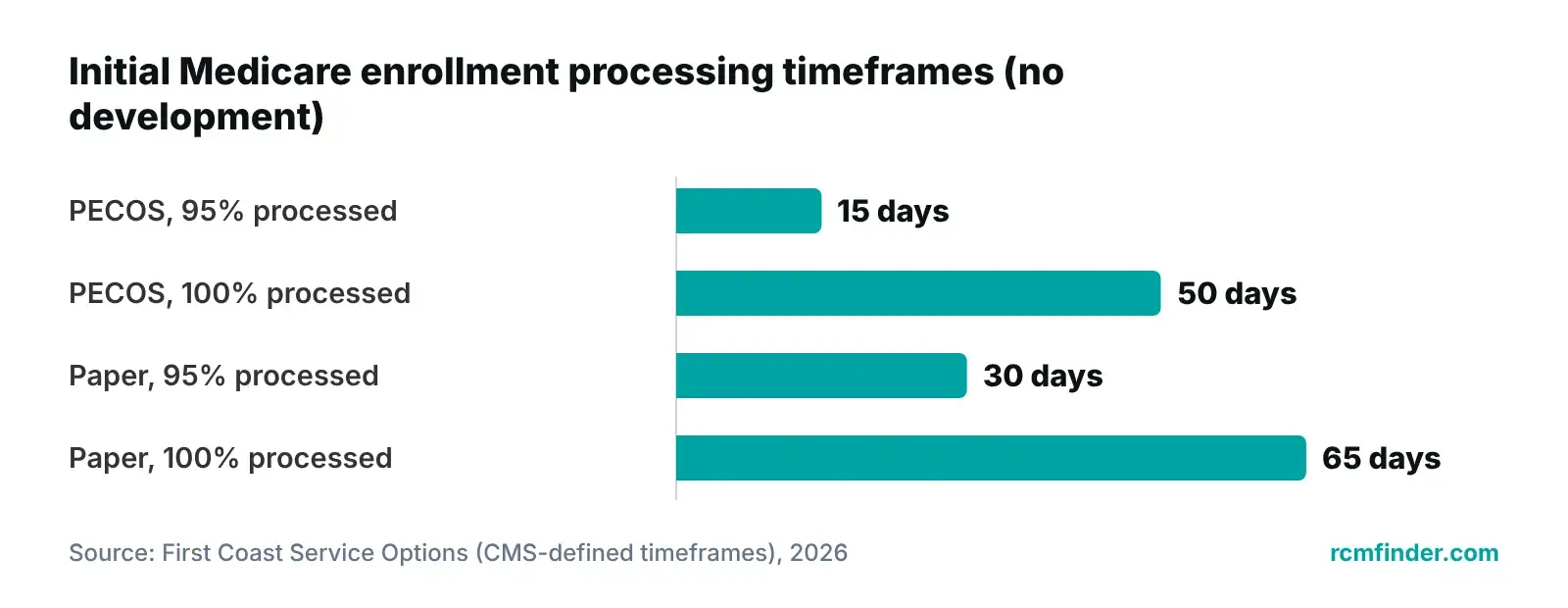
For an initial PECOS application with no development, site visit or fingerprinting, CMS’s timeframes call for 95% to be processed within 15 days and all within 50 days. Applications that need development get longer timeframes, and incomplete answers can get an application returned, so fast, complete answers matter most.
MAC First Coast Service Options publishes these CMS-defined timeframes (February 2026). Initial paper applications take longer: 95% within 30 days, all within 65. With development, a site visit or fingerprinting, initial PECOS applications run to 95% within 50 days and all within 85. First Coast’s new provider roadmap (June 2026) gives 30 days from the date on a development letter to respond.
Starting early has one trap: CMS’s PECOS inactivity policy deletes NEW or EDIT applications after 120 days of inactivity.
| When | What to do | Window or rule | Source |
|---|---|---|---|
| Start date set | Check NPI and NPPES; create I&A logins | NPPES changes within 30 days | 45 CFR 162.410 |
| Before the first visit | Submit CMS-855I with reassignment | Effective date: later of filing or first service | 42 CFR 424.520(d) |
| Draft in PECOS | Reopen it regularly | Deleted after 120 days of inactivity | CMS PECOS policy |
| After submission | Answer development letters | 30 days from the letter date | First Coast, 2026 |
| MAC review | Track status in PECOS | 95% in 15 days, all in 50; up to 85 with development | First Coast, 2026 |
| Filed after start | Ask about retrospective billing | Up to 30 days back (90 in a declared disaster) | 42 CFR 424.521 |
| After approval | Report changes; keep billing | 30 or 90 days for changes; no claims for 6 months risks deactivation | CMS; 42 CFR 424.540 |
| Every 5 years | Revalidate | Due dates posted 7 months ahead; file within 3 months of due date | 42 CFR 424.515; CMS |
Sources: eCFR (current as of October 2026); CMS enrollment, PECOS and revalidation pages (2025–2026); First Coast Service Options (2026). Processing times are CMS standards for initial PECOS applications, not promises.
Are enrollment gaps showing up in your denials?
Our free practice audit reviews a sample of your claims, denials and A/R aging, so claims held or denied around a new provider's start date surface early.
Get a Free Practice AuditAfter approval: changes, deactivation and revalidation
Approval is not the finish line. Report changes on time, keep claims flowing and revalidate every five years, or billing privileges can be deactivated.
- Changes: CMS wants ownership changes, adverse legal actions and practice location changes within 30 days, other changes within 90.
- No-claims deactivation: under 42 CFR 424.540, CMS may deactivate after 6 consecutive months with no Medicare claims, and nothing is paid while deactivated.
- Revalidation: 42 CFR 424.515 sets a 5-year cycle and gives 60 days to answer a CMS request. The CMS revalidation page (July 2025) says due dates are posted seven months ahead.
Once billing starts, our Medicare billing guide covers claims and appeals.
The commercial side: CAQH ProView and payer credentialing
MAC enrollment covers traditional Medicare only. Commercial and Medicare Advantage plans credential the clinician separately, and many start from the CAQH profile.
CAQH has rebranded as DataSpring, and the portal offices call ProView now appears as the Provider Data Portal. DataSpring’s clinician Q&A (June 2026) says logins did not change and providers are not charged. Its fact sheet (May 2026) says about 1,000 health plans accept its credentialing application.
The practitioner quick reference guide (June 2026) requires re-attestation every 120 days, or every 180 days in Illinois. Only the clinician can authorize which organizations see the profile.
Each plan runs its own process. Blue Cross Blue Shield of Michigan, for example, requires a complete CAQH profile, wants attestation within 14 days of its enrollment form and recredentials every three years. Keep a tracker per payer, and see our posts on getting paneled with insurers, payer enrollment strategies, Medicaid credentialing and credentialing for group practices.
| Item | Medicare (CMS-855I / PECOS) | CAQH profile | Notes |
|---|---|---|---|
| NPI and NPPES record | Required; name must match | Needed to register | Fix NPPES first |
| State license(s) | Section 2B: license number and state | License number | Every state of practice |
| Locations and first service date | Section 4B: first Medicare patient date | All current locations | Drives the effective date |
| DEA and state CDS | DEA number in Section 2B; no Section 12 copy | Scanned copies | Keep current |
| Malpractice coverage | Not on Section 12 list | Face sheet; case summary | Update at re-attestation |
| CMS-588 EFT | Not needed if all payments reassigned | Not applicable | Voided check if filed |
| CMS-460 | Only if participating | Not applicable | Decide with billing lead |
| Adverse actions; IRS letter | If applicable | Not applicable | MAC may ask for more |
Sources: CMS-855I (05/23), Sections 2B, 4B and 12; 42 CFR 424.510; CMS PECOS fact sheet (2024); DataSpring Practitioner Quick Reference Guide v4.0 (2026).
Coming next in our portal
A provider credentialing module is coming next in the RCM Finder practice management portal. It is not live yet, and we do not quote a release date.
Our recommendations
- Start with the offer letter. We recommend opening the NPI check, I&A login and PECOS application the week a start date is agreed, not on day one.
- File before the first visit. Filing early costs nothing: the effective date becomes the first day of service. Treat the 30-day look-back as a safety net, never as the plan.
- Give development letters one owner. Thirty days is short when MAC letters land in a personal inbox. We suggest routing enrollment mail to a shared inbox someone checks daily.
- Keep one master record. Copy legal name, addresses and license numbers from one record into NPPES, PECOS and CAQH, so they never disagree.
- Check the ordering file first. Before a new clinician orders imaging, lab, DMEPOS or home health, confirm they appear in CMS’s ordering and certifying data.
- Put every renewal on one calendar. Medicare revalidation, CAQH re-attestation and each plan’s recredentialing date sit in one tracker, each with an owner.
Bottom line
Medicare enrollment for a new provider is a sequence, not a single form: NPI, PECOS access, the CMS-855I with reassignment, quick answers to the MAC, then CAQH and each plan. File before the first visit and the effective date takes care of itself. If you want a team watching the claims, denials and A/R that follow, see our end-to-end revenue cycle management services or start with a free practice audit.
Frequently asked questions
How long does Medicare enrollment take for a new provider?
It depends on how you file and whether the MAC needs more information. Under CMS-defined timeframes published by First Coast Service Options in 2026, 95% of initial PECOS applications with no development, site visit or fingerprinting should be processed within 15 days and all within 50 days. Paper takes longer, applications that need development run to 50 and 85 days, and incomplete answers can get an application returned.
Can a new provider bill Medicare before enrollment is approved?
Medicare pays for services on or after the effective date, which is the later of the filing date or the first day of service at the location. Under 42 CFR 424.521, services up to 30 days before that date can be billed if circumstances prevented enrolling in advance. If you hold claims until approval, submit them within Medicare’s one-calendar-year filing limit.
Is the CMS-855R still used for reassignment?
No. CMS discontinued the CMS-855R in 2023. Reassignment now goes on the CMS-855I (05/23) in Section 4F, with the clinician signing Section 15B and the group’s authorized or delegated official signing Section 15C. In PECOS, use the Reassignment topic. MACs have returned applications filed on the old forms since November 1, 2023.
Do physicians pay the Medicare application fee?
No. The fee, $750 for calendar year 2026, applies to institutional providers that enroll, revalidate or add a practice location. Physicians and NPPs filing a CMS-855I are exempt, and physician and NPP group practices fall outside the definition of institutional provider. CMS adjusts the amount every year, so check the current notice if you also enroll a facility.
How often do providers revalidate Medicare enrollment?
Every five years for most providers and suppliers under 42 CFR 424.515, and every three years for DMEPOS suppliers. CMS posts due dates seven months ahead on its revalidation list, and you should submit once you are within three months of the due date. Miss it and billing privileges can be deactivated, with no payment for that gap.
How often do you need to re-attest a CAQH ProView profile?
Every 120 days, or every 180 days for clinicians practicing in Illinois, according to DataSpring’s practitioner quick reference guide (June 2026). CAQH has rebranded as DataSpring, but logins and profiles stayed the same and the portal is free for providers. Update the profile whenever a license, location or malpractice policy changes.
Get your free practice audit
Tell us about your practice. A member of our operations team replies within one business day.
- A review of your recent claims, denials and A/R aging
- Where your front desk and prior authorizations slow payment
- A prioritized fix list you keep, whether or not you hire us
Pricing is quoted after the audit, based on your volume and the services you choose. Prefer to talk? Call +1 (302) 556-2288.
Sources
- Become a Medicare Provider or Supplier — CMS (2026)
- Medicare Enrollment Applications — CMS (2026)
- Medicare Provider Enrollment, Chain, and Ownership System (PECOS) — CMS (2026)
- Consolidated CMS-855I/CMS-855R Enrollment Applications bulletin — CMS (2023)
- Medicare Enrollment Application: Physicians and Non-Physician Practitioners (CMS-855I, 05/23) — CMS (2023)
- Consolidated CMS-855I/CMS-855R Enrollment Applications (J15 guide) — CGS Administrators (Medicare Administrative Contractor) (2023)
- PECOS login page — CMS (2026)
- Identity & Access Management System login terms — CMS (2026)
- PECOS Fact Sheet — CMS (2024)
- Protect Your PECOS Application (PECOS Inactivity Deletion Policy) — CMS (2026)
- Ordering & Certifying — CMS (2026)
- Medicare Program Integrity Manual, Chapter 10 (Rev. 13717) — CMS (2026)
- Revalidations (Renewing Your Enrollment) — CMS (2025)
- Provider Enrollment Application Fee Amount for Calendar Year 2026 — Federal Register (CMS) (2025)
- 42 CFR 424.514: Application fee — eCFR (National Archives) (2026)
- 42 CFR 424.502: Definitions — eCFR (National Archives) (2026)
- 42 CFR 424.510: Requirements for enrolling in the Medicare program — eCFR (National Archives) (2026)
- 42 CFR 424.515: Requirements for reporting changes and updates to, and the periodic revalidation of Medicare enrollment information — eCFR (National Archives) (2026)
- 42 CFR 424.520: Effective date of Medicare billing privileges — eCFR (National Archives) (2026)
- 42 CFR 424.521: Request for payment by physicians, non-physician practitioners, and other suppliers — eCFR (National Archives) (2026)
- 42 CFR 424.540: Deactivation of Medicare billing privileges — eCFR (National Archives) (2026)
- 42 CFR 424.80: Prohibition of reassignment of claims by suppliers — eCFR (National Archives) (2026)
- 42 CFR 424.44: Time limits for filing claims — eCFR (National Archives) (2026)
- 45 CFR 162.410: Implementation specifications: Health care providers — eCFR (National Archives) (2026)
- CMS-855 enrollment application processing timeframes — First Coast Service Options (Medicare Administrative Contractor) (2026)
- New provider roadmap: Provider enrollment — First Coast Service Options (Medicare Administrative Contractor) (2026)
- DataSpring Provider Data Portal Practitioner Quick Reference Guide v4.0 — DataSpring (formerly CAQH) (2026)
- DataSpring for Clinicians — DataSpring (formerly CAQH) (2026)
- DataSpring Clinicians FAQs (rebrand Q&A) — DataSpring (formerly CAQH) (2026)
- DataSpring Provider Data Portal Fact Sheet — DataSpring (formerly CAQH) (2026)
- For Providers: What Do I Need to Know About Credentialing and Recredentialing? — Blue Cross Blue Shield of Michigan (2026)
Disclaimer: This article is general educational information about Medicare enrollment and payer credentialing for medical practices. It is not legal, billing-compliance or credentialing advice. CMS forms, systems, fees and MAC procedures change, and commercial plan rules vary by plan and state. Confirm current requirements with CMS, your Medicare Administrative Contractor and each payer before acting.