
Infusion and drug claims, regimen-level prior authorization, referral marketing and a claims portal for medical oncology and hematology-oncology practices, built on CMS rules and your payers' drug policies.
By Awais Afzal | Healthcare Operations & Data Analyst
Published October 12, 2026 · Last reviewed October 12, 2026 · Next review April 12, 2027
Quick answer
Oncology billing services manage the claims an infusion practice creates: drug administration codes, J-code drug lines with correct units, JW or JZ modifiers and NDCs, drug prior authorization, clinical trial claims and denial appeals. RCM Finder pairs that billing with front-desk assistants, referral marketing and a claims portal, starting with a free practice audit.
On this page
Oncology billing is different because an infusion visit bills both the care and the drug itself. One infusion day creates administration codes and separate drug lines, each with its own rules.
Under buy-and-bill, the practice buys the drug first and recovers the cost when the claim pays. Medicare Part B pays most separately payable drugs at average sales price (ASP) plus 6 percent, updated quarterly. A denied drug line is a drug already paid for.
For benign blood disorders, see our hematology billing services.
An oncology practice needs referrals, every drug cleared before chair time, claims coded to CMS drug rules and software that shows each claim. Revenue leaks at the handoffs, so all four pillars work from one set of payer rules.
Our healthcare digital marketing reaches referring physicians and patients seeking a consult or second opinion through local SEO, Google Ads and reputation work.
Our virtual medical assistants for oncology work on your practice's time zone. They verify drug benefits, start prior authorizations for each drug in a regimen and flag trial patients at registration.
Our end-to-end oncology revenue cycle management covers coding support, claim scrubbing, denial management and A/R follow-up, with extra checks on administration codes and drug lines.
Our practice management system tracks every claim by stage, applies specialty-aware billing logic per claim, checks data completeness before submission and flags underpayments.
Find where your infusion claims leak
We review recent infusion claims, drug-line denials and authorization logs, then show what to fix first. Pricing is quoted after the audit.
For Medicare, report one initial administration code per encounter, then code other infusions and pushes as sequential, concurrent or added time. Each drug goes on its own line.
CMS's Claims Processing Manual, chapter 12, section 30.5 applies chemotherapy administration codes to non-radionuclide anti-neoplastic drugs, to monoclonal antibodies and other biologic response modifiers, and to hormonal anti-neoplastics, but not to anti-anemia or anti-nausea drugs.
| Claim family | Code examples (our wording) | Medicare rule to follow | Common error or denial trigger |
|---|---|---|---|
| Chemotherapy IV infusion | 96413 (initial); 96415 (each added hour); 96417 (added infusion of a different drug) | One initial code per encounter; an added hour only when the infusion runs over 30 minutes past the hour | Second initial code with no second IV site or return visit |
| Chemotherapy push or injection | 96409 (first push); 96411 (each added push); 96401, 96402 (under the skin or into muscle; non-hormonal, hormonal) | Push: clinician present throughout, or 15 minutes or less | Push billed for a longer infusion |
| Supportive drugs and fluids | 96367 (sequential infusion); 96368 (concurrent infusion); 96361 (added hydration) | 96368 once per encounter; hydration during chemotherapy not billed | Hydration billed for fluid that carried a drug |
| Same-day visit | E/M visit with modifier 25 | 99211 is not paid with drug administration | Modifier 25 with no separate visit note |
| Drug lines | J9271 (pembrolizumab, per 1 mg); J9999 (unlisted anti-cancer drug) | Units follow the code's dose; unlisted drug is one unit with name and dose | Units that do not match the dose given |
| Single-dose containers | Drug code plus JW (amount discarded) or JZ (none discarded) | JZ required by July 1, 2023; neither applies to multi-dose containers | Missing modifier; claim may be returned since October 1, 2023 |
| Biosimilars | J9035 (bevacizumab) vs Q5107 (bevacizumab-awwb biosimilar), each per 10 mg | Bill the code of the product given | Code does not match the product given |
| Anemia drugs during chemotherapy | J0881, J0885 (ESAs) with modifier EA | Both hemoglobin and hematocrit readings on the claim (Noridian JE) | Either reading missing; Noridian says the claim rejects |
Sources: CMS Claims Processing Manual ch. 12 §30.5; NCCI Policy Manual ch. XI (2026); Noridian JE Part B (2025–2026); CMS JW/JZ FAQ (2025); AAPC. Rules vary by contractor.
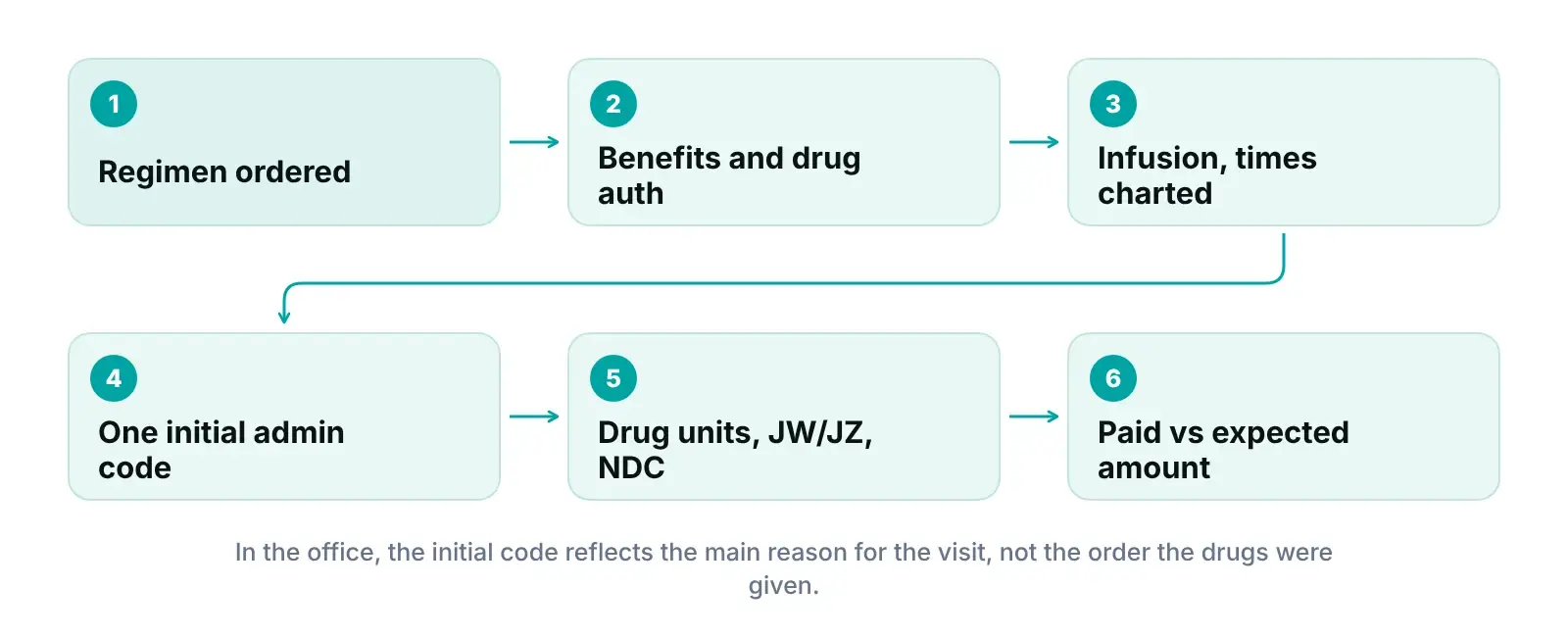
Noridian, a Medicare contractor, says the office initial code reflects the main reason for the encounter, whatever the drug order. Facilities follow the CPT ranking instead: chemotherapy, then other drugs, then hydration; infusions before pushes before injections. A second initial code needs a protocol-required second IV site or a return visit, with modifier 59. The 2026 NCCI policy manual treats port flushing as part of the service, so 96523 is not billed for it. Medicare does not cover staff-given injections without incident-to supervision; see our incident-to billing guide. For a code primer, see our oncology CPT codes guide.
Noridian says to bill each drug code in the quantity its definition sets: J9271 is per 1 mg, so 200 mg is 200 units. Unlisted anti-cancer drugs go under J9999 as one unit, with name and dose. See our J-codes guide and, for treatment at home, home infusion billing.
CMS's JW and JZ modifier FAQ has required JW on discarded single-dose amounts since January 1, 2017, and JZ when nothing is discarded since July 1, 2023. Bill administered units on one line and discarded units on a second line with JW, and chart the discarded amount. CMS's discarded drugs program also collects manufacturer refunds when discards pass an applicable percentage, 10% by statute.
Medicaid needs the NDC: 42 CFR 447.520 makes states require NDCs on physician-administered drug claims so they can invoice manufacturers for rebates.
A biosimilar can carry its own code, as Q5107 does for bevacizumab-awwb. Under 42 CFR 414.904, Medicare pays a biosimilar its own ASP plus 6% of the reference product's amount. The Inflation Reduction Act raised that add-on to 8% for five years for biosimilars priced at or below the reference product, as a CMS FAQ explains. Noridian covers a biosimilar on its reference product's criteria unless an article says otherwise.
Medicare pays routine costs in qualifying clinical trials and off-label anticancer uses that recognized compendia support, and it expects an ABN before a service it will probably deny.
NCD 310.1 covers routine trial costs, including conventional care and treatment of complications. It excludes the investigational item unless otherwise covered, data-collection-only items and items the sponsor gives free. Federally funded trials and FDA IND trials are deemed to qualify. Noridian lists the claim marks: Q0 on investigational items, Q1 on routine services, diagnosis Z00.6 and the eight-digit NCT number.
Noridian names five compendia CMS recognizes for anticancer drugs: AHFS-DI, the NCCN Drugs and Biologics Compendium, Micromedex DrugDex, Clinical Pharmacology and Lexi-Drugs. NCCN categories 1 and 2A support coverage; category 3 does not, and an unsupported or not-recommended listing blocks payment. 42 CFR 414.930 governs changes to the list. Other contractors may word this differently.
The ABN (form CMS-R-131) is for Original Medicare patients when payment is expected to be denied. Noridian says to give it early enough for the patient to decide, never routinely. Modifier GA shows a required ABN is on file; GZ shows an expected denial with no ABN. See our ABN billing guide.
Clear every drug in the regimen before chair time is booked. Medicare Advantage plans face separate deadlines for Part B drugs, while the new 2026 deadlines exclude drugs.
Since January 1, 2026, the CMS-0057-F final rule has required Medicare Advantage, Medicaid and CHIP plans to decide standard requests within seven calendar days and expedited ones within 72 hours, but CMS says this does not apply to drug decisions. Medicare Advantage Part B drug requests already have tighter limits: 72 hours, or 24 when expedited, with no extensions (42 CFR 422.568 and 422.572). Commercial plan timelines vary.
UnitedHealthcare, for example, runs prior authorization and notification programs for oral and injectable chemotherapy. Under 42 CFR 422.136, Medicare Advantage plans may apply step therapy to Part B drugs only for new administrations, with a lookback of at least 365 days.
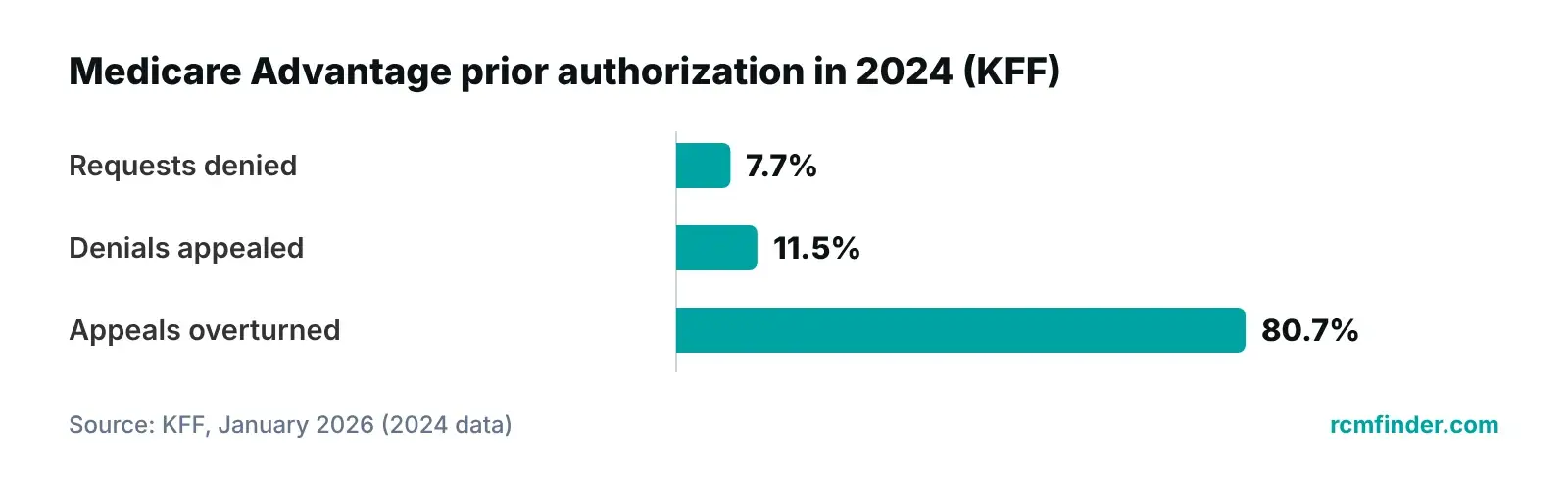
In KFF's January 2026 analysis, Medicare Advantage insurers fully or partly denied 7.7% of 52.8 million prior authorization requests in 2024, and 80.7% of appeals were at least partly overturned. KFF names chemotherapy among the services that commonly need approval.
| Rule | Source | What the VMA checks |
|---|---|---|
| Plans run prior authorization or notification programs for chemotherapy | UnitedHealthcare (2026) | Each drug in the regimen; approval matched to drug, dose and dates |
| Medicare Advantage step therapy for Part B drugs: new starts only, 365-day lookback | 42 CFR 422.136 | Use of the drug in the past year; exception paperwork if needed |
| MA Part B drug decisions due in 72 hours (24 if expedited); CMS-0057-F deadlines exclude drugs | 42 CFR 422.568, 422.572; CMS-0057-F | Request date and time logged; follow-up when the deadline passes |
| Off-label use needs compendium support | Noridian (2025) | Compendium listing and category saved with the order |
| Trial claims need Q0 or Q1, Z00.6 and the NCT number | NCD 310.1; Noridian (2026) | NCT number on file; sponsor's list of free items |
| ABN only when Medicare is likely to deny, never routinely | CMS ABN page; Noridian (2026) | Provider's ABN decision before treatment; signed form on file |
| Orders show a physician's or NPP's intent; PharmD orders need a cosign | Noridian drugs page | Authenticated order for each drug |
| Medicaid drug claims need the NDC | 42 CFR 447.520 | NDC captured from the product used |
Sources: UnitedHealthcare (2026); eCFR 42 CFR 422.136, 422.568, 422.572 and 447.520; CMS-0057-F fact sheet (2024); CMS NCD 310.1 and ABN page; Noridian (2025–2026). Always check the member's current plan.
In ASCO's 2023 position statement, buy-and-bill, the most common method, means the practice buys the drug and bills the insurer. White bagging means the plan pays only if a payer-owned or affiliated specialty pharmacy ships the drug to the clinician; ASCO opposes it when mandatory. We confirm each plan's model before the drug is ordered.
Oral anticancer and anti-nausea drugs fall under separate Medicare benefit categories, and Noridian points to its Part B and DME pages for how to bill them. For approval tactics, see our prior authorization guide and guide to faster medication approvals.
See what drug denials cost you
Enter your claim volume and denial rate to estimate what your oncology practice is losing.
Oncology marketing serves two audiences: physicians who refer to you and patients seeking a consult or second opinion. Both need a fast path to an appointment.
We build location pages for each clinic and infusion center, a referring-provider page and plain-language pages on the cancers you treat, plus a trials page if you run trials. We never write survival or cure claims.
HHS guidance on online tracking says tracking on appointment pages can collect protected health information, a vendor that receives it needs a Business Associate Agreement, and a cookie banner is not a HIPAA authorization. A 2024 court order vacated part of that guidance. We still keep tracking off appointment and referral forms unless the vendor signs a BAA.
Stay in-house if you have experienced oncology coders and staff time for drug authorizations. Use a billing-only vendor if claims are your only gap. Choose a combined partner when problems span both.
| Job | In-house team | Billing-only vendor | Four-pillar partner (RCM Finder) |
|---|---|---|---|
| Drug prior authorization per regimen | Nurses or front desk | Usually left to the practice | VMA tracks each request to a decision |
| Initial, sequential and concurrent coding | Depends on one coder | Coded from the charge sheet | Checked against CMS rules before submission |
| JW, JZ and NDC on drug lines | Entered at charge time | Depends on what the practice sends | Checked on every single-dose drug line |
| Clinical trial claims | Research staff | Often out of scope | Q0/Q1 and NCT checked |
| Referral growth | A separate agency, or nobody | Not included | Marketing pillar tied to new consults |
| Cost structure | Salaries, benefits, turnover | Varies; ask how fees are set | Quoted after a free practice audit |
If the audit shows you need only one pillar, we will say so.
We start with a free audit and change nothing until you see the findings. We build our billing pipeline around how claims actually move through a practice: registration, charge entry, submission, payment and follow-up. For oncology, we add the drug-line and authorization checks on this page.
We review recent infusion claims, drug-line denials, JW and JZ use and authorization logs.
We put a Business Associate Agreement in place before accessing patient data. Then we work inside your existing EHR (for example PrognoCIS, eClinicalWorks or athenahealth).
Your contractor's guidance and your main plans' drug policies become a pre-treatment checklist and portal workflow rules.
VMAs start authorizations for each regimen. Claims are coded, scrubbed, submitted and worked to payment.
Each week we review drug-line denials, A/R days, cycles cleared before treatment, underpayments and referrals.
Talk to us about your oncology practice
Tell us your sites, regimen mix and hardest payer. We will tell you honestly if we fit.
Any billing vendor that handles your patients' data is a HIPAA business associate. Get a Business Associate Agreement before they have any access, and ask how they limit and log that access.
HHS guidance names claims processing and billing as business associate work; subcontractors need their own agreement. The minimum necessary standard limits use to what each task needs. The Security Rule's technical safeguards cover access control, audit controls, integrity, person or entity authentication and transmission security.
We use role-based access, audit logging and encrypted (HTTPS) connections, and we put a Business Associate Agreement in place before accessing patient data. For your own side, use our HIPAA compliance checklist for medical practices.
We would rather tell you now than after you sign. Here is where we fit and where we do not.
A good fit if you are
Probably not a fit if you are
What we would do first if we were running your practice's revenue cycle tomorrow.
In the office, we code the initial service by the encounter's main reason and ask for start and stop times on every infusion.
We check each single-dose drug line for JW or JZ and confirm the discarded amount is charted.
Every drug gets its own approval check, and we log approval dates so no cycle starts on an expired authorization.
A biosimilar and its reference product can carry different codes. We match the code and NDC to the product actually given.
We record NCT numbers and the sponsor's free items at registration, and save compendium support with off-label orders.
Medicare updates ASP-based payment limits quarterly, so we update expected amounts to keep underpayment flags accurate.
They cover coding support, claim scrubbing, submission, denial management and A/R follow-up for infusion visits and the drugs given. A good partner also handles administration code selection, drug units, JW and JZ modifiers, NDCs for Medicaid, clinical trial claims and drug prior authorization. RCM Finder adds front-desk assistants, referral marketing and a claims portal, so one team owns the process from referral to payment.
For Medicare, bill one initial administration code per encounter. In the office, it reflects the main reason for the visit, not the order of the drugs. Code other drugs as sequential, concurrent or added pushes, and bill an added hour only when the infusion runs more than 30 minutes past the hour. A second initial code needs a separate IV site required by protocol or a separate return visit.
Use them on drugs from single-dose containers. Bill the administered amount on one line and any discarded amount on a second line with JW. If nothing was discarded, add JZ to the drug line. CMS has required JZ since July 1, 2023, and since October 1, 2023 claims without the right modifier may be returned as unprocessable. Neither modifier applies to multi-dose containers.
Not the new ones. Since January 1, 2026, CMS-0057-F has required Medicare Advantage, Medicaid and CHIP plans to decide standard requests within seven calendar days and expedited ones within 72 hours, but CMS says that provision does not apply to drug decisions. Medicare Advantage plans already must decide Part B drug requests within 72 hours, or 24 hours when expedited. Commercial plan timelines vary.
Under NCD 310.1, Medicare covers routine costs in qualifying trials, but not the investigational item itself unless it is covered otherwise, services used only for data collection, or items the sponsor gives free. One Medicare contractor, Noridian, asks for Q1 on routine services, Q0 on investigational items, diagnosis Z00.6 and the eight-digit NCT number. Get the sponsor's list of free items before the first claim.
It can be, if the vendor is treated as a business associate. HIPAA requires a Business Associate Agreement before the vendor receives patient data, and that agreement must require the vendor to safeguard it. The Security Rule's technical safeguards include access control and audit controls. We put a Business Associate Agreement in place before accessing patient data, and we use role-based access, audit logging and encrypted (HTTPS) connections.
Tell us about your practice. A member of our operations team replies within one business day.
Pricing is quoted after the audit, based on your volume and the services you choose. Prefer to talk? Call +1 (302) 556-2288.
Tell us about your practice
About the author: Awais Afzal
Healthcare Operations & Data Analyst, RCM Finder
Awais has spent more than 16 years in healthcare digital marketing and clinical operations management. He builds data-driven revenue cycle blueprints for high-ticket medical practices and leads product development of the RCM Finder portal. More about our team.
How we write: every figure, code and rule on this page was checked against the primary source listed below and independently fact-checked before publishing. We re-review this page every six months. Last reviewed October 12, 2026; next review April 12, 2027.
We use cookies to understand how our site is used and to measure our advertising. You can accept or reject non-essential cookies. See our Privacy Policy.