
Drug and infusion claims, prior authorization for IV iron, ESAs, IVIG and clotting factor, patient marketing and a claims portal for benign hematology practices, built on CMS rules and your payers' own policies.
By Awais Afzal | Healthcare Operations & Data Analyst
Published October 12, 2026 · Last reviewed October 12, 2026 · Next review April 12, 2027
Quick answer
Hematology billing services manage the claims a benign hematology practice creates: IV iron and other drug units, infusion and injection codes, JW and JZ modifiers, lab values on ESA claims, clotting factor billing, prior authorization and denial appeals. RCM Finder pairs that billing with front-desk assistants, patient marketing and a claims portal, starting with a free audit.
On this page
In hematology, much of a claim's value sits on the drug line, not the visit. One iron infusion can carry a drug code billed in units, an administration code and a JZ or JW modifier, each with its own rule.
Medicare pays Part B drugs that are not paid on a cost or prospective basis at 106 percent of the average sales price, per CMS's claims processing manual, chapter 17. A units error on a costly drug is not a rounding problem. Under 42 CFR 447.520, states must also require National Drug Codes (NDCs) on Medicaid claims for physician-administered drugs.
This page covers non-malignant hematology: anemias, immune thrombocytopenia (ITP), bleeding and clotting disorders, and iron overload. For cancer care, see our oncology billing services page and oncology CPT codes guide; for anemia of kidney disease, see nephrology billing services.
Since January 1, 2026, the CMS-0057-F final rule has required Medicare Advantage, Medicaid and CHIP plans to decide expedited prior authorization requests within 72 hours and standard requests within seven calendar days. The catch for hematology: CMS says the rule does not apply to prior authorization decisions for drugs. Medicare Advantage plans must already decide Part B drug requests within 72 hours, or 24 hours when expedited, with no extensions (42 CFR 422.568 and 422.572). Commercial plan timelines for IV iron, ESAs, immune globulin and clotting factor vary.
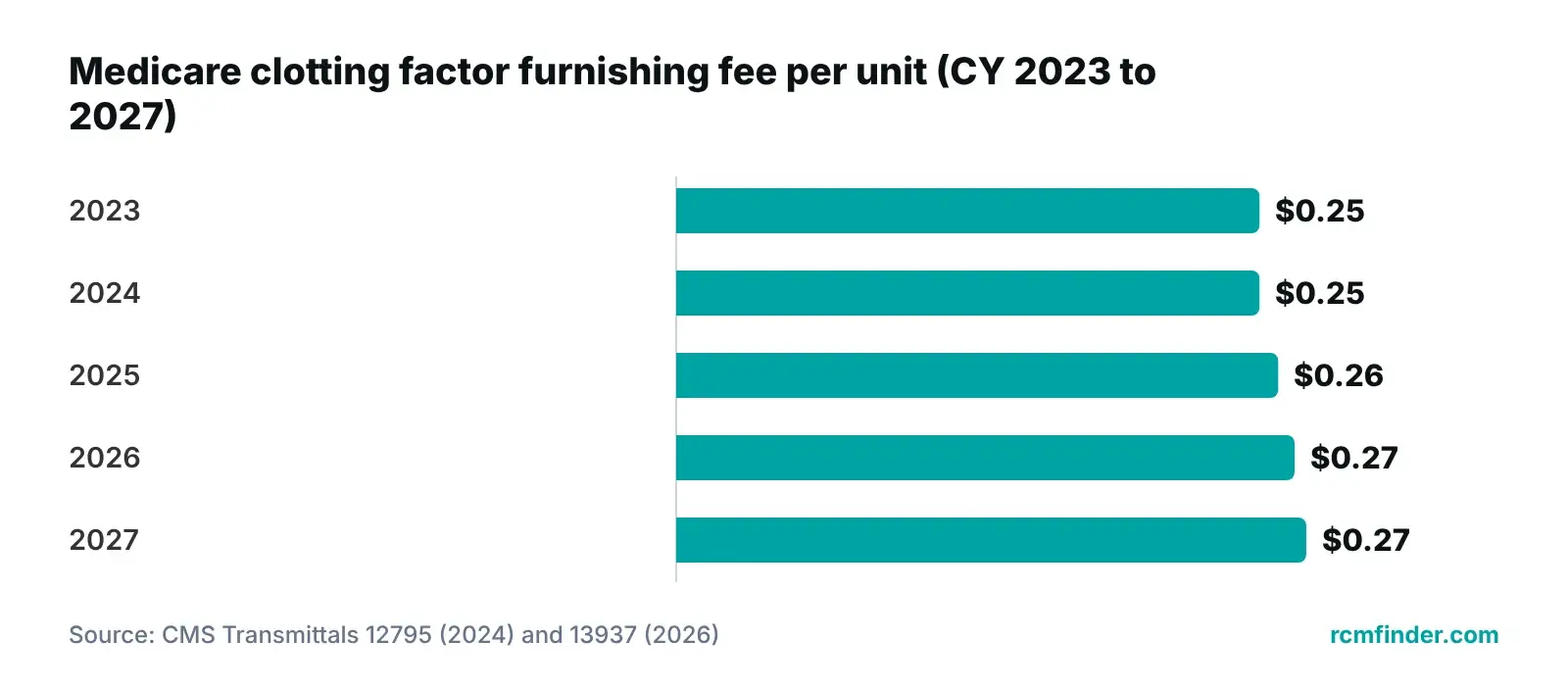
CMS raised the clotting factor furnishing fee to $0.265 per unit for 2026 (Transmittal 13379) and set $0.270 for 2027 (Transmittal 13937, August 27, 2026). Plan policies move too: UnitedHealthcare's current commercial ESA, IV iron, immune globulin and clotting factor policies took effect between April and October 2026.
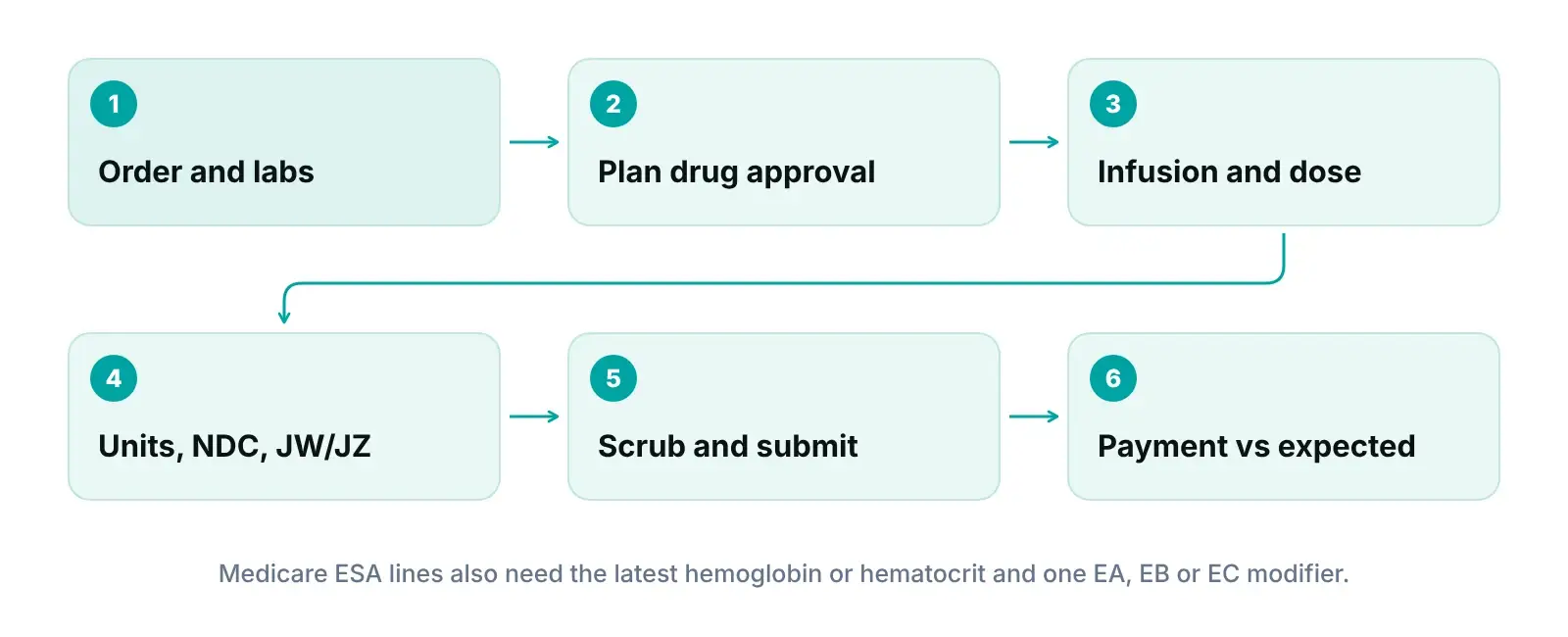
A hematology practice needs referrals, drugs approved before the chair is booked, claims billed in the right units and software that shows every claim.
Revenue leaks at the handoffs: an infusion booked before approval, an ESA dose with no recent hemoglobin on file, units billed on the wrong unit size. We run all four pillars against one set of payer rules.
Our healthcare digital marketing builds demand from patients searching for help with anemia, bleeding or clotting problems and from the clinicians who refer to you, through local SEO, Google Ads and reputation work.
Our virtual medical assistants for hematology work on your practice's time zone. They check eligibility and which benefit covers a drug, start prior authorizations for IV iron, ESAs, immune globulin and factor, and gather the labs each plan asks for.
Our end-to-end hematology revenue cycle management covers coding support, claim scrubbing, denial management and A/R follow-up, with extra checks on drug units, JW or JZ, Medicaid NDCs, ESA lab values and NCCI bundling.
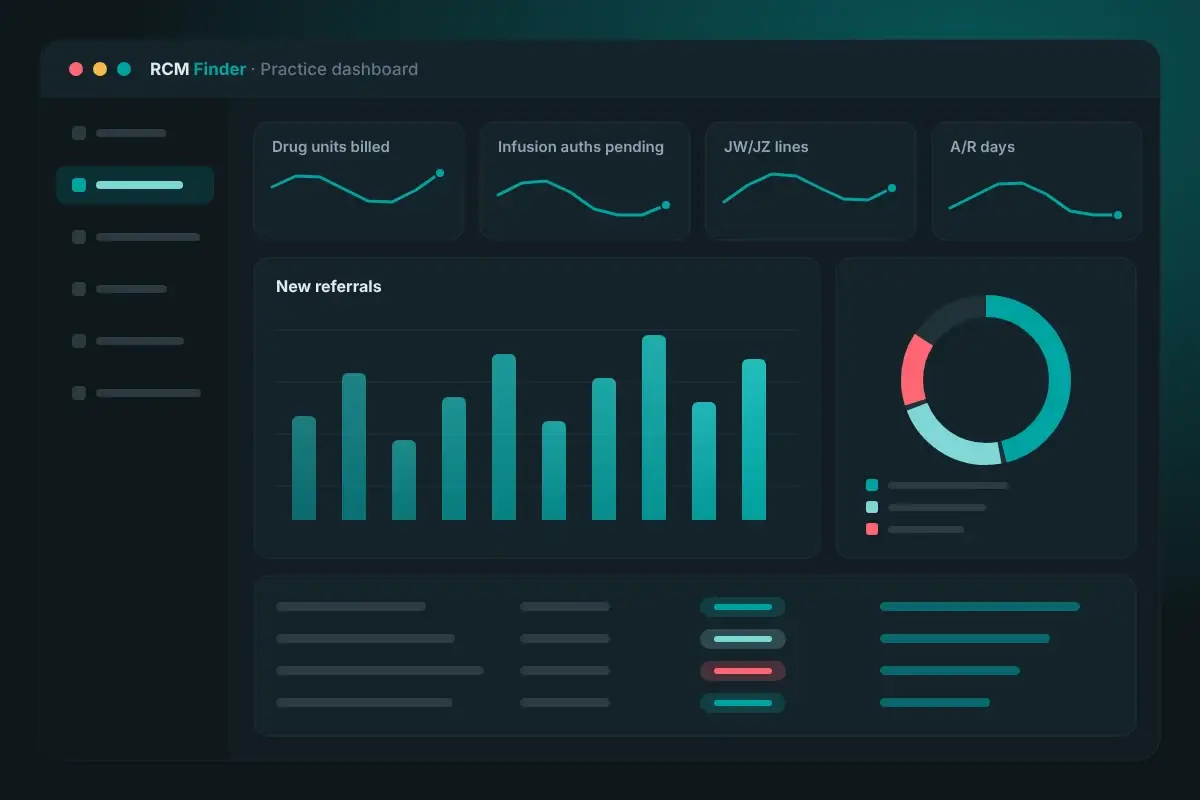
Our practice management system tracks every claim by stage. It applies specialty-aware billing logic to each claim, checks that data is complete before submission and flags payments below the expected amount.
Find where your infusion claims leak
We review recent drug and infusion claims, denials and authorization logs, then show where units, modifiers or missing approvals cost you.
Each service family has its own unit, modifier or bundling rule, and the table shows where claims often break. Codes are described in our own words (the AMA owns CPT descriptors); check current code sets and your contractor's guidance before billing.
| Service family | Code examples (our wording) | Billing nuance | Typical denial trigger |
|---|---|---|---|
| IV iron infusion | J1439 ferric carboxymaltose (1 mg); J1756 iron sucrose (1 mg); J1437 ferric derisomaltose (10 mg); Q0138 ferumoxytol, non-ESRD (1 mg) | Units equal the dose divided by the code's unit; JZ, or a separate JW line for single-dose waste | Units copied from another product; JW or JZ missing; non-preferred product without approval |
| ESAs for anemia | J0885 epoetin alfa, non-ESRD (1,000 units); J0881 darbepoetin alfa, non-ESRD (1 mcg) | Latest hemoglobin or hematocrit (both at Noridian JE) plus EA, EB or EC on every non-ESRD line | Lab value or modifier missing; EA with hemoglobin of 10.0 g/dL or more; EC with iron, folate or B-12 deficiency |
| Drug administration | 96365 (IV infusion, first hour); 96366 (each added hour); 96374 (IV push); 96372 (injection under the skin or into muscle) | One initial code per encounter unless separate IV sites; IV start, port flush and 99211 included | Two initial codes on one date; 99211 billed with the infusion; physician billing it in a hospital outpatient setting |
| Therapeutic phlebotomy | 99195 | Venipuncture, IV access and drug administration are included | Billed with autologous blood collection, plasmapheresis or exchange transfusion |
| Bone marrow aspiration and biopsy | 38220 (aspiration); 38221 (biopsy); 38222 (both) | 38222 for both on the same iliac bone; 38220 with 38221 only on different bones or at separate encounters | Both single codes for one bone; 38220 billed with bone biopsy code 20220 |
| Clotting factor | J7192 (recombinant factor VIII, not otherwise specified, per IU); factor codes J7177 to J7214 | Billed per IU; Medicare's furnishing fee ($0.265 per unit in 2026) is built into the payment limit | Plan criteria unmet, such as no inhibitor assay on file for FEIBA or NovoSeven |
| Anticoagulation management | 93793 (warfarin INR review and dosing); 93792 (home INR monitor training) | Medicare home INR: mechanical valve, chronic AF or VTE; 3+ months on warfarin; at most weekly | Home testing started too early or done more than weekly; no face-to-face training on record |
Sources: CMS Medicare Claims Processing Manual ch. 17 §40 and ch. 12 §30.5; CMS Transmittals 1412 and 1413 (2008) and 13379 (2025); Noridian JE Part B (2026); NCD 190.11; Medicare NCCI Policy Manual 2026, chapters V and XI; UnitedHealthcare policy 2026D0047AN (2026); AAPC code summaries. Rules vary by MAC and payer.
Drug codes are billed in the unit written into the code. Ferric carboxymaltose (J1439) bills per 1 mg and ferric derisomaltose (J1437) per 10 mg, so 750 mg is 750 units under J1439 but 75 units under J1437. Our guide to J-codes in medical billing explains how drug codes work.
For single-dose containers, CMS's claims manual (chapter 17, section 40) has required the JW modifier since January 1, 2017, for any discarded amount, on its own line. Since July 1, 2023, JZ attests that nothing was discarded. If one billing unit covers both dose and leftover, JW is not allowed. Neither modifier applies to multiple-dose containers.
The 2026 NCCI policy manual, chapter XI, allows one initial administration code per encounter unless drugs need separate IV sites. Starting the IV and flushing a port are included, and so is a nurse-level visit (99211). A significant, separately documented E/M visit takes modifier 25. Physicians do not report these codes in facility settings such as a hospital outpatient department. See our 96372 CPT code guide and our guide to home infusion and IVIG billing.
Since January 1, 2008, every non-ESRD claim for an ESA must report the most recent hemoglobin or hematocrit and one modifier: EA (anemia from chemotherapy), EB (from radiation) or EC (from neither), per CMS Transmittal 1412. On an electronic professional claim, the value goes in loop 2400, MEA segment; professional claims without it are returned as unprocessable. Some contractors ask for more: Noridian (JE Part B) has required both hemoglobin and hematocrit since a June 2025 update and rejects claims missing either.
NCD 110.21 sets Medicare coverage for ESAs in cancer and related neoplastic conditions. Its claim edits (Transmittal 1413) still reach benign practices: contractors deny EA lines reporting hemoglobin of 10.0 g/dL or more, and EC lines carrying listed diagnoses such as iron, folate or B-12 deficiency, hemolysis or bleeding. For uses the NCD does not address, your MAC decides. Lab orders need diagnosis support too; see our CBC ICD-10 code guide.
NCCI bundles venipuncture, IV access and drug administration into therapeutic phlebotomy (99195). For bone marrow, NCCI chapter V uses 38222 when aspiration and biopsy share one iliac bone; 38220 and 38221 pair only across different bones or encounters.
Get the drug approved before the chair is booked, not after a denial. Criteria for IV iron, ESAs, immune globulin and clotting factor differ by plan and product.
Plan rules name products, labs and prior treatments. UnitedHealthcare’s 2026 commercial IV iron policy treats Feraheme, Ferrlecit, INFeD and Venofer as preferred, sets criteria for Injectafer and calls Monoferric not medically necessary for the diagnoses it covers. For Injectafer, it asks for records of iron deficiency anemia, an oral iron failure, intolerance or listed exception, and failure of, or intolerance to, preferred IV products. Its ESA policy prefers Retacrit on medical necessity plans and, for kidney disease without dialysis, starts therapy only below 30% hematocrit.
Hemophilia adds benefit questions. UnitedHealthcare's clotting factor policy requires inhibitor documentation, such as a Bethesda assay, for FEIBA and NovoSeven and generally places non-factor agents such as Hemlibra under the pharmacy benefit. Its immune globulin policy sets platelet criteria for ITP.
The workload is heavy. In the AMA’s 2025 survey of 1,000 physicians, released in May 2026, physicians averaged 40 prior authorizations and 13 hours of physician and staff time each week. For the general process, read our prior authorization guide for providers.
| Rule | Source | What the VMA checks |
|---|---|---|
| MA, Medicaid and CHIP plans decide in 72 hours or 7 days, but drugs are excluded; MA Part B drug requests are due in 72 hours (24 if expedited) | CMS-0057-F (Jan 1, 2026); 42 CFR 422.568, 422.572 | Request date and time logged; follow-up when the plan's drug deadline passes |
| Feraheme, Ferrlecit, INFeD and Venofer are preferred; Injectafer needs criteria; Monoferric is not medically necessary | UnitedHealthcare 2026D0088R (Sept 1, 2026) | Product against the plan list; iron deficiency records and oral iron history |
| Retacrit preferred; kidney disease without dialysis starts below 30% hematocrit, other causes ruled out | UnitedHealthcare 2026D0028Y (Apr 1, 2026) | Product, recent hematocrit or hemoglobin and iron studies |
| Medicare non-ESRD ESA lines need the latest hemoglobin or hematocrit (Noridian JE: both) and EA, EB or EC | CMS Transmittal 1412 (2008); Noridian JE (2025) | Lab value and date passed to billing with the dose |
| IVIG for ITP: acute needs platelets below 50 × 10⁹/L within 30 days; chronic needs steroid or splenectomy failure, contraindication or intolerance | UnitedHealthcare 2026D0035AV (Oct 1, 2026) | Platelet count date and prior ITP treatments |
| FEIBA and NovoSeven need inhibitor documentation; non-factor agents generally use the pharmacy benefit | UnitedHealthcare 2026D0047AN (Oct 1, 2026) | Inhibitor assay, use type and which benefit pays |
| Home INR: mechanical valve, chronic AF or VTE; 3+ months on warfarin; training first; at most weekly | Medicare NCD 190.11 | Warfarin start date and training record |
Sources: CMS-0057-F fact sheet (2024); eCFR 42 CFR 422.568 and 422.572; UnitedHealthcare commercial medical benefit drug policies 2026D0088R, 2026D0028Y, 2026D0035AV and 2026D0047AN (2026); CMS Transmittal 1412 (2008); Noridian JE Part B (2026); NCD 190.11. Commercial rows are one plan's rules; always check the member's current plan.
See what drug denials cost you
Enter your claim volume and denial rate to estimate what delayed approvals and unit errors cost your hematology practice.
Hematology growth depends on referring clinicians and on patients searching for answers about anemia, bleeding or clotting, and your tracking must respect HIPAA.
We build location pages, condition pages for patients and a simple referral path for primary care, OB-GYN, nephrology and other offices, listing which recent labs to send. We ask real patients for reviews and write responses that never confirm someone is a patient.
HHS guidance on online tracking says tracking tools on login or appointment pages can collect protected health information, and a cookie banner is not a HIPAA authorization. A 2024 court order vacated part of that guidance. Even so, we keep tracking off appointment and referral forms unless the vendor signs a BAA.
Stay in-house if your billers know drug units and infusion rules and your front desk has time for drug approvals. Use a billing-only vendor if claims are your only gap. Choose a combined partner when problems span approvals, billing and growth.
| Job | In-house team | Billing-only vendor | Four-pillar partner (RCM Finder) |
|---|---|---|---|
| Drug prior authorization | Front desk or nurses, between patients | Usually left to the practice | VMA starts each request and tracks it to a decision |
| Drug units, NDCs and JW/JZ | Depends on one biller | Fixed after the fact | Checked before submission |
| ESA lab values and modifiers | Pulled from the chart at billing time | Requested from the practice | Captured with the dose; claim held if missing |
| Referral growth and reviews | A separate agency, or nobody | Not included | Marketing pillar tied to booked visits |
| Reporting | EHR reports | Claim reports only | Portal and dashboards, referral to paid claim |
| Cost structure | Salaries, benefits, turnover | Varies; ask how fees are set | Quoted after a free practice audit |
We will tell you in the audit if you need only one pillar; our revenue cycle management services and virtual medical assistant services can be contracted separately.
We start with a free audit and change nothing until you see the findings. We build our billing pipeline around how claims actually move through a practice: registration, charge entry, submission, payment and follow-up. For hematology, we add the drug, infusion and lab-value checks on this page.
We review recent drug and infusion claims, denials and authorization logs, checking units, modifiers and lab values line by line.
We put a Business Associate Agreement in place before accessing patient data. Then we work inside your existing EHR (for example PrognoCIS, eClinicalWorks or athenahealth).
Your plans' drug policies and your Medicare contractor's guidance become a pre-infusion checklist and portal workflow rules.
VMAs start drug approvals and collect labs. Claims are scrubbed, submitted and worked through denials and A/R.
Each week we review denials by reason, A/R days, infusions cleared in advance and referrals.
Talk to us about your hematology practice
Tell us your infusion volume, drug mix and hardest payer. We will tell you honestly whether we fit.
Any billing vendor that handles your patients' data is a HIPAA business associate. Get a Business Associate Agreement before they have any access, and check how they limit and log that access.
HHS guidance names billing and claims processing as business associate work, and subcontractors need their own agreement. The minimum necessary standard limits use to what each task needs. The Security Rule's technical safeguards require access control, audit controls, integrity controls, person or entity authentication and transmission security.
We use role-based access, audit logging and encrypted (HTTPS) connections, and we put a Business Associate Agreement in place before accessing patient data. For your own side, use our HIPAA compliance checklist for medical practices.
We would rather tell you now than after you sign. Here is where we fit and where we do not.
A good fit if you are
Probably not a fit if you are
What we would do first if we were running your practice's revenue cycle tomorrow.
We divide every dose by the unit in the HCPCS code and check it against the administration record. Unit sizes differ even between iron products.
Each single-dose line gets JZ when nothing was discarded, or a separate JW line for the waste. We ask nurses to chart the discarded amount.
We pass the most recent hemoglobin and hematocrit to billing with the dose and choose EA, EB or EC from the chart. Under Medicare's ESA edits, an EC line coded with iron deficiency is a predictable denial.
Plans prefer specific iron and ESA products. We check the member's preferred list before the order is final.
The UnitedHealthcare IV iron, ESA and immune globulin policies we reviewed cap approvals at 12 months. We start renewals early, with fresh labs.
Factor products and non-factor agents can sit under different benefits. We confirm the benefit and inhibitor status before the first dose.
They cover coding support, claim scrubbing, submission, denial management and A/R follow-up for hematology visits, infusions, injections and procedures such as bone marrow biopsy and therapeutic phlebotomy. Because drug lines have their own unit and modifier rules, a good service also checks drug units, NDCs, JW and JZ modifiers and ESA lab reporting, and starts prior authorizations before the infusion. We add front-desk assistants, patient marketing and a claims portal.
Divide the dose given by the unit in the HCPCS code. Ferric carboxymaltose (Injectafer, J1439) and iron sucrose (Venofer, J1756) are billed per 1 mg, so 200 mg of iron sucrose is 200 units. Ferric derisomaltose (J1437) is billed per 10 mg. For single-dose vials, report any discarded amount on its own line with JW, or add JZ when nothing was discarded.
For patients without end-stage renal disease (ESRD), CMS has required since January 1, 2008, that each ESA line report the most recent hemoglobin or hematocrit and one modifier: EA for anemia from chemotherapy, EB for anemia from radiation, or EC for anemia from neither. On electronic professional claims, the value goes in loop 2400, MEA segment. Claims missing the value or modifier are returned, and EA lines reporting hemoglobin of 10.0 g/dL or more are denied. Noridian JE now asks for both values.
Clotting factor is billed per international unit with HCPCS codes such as J7192 for recombinant factor VIII not otherwise specified. Medicare also pays a furnishing fee per unit to entities that furnish clotting factor, unless another payment system already covers those costs. The fee is $0.265 per unit for 2026 and $0.270 for 2027, and it is built into the published payment limit for clotting factor codes.
Sometimes. Under the 2026 NCCI manual, a nurse-level visit (99211) is included in drug administration and is not billed separately. A higher-level visit can be billed with modifier 25 when the physician provides a significant, separately identifiable service and documents it. For therapeutic phlebotomy, venipuncture, IV access and drug administration are part of the service and are not billed on their own.
It can be, if the vendor is treated as a business associate. HIPAA requires a Business Associate Agreement before the vendor receives patient data, and that agreement must require the vendor to safeguard it. The Security Rule's technical safeguards include access control and audit controls. We put a Business Associate Agreement in place before accessing patient data, and we use role-based access, audit logging and encrypted (HTTPS) connections.
Tell us about your practice. A member of our operations team replies within one business day.
Pricing is quoted after the audit, based on your volume and the services you choose. Prefer to talk? Call +1 (302) 556-2288.
Tell us about your practice
About the author: Awais Afzal
Healthcare Operations & Data Analyst, RCM Finder
Awais has spent more than 16 years in healthcare digital marketing and clinical operations management. He builds data-driven revenue cycle blueprints for high-ticket medical practices and leads product development of the RCM Finder portal. More about our team.
How we write: every figure, code and rule on this page was checked against the primary source listed below and independently fact-checked before publishing. We re-review this page every six months. Last reviewed October 12, 2026; next review April 12, 2027.
We use cookies to understand how our site is used and to measure our advertising. You can accept or reject non-essential cookies. See our Privacy Policy.