
A CBC ICD-10 code supports medical necessity when it names the documented reason the test was ordered, such as a symptom or a confirmed condition. Medicare's Blood Counts rule does not cover screening in patients with no symptoms or condition, so a routine-exam code on a sick-patient order invites a denial.
This guide is for billers, coders and practice managers who send lab claims. It explains the logic behind the diagnosis code, not a list to copy. For the code you pick, look it up in the FY 2027 code set on the date of service.
Key takeaways
- The diagnosis code must reflect the reason documented in the note.
- Medicare’s NCD 190.15 treats testing without a symptom or condition as screening, which is not covered.
- FY 2027 ICD-10-CM codes and updated Medicare lab edits apply from October 1, 2026.
- If only hemoglobin or hematocrit is ordered, bill that, not a full CBC.
- Use an ABN only when you expect a denial for a specific reason.
What makes a diagnosis code support a CBC?
A diagnosis code supports a complete blood count when it tells the payer why this patient needed this test on this date. The code is not a password. It is a short summary of what the provider documented, and the payer checks whether that summary fits the test.
For Medicare, the rule sits in National Coverage Determination 190.15, Blood Counts. In the CMS Medicare Coverage Database, the NCD says testing of patients who are asymptomatic, or who do not have a condition, is screening and is not a covered service. It also says that when the ordering provider requests only a hemoglobin or hematocrit, the remaining parts of the CBC are not covered. Repeat testing, it adds, may not be indicated unless abnormal results are found.
That wording explains most CBC denials. The test itself is routine. The reason attached to it is where the claim succeeds or fails.
Correcting a common belief
Many billers think Medicare keeps a list of approved diagnoses for the CBC. For Blood Counts, CMS describes the edit differently. Its transmittals refer to a list of ICD-10-CM codes that are not medically necessary for the Blood Counts (190.15) NCD. In practice, the question is less “is this code on a good list?” and more “does my code describe a real reason, and is it a code the edit rejects for this test?”
This post covers the diagnosis side. If you are looking at lab billing as a whole, including CPT pairing and CLIA, start with our laboratory billing and coding guide. For lab denial review across many test types, see ICD-10 for lab review.
What changed on October 1, 2026?
The FY 2027 ICD-10-CM code set took effect on October 1, 2026. CMS says to use the 2027 files for encounters from October 1, 2026 through September 30, 2027. Any code you pick for a CBC should come from that set when the date of service falls in that window.
The Medicare lab edits moved too. A CMS change request directs the edit module developer to delete some ICD-10-CM codes from the Blood Counts (190.15) list effective September 30, 2026, and to add others effective October 1, 2026. The implementation date in that document is October 5, 2026. The document does not print the codes. They sit in a CMS spreadsheet package, so a coder has to open the October 2026 file to see what changed.
Two practical points follow. First, do not rely on a code cheat sheet from last year, including an old code table in your EHR favorites. Second, a claim that passed in September may be handled differently for a date of service in October. Review your CBC denials by date of service and not only by month paid.
How do you match the documented reason to a code?
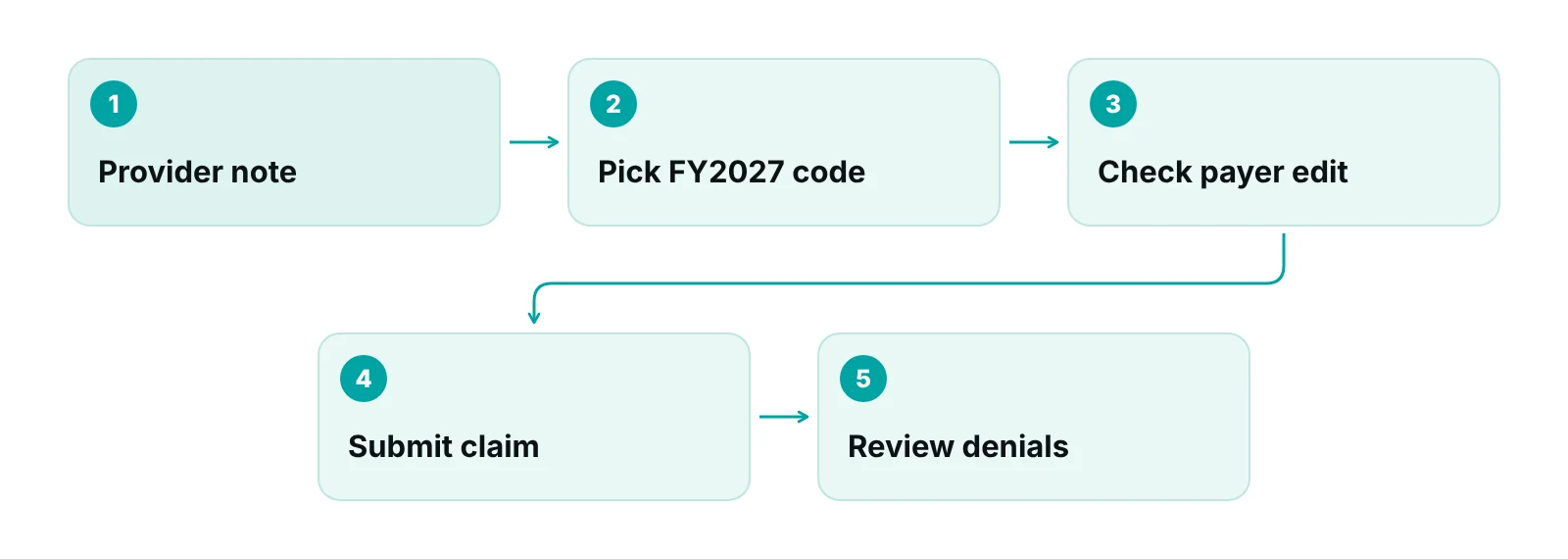
Start from the provider’s note and work toward the code, never the other way round. The ICD-10-CM Official Guidelines for FY 2027 say each encounter should be coded to the level of certainty known for that encounter (Section I.B.18). The same section says it is appropriate to report sign or symptom codes when there is no definitive diagnosis. The full text is in the FY 2027 guidelines.
In plain terms, there are three situations at the front desk or in the billing queue.
| What the note says | Kind of code to search | Medicare Blood Counts risk |
|---|---|---|
| A symptom, such as tiredness or easy bruising, and no diagnosis yet | A sign or symptom code from the Index, at the most specific level documented | Lower, because a real reason is stated. The edit can still reject a code it lists as not medically necessary. |
| A confirmed condition, such as a named type of anemia or an infection | The code for that condition, at the specificity the provider wrote | Lower, as long as the note supports the diagnosis and the test |
| A chronic condition being monitored, such as a known blood disorder | The code for the condition, plus any code the provider documents for treatment that needs lab monitoring | Lower, but repeat testing needs a reason in the note, per the NCD |
| Routine exam, no complaint, no known condition | A preventive or screening encounter code, if the payer covers it | High for Medicare, because the NCD treats testing without a symptom or condition as screening |
| “Rule out” or “suspected” only | The symptom or finding that prompted the suspicion, not the unconfirmed diagnosis | Depends on how the note is written. See guideline Section IV.H, Uncertain diagnosis. |
Source: CMS NCD 190.15 Blood Counts (effective 2002); ICD-10-CM Official Guidelines for Coding and Reporting FY 2027, Section I.B.18 and the Section IV headings.
Look the code up in the CDC ICD-10-CM Browser Tool. NCHS describes it as a no-cost tool where you can search by code or Index term and choose the fiscal year that matches the date of service. Use the Index first, then confirm in the Tabular List, because the Tabular List holds the notes and exclusions that change which code is allowed.
Why the screening code is a trap on a sick-patient order
Using a general adult exam code for every blood draw is a habit that shows up in lab denials. If the note records fatigue and the claim carries only the routine exam code, the payer reads a screening claim. Under the Medicare NCD that is not covered. Under many commercial plans the preventive benefit may apply, with its own frequency rules. Swapping in the symptom the provider documented fixes the claim only when the symptom is truly in the note. It is never a coding shortcut.
“The diagnosis code should summarize the note. If the note cannot support the code, the code is the problem, not the payer.”
What should the provider document so the code holds up?
Coders can only assign what the provider wrote. A short, specific line in the note does more for a CBC claim than any code table. The goal is that a reviewer reading only the note and the claim would agree on why the test was ordered.
- The reason, in words. “CBC to evaluate fatigue and pallor” beats “labs.”
- Specificity. A named type of anemia gives the coder more to work with than the word anemia alone.
- What the test will change. A line such as “repeat to check response to treatment” supports repeat testing.
- Which components were ordered. If only hemoglobin or hematocrit was ordered, the NCD says the rest of the CBC is not covered, so the order and the billed test must match.
- The order itself. Keep the signed order with the note. A diagnosis on a referral is information, not proof the test was necessary.
This is also where a front-desk or intake workflow earns its keep. A missing diagnosis on a standing order is cheaper to fix before the draw than after the denial. Our guide to clean claims and the post on claim scrubbing describe the pre-submission checks that catch it.
A practice management system that checks claim data before submission can also flag a claim whose diagnosis field is empty or does not match the ordered service, so a person reviews it first. Whatever tool you use, the rule is the same: a human decides when the note and the code disagree.
When does a patient need an ABN for a CBC?
A Medicare patient needs an Advance Beneficiary Notice when you expect Medicare to deny the service as not reasonable and necessary and you want to bill the patient if that happens. The Medicare Claims Processing Manual, Chapter 30, Section 50, lists that ground among the provisions that make a notice mandatory (Section 50.3.1). Section 50.3.2 says an ABN is not required for care that is statutorily excluded, though it may be given voluntarily as a courtesy.
| Scenario | ABN position | What to check |
|---|---|---|
| Order with a documented symptom that fits the test | Usually not needed | The note supports the code and the test |
| Order you expect Medicare to deny as not reasonable and necessary | Notice is mandatory to shift liability to the patient | Chapter 30 Section 50.3.1, and your MAC’s instructions on how to complete it |
| Test Medicare excludes by statute | Not required. May be given voluntarily | Chapter 30 Section 50.3.2 |
| Routine screening with no symptom or condition | Depends on whether the service is excluded by statute or denied as not necessary | Confirm with your MAC. The NCD says such testing is screening and not covered |
| Hemoglobin or hematocrit only ordered | The rest of a CBC is not covered, so do not bill a full CBC | NCD 190.15 limitations |
Source: CMS Medicare Claims Processing Manual, Chapter 30, Section 50 (ABN); CMS NCD 190.15 Blood Counts.
Our ABN billing guide covers the notice in more detail. Do not use an ABN as a blanket form signed at check-in. A notice has to be specific to the test and the reason you expect a denial.
How do you find and fix CBC denials?
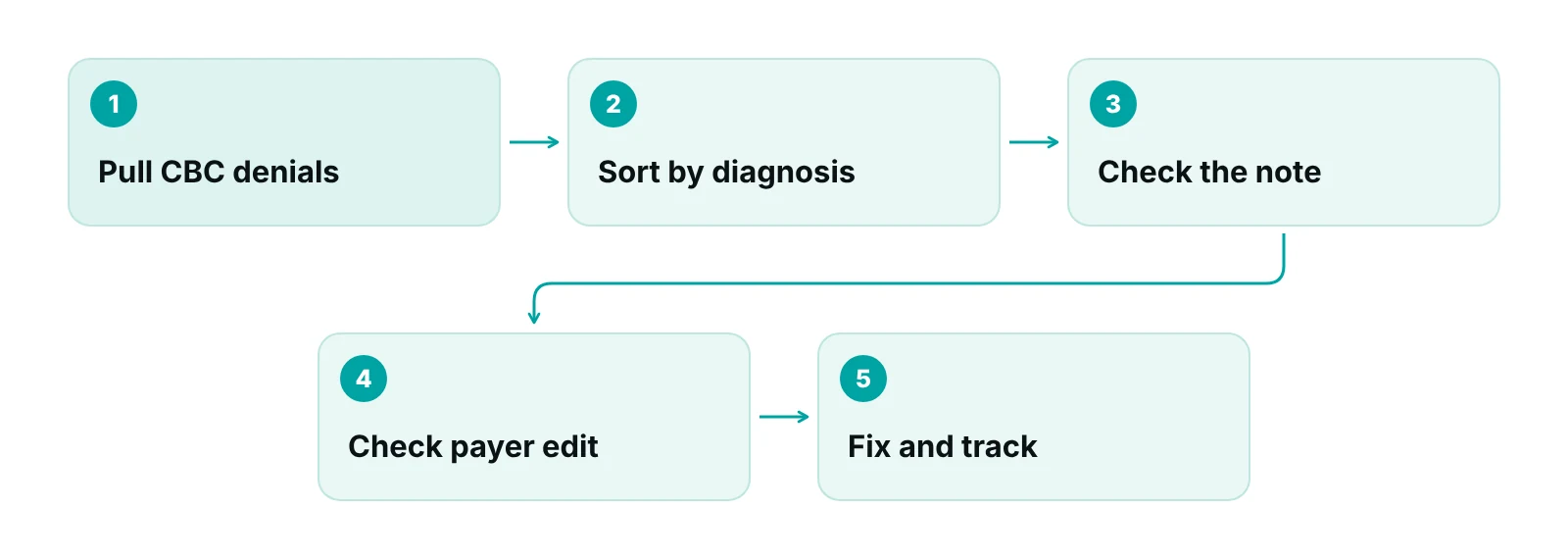
Pull your CBC denials for one quarter and sort them by diagnosis code, payer and date of service. Patterns show up quickly. The goal is to separate three causes: a code that does not fit the reason, a note that does not support the code, and a payer edit that changed.
| Finding | Likely cause | Action |
|---|---|---|
| Routine or screening code on a symptomatic order | Code does not match the documented reason | Correct the claim only if the note supports the symptom code |
| Code matches, but the note is thin | Documentation gap | Ask the provider for a compliant late entry or addendum, per your policy, and add a template prompt |
| Many denials from one payer starting on one date | Payer edit or policy change | Check the payer bulletin and the October 2026 edit files for Medicare |
| Same patient, repeat CBC denied | Repeat testing not justified in the note | Document the reason for the repeat, or prepare an appeal |
| Only part of the CBC components ordered | Order and billed test do not match | Bill what was ordered and performed |
Source: RCM Finder analysis of the rules cited above. Payer policies vary.
For appeals and recurring patterns, see our guides on medical billing denial management and on denial management services if you want outside help working the queue.
Some conditions behind a CBC order, such as blood disorders, are managed by specialists, and their claims have their own patterns. Our hematology billing page explains billing for that specialty.
Where do CBC claims leak in your practice?
If your lab denials keep returning with the same diagnosis codes, the cause is rarely the test. It is usually a gap between the order, the note and the claim.
Find out where lab claims are denied
We review a sample of your recent lab claims and show where the diagnosis, the note and the payer edit disagree.
Our recommendations
- Code from the note, then check the Index. Read the provider’s wording first, find it in the ICD-10-CM Index, and confirm in the Tabular List for the fiscal year of the date of service.
- Do not use a screening code to cover for a missing reason. If the note records a symptom, code the symptom. If it records nothing, ask the provider before the claim goes out.
- Match the billed test to the order. A hemoglobin-only order is not a full CBC. Make sure the lab order, the result and the claim line agree.
- Rebuild your favorites list each October. Review any saved diagnosis shortcuts against the new code set and the new Medicare lab edit files.
- Track CBC denials by date of service. A payer change shows up as a break in a trend line. Monthly totals hide it.
- Give the ABN a clear job. Use it only when you expect a denial for a specific reason and you want to be able to bill the patient. Never as a standing form.
Check claim data before it goes out.
A claim-centred practice management system can flag a claim whose diagnosis field is empty or does not fit the ordered service, so a person reviews it before submission.
See how the RCM Finder portal works · Create a portal account
Disclosure: RCM Finder builds and sells this portal. It is a practice management system, not an EHR.
Bottom line
A CBC ICD-10 code works when it summarizes a documented reason the test was needed. Match the code to the note, use the code set for the date of service, and check the payer edit before you blame the code. If you want help with lab billing or recurring denials, see our medical billing services, or request a free practice audit. You can also estimate what denials cost with the revenue calculator.
Frequently asked questions
Which ICD-10 code should I use for a CBC?
There is no single code. Use the code for the reason the provider documented, either a symptom or a confirmed condition, at the most specific level in the note. Look it up in the Index and confirm in the Tabular List for the fiscal year of the date of service. If the note has no reason, ask the provider before submitting the claim and do not default to a routine-exam code.
Does Medicare cover a CBC as part of a routine physical?
Under NCD 190.15, testing of patients who are asymptomatic, or who have no condition, is screening and is not a covered service. Other payers may cover preventive labs under their own rules and frequency limits, so check the plan, and check whether the patient has the preventive benefit before the draw.
Can I list more than one diagnosis on a CBC claim?
Yes, when the note documents more than one reason for the test. Only include conditions the provider documented, and follow Section IV.A of the outpatient guidelines on selecting the first-listed condition. Keep the order consistent with the note, so a reviewer sees the same story on the claim and in the chart.
What if the provider only orders hemoglobin or hematocrit?
The Blood Counts NCD says the remaining components of the CBC are not covered when only a hemoglobin or hematocrit is requested. Bill what was ordered and performed, not a full CBC.
Do the Medicare CBC edits change over time?
Yes. CMS updates the lab edit module quarterly, and the October 2026 change request adds and removes ICD-10-CM codes on the Blood Counts list. Review the current files rather than an older table, and re-check your saved diagnosis shortcuts each October when the new code set starts.
Should every CBC order get an ABN?
No. A notice is for a service you expect Medicare to deny as not reasonable and necessary, when you want to be able to bill the patient. Statutorily excluded care does not require one, though it can be given voluntarily.
Get your free practice audit
Tell us about your practice. We will contact you using the details you give.
- A review of your recent claims, denials and A/R aging
- Where your front desk and prior authorizations slow payment
- A prioritized fix list you keep, whether or not you hire us
Pricing is quoted after the audit, based on your volume and the services you choose. Prefer to talk? Call +1 (302) 556-2288.
Sources
- National Coverage Determination 190.15, Blood Counts — CMS Medicare Coverage Database (2002 (effective); code lists updated quarterly)
- Change request on lab NCD ICD-10-CM edits (r13849cp) — CMS (2026)
- Transmittal r4400cp (lab NCD ICD-10 edits) — CMS (2019)
- ICD-10 codes (2027 files) — CMS (2026)
- ICD-10-CM Official Guidelines for Coding and Reporting FY 2027 — CDC / NCHS (2026)
- ICD-10-CM Browser Tool — CDC / NCHS (2026)
- Medicare Claims Processing Manual, Chapter 30, Section 50 (ABN) — CMS (current)
Disclaimer: This article is educational and is not clinical, legal, coding or compliance advice. ICD-10-CM changes each fiscal year, payer and Medicare Administrative Contractor policies vary, and the provider's documentation controls code assignment. Confirm each code in the current Tabular List and your payer's policy before you bill.
