
Billing for surgery, injections, braces and therapy, plus prior authorization, injury intake, patient marketing and a claims portal, built on CMS rules and your payers' own policies.
By Awais Afzal | Healthcare Operations & Data Analyst
Published October 12, 2026 · Last reviewed October 12, 2026 · Next review April 12, 2027
Quick answer
Orthopedic billing services code, submit and follow up on claims for surgery, injections, braces and therapy. Done well, they also track global surgical periods and modifiers 24, 25, 57, 58, 78 and 79, clear imaging and surgery prior authorizations, and bill workers' comp, auto and DME payers correctly. RCM Finder adds front-desk staff, marketing and a claims portal.
On this page
Orthopedic billing is different because one patient can create several kinds of claims: a surgery with a global period, office injections, a brace billed to a separate Medicare contractor, therapy under a signed plan of care, and sometimes an injury insurer that pays first.
Surgery claims depend on the global surgical package and modifiers 24, 25, 57, 58, 78 and 79. Medicare brace claims go to a DME Medicare Administrative Contractor (DME MAC). Job and accident injuries change who pays first. And the site of service changes how the surgeon is paid.
Under section 20.4.2 of CMS's claims processing manual, chapter 12, physicians get the fee schedule's facility rate in hospital settings (POS 19, 21, 22 or 23) and ambulatory surgical centers (POS 24), and the nonfacility rate in the office (POS 11).
Site options are widening. CMS's CY 2026 OPPS and ASC final rule (November 2025) began a three-year phase-out of the inpatient-only list, starting with 285 mostly musculoskeletal procedures, and added hundreds of codes to the ASC covered procedures list.
We build our billing pipeline around how claims actually move through a practice: registration, charge entry, submission, payment and follow-up. For orthopedics, we add the checks on this page. For interventional spine work, see our pain management billing services.
An orthopedic practice needs four things working together: patients and referrals, a front desk that settles payer questions before the visit, billing that respects global periods and DME rules, and software that shows every claim.
Revenue leaks at the handoffs: an MRI booked before approval, a job injury billed to health insurance, a brace under the wrong code. We run all four pillars against one set of payer rules.
Our healthcare digital marketing builds demand from patients seeking joint, spine and sports injury care, and from referring offices, through local SEO, Google Ads and reputation work.
Our virtual medical assistants cover your front desk on your practice's time zone. They verify eligibility, ask the injury questions that decide who pays, and start imaging and surgery authorizations.
Our end-to-end orthopedic revenue cycle management covers coding support, claim scrubbing, denial management and A/R follow-up, with added checks for global periods, surgical modifiers, injection units and payer order.
Our practice management system tracks every claim by stage, applies specialty-aware billing logic per claim, checks data completeness before submission and flags underpayments.
See where your orthopedic claims stall
We review recent surgery, injection, brace and therapy claims and your intake workflow, then show what to fix first. Pricing is quoted after the audit.
Most orthopedic denials trace to a short list: a visit billed inside a global period, the wrong surgical modifier, injection units or laterality, a missed viscosupplement criterion, or a brace coded or ordered wrong.
Codes are examples in our own words; check current code sets. Sources: the CMS Global Surgery booklet (MLN907166, December 2025), WPS LCD L39529 and article A56157, the DME MAC knee orthoses LCD and policy article, and CMS and CGS therapy guidance.
| Service | Codes (our wording) | Rule to check | Common error or denial |
|---|---|---|---|
| Visit before or on procedure day | E/M with modifier 57 or 25 | 57 only for a 90-day surgery decision; 25 only for a significant, separate visit | 57 before a 0- or 10-day procedure; 25 on every injection visit |
| Care in a global period | Modifiers 24, 58, 78, 79 | Routine follow-up is included; 58 and 79 start a new period | Routine post-op visits billed; 78 used for a planned stage |
| Major joint injection | 20610 (no ultrasound); 20611 (ultrasound, recorded) | One unit for aspirate-and-inject; RT/LT or 50 (WPS) | Two units billed; laterality missing |
| Knee viscosupplementation | 20610 or 20611 plus a hyaluronan code, e.g. J7321 (per dose) or J7325 (per mg) | X-ray-supported knee OA; 3 months failed conservative care; standardized tool; EJ on later doses | Repeat series under 6 months; a joint other than the knee |
| Knee and back braces | L1833 (off-the-shelf knee); L1832 (same, custom fitted); L1851 (knee OA); L0650 (off-the-shelf lumbar-sacral) | Bill the DME MAC; written order first; KX only if all criteria are met | Custom-fitted code without expert fitting; no laxity test; no prior authorization |
| Outpatient PT | Therapy codes with GP | Plan sent within 30 days of the evaluation (order on file) or signed; recertified at least every 90 days; KX above $2,480 (2026) | Unsigned plan with no order on file; late recertification; no KX over the threshold |
Sources: CMS MLN907166 (2025) and claims manual ch. 12 (2026); WPS L39529 (2025), A56157 (2026); DME MAC L33318, A52465 (2026); CMS therapy page (2026); 42 CFR 424.24 (2026); CGS (2021); Noridian (2026); AAPC. Rules vary by MAC and payer.
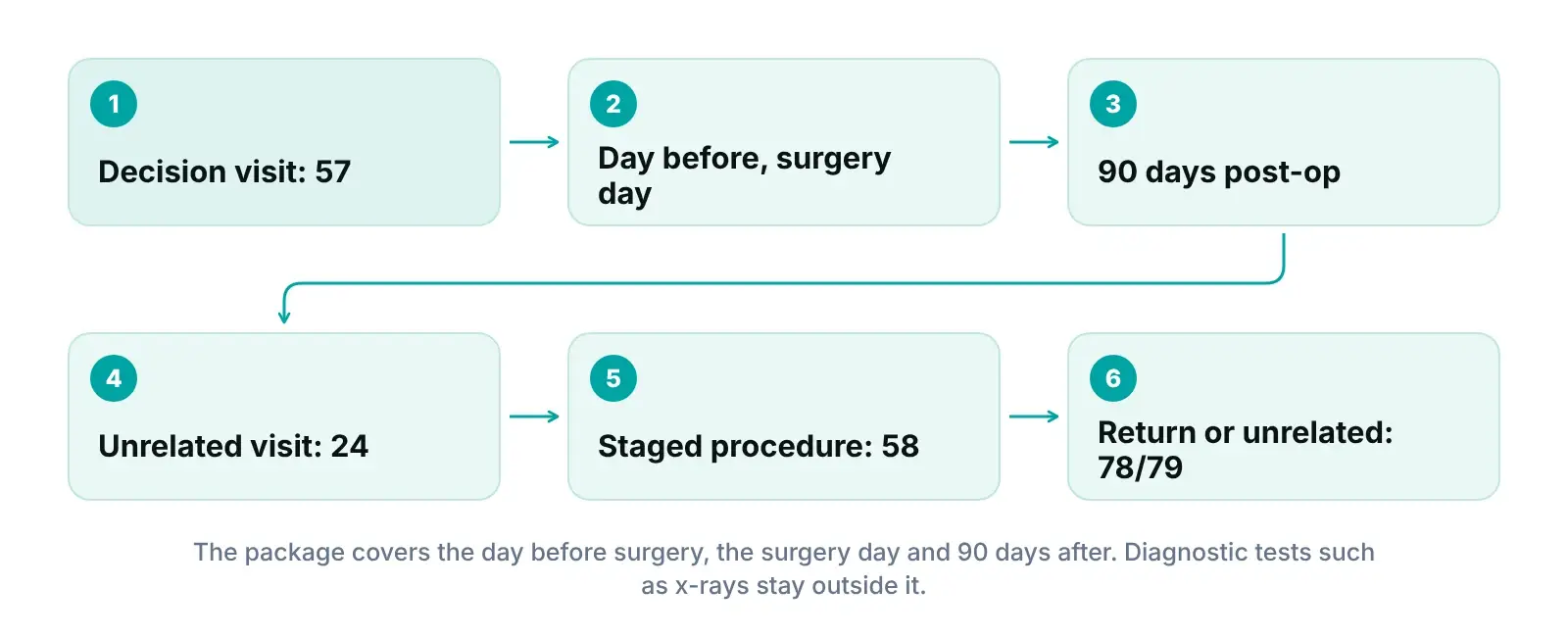
Global periods are 0, 10 or 90 days, and a 90-day global also covers the day before surgery. Check each code's indicator (000, 010, 090, or ZZZ for add-ons) in the PFS Look-Up Tool before billing post-op work.
The package includes pre-op visits after the decision, normal follow-up, complications that do not need a return to the OR, and removal of sutures, casts and splints. Outside it: the decision visit (57), unrelated visits (24), staged procedures (58), OR returns (78), unrelated procedures (79) and x-rays. See our guides to modifier 79, modifiers 25 vs 59 and joint replacement billing.
WPS LCD L39529 covers knee hyaluronan injections in Jurisdictions 5 and 8, including Indiana, Michigan, Iowa, Kansas, Missouri and Nebraska. A repeat series needs at least 6 months since the last one and a documented response. Other joints are denied. Other MACs publish their own rules.
Article A56157 adds RT, LT or 50 on the injection code, EJ on later injections, and JW for discarded drug. If the drug is denied, the injection is too. The LCD warns that routine ultrasound or fluoroscopy guidance may bring prepayment review. See our knee pain ICD-10 codes guide.
Orthopedic prior authorization starts at scheduling. Commercial plans may require it for MRI and CT, and some send joint and spine procedures to a benefit manager. Traditional Medicare requires it for a short list of hospital outpatient services and for some braces.
UnitedHealthcare commercial plans, for example, may require it for outpatient CT, MRI, MRA and PET, but not in the ER, observation, urgent care or inpatient. Blue Cross NC uses Carelon for spine surgery, joint replacement, arthroscopy and spine injections. Medicare claims carry no AUC data: CMS paused that program and rescinded its rules effective January 1, 2024.
CMS's OPD prior authorization program has covered hospital outpatient cervical fusion with disc removal since July 1, 2021. Per the CMS OPD FAQ (2024), claims without a provisional affirmation are denied and related physician services go unpaid; ASCs and offices are outside the program. Since January 1, 2026, CMS-0057-F has required Medicare Advantage, Medicaid and CHIP plans to decide within 72 hours (expedited) or 7 days (standard).
In the AMA’s 2025 survey (released May 2026), physicians averaged 40 prior authorizations and 13 hours of physician and staff time a week. See our prior authorization guide for the general process.
| Payer rule | Source | What the VMA checks |
|---|---|---|
| Outpatient CT, MRI, MRA and PET may need approval (not ER, observation, urgent care or inpatient) | UnitedHealthcare commercial (2026) | Plan list; approval matches code and site |
| Spine surgery, joint replacement, arthroscopy and spine injections reviewed by a benefit manager | Blue Cross NC and Carelon (2024) | Which vendor reviews; approval before surgery |
| Hospital OPD cervical fusion needs Medicare prior authorization; ASC and office do not | CMS OPD program and FAQ | Site of service; provisional affirmation on file |
| MA, Medicaid and CHIP decide in 72 hours or 7 days, with a specific denial reason | CMS-0057-F (Jan 1, 2026) | Due date logged; denial reason saved |
| Workers' comp, no-fault and liability insurance pay before Medicare | CMS MLN006903 (2025) | Injury questions, carrier and claim number at intake |
| Texas comp: preauthorize outpatient or ASC surgery, spinal surgery, DME over $500 per item, and PT or OT beyond six visits in the first two weeks after injury or surgery | 28 TAC §134.600 (example) | Carrier approval before scheduling |
| Florida PIP: care within 14 days of the crash; $2,500 cap if a provider finds no emergency medical condition | Fla. Stat. §627.736 (example) | Accident date, first visit and the provider's determination in the note |
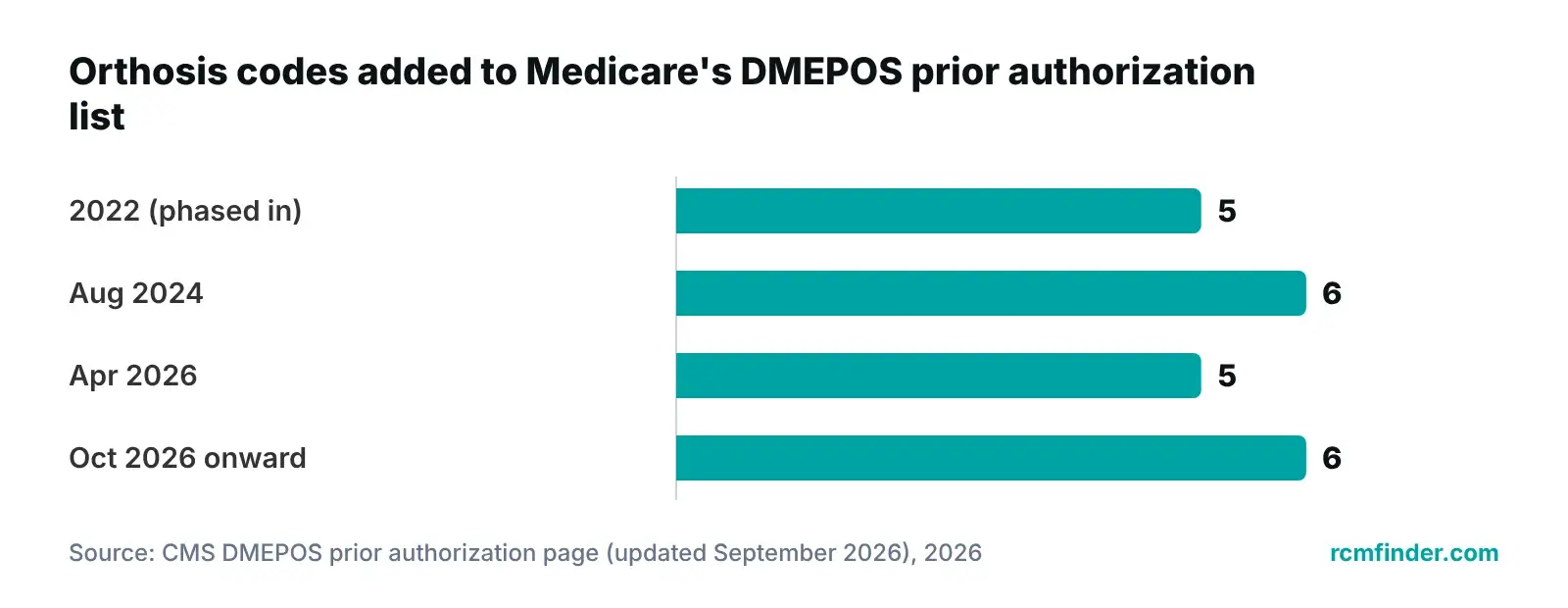
| Listed knee, back and ankle orthoses need DME MAC prior authorization | CMS DMEPOS page; CGS (2026) | Decision before dispensing; delivery within 60 days |
Sources: UnitedHealthcare commercial (2026); Blue Cross NC (2024); CMS OPD page (2026), FAQ (2024); CMS-0057-F (2024); CMS MLN006903 (2025); 28 TAC §134.600 (2023); Fla. Stat. §627.736 (2026); CMS and CGS (2026). Check each plan and state.
Estimate what denials and payer delays cost you
Model how denials and slow A/R affect a surgical practice, then bring the numbers to your audit.
Ask about the injury before the first visit. Workers' comp and auto insurers usually pay before health plans, and each state sets its own rules.
CMS's Medicare Secondary Payer booklet (July 2025) says workers' comp pays first for job injuries, and no-fault or liability insurance, including auto, pays first for accidents. Ask about other coverage at each visit and bill the primary payer first. CMS-1500 items 10a to 10c flag the injury, per chapter 26 of the claims manual.
In Texas, 28 TAC §134.600 requires comp preauthorization for outpatient or ASC surgery, spinal surgery, DME over $500 per item, and physical and occupational therapy beyond the first six visits within two weeks of the injury or a preauthorized surgery. Florida's PIP statute pays only if care starts within 14 days of the crash, limits benefits to $2,500 if a provider finds no emergency medical condition, and generally bars charges over 35 days old. See our workers’ compensation and RCM guide.
A practice that furnishes braces to Medicare patients is a DMEPOS supplier. Under 42 CFR 424.57, each location enrolls separately; physicians supplying only their own patients skip the surety bond. A CMS fact sheet says MIPPA exempts physicians and physical therapists from accreditation unless CMS sets standards for them.
The knee orthoses LCD requires a written order before the claim and exam findings such as laxity testing. Its policy article codes off-the-shelf or custom fitted by the fitting done, and allows KX only when all criteria are met. Prior authorization is a condition of payment for a growing list of orthoses (CGS list). See our DME coding and HCPCS modifiers guide.
Medicare pays outpatient therapy only under a certified plan of care. Under 42 CFR 424.24, a therapist's plan needs no physician or NPP signature if a written order or referral is on file and the plan was sent to that practitioner within 30 days of the initial evaluation. Otherwise the practitioner signs it, which CGS treats as timely within 30 days of the first treatment. Recertification is due at least every 90 days (Noridian). CMS denies claims over the 2026 KX threshold of $2,480 for PT and speech-language pathology combined when KX is missing.
Choose by where your claims break. If denials start at intake or authorization, a billing-only vendor sees them too late. If only claims lag, outsourced billing may be enough.
| Question | In-house team | Billing-only vendor | Four-pillar partner |
|---|---|---|---|
| Who checks global periods and modifiers? | Your coder, if orthopedic-trained | Vendor coders, after the visit | RCM coders plus portal checks |
| Who clears imaging and surgery authorizations? | Front desk, between calls | Often left to the practice | VMA tracks each to a decision |
| Who sets up workers' comp and auto cases? | Front desk, if asked | Often found after a denial | VMA captures carrier details at intake |
| Who bills braces to the DME MAC? | Your staff, under your supplier number | Depends on the contract | RCM team, with order and fitting checked |
| Who connects marketing to paid claims? | Rarely anyone | Not in scope | Shared KPIs, consult to paid claim |
| Strongest fit when | Staff are trained, turnover low | Front end is strong | Gaps span intake, billing and growth |
We will tell you in the audit if you need only one pillar. Our revenue cycle management services and virtual medical assistant services can be contracted separately.
We start with a free audit, put a Business Associate Agreement in place, then take over the parts you choose inside your existing EHR.
We review recent surgery, injection, brace and therapy claims, denial reasons and injury-case setup. You get a prioritized fix list.
We put a Business Associate Agreement in place before accessing patient data, then set role-based access in your EHR (for example PrognoCIS, eClinicalWorks or athenahealth).
We map your MAC and DME MAC rules, each plan's review vendor, and your states' workers' comp and auto rules.
Virtual medical assistants start intake and authorizations on your time zone. The RCM team scrubs, submits and works denials and A/R.
Each week you see denials by reason, authorization turnaround, A/R days by payer and underpayments; we adjust where claims stall.
Talk through your orthopedic workflow
Call to walk through your sites, procedure mix, payer types and where claims stall. We will tell you which pillars you need.
Any vendor that handles your claims is a HIPAA business associate and must sign a Business Associate Agreement before seeing patient data. Also ask how it limits and logs access.
HHS lists billing, claims processing and practice management as business associate activities; the agreement must require safeguards, and subcontractors need their own. The minimum necessary standard limits each use to what the task needs. See our HIPAA compliance checklist for medical practices. RCM Finder uses role-based access, an audit log and encrypted HTTPS connections, and we put a Business Associate Agreement in place before accessing patient data.
We would rather tell you now than after you sign. Here is where we fit and where we do not.
A good fit if you are
Probably not a fit if you are
What we would do first if we were running your practice's revenue cycle tomorrow.
We look up each code's global days and hold visits inside the window until the modifier is settled.
For 0- and 10-day procedures, the decision visit is part of the procedure. We add 25 only for separate work.
We capture job or accident details, the carrier and the claim number at intake, so the first claim goes to the right payer.
Supplier number per location, a written order, the right off-the-shelf or custom-fitted code and a prior authorization check, before any brace is billed.
Repeat series need 6 months and a documented response under WPS L39529. We keep dates and scores together.
Imaging and surgery approvals may sit with a benefit manager. We check who reviews the case first.
Send the plan to the referring practitioner within 30 days of the evaluation when an order is on file, or get it signed. Recertify at least every 90 days. We route each plan and track due dates.
They cover coding support, claim scrubbing, submission, denial management and A/R follow-up for orthopedic surgery, office visits, joint injections, braces and therapy. A strong service also tracks global surgical periods and modifiers, clears imaging and surgery prior authorizations, and bills workers' comp, auto and DME payers in the right order. RCM Finder adds front-desk staff, patient marketing and a claims portal, so the same payer rules apply from intake to payment.
Use 57 on the visit where you decide to do a major surgery, one with a 90-day global period, when that visit falls on the day before or the day of surgery. Use 25 when a significant, separately identifiable visit happens on the same day as a minor procedure, such as a joint injection. CMS says contractors may not pay a visit billed with 57 on the day of or day before a 0- or 10-day procedure.
Not for normal recovery. Follow-up visits, complications that do not need a return to the operating room, and suture or cast removal are part of the package. You can bill an unrelated visit with modifier 24, a staged or planned procedure with 58, an unplanned return to the OR for a related problem with 78, and an unrelated procedure with 79. Diagnostic tests such as x-rays are outside the package.
Under WPS LCD L39529, a repeat series is covered only if at least 6 months have passed since the prior series, symptoms have returned, and the prior series brought documented improvement in pain and function on a standardized tool, or a significant drop in NSAID or steroid use. The first series needs x-ray-supported knee osteoarthritis and 3 months of failed conservative care. Other MACs publish their own rules.
Yes. A practice that furnishes braces to Medicare patients is a DMEPOS supplier under 42 CFR 424.57, bills the DME MAC, and enrolls each location separately. Physicians who furnish items only to their own patients are exempt from the surety bond, and a CMS fact sheet says MIPPA exempts physicians from accreditation unless CMS sets standards for them. Written orders, correct coding and prior authorization rules still apply to every brace.
Yes. Our team works inside your existing EHR, for example PrognoCIS, eClinicalWorks or athenahealth, and we put a Business Associate Agreement in place before accessing patient data. Pricing depends on your procedure mix, claim volume, payer types and which of the four pillars you need, so we quote it after a free practice audit rather than publishing a flat rate.
Guides from our operations team on topics covered on this page.
Tell us about your practice. A member of our operations team replies within one business day.
Pricing is quoted after the audit, based on your volume and the services you choose. Prefer to talk? Call +1 (302) 556-2288.
Tell us about your practice
About the author: Awais Afzal
Healthcare Operations & Data Analyst, RCM Finder
Awais has spent more than 16 years in healthcare digital marketing and clinical operations management. He builds data-driven revenue cycle blueprints for high-ticket medical practices and leads product development of the RCM Finder portal. More about our team.
How we write: every figure, code and rule on this page was checked against the primary source listed below and independently fact-checked before publishing. We re-review this page every six months. Last reviewed October 12, 2026; next review April 12, 2027.
We use cookies to understand how our site is used and to measure our advertising. You can accept or reject non-essential cookies. See our Privacy Policy.