
Routine foot care rules, nail and callus coding, diabetic shoe paperwork and contractor-specific checks, plus patient marketing, remote front-desk staff and a claims portal for podiatry practices.
By Awais Afzal | Healthcare Operations & Data Analyst
Published October 12, 2026 · Last reviewed October 12, 2026 · Next review April 12, 2027
Quick answer
Podiatry billing services manage the claims a foot and ankle practice creates: routine foot care, nail debridement, callus paring, ingrown nail surgery, diabetic foot exams and diabetic shoes. They check Medicare coverage rules, class findings, toe modifiers and visit frequency before each claim goes out. RCM Finder adds front-desk assistants, marketing and a claims portal.
On this page
Podiatry billing is different because Medicare excludes most routine foot care and pays for it only when the chart proves a covered reason. One visit can mix covered care, excluded care, a procedure and an office visit.
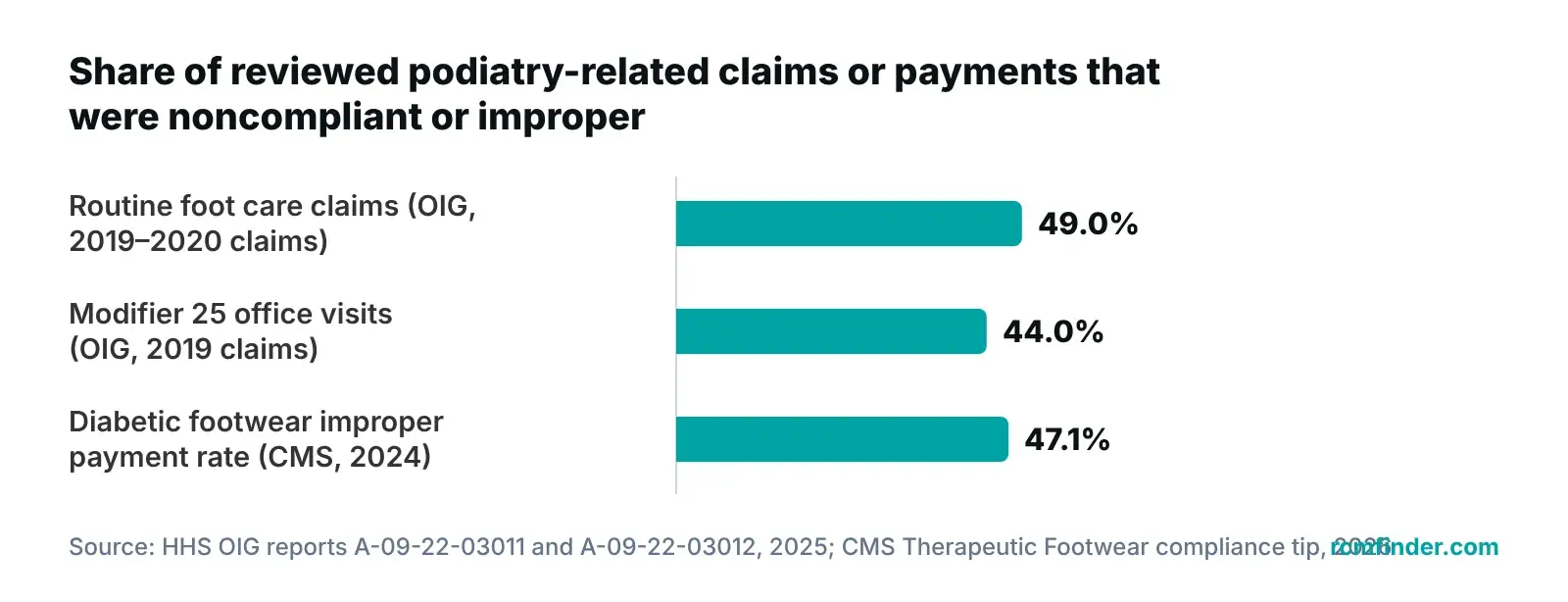
Federal auditors have noticed. In a December 2025 report, the HHS Office of Inspector General (OIG) found that 49 of 100 sampled podiatrist claims for routine foot care related to a systemic condition, from 2019 and 2020, did not comply with Medicare requirements, about $4.4 million of $18.2 million paid.
A second report on 2019 claims, summarized in its highlights, found 44 of 100 sampled modifier 25 office visits noncompliant, about $39.6 million of $222.5 million paid. Errors were insufficient documentation, incorrect coding, and a visit that was not significant and separately identifiable.
The American Podiatric Medical Association replied on December 5, 2025 that modifier 25 is often clinically justified and that 2019 data may not reflect current practice. Either way, your record must show why the claim was right.
CMS’s CY 2026 fee schedule final rule fact sheet (October 31, 2025) set the conversion factor at $33.40 for clinicians who are not qualifying APM participants, up from $32.35, and applied a -2.5% efficiency adjustment to non-time-based services. E/M visits are exempt.
The CY 2027 proposed rule fact sheet (July 14, 2026) projects $32.84 for the same group as the one-year 2.50% increase expires. Check the final rule before budgeting. For ulcer care, see our wound care coding guide.
A podiatry practice needs patients and referrers who find you, a front desk that gathers the right facts, billing that knows the exclusion rules, and software that shows every claim. We run all four on one set of payer rules.
Our healthcare digital marketing reaches people with heel pain, ingrown toenails and diabetic foot concerns through local SEO, Google Ads and reputation work, plus the doctors and facilities that refer high-risk feet.
Our virtual medical assistants for podiatry practices work on your practice’s time zone. They verify coverage, record each patient’s managing physician, log the last foot care date and chase shoe paperwork.
Our end-to-end podiatry revenue cycle management covers coding support, claim scrubbing, denial management and A/R follow-up, with extra checks for class findings, toe modifiers, nail and lesion counts and same-day visits.
Our practice management system tracks every claim by stage, applies specialty-aware billing logic per claim, checks data completeness before submission and flags underpayments.
Find where your foot care claims leak
We review recent foot care, nail, callus and shoe claims and denials, then show what to fix first.
Medicare treats cutting corns and calluses, trimming or debriding nails, and hygienic foot care as routine and does not cover them unless an exception applies. The Novitas routine foot care LCD (L35138) points to Chapter 15, Section 290 of the Medicare Benefit Policy Manual for the exceptions.
Routine care may be covered when a metabolic, neurologic or peripheral vascular disease makes nonprofessional trimming hazardous, per Noridian. Novitas adds conditions such as chronic venous insufficiency, lymphedema and Raynaud’s disease.
For asterisk conditions, Novitas requires active care by an MD, DO or non-physician practitioner for the underlying disease in the six months before the service. Noridian names an MD or DO only. Novitas article A52996 puts the last-visit date in line 19 of the CMS-1500.
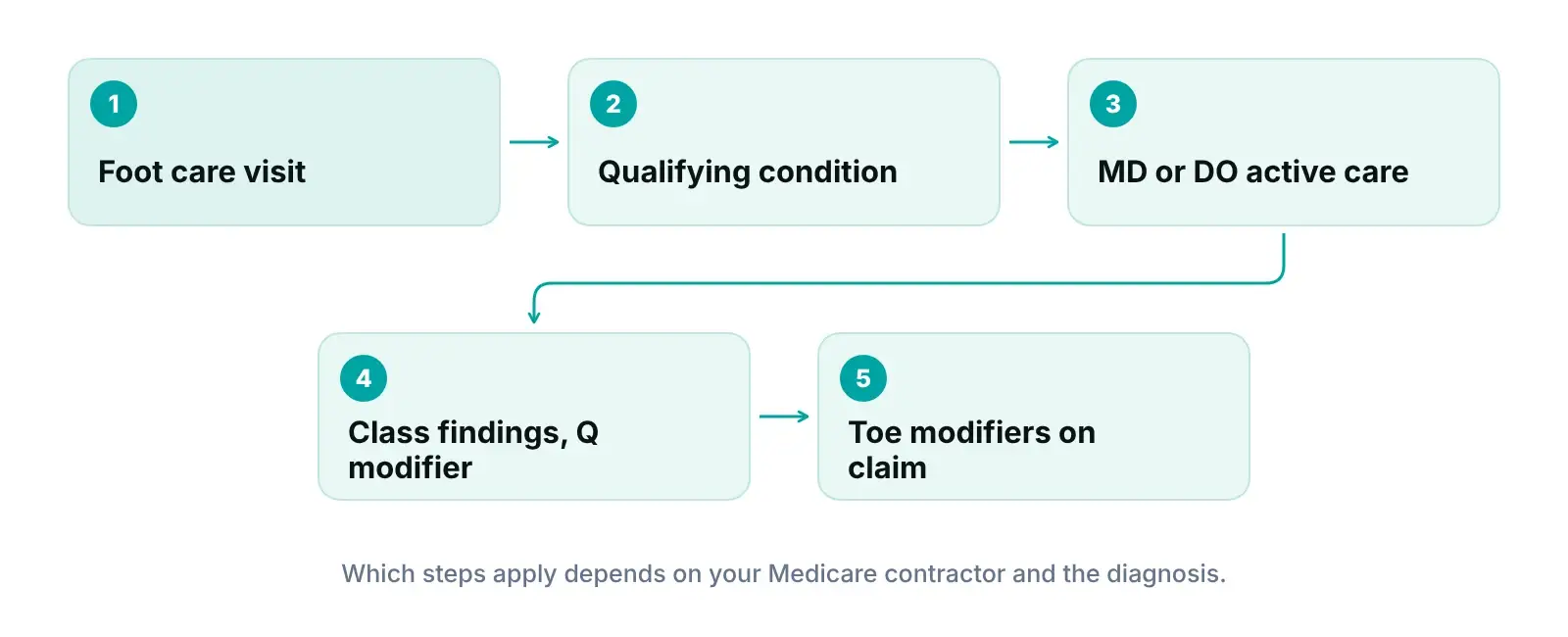
Noridian’s routine foot care article defines the class findings that Q7, Q8 and Q9 report:
Contractors differ on Q modifiers. Novitas requires one on routine foot care claims that meet an exclusion. Noridian’s article A57954 ties them to its vascular diagnosis group, with none for neuropathy-only codes. Our routine foot care guide and podiatry modifiers post cover the basics.
Noridian covers debridement of fungal nails when records show clinical evidence of mycosis plus marked limitation of walking, pain or infection (ambulatory patients), or pain or infection (nonambulatory). Novitas’ LCD L35013 treats debridement as an adjunct to antifungal treatment and expects options to be reviewed at the first visit.
Novitas allows routine foot care and nail debridement no more often than every 60 days, with no more than six debridement sessions per 12 months absent medical review. Novitas also limits a repeat avulsion of the same toe to every 8 months without a KX-supported exception. Separately, the national coverage determination for diabetic foot evaluations allows one every six months.
Each podiatry service has its own frequency, count or paperwork rule. Codes are described in our own words (the AMA owns CPT descriptors); check the current code set and your contractor.
| Service | Code examples (our wording) | Billing rule to know | Typical denial trigger |
|---|---|---|---|
| Nail debridement | 11720 (1–5 nails); 11721 (6 or more) | Once per 60 days; six sessions per 12 months; B35.1 on the claim with another listed diagnosis (Novitas) | Chart says only “nails debrided” |
| Nail trimming | 11719 (normal nails); G0127 (dystrophic nails) | Trimming is not debridement | Trim billed as debridement |
| Corn and callus paring | 11055 (one lesion); 11056 (2–4); 11057 (more than 4) | One code per date of service, by total lesions; not 11305–11308 for feet (Novitas) | Lesion locations not recorded |
| Ingrown nail surgery | 11730 (avulsion); 11732 (added avulsion); 11750 (nail and matrix excision); 11765 (toe nail fold excision) | Digit modifier required; same toe avulsion within 8 months needs KX; repeat excision needs KX | No digit modifier; repeat procedure without KX support |
| Same-day office visit | E/M with modifier 25 | Significant and separately identifiable; E/M for routine foot conditions not payable except the diagnosing visit (Novitas) | Note repeats the procedure note |
| Toe and foot location | LT, RT; TA and T1–T4 (left toes); T5–T9 (right toes) | Required on foot care claims (Novitas); use instead of 59 for different digits | Digit modifier missing or on the wrong side |
| Diabetic foot evaluation | Exam and treatment for loss of protective sensation (NCD 70.2.1) | Every six months at most; monofilament testing documented; no other foot specialist visit between | Sensory test not recorded |
| Diabetic shoes and inserts | A5500 (depth shoe); A5501 (custom-molded shoe) | Billed to the DME MAC with KX; certification and visits on schedule; annual limits | No KX; certification signed late |
Sources: Novitas LCDs L35138, L35013, L34887, DME MAC LCD L33369 and articles A52996, A56640, A52998 (2019–2026); Noridian JF modifier 59 page (2025); CMS NCD 70.2.1; CMS Therapeutic Footwear compliance tip (2026); HHS OIG A-09-22-03012 (2025); AAPC code pages for plain-language meanings. Rules vary by contractor and payer.
Under L35138, the record needs a detailed description of the feet, not a list of findings. It must identify each nail and lesion location, and describe debridement beyond “nails debrided.” Nursing home residents need a current, dated, signed facility order; standing orders do not count.
The Novitas mycotic nail policy (LCD L35013) asks for each nail’s size, thickness, color and local pathology, with six nails documented for 11721. Noridian’s podiatry documentation page adds signature attestations for illegible signatures.
Noridian describes modifier 25 as a significant, separately identifiable E/M with its own history, exam and decision-making. Modifier 59 is a last resort and does not replace the T1–T9 anatomic modifiers, per Noridian. Ingrown nail repeats follow article A52998. Our modifiers 25 vs 59 guide has examples.
The Novitas LCDs above apply to Jurisdictions H and L, including Texas, Pennsylvania, New Jersey and Maryland. Other contractors differ. In 2024, APMA reported that Palmetto stopped accepting non-physician practitioners as the qualifying active-care provider. Pull your own contractor’s policies before setting claim edits.
Diabetic foot care has two rule sets: a physician service for patients who have lost protective sensation, and a shoe benefit billed to a DME contractor.
National Coverage Determination 70.2.1 covers a foot evaluation every six months at most for diabetic sensory neuropathy with loss of protective sensation. The diagnosis rests on 5.07 monofilament testing at five plantar sites per foot; absent sensation at two or more sites on either foot supports it. Coverage does not apply if the patient saw a foot care specialist for another reason in the interim.
CMS defined G0245 and G0246 (initial and follow-up evaluations) and G0247 (routine foot care for these patients) in a 2005 transmittal written for facility billing. Ask your contractor how professional claims are edited.
LCD L33369, used by the DME MACs, covers depth shoes and custom-molded shoes (A5501, for a deformity a depth shoe cannot fit) for patients with diabetes. Depth shoes are reported with A5500. Noridian’s guide says the certifying physician must be an MD or DO who manages the diabetes. A podiatrist can prescribe or supply.
The CMS therapeutic footwear compliance tip (March 2026) reports a 47.1% improper payment rate for 2024, with insufficient documentation behind 85.5% of improper payments. Other orthopedic shoes and supportive foot devices are generally excluded, per Noridian’s exclusions page. See our DME modifiers guide.
Most podiatry denials are visible before the patient arrives, such as a frequency limit, a missing physician date or an approval never requested.
CMS’s MLN006266 booklet (May 2025) says providers must give an Advance Beneficiary Notice (form CMS-R-131) when they expect Medicare to deny a service as not reasonable and necessary. GA reports a required notice, GZ reports an expected denial with no notice, and GY reports a service that is never covered. Notices are allowed for services with LCD frequency limits. See our ABN billing guide.
In KFF’s analysis of 2024 data (January 2026), Medicare Advantage insurers denied 7.7% of 52.8 million prior authorization determinations in full or in part. Only 11.5% of denials were appealed; 80.7% of appeals were partly or fully overturned. Since January 2026, CMS-0057-F requires MA, Medicaid and CHIP plans to decide standard requests within seven calendar days. See our prior authorization guide.
| Rule | Source | What the VMA checks before the visit |
|---|---|---|
| Asterisk diagnoses need MD or DO active care in the prior six months | Novitas L35138; Noridian (2025) | Managing physician’s name and last-seen date recorded |
| Routine foot care no more often than every 60 days | Novitas L35138 and L35013 | Last visit date checked before booking; ABN flagged if too soon |
| Class findings documented when a Q modifier is needed | Noridian A57954; Novitas A52996 | Clinician alerted when findings are missing |
| Loss of protective sensation: one evaluation per six months | NCD 70.2.1 | Prior foot care visits in the last six months checked |
| Diabetic shoes: physician visit within six months; certification signed within three months of delivery | Noridian JF (2025) | Visit, signature and delivery dates tracked |
| Nursing home residents: dated, signed facility order | Novitas L35138 | Order obtained before the visit |
| MA, Medicaid and CHIP plans decide in 7 calendar days (standard) or 72 hours (expedited) | CMS-0057-F (in effect January 1, 2026) | Request and due dates logged |
Sources: Novitas LCDs L35138 and L35013 and article A52996; Noridian JF podiatry and shoe pages (2025); Noridian article A57954 (2025); CMS NCD 70.2.1; CMS-0057-F fact sheet (2024). Always check your own contractor and plan.
Eligibility is a separate step; our insurance verification guide covers it.
See what denied foot care claims cost you
Enter your claim volume and denial rate to estimate what your practice is losing.
Stay in-house if your staff already track visit dates, class findings and shoe paperwork well. Use a billing-only vendor if claims are your only gap. Choose a combined partner when problems start at the front desk.
| Job | In-house team | Billing-only vendor | Four-pillar partner (RCM Finder) |
|---|---|---|---|
| Coverage rule checks (active care, 60-day limit) | Front desk, between calls | Often left to the practice | VMA checks before every visit |
| Documentation of nails, lesions and class findings | Clinician templates, quality varies | Coded from the note as written | Claims held when a field you choose is empty |
| Diabetic shoe paperwork | Tracked by hand, if at all | Usually not included | Dates tracked; orders chased from the certifying physician |
| Referral and patient growth | A separate agency, or nobody | Not included | Marketing tied to booked first visits |
| Cost structure | Salaries, benefits, turnover | Varies; ask how fees are set | Quoted after a free practice audit |
We start with a free audit and change nothing until you see the findings. We build our billing pipeline around how claims actually move through a practice: registration, charge entry, submission, payment and follow-up. For podiatry, we add the checks on this page.
We review recent foot care, nail, callus and shoe claims, denials and eligibility logs.
We put a Business Associate Agreement in place before accessing patient data. Then we work inside your existing EHR (for example PrognoCIS, eClinicalWorks or athenahealth).
Your Medicare contractor’s LCDs and articles and your main plans’ policies become a pre-visit checklist and portal rules.
VMAs verify coverage and track dates. Claims are scrubbed, submitted and worked through denials and A/R.
We review denials by reason, A/R days, visits cleared before the date of service and shoe orders pending.
Talk to us about your podiatry practice
Tell us your Medicare contractor and your hardest denial. We will say honestly whether we fit.
Any billing vendor that handles your patients’ data is a HIPAA business associate. Get a Business Associate Agreement before access, and ask how access is logged.
HHS guidance lists billing and claims processing as business associate work; for electronic data, the agreement must require the vendor and its subcontractors to follow the Security Rule. The minimum necessary standard limits each use to what the task needs, and the technical safeguards cover access control, audit controls, integrity, authentication and transmission security.
We use role-based access, audit logging and encrypted (HTTPS) connections, and we put a Business Associate Agreement in place before accessing patient data. For your own side, use our HIPAA compliance checklist for medical practices.
Marketing carries risk too. HHS guidance on online tracking says tools on appointment pages may collect protected health information, tracking vendors that handle it generally need a Business Associate Agreement, and cookie banners are not authorizations. A 2024 court order vacated part of it; we keep tracking off forms unless the vendor signs one.
We would rather tell you now than after you sign. Here is where we fit and where we do not.
A good fit if you are
Probably not a fit if you are
What we would do first if we were running your practice's revenue cycle tomorrow.
Nail and callus codes are paid by count. We check the note names each nail and lesion before a code is chosen.
Asterisk diagnoses depend on active MD or DO care. We capture the physician’s name and last-seen date when scheduling.
Routine foot care and debridement have a 60-day limit. We check the last date before booking and flag an ABN if needed.
A Q modifier should trace to a documented class finding. We return the chart to the clinician when it does not.
A same-day visit needs its own history, exam and decision-making. We review these claims against the note.
Visits, signatures and delivery dates sit with different people. We track each date and chase the certifying physician.
They cover coding support, claim scrubbing, submission, denial management and A/R follow-up for routine foot care, nail debridement, callus paring, ingrown nail procedures, diabetic foot care and diabetic shoes. A good partner also checks your Medicare contractor’s rules, class findings and visit frequency before each claim. We add front-desk assistants, referral-focused marketing and a claims portal, so one team owns the process from first call to payment.
Generally no. Cutting corns and calluses, trimming or debriding nails and hygienic care are treated as routine and excluded. Exceptions apply when a systemic condition such as diabetes or peripheral vascular disease makes nonprofessional care hazardous, or when mycotic nails meet pain or walking tests. Rules differ by contractor, and your record has to show the reason for each visit.
They report class findings for routine foot care. Q7 is one Class A finding, such as a nontraumatic amputation of the foot or part of it. Q8 is two Class B findings, such as an absent pedal pulse. Q9 is one Class B and two Class C findings, such as claudication, edema or burning. Contractors differ on when a Q modifier is required, so check yours.
Under Novitas’ mycotic nail policy, 11720 and 11721 are covered no more often than every 60 days, and no more than six sessions in 12 months without medical review. Other contractors may differ. If a visit may fall inside a limit, CMS allows an ABN that states the frequency limit as the reason for the expected denial.
Under the DME MAC policy, the certifying physician must be an MD or DO who manages the patient’s diabetes. A podiatrist can be the prescribing practitioner who does the foot exam and writes orders, and can be the supplier. The certification statement must be backed by the medical record, with a physician visit on diabetes within six months before delivery.
Use it when the visit is a significant, separately identifiable service with its own history, exam and decision-making, beyond the usual work of the procedure. Medicare does not pay E/M services for routine foot conditions except the first visit that diagnoses the condition, per Novitas. OIG found 44 of 100 sampled modifier 25 visits noncompliant, so document the separate work.
Guides from our operations team on topics covered on this page.
Tell us about your practice. A member of our operations team replies within one business day.
Pricing is quoted after the audit, based on your volume and the services you choose. Prefer to talk? Call +1 (302) 556-2288.
Tell us about your practice
About the author: Awais Afzal
Healthcare Operations & Data Analyst, RCM Finder
Awais has spent more than 16 years in healthcare digital marketing and clinical operations management. He builds data-driven revenue cycle blueprints for high-ticket medical practices and leads product development of the RCM Finder portal. More about our team.
How we write: every figure, code and rule on this page was checked against the primary source listed below and independently fact-checked before publishing. We re-review this page every six months. Last reviewed October 12, 2026; next review April 12, 2027.
We use cookies to understand how our site is used and to measure our advertising. You can accept or reject non-essential cookies. See our Privacy Policy.