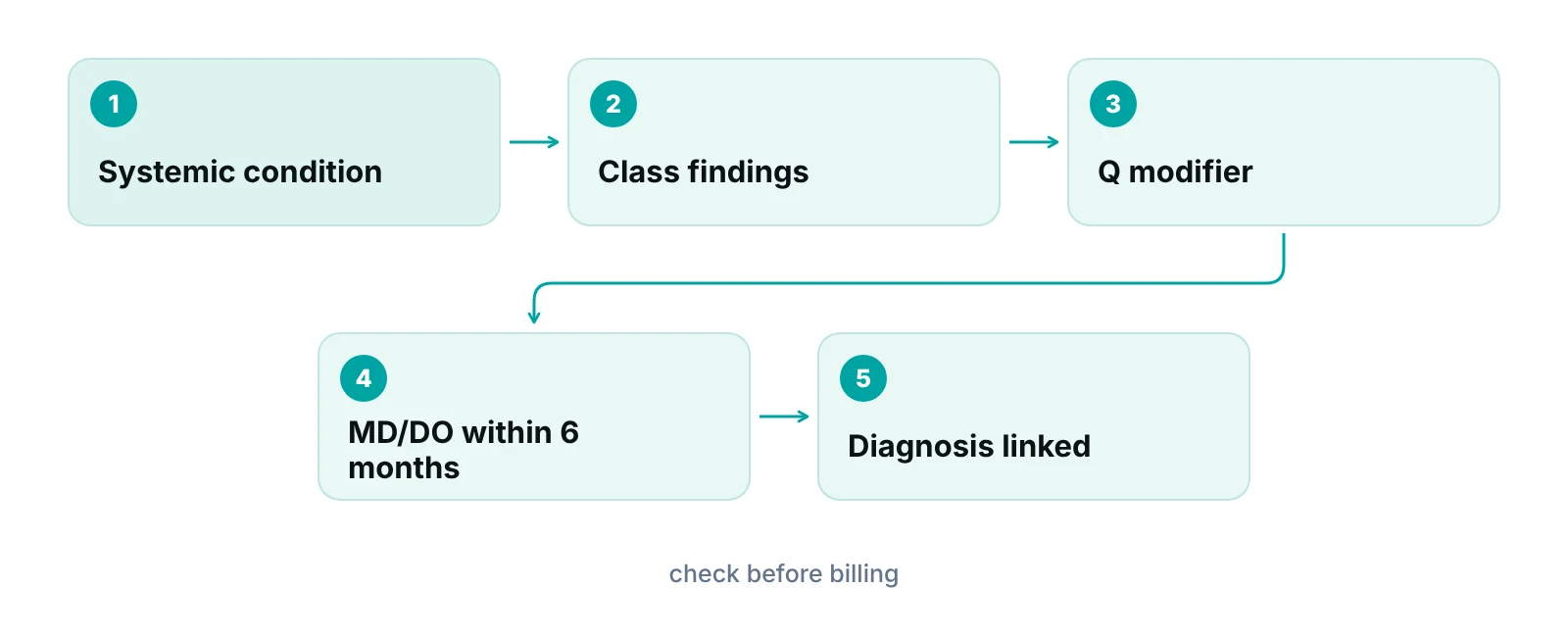
Routine foot care billing starts from a Medicare exclusion: corn and callus removal and nail trimming are not covered unless an exception applies. The usual one is a qualifying systemic condition, documented class findings, a Q7, Q8 or Q9 modifier, and, for some conditions, MD or DO active care within six months.
Routine foot care is one of the easiest places for a podiatry claim to go wrong, because the same nail trim can be excluded or covered depending on the chart. This guide reflects CMS and contractor pages we read on October 14, 2026, and it also covers the Q7, Q8 and Q9 modifier material from our older podiatry modifiers post. It is written for practice owners and billing leads, not for clinical decisions. The earlier version carried statistics, case studies and a revenue claim we could not support, and we removed them.
Key takeaways
- Medicare excludes routine foot care under 42 CFR 411.15(l); payment needs an exception such as a systemic condition, mycotic nails or care integral to covered treatment.
- Q7 is one Class A finding, Q8 two Class B findings, Q9 one Class B plus two Class C; the chart must show them.
- Asterisked conditions need MD or DO care within six months, and contractors want those details on the claim.
- Mycotic nail care is limited to once every 60 days unless more is documented; contractors publish their own articles.
Does Medicare pay for routine foot care?
Usually not. Medicare excludes routine foot care, and the exclusion sits in the regulation at 42 CFR 411.15(l): removing corns or calluses, trimming nails and routine hygiene, along with any service done without a localized illness, injury or symptom in the foot. CMS’s podiatry compliance page adds cleaning and soaking the feet and applying skin cream for skin tone.
Payment depends on an exception. Table 1 lists the four exceptions most podiatry claims rely on.
| Exception | What the rule says | What your record and claim need |
|---|---|---|
| Necessary and integral to covered care | Routine services may be covered when they are a necessary part of an otherwise covered service, such as treating an ulcer, wound or infection. | A diagnosis and note that tie the service to the covered treatment. |
| Warts | Foot warts, including plantar warts, are covered to the same extent as warts elsewhere on the body. | Wart diagnosis and the lesion documented. |
| Systemic condition | May be covered when a metabolic, neurologic or peripheral vascular disease creates a risk if a non-professional does the care. | Qualifying diagnosis, class findings, a Q7, Q8 or Q9 modifier where your MAC requires one, and MD or DO details for some conditions. |
| Mycotic (fungal) nails | May be covered when criteria are met, with or without a systemic condition. The regulation allows treatment no more often than every 60 days unless a need for more is documented. | Clinical evidence of mycosis plus pain, infection or limited ambulation, depending on the patient. Your MAC may also ask for a documented antifungal discussion. |
Source: CMS MLN Podiatry Care compliance tip; 42 CFR 411.15(l), eCFR; CMS Medicare Coverage Database LCD L34246 and Article A57954.
One exception we removed
Our earlier version listed nail trimming for cast fitting as a Medicare exception. We could not find it in the exceptions CMS publishes, so we removed it.
The systemic-condition exception: what has to be true
Three things have to line up: a qualifying systemic condition, documented class findings, and, for some conditions, recent active care by an MD or DO. Miss one and the claim reads as routine.
Qualifying conditions
The CMS podiatry compliance page lists conditions that may justify coverage and says the list is not comprehensive. The ones it names:
- Diabetes mellitus and associated conditions (asterisked).
- Arteriosclerosis obliterans, Buerger’s disease and chronic thrombophlebitis (the last is asterisked).
- Peripheral neuropathies involving the feet linked to malnutrition and vitamin deficiency, carcinoma, drugs and toxins, multiple sclerosis or uremia (all asterisked), or to traumatic injury, leprosy or neurosyphilis.
- Hereditary disorders, including Fabry disease and amyloid neuropathy.
An asterisk means the patient must be under the active care of an MD or DO who documents the condition. For a Part B contractor, CMS says that is met if the claim or other evidence shows the patient saw a physician to treat or evaluate the complicating disease within the six months before the routine services began.
Contractors then ask for proof on the claim. WPS asks for the date the patient was last seen and the NPI of the managing physician, and Noridian asks for the diagnosing physician’s name and the approximate date of the last visit (see WPS Article A56232 and Noridian Article A57954). Intake needs a field for the managing MD or DO.
Q7, Q8 and Q9: class findings and which modifier to use
A Q modifier tells the contractor which class-finding threshold the physician documented. Pick the one that matches the exam in the chart: Q7 for one Class A finding, Q8 for two Class B findings, Q9 for one Class B plus two Class C findings. Table 2 shows the findings behind each.
| Modifier | Presumption threshold | Findings that count |
|---|---|---|
| Q7 | One Class A finding | Class A: non-traumatic amputation of the foot or an integral skeletal portion. |
| Q8 | Two Class B findings | Class B: absent posterior tibial pulse; absent dorsalis pedis pulse; advanced trophic changes (three of the five listed: hair growth, nail thickening, pigmentation, skin texture, skin color). |
| Q9 | One Class B finding and two Class C findings | Class C: claudication, temperature changes such as cold feet, edema, paresthesia, burning. |
| No Q modifier | Neuropathy without vascular impairment | Several contractors say class modifiers are not required here, and the ICD-10-CM code on the claim carries the condition. |
Source: CMS MLN Podiatry Care compliance tip; CMS Medicare Coverage Database Articles A57954 (Noridian), A57759 (NGS) and LCD L34246 (CGS).
Findings below those thresholds are not an automatic denial. CMS says the contractor reviews and develops them instead of presuming coverage.
The modifier is a statement about the exam. CMS notes that claim information must be verifiable against the medical record, so the pulse check, trophic changes or claudication history should appear in the note for that date of service.
Two contractor details older guides miss. Noridian says the presumption of coverage applies when the rendering physician identifies the findings with the Q modifiers, and that vascular-group diagnoses require them while neuropathy-group diagnoses do not. And one MAC article requires Q7 to Q9 with the paring codes (11055 to 11057), 11719 and G0127, and with 11720 and 11721 when coverage rests on a systemic condition (see NGS Article A57759). Your own contractor’s article is the rule that applies to you.
“If a Q modifier cannot be traced to a line in the note, I would not bill it. A modifier is a claim about the exam, not a way to get a code through.”
— Awais Afzal, Healthcare Operations & Data Analyst
CPT 11719, 11720, 11721, 11055 to 11057 and G0127: what each code is for
The paring codes (11055 to 11057) cover corns and calluses by lesion count. The nail codes split by what is being done and whether the nails are dystrophic: 11719 for trimming non-dystrophic nails, G0127 for trimming dystrophic nails, and 11720 and 11721 for debridement by number of nails. Table 3 puts the contractor notes next to each. Descriptions are in our own words.
| Code | What it is for | Contractor notes |
|---|---|---|
| 11055, 11056, 11057 | Paring or cutting of benign hyperkeratotic lesions such as corns and calluses, reported by lesion count (11056 is two to four lesions). | Subject to global surgery rules. One MAC requires Q7 to Q9 on these codes. Painful calluses may fall under a wound and ulcer care policy instead. |
| 11719 | Trimming of non-dystrophic nails. | Noridian allows L60.8 with 11719 only when a qualifying systemic condition is present and the patient does not have dystrophic nails. One MAC requires Q7 to Q9. |
| G0127 | HCPCS code for trimming dystrophic nails. | Noridian says to use it only for dystrophic nail trimming, and not to report L60.8, L84 or L98.7 with it. |
| 11720 | Debridement of nails, the lower count (one to five). | Covered for mycotic nails when criteria are met. Q7 to Q9 needed when coverage rests on a systemic condition. |
| 11721 | Debridement of nails, the higher count (six or more). | Same criteria as 11720. Debridement of more than five nails in one day may get special review. |
Source: CMS Medicare Coverage Database Articles A57954 (Noridian), A57759 (NGS) and A56232 (WPS); Noridian JE Part B review results for CPT 11056.
Without an exception, nail trimming alone is routine foot care and the exclusion applies. The NGS article lists 11719 among the codes that need Q modifiers.
Contractors publish their own articles
Each Medicare Administrative Contractor writes its own routine foot care policy and billing article, for example Noridian A57954, WPS A56232, NGS A57759 and CGS LCD L34246. They differ on details such as which codes need Q modifiers and which diagnosis comes first. Read yours before you build a claim rule.
Mycotic nails and the 60-day limit
Nail debridement can be covered without a systemic condition, but only when the record shows a problem the toenail itself is causing. The rule differs by mobility, and both versions need clinical evidence of toenail mycosis.
- Ambulatory patients: clinical evidence of mycosis, plus marked limitation of ambulation, pain or secondary infection from thickened, dystrophic nail plates.
- Non-ambulatory patients: clinical evidence of mycosis, plus pain or secondary infection from the thickened, dystrophic nail plates.
Some contractors also want a documented antifungal discussion at the initial visit (see CGS LCD L34246). NGS requires a primary diagnosis of B35.1, L60.2 or L60.3 for mycotic nail codes when there is no vascular impairment, with a symptom diagnosis as secondary. See our guide to onychomycosis ICD-10 coding for diagnoses.
Frequency is the other trap. The regulation permits mycotic nail treatment no more often than every 60 days unless a need for more is documented, and the contractor articles say more frequent services are denied as not reasonable and necessary.
Same-day services, modifier 25 and other podiatry modifiers
Routine foot care codes carry global surgery rules, so an E/M service on the same day is payable only when it is significant and separately identifiable, shown by modifier 25 and supported by the record. Both the NGS article and the CGS LCD say this.
The NGS article says these codes can be subject to NCCI and OPPS edits and does not list the pairs. Before you report 11719 with 11720 or 11721, or pair a paring code with a nail code, look the pair up in the current NCCI edit tables and read the policy manual. If an edit allows a modifier, the note must show why the services were distinct. Our posts on modifier 25 versus 59 and how modifier 59 works explain the logic.
The older podiatry modifiers post promoted modifier 59 as a way to raise collections. We removed that framing: a modifier that bypasses an edit is an audit risk if the chart does not support it.
Documentation and denial patterns auditors see
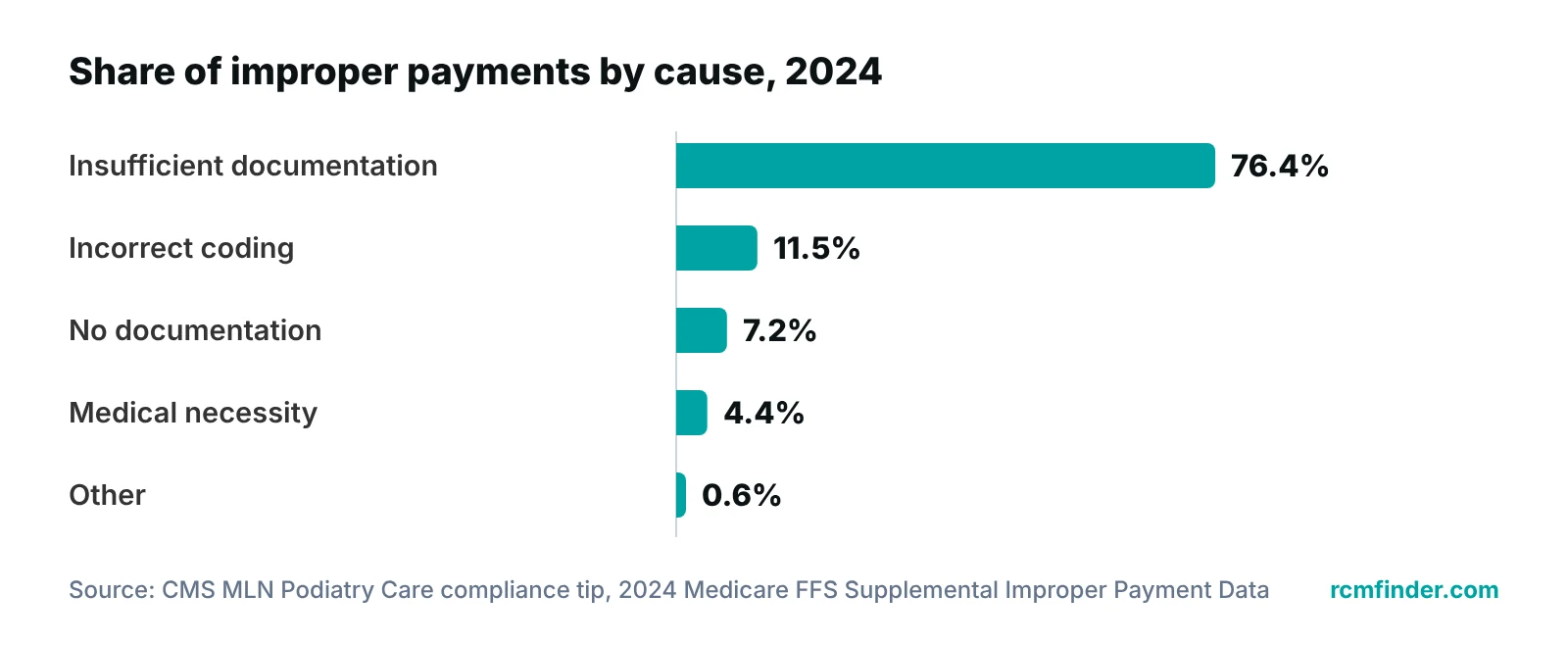
Documentation is where podiatry claims fail. On its podiatry care page for the 2024 reporting period, CMS reports an 11.2% improper payment rate, a projected $216.9 million, and says insufficient documentation accounts for 76.4% of those improper payments.
Noridian’s Part B review of CPT 11056 for October 1 to December 31, 2025 found three top denial reasons: failure to return records, documentation that did not support medical necessity under the NCD or LCD, and no valid signature or no response to a signature request (see Noridian review results). None of those is a coding error.
Build the note template around what contractors ask for:
- The systemic condition, and where applicable the MD or DO’s name, NPI and last visit date.
- The class findings, written as findings (for example “posterior tibial pulse absent, right”), not just the modifier.
- Exact exam findings for nails or lesions: location, appearance, characteristics and symptoms.
- A procedure note that says what was done, how and where, tied to the exam findings.
- The diagnosis codes, codes and modifiers billed, a legible signature or attestation, and an ABN where applicable (see Noridian’s documentation list and NGS Article A57759).
What is not routine foot care: wounds, ulcers and pain
Treating a wound or ulcer is not routine foot care, even though the foot is involved. Routine services can be covered when they are a necessary part of treating an ulcer, wound or infection, but the wound work itself follows different policies and codes.
Pain changes the picture too. Noridian’s Article A52918 says foot care tied to a pain complaint is not considered routine, because pain may signal an ulcer or infection, and evaluating the pain is reasonable and necessary (see Noridian Article A52918). Noridian’s routine foot care article also sends painful calluses to its wound and ulcer care policy (LCD L38902). For the wound side, see our posts on wound care types and treatment and debridement coding, which is a separate code family from nail debridement.
In-house checks or outside help: how to decide
The decision turns on where your denials come from. If they come from missing modifiers, unlinked diagnoses or thin notes, a template and a pre-bill check often fix them in house. If they come from contractor differences, records requests and edits you cannot track, outside support is worth pricing.
A practice management system that tracks claims by stage, assigns an owner to each claim and checks claim data before submission can catch a missing modifier or physician field before the claim leaves. Ours is described on the practice management system page; it is a claim-centred system, not an EHR.
If you are weighing help, ask any partner:
- Which MAC article or LCD do you use for our jurisdiction, and how do you track revisions?
- How is the Q modifier chosen, and who checks it against the chart?
- How do you flag the 60-day frequency limit before scheduling?
For podiatry-specific billing support, see our podiatry billing page and our medical billing and coding support.
Have us review your foot care claims
Send a sample of recent routine foot care claims and the notes behind them. We will check modifiers, diagnosis order and documentation against your MAC's article with you. The audit is free, and any pricing is quoted afterward.
Our recommendations
- Pull your MAC's article before you write claim rules. We start with the Coverage Database article for the jurisdiction, because Q modifier rules and diagnosis order differ. Save its revision date next to the rule.
- Add the managing physician to intake. For asterisked conditions, collect the MD or DO’s name, NPI and last visit date at intake. Asking once costs less than chasing it after a denial.
- Write class findings as findings. Template fields for pulses, trophic changes and claudication make the Q modifier traceable to the note.
- Show the last paid date on the schedule. The 60-day limit is easy to hit by accident. A date on the scheduling screen is cheaper than a denial.
- Keep wound work in its own workflow, and answer records requests fast. Different policies apply to wounds. And failure to return records was the first denial reason in Noridian’s review, so give one person that job.
Track each foot care claim by stage, with an owner.
RCM Finder's practice management system tracks claims by stage with an assigned owner and can flag incomplete claim data before submission, so a missing modifier or physician detail is caught before the claim goes out. It is a claim-centred system, not an EHR.
See how the RCM Finder portal works · Create a portal account
Disclosure: RCM Finder builds and sells this portal. It is a practice management system, not an EHR.
Bottom line
Routine foot care billing is paid only through an exception, and each exception has to be provable from the chart: the qualifying condition, the class findings behind the Q modifier, the managing physician where required, and the 60-day frequency. Read your MAC’s article, build the note template around it, and keep wound work separate. If you want a second set of eyes, see our denial management services or contact us for a free practice audit.
Frequently asked questions
Does Medicare cover routine foot care for patients with diabetes?
Not automatically. Diabetes is listed by CMS as a systemic condition that may justify coverage, and it carries the asterisk, so the patient must be under active MD or DO care. The record also needs class findings and, where your MAC requires it, a Q7, Q8 or Q9 modifier. Check your contractor’s article for the diagnosis list.
What is the difference between Q7, Q8 and Q9?
They record which class-finding threshold the physician documented. Q7 is one Class A finding, Q8 is two Class B findings, and Q9 is one Class B finding plus two Class C findings. Class A is a non-traumatic foot or skeletal amputation, Class B covers absent pulses or trophic changes, and Class C covers claudication, edema and similar signs.
Is CPT 11719 payable by Medicare?
Only under an exception. Nail trimming without a localized problem is routine foot care and excluded. With a qualifying systemic condition and class findings, contractor articles list 11719 among the codes billed with Q7 to Q9. Dystrophic nails use G0127 instead. Check your own MAC’s article for the current rule before you bill it.
How often can nail debridement be billed?
The regulation allows mycotic nail treatment no more often than every 60 days unless a need for more is documented, and the contractor articles say more frequent services are denied as not reasonable and necessary. Debridement of more than five nails in one day may also get special review.
Do I need the physician's details on the claim?
For asterisked systemic conditions, yes. WPS asks for the date last seen and the managing physician’s NPI, and Noridian asks for the physician’s name and the approximate date. The patient must have seen that MD or DO for the complicating disease within the six months before the service.
Is wound care the same as routine foot care?
No. Treating ulcers and wounds follows different policies and codes. Routine services can be covered when they are a necessary part of that treatment, and foot care tied to a pain complaint is not considered routine, according to Noridian’s Article A52918.
Get your free practice audit
Tell us about your practice. We will contact you using the details you give.
- A review of your recent claims, denials and A/R aging
- Where your front desk and prior authorizations slow payment
- A prioritized fix list you keep, whether or not you hire us
Pricing is quoted after the audit, based on your volume and the services you choose. Prefer to talk? Call +1 (302) 556-2288.
Sources
- Podiatry Care (Medicare Provider Compliance Tips) — CMS Medicare Learning Network (2025)
- 42 CFR 411.15 Particular services excluded from coverage — eCFR (2026)
- Billing and Coding: Routine Foot Care (A57954) — CMS Medicare Coverage Database (Noridian) (2025)
- Billing and Coding: Foot Care (A56232) — CMS Medicare Coverage Database (WPS) (2025)
- Billing and Coding: Routine Foot Care and Debridement of Nails (A57759) — CMS Medicare Coverage Database (NGS) (2025)
- Routine Foot Care and Debridement of Nails (L34246) — CMS Medicare Coverage Database (CGS) (2026)
- CPT 11056 review results — Noridian JE Part B (2025)
- Podiatry and Routine Foot Care Documentation Requirements — Noridian JE Part B (2026)
- Coverage of Foot Care Services (A52918) — CMS Medicare Coverage Database (Noridian) (2023)
Disclaimer: This post is general educational information about revenue cycle operations. It is not legal, coding, billing-compliance or clinical advice. CPT is a registered trademark of the American Medical Association. Medicare rules, contractor articles and payer policies change and vary by MAC and plan. Confirm current codes and requirements with the AMA CPT code set, CMS, your MAC and each payer before you bill.