
CPT codes for debridement fall into four families: 11042-11047 for surgical debridement reported by tissue depth and area, 97597 with add-on 97598 for selective debridement, 97602 for non-selective debridement, and 16020-16030 for burns. The deepest tissue removed, the method and the measured area decide the code.
Most debridement claim problems start before the code is picked, in a note that does not say what tissue came off, how, or how large the wound was. This guide sorts the four code families and shows what the sources we read on October 14, 2026 say about each one. It replaces an older version of this post that mixed debridement with general coding advice. For visit coding, supplies and related services, see our wider wound care coding guide. For the clinical side, see wound types and how debridement is used.
Key takeaways
- Codes 11042-11047 are chosen by the deepest tissue removed, then add-on codes cover extra area at that depth.
- Selective debridement is 97597, with add-on 97598 for each further 20 sq cm; non-selective is 97602.
- Do not report a surgical debridement code and a 97597-97602 code for the same wound.
- Burn debridement belongs under the burn codes (16020-16030), not 11042-11047.
- Medicare contractors differ on place of service, 97602 payment and documentation, so read your own MAC’s article.
The four debridement code families at a glance
Debridement means removing dead, damaged or contaminated tissue from a wound. In CPT, how you report it depends on the method, the depth and the size. Table 1 lists the four families. The descriptions below are in our own words, because the AMA owns the official CPT descriptors.
| Family | Codes | What it is used for | What decides the code |
|---|---|---|---|
| Surgical debridement by depth | 11042-11047 | Removing devitalized tissue from a wound, by tissue layer | Deepest tissue removed, then wound area at that depth |
| Selective debridement | 97597, add-on 97598 | Removing only dead or non-viable tissue from the wound bed | Total wound area, in blocks of 20 sq cm |
| Non-selective debridement | 97602 | Removing tissue without choosing dead from living, such as wet-to-moist or enzymatic methods | Method used, per session |
| Burn dressing and debridement | 16020-16030 | Dressings and debridement for burns | Burn size class in the CPT book |
Source: First Coast Service Options coding guidelines L33566 (2017 revision); contractor coding article L34587; TrailBlazer Article 4S-150AB; Delaware DMMA Wound Care Quick Reference Guide (August 2024). Codes described in our own words.
Two cautions before the detail. First, every source we cite is one contractor or one state program, and rules vary by payer. First Coast’s wound debridement coding guidelines (L33566), for instance, is a Florida and territories policy dated 2017. Second, a few older contractor articles describe 97597 and 97598 with pre-2020 wording. Always confirm the current descriptor in your CPT book.
11042-11047: pick the depth first, then add the area
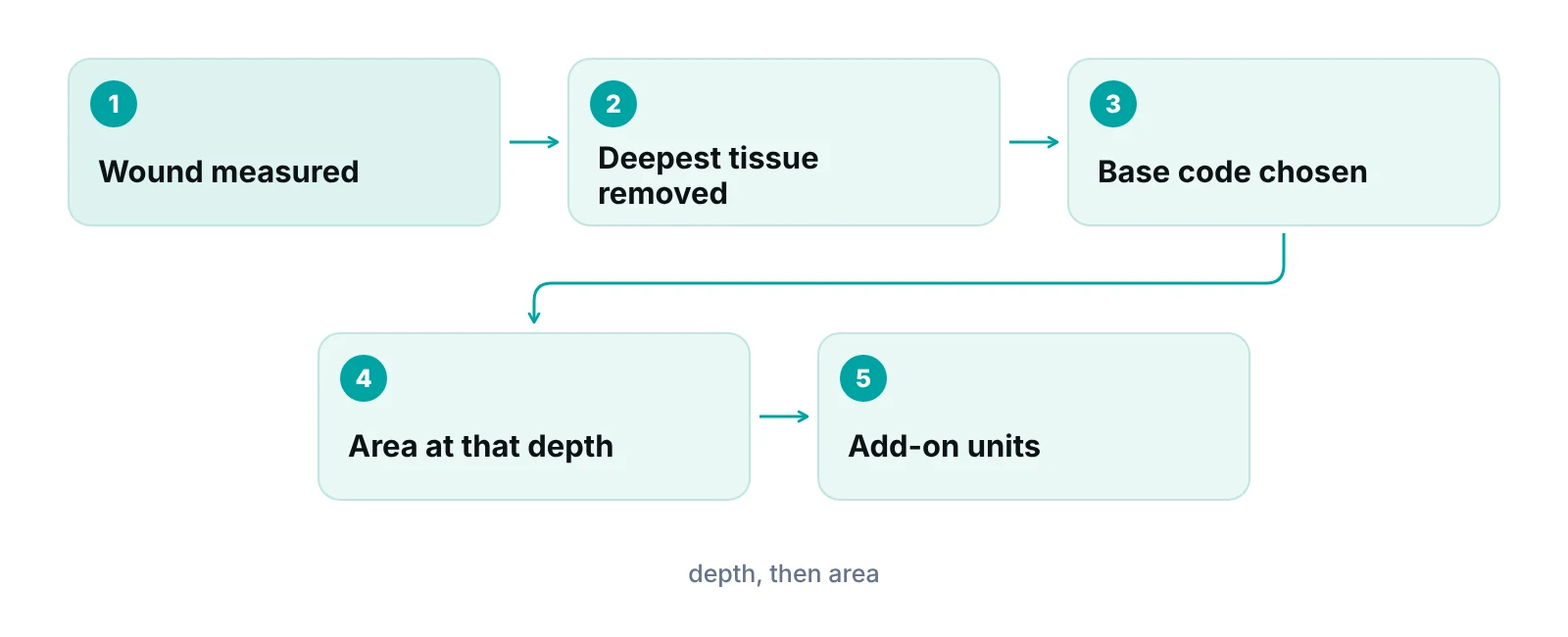
For surgical debridement, the code follows the deepest tissue layer removed, not the depth of the ulcer. TrailBlazer Article 4S-150AB gives the example: if only dead skin and subcutaneous tissue are removed, 11042 applies even when the ulcer reaches bone. First Coast’s wound debridement coding guidelines (L33566) says the same for a single wound: report the deepest level.
| Deepest tissue removed | Base code (first 20 sq cm) | Add-on (each further 20 sq cm or part) | Note |
|---|---|---|---|
| Skin and subcutaneous tissue | 11042 | 11045 | 11042 is the usual starting point for ulcers debrided to subcutaneous fat |
| Muscle and/or fascia | 11043 | 11046 | Deep code; some contractors limit place of service |
| Bone | 11044 | 11047 | Deep code; some contractors limit place of service |
Source: First Coast L33566 (11042 with 11045 worked example); TrailBlazer Article 4S-150AB (code-to-tissue pairings); contractor article L34587 (muscle and bone codes). Confirm descriptors in the current CPT book.
Adding up area across wounds
When a patient has more than one wound, First Coast’s wound debridement coding guidelines (L33566) says to add the surface areas of wounds debrided to the same depth, and not to combine totals across depths. Two worked examples from that guide:
- A 16 sq cm abdominal wound and a 10 sq cm thigh wound, both debrided to subcutaneous tissue, total 26 sq cm. Report 11042 for the first 20 sq cm and 11045 once for the remaining 6.
- A 4 sq cm heel ulcer and a 10 sq cm ischial ulcer, both debrided to bone, total 14 sq cm. Report 11044 once. No add-on is needed.
What the code includes
First Coast’s wound debridement coding guidelines (L33566) states that surgical debridement includes the assessment before the procedure, the debridement itself and the instructions after it on the date of service. An evaluation and management (E/M) visit on the same day is not usually billed unless it was separately identifiable and carries modifier 25. We cover that logic in modifier 25 versus 59.
Local infiltration or anesthesia given by the debriding provider is also not paid separately, according to the contractor coding article L34587.
Place of service can decide payment
Two contractor documents we read limit the muscle and bone codes (11043, 11044, 11046, 11047) to inpatient hospital, outpatient hospital or ambulatory surgery center settings: the contractor coding article L34587 and WPS LCD L28572. The WPS revision history uses softer wording in one place and says billing them elsewhere is most likely a billing error. If your clinic is an office or wound center, check your MAC before billing a deep code.
97597, 97598 and 97602: selective versus non-selective
Selective debridement removes only dead or non-viable tissue from the wound bed. Non-selective debridement removes dead and living tissue together. Delaware Medicaid’s wound care quick reference guide (August 2024) uses those definitions and ties 97597 to the first 20 sq cm and add-on 97598 to each additional 20 sq cm or part of that. It describes 97602 as non-selective debridement without anesthesia.
Selective debridement can be done with a scalpel, scissors, forceps or a high-pressure waterjet. Noridian’s wound care and debridement article (updated June 25, 2025) lists those instruments as items to record. For non-selective work, that article says to name the technique, such as wet-to-moist dressings, enzymatic agents or abrasion.
Who may bill which family
First Coast’s wound debridement coding guidelines (L33566) says only physicians and qualified non-physician practitioners bill the 11000-series codes, within state licensure. Physicians, non-physician practitioners and therapists working within their scope may use 97597, 97598 and 97602. Noridian’s wound care and debridement article adds that therapists bill these only under a certified plan of care, with the therapy modifier, and cannot bill E/M or the 11000 series.
Is 97602 paid?
It depends on the payer. Two contractor documents we read, dated 2017, say 97602 carries a B status indicator on the Medicare physician fee schedule, which means payment is bundled and it is not separately paid (First Coast’s wound debridement coding guidelines (L33566); contractor coding article L34587). Other programs do pay it: Delaware Medicaid’s wound care quick reference guide lists it as billable. Before you write a charge-entry rule, check the payer’s fee schedule and policy.
| Situation | What the sources say | What to check |
|---|---|---|
| Surgical debridement (11042-11047) and 97597-97602 on the same wound | Do not report both for the same wound | Pick one method per wound from the operative or procedure note |
| Two different wounds, different methods, same day | Modifier 59 or XS is used with the applicable codes to show distinct wounds | Separate wound locations and measurements in the note; see how modifier 59 is used |
| 97602 and 97597/97598 on one wound, same day | Delaware’s guide says 97602 cannot be billed the same day for the same wound as 97597 or 97598 | Payer-specific; confirm in the payer policy |
| Dressing change only | Not billable as debridement; bundled into the billed procedure | Do not code a change as a debridement |
| Cleansing only, or removal of secretions, fibrin or biofilm | Does not meet the definition of debridement | The note must show devitalized tissue was removed |
Source: First Coast L33566; contractor article L34587; Noridian wound care and debridement article (June 25, 2025); TrailBlazer Article 4S-150AB; Delaware DMMA guide (August 2024).
Modifier 59 and XS are payer-sensitive and draw audit attention, so use them to describe a truly separate wound and not to get past an edit. Our post on how modifier 59 is used covers the general rules.
“If two wounds are separate, the note should say so in plain words and give two sets of measurements. A modifier on its own proves nothing.”
— Awais Afzal, Healthcare Operations & Data Analyst
Burns: 16020-16030, not 11042-11047
Burn wounds are coded differently. First Coast’s wound debridement coding guidelines (L33566) says the 11000-series debridement codes should not be used for burn debridement, and it lists local burn treatment under 16000-16030. TrailBlazer Article 4S-150AB describes 16020-16030 as burn dressing and debridement codes whose descriptors use small, medium and large size classes.
Those documents do not give the size cut-offs, so we do not either. Check the CPT book for the class definitions and record the burn size and depth in the note. The same First Coast guide lists 11004-11008 as codes for necrotizing soft tissue infection, shown there as inpatient only. They are outside this guide.
Nail debridement for routine foot care follows a separate policy. If your clinic treats feet, see our routine foot care billing guide.
What the debridement note has to show
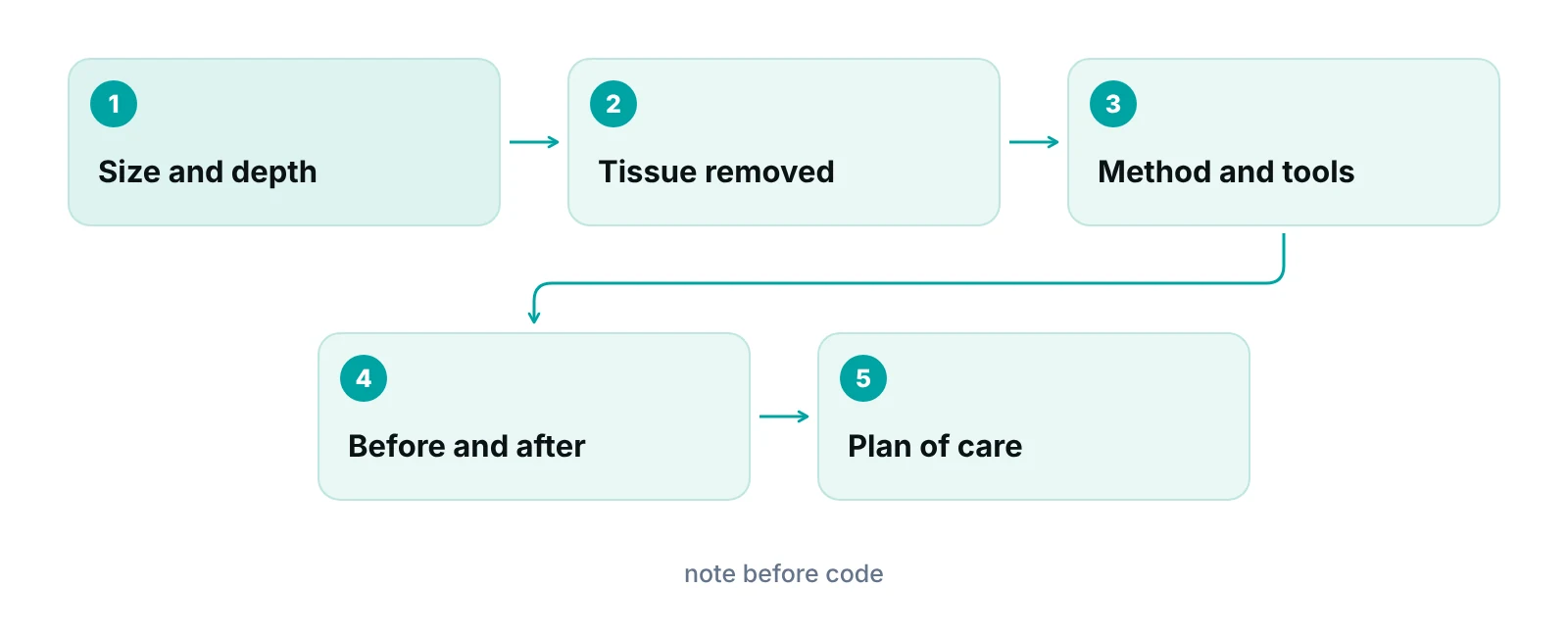
A debridement note should let a reviewer pick the same code you did. Three sources we read list what to record: WPS LCD L28572, Noridian’s wound care and debridement article and Delaware Medicaid’s wound care quick reference guide. Together they ask for:
- The wound before and after: location, size, depth, drainage, signs of infection and the amount of non-viable tissue.
- The tissue actually removed (skin, subcutaneous tissue, muscle or bone), and the method used.
- The measured surface area, since the 20 sq cm steps in 97597/97598 and in the add-on codes depend on it.
- The instruments or agent used, and any dressing applied afterward by product.
- A plan of care with goals and follow-up, and a reasonable expectation that the wound will heal.
Medical necessity matters too. The TrailBlazer Article 4S-150AB (2011) limits its policy to wounds that are slow to heal or have complicated healing, and it excludes acute wounds and primarily closed surgical wounds. Not every MAC uses that wording today, so read yours. Services that fall short are denied as not reasonable and necessary under WPS LCD L28572.
Want a second set of eyes on your debridement notes?
Send a few recent wound care claims and the notes behind them. We will check code choice, area and depth against your MAC's article with you. The audit is free, and any pricing is quoted afterward.
Where debridement claims go wrong
The patterns below come from what the contractor documents list as denial reasons and from the rules above. They are not statistics about any group of practices.
- Coding to ulcer depth. The code follows tissue removed. A deep ulcer debrided only to subcutaneous tissue is still 11042 and 11045.
- Missing area. Without a measured size, the add-on units and the 20 sq cm steps cannot be supported.
- Both families on one wound. Reporting 11042 and 97597 for the same wound is a conflict in the sources we read.
- Deep codes in the wrong setting. Muscle and bone codes in an office can be denied where a contractor limits place of service.
- Unqualified rendering provider. Contractor documents list billing by unqualified personnel as a denial reason.
- Billing a dressing change or cleansing as debridement. Neither meets the definition.
Most of these can be caught before submission by a code-to-note review and a clean claim checklist. An occasional medical coding audit of wound care charts catches the rest. A practice that sees wound patients regularly may also want wound care billing and revenue cycle support, or medical billing and coding support for charge entry and claim review.
What we removed from the older version
The earlier post quoted several statistics (a 30% revenue loss, a 30% denial rate, a 25% billing efficiency gain, a 154% telehealth increase and others) attributed to AAPC, AHIMA, MGMA, Frost & Sullivan and the AMA. We could not verify any of them against a primary source, and they were not specific to debridement, so we removed them. A stray sentence about oncology coding was also deleted.
Our recommendations
- Make the note drive the code. We ask the clinic to record tissue removed, method and measured area in structured fields. The coder then reads the answer from the chart rather than guessing from the diagnosis.
- Keep a one-page code map for each provider type. Put 11042-11047, 97597/+97598, 97602 and 16020-16030 on one page, with who may bill which. A therapist and a physician in the same clinic follow different rules.
- Read your MAC's article before you set claim rules. Place of service, 97602 payment and documentation wording differ. Save the article’s revision date next to each rule so you know when to recheck.
- Review same-wound and same-day pairs. Add a pre-bill check for 11042-11047 appearing with 97597-97602, and for any modifier 59 or XS. Each one needs a note that supports distinct wounds.
- Re-read the CPT book every January. Descriptors change. Several older contractor articles still show pre-2020 wording for 97597 and 97598, so a lookup page can be out of date.
Bottom line
Choose the debridement code by method, depth and measured area: 11042-11047 for surgical debridement by tissue layer, 97597 with add-on 97598 for selective work, 97602 for non-selective work and 16020-16030 for burns. Never report two families for one wound, and check your MAC for place of service and 97602 payment. If denials on wound claims are piling up, our denial management services can review them with you, and you can start with a free practice audit.
Frequently asked questions
What is CPT 11042 used for?
11042 is the base code for surgical debridement when the deepest tissue removed is subcutaneous tissue, for the first 20 sq cm. If the wound is larger, add-on 11045 covers each additional 20 sq cm or part of it. The code follows the layer removed, not how deep the ulcer is.
What is the difference between 11042 and 97597?
11042 is a surgical debridement code chosen by the deepest tissue removed. 97597 is a selective debridement code that removes only non-viable tissue and is sized by total wound area. The sources we read say not to report both for the same wound, so pick the one that matches the procedure note.
How do I code debridement of several wounds in one visit?
For 11042-11047, add the areas of wounds debrided to the same depth and report the base and add-on codes for that total. Do not add areas across different depths. Distinct wounds treated by different methods may need modifier 59 or XS, depending on the payer.
Does Medicare pay for 97602?
It depends on the policy. Two 2017 contractor documents we read list 97602 with a B status indicator, meaning bundled, while a 2024 Delaware Medicaid guide lists it as billable. Check the payer’s current fee schedule and policy before setting a billing rule.
Which code do I use for burn debridement?
Use the burn dressing and debridement codes, 16020-16030, which are sized in classes in the CPT book. The contractor documents we read say the 11000-series debridement codes should not be used for burns. Record the burn size and depth in the note.
Can a physical therapist bill debridement?
Therapists working within their scope may bill 97597, 97598 and 97602 under a certified plan of care with the therapy modifier, according to Noridian’s 2025 article. They cannot bill the 11000-series surgical debridement codes or E/M services. Other payers may differ.
Get your free practice audit
Tell us about your practice. We will contact you using the details you give.
- A review of your recent claims, denials and A/R aging
- Where your front desk and prior authorizations slow payment
- A prioritized fix list you keep, whether or not you hire us
Pricing is quoted after the audit, based on your volume and the services you choose. Prefer to talk? Call +1 (302) 556-2288.
Sources
- Wound Debridement Services coding guidelines (L33566) — First Coast Service Options via CMS Medicare Coverage Database (2017 revision)
- Billing and Coding Guidelines for Wound Care (L34587) — CMS Medicare Coverage Database (2017 revision)
- Article 4S-150AB (R9) Wound Care — TrailBlazer Health Enterprises via CMS Medicare Coverage Database (2011)
- Wound Care & Debridement – Provided by Therapist — Noridian Healthcare Solutions (JE Part A) (2025)
- LCD GSURG-051 Wound Care (L28572) coding and billing guidelines — WPS via CMS Medicare Coverage Database (2012 revision)
- Wound Care Quick Reference Guide — Delaware Division of Medicaid and Medical Assistance (2024)
Disclaimer: This post is general educational information about revenue cycle operations. It is not legal, coding, billing-compliance or clinical advice. CPT is a registered trademark of the American Medical Association, and code descriptions here are paraphrased. Medicare rules, contractor articles and payer policies change and vary by plan and region. Confirm current codes and requirements with the AMA CPT code set, CMS, your MAC and each payer before you bill.
