
Visit, CGM, thyroid and bone density claims, device paperwork, drug prior authorization, patient marketing and a claims portal for endocrinology practices, built on Medicare rules and your payers' own policies.
By Awais Afzal | Healthcare Operations & Data Analyst
Published October 12, 2026 · Last reviewed October 12, 2026 · Next review April 12, 2027
Quick answer
Endocrinology billing services handle the claims a diabetes, thyroid and bone practice creates: office visits, professional CGM codes, thyroid ultrasound and FNA, DXA frequency rules, DSMT and MNT hour limits, and the paperwork behind CGM, pump and GLP-1 approvals. RCM Finder pairs that billing with front-desk assistants, patient marketing and a claims portal.
Endocrinology billing is different because many rules that decide payment sit outside your own claim. Suppliers bill CGMs and pumps from your notes, drug plans approve GLP-1s, and Medicare caps education hours and repeat bone density scans.
The office visit still anchors this chronic-care specialty. CMS's CY 2026 Physician Fee Schedule final rule fact sheet (October 31, 2025) set the conversion factor at $33.40 for clinicians who are not qualifying APM participants, up from $32.35. Its -2.5% efficiency adjustment to work RVUs exempts E/M and care management services. For 2027, CMS's proposed rule (July 14, 2026) projects $32.84 and proposes an initiating visit when remote monitoring starts. Both are proposals.
CMS MLN Matters MM13473 (revised May 1, 2025) ties the G2211 add-on to ongoing care of a single serious or complex condition, or to being the continuing focal point for a patient's care. It is not payable with modifier 25, except when the other service is a Part B preventive service, an immunization administration or an annual wellness visit. A visit billed with modifier 25 for a same-day thyroid FNA gets no G2211.
An endocrinology practice needs referrals, early device and drug paperwork, correctly coded claims and software that shows every claim. Each pillar handles one.
Revenue leaks at handoffs: a CGM order without a qualifying visit note, or a GLP-1 request sent to the wrong program. All four pillars run on one set of payer rules.
Our healthcare digital marketing reaches local patients looking for diabetes, thyroid and bone care, and the primary care offices that refer to you, through local SEO, Google Ads and reputation work.
Our virtual medical assistants for endocrinology work on your practice's time zone. They verify eligibility, prepare CGM and pump paperwork, route drug requests and book follow-ups inside coverage windows.
Our end-to-end endocrinology revenue cycle management covers coding support, claim scrubbing, denial management and A/R follow-up, with extra checks for frequency, units and same-day conflicts.
Our practice management system tracks every claim by stage, applies specialty-aware billing logic per claim, checks data completeness before submission and flags underpayments.
Find where your endocrinology claims leak
We review recent claims, denials and request logs, then show what to fix first.
Each service family has its own frequency, bundling or documentation rule. Codes are in our own words (the AMA owns CPT descriptors); check current code sets before billing.
| Service family | Code examples (our wording) | Billing rule | Typical denial trigger |
|---|---|---|---|
| Professional CGM | 95249 (setup on the patient's own device); 95250 (office device); 95251 (interpretation) | At least 72 hours of data; payers limit how often each code can be billed, so check the current rules | Billed more often than the payer allows; under 72 hours of data |
| Therapeutic CGM (DME) | E2103 with A4239, billed by the supplier | Visit within 6 months before ordering, then every 6 months; KX or KS | No written order; no visit note; KX with oral agents only |
| Insulin pump (DME) | E0784, billed by the supplier | C-peptide or antibody test; injection and testing history; 3-month visits | C-peptide without same-time fasting glucose; missed 3-month visit |
| Diabetes self-management training (DSMT) | G0108 (individual, 30 min); G0109 (group, 30 min) | 10 initial hours in 12 months, 9 in groups; 2 follow-up hours a year | Undocumented individual hours; same day as MNT |
| Medical nutrition therapy (MNT) | 97802 (initial), 97803 (reassessment), 97804 (group); G0270, G0271 | Physician referral; diabetes or kidney disease; RD or nutrition professional | No referral; extra hours without a documented change |
| Thyroid ultrasound and FNA | 76536 (head and neck ultrasound); 10005, 10006 (guided FNA, first and added lesion) | Guidance included in 10005; one unit per lesion | Separate guidance code; FNA plus another biopsy of one lesion |
| Bone density (DXA) | 77080 (axial); 77085 (axial plus vertebral fracture assessment); 77081 (peripheral) | Qualifying group; 23 months since the last study, with exceptions | Repeat too soon; two axial studies on one date |
Sources: DME MAC LCDs L33822 (2024), L33794 (2026) and article A52464 (2025); 42 CFR 410.31, 410.132, 410.141; Medicare.gov; Noridian (2025–2026); CMS NCCI manual (2026); Dexcom (2025); Cook Medical (2022); AAPC. Rules vary by payer.
Diagnosis specificity drives medical necessity. See our guides to diabetes ICD-10 codes and diabetic HCC coding.
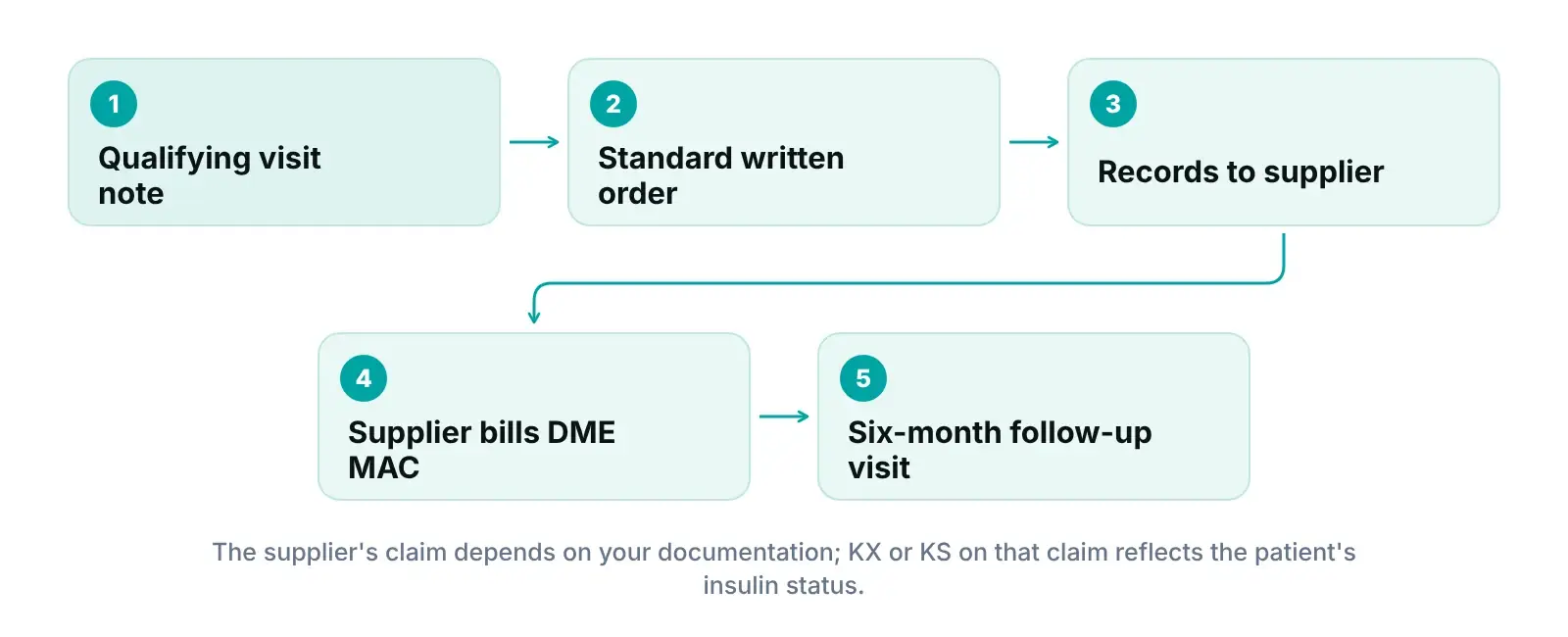
You bill the visit and professional CGM services; the supplier bills the device (see our guide to Medicare coverage for diabetic supplies). Per DME MAC policy article A52464, non-adjunctive CGMs have used E2103 and supply allowance A4239 since January 1, 2023. Suppliers add KX for insulin-treated patients or KS for others, so your note must say which. Payers also limit how often 95249, 95250 and 95251 can be billed, and a 2025 manufacturer coding sheet notes that those limits vary by payer. Check the current CPT rules and each payer's policy before billing.
A 2022 Cook Medical coding guide lists the thyroid among the examples for 76536 and treats 10006 as an add-on to 10005. CMS's NCCI manual, chapter III (revised January 1, 2026) counts one unit per separate lesion, bars a separate guidance code when the descriptor includes guidance, and allows only one code when FNA and another biopsy target one lesion. See our hypothyroidism ICD-10 guide.
Under 42 CFR 410.31, Medicare covers bone mass measurement for five groups, including estrogen-deficient women at clinical risk, patients taking, or expected to take, the equivalent of 5 mg or more of prednisone daily for over 3 months, and patients with primary hyperparathyroidism. At least 23 months must pass after the month of the last bone mass measurement, except, for example, to monitor long-term steroid therapy or confirm a baseline. NCCI chapter IX blocks two axial studies on one date.
Medicare pays for diabetes devices and education only when written criteria are met and documented, often on a claim your practice never sees.
LCD L33822, published for all four DME MAC jurisdictions (CGS and Noridian; revision effective October 1, 2024), covers a CGM for a trained patient with diabetes, used per its FDA indications, when the patient is insulin-treated or has problematic hypoglycemia. That means more than one level 2 event (glucose below 54 mg/dL) despite treatment changes, or one level 3 event needing another person's help. A visit, in person or by Medicare-approved telehealth, is required within six months before ordering and every six months after. The supplier needs a standard written order before billing.
LCD L33794 (revision effective July 1, 2026) covers insulin pump E0784 when a C-peptide or beta cell autoantibody test qualifies the patient. The patient must also have used a pump, with documented self-testing, before Medicare enrollment, or meet criteria that include diabetes education, at least 3 daily injections for 6 months, self-testing averaging 4 or more times a day for 2 months, and a problem such as HbA1c above 7%. Visits are required at least every 3 months. If criteria fail, the pump, supplies and insulin are denied.
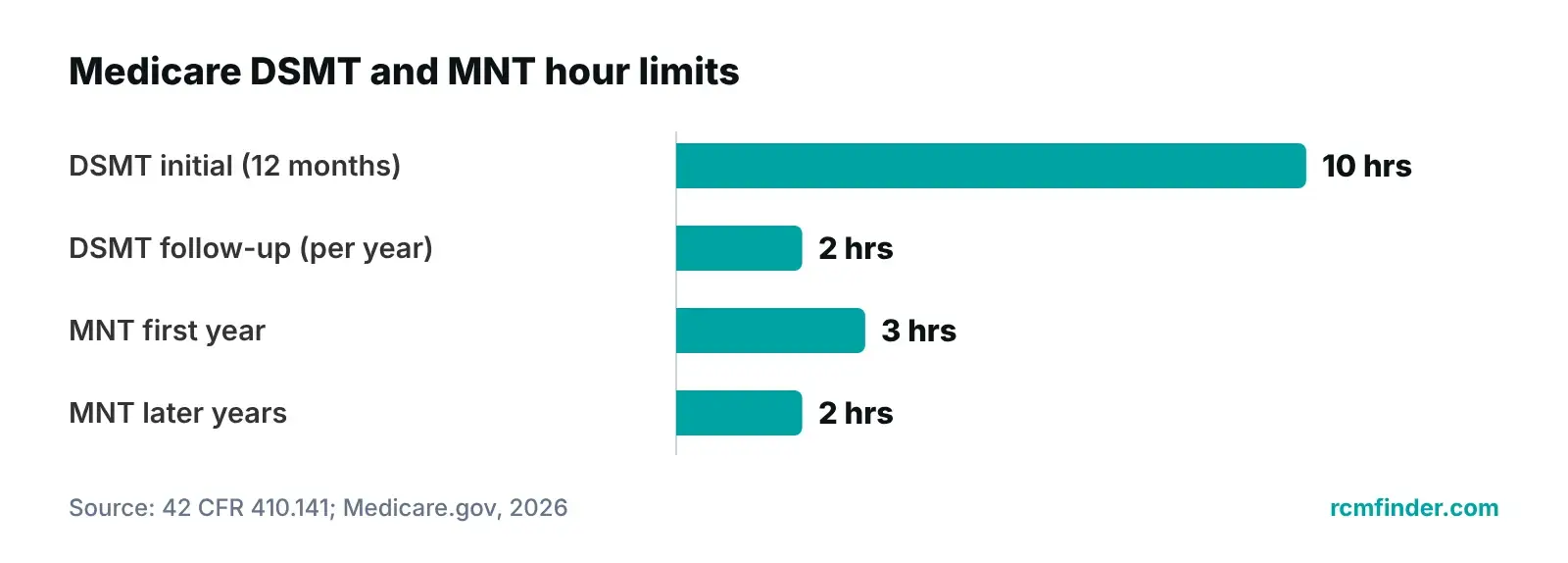
Under 42 CFR 410.141, DSMT needs an order and a plan of care from the practitioner treating the patient's diabetes. Initial training is capped at 10 hours in 12 months, 9 in groups unless no group is available within 2 months or a special need is documented. Follow-up is capped at 2 hours a year. Medicare.gov lists MNT at 3 hours in the first calendar year and up to 2 hours each later year, with a physician referral, for diabetes, kidney disease or a kidney transplant in the last 36 months. Noridian, a Medicare contractor, says DSMT and MNT cannot be provided on the same day. See our nutrition therapy billing guide and, for kidney patients, our nephrology billing services page.
For remote physiologic monitoring (RPM), the CMS remote monitoring booklet (December 2025) requires consent, an FDA-defined device, an established patient and 2–15 or 16+ data days in 30, by code. Only one practitioner can bill per patient per 30 days, and RPM can be billed with chronic care management if time is not counted twice. Noridian's 2026 update says 99445 (2–15 days) and 99454 (16–30 days) are not billed for the same period. See our chronic care management billing guide.
Route each drug request by indication before you submit it. A GLP-1 for type 2 diabetes goes to the patient's drug plan. In Medicare, one for weight management may go through CMS's GLP-1 Bridge.
Drug requests run on different clocks. The CMS-0057-F rule, including its timeframes for Medicare Advantage, Medicaid and CHIP plans, does not apply to drugs. Part D plans must decide standard requests within 72 hours (42 CFR 423.568) and expedited ones within 24 hours (42 CFR 423.572).
The Medicare GLP-1 Bridge runs from July 1, 2026, to December 31, 2027, outside the regular Part D benefit, with a $50 copay for eligible patients. Per its provider page (updated August 6, 2026), the prescriber sends the prescription first and the pharmacy starts the request. Decisions come within 72 hours. There is no appeal, but a denied request can be resubmitted. Type 2 diabetes is excluded; those GLP-1s stay with the Part D plan. CMS's voluntary BALANCE model lets state Medicaid programs join from May 2026 and does not guarantee coverage for any individual.
In the AMA's 2025 prior authorization survey of 1,000 physicians, released May 13, 2026, physicians averaged 40 prior authorizations and 13 hours of physician and staff time a week.
| Rule | Source | What the VMA checks before the visit or order |
|---|---|---|
| CGM: insulin-treated or problematic hypoglycemia; visit within 6 months before ordering | LCD L33822 (2024) | Visit date and insulin or hypoglycemia history noted; order sent to supplier |
| CGM: visit every 6 months to document adherence | LCD L33822 (2024) | Next visit booked before the window closes |
| Pump: qualifying lab, injection and testing history, education; visit every 3 months | LCD L33794 (2026) | C-peptide with same-time fasting glucose, or antibody result; logs on file |
| Part D drugs: decision in 72 hours, or 24 if expedited | 42 CFR 423.568, 423.572 | Supporting statement sent; follow-up when the clock ends |
| GLP-1 Bridge (weight management): pharmacy starts the request; 72-hour decision; no appeals; type 2 diabetes excluded | CMS Bridge provider page (2026) | Indication confirmed; prescription sent first; BMI and condition at therapy start noted |
| MA, Medicaid and CHIP medical requests: 72 hours expedited, 7 days standard; drugs excluded | CMS-0057-F (from Jan 1, 2026) | Request and due dates logged; denial reason saved |
| DXA: 23 months since the last bone mass measurement, unless an exception applies | 42 CFR 410.31 | Last DXA date, including outside studies |
| DSMT and MNT: order or referral, hours left, not on the same day | 42 CFR 410.141; Noridian (2025) | Hours used this year; separate dates |
Sources: CMS Medicare Coverage Database (2024, 2026); eCFR; CMS GLP-1 Bridge provider page (2026); CMS-0057-F fact sheet (2024); Noridian (2025). Always check the member's current plan.
See our prior authorization guide for providers and our guide to speeding up medication prior authorization.
See what slow approvals and denials cost you
Enter your claim volume and denial rate to estimate what your endocrinology practice is losing.
Endocrinology growth comes from primary care referrals and local search. Market conditions and services, not drug names, and keep tracking off patient forms.
Google's Healthcare and medicines policy restricts prescription drug terms in ads, landing pages and keywords. In the US, it lets telemedicine providers advertise if they hold LegitScript accreditation and Google certification. HHS guidance on online tracking says trackers on scheduling pages may access protected health information, such vendors need a Business Associate Agreement, and a cookie banner is not a HIPAA authorization. A June 2024 court order vacated part of it. We still keep tracking off patient forms unless the vendor signs a BAA.
Stay in-house if your team handles device paperwork and drug requests well. Use a billing-only vendor if claims are your only gap. Choose a combined partner when front-desk problems end in denials.
| Job | In-house team | Billing-only vendor | Four-pillar partner (RCM Finder) |
|---|---|---|---|
| CGM and pump paperwork for suppliers | A nurse or MA, between visits | Usually out of scope | VMA checks the note, sends the order, books follow-ups |
| GLP-1 and other drug requests | Front desk or nurse | Usually left to the practice | VMA routes by indication and tracks each request |
| DSMT and MNT hours | Educator's spreadsheet | Billed as submitted | Hours tracked per patient; same-day conflicts held |
| FNA, DXA and CGM coding | Depends on one coder | Vendor coders, after the fact | Units, frequency and bundling checked before submission |
| Referral and patient growth | A separate agency, or nobody | Not included | Marketing pillar tied to booked visits |
| Cost structure | Salaries, benefits, turnover | Varies; ask how fees are set | Quoted after a free practice audit |
We start with a free audit and change nothing until you see the findings. We build our billing pipeline around how claims actually move through a practice: registration, charge entry, submission, payment and follow-up. For endocrinology, we add the checks on this page.
We review recent visit, CGM, thyroid and DXA claims, denials and request logs.
We put a Business Associate Agreement in place before accessing patient data. Then our team works inside your existing EHR (for example PrognoCIS, eClinicalWorks or athenahealth).
DME MAC LCDs, your drug plans, the GLP-1 Bridge and Medicare's education limits become a checklist and portal workflow rules.
VMAs prepare device paperwork and drug requests. Claims are scrubbed, submitted and worked through denials and A/R.
Each week we review denials by reason, A/R days, requests decided on time and new referrals.
Talk to us about your endocrinology practice
Tell us your services, payer mix and hardest approval. We will tell you honestly whether we fit.
Any billing vendor that handles your patients' data is a HIPAA business associate. Get a Business Associate Agreement before any access, and check how access is limited and logged.
HHS guidance names billing, claims processing and practice management as business associate work, and subcontractors need their own agreement. The minimum necessary standard limits use to what each task needs. The Security Rule's technical safeguards require access control, audit controls, integrity controls, person or entity authentication and transmission security.
We use role-based access, audit logging and encrypted (HTTPS) connections, and we put a Business Associate Agreement in place before accessing patient data. For your own side, use our HIPAA compliance checklist for medical practices.
We would rather tell you now than after you sign. Here is where we fit and where we do not.
A good fit if you are
Probably not a fit if you are
What we would do first if we were running your practice's revenue cycle tomorrow.
We ask providers to record insulin use or hypoglycemia events in one place. The supplier's claim and its KX or KS modifier depend on that note.
CGM coverage needs a visit every six months and pump coverage every three. We book the next one at checkout.
Type 2 diabetes goes to the patient's drug plan; Medicare weight management may go to the GLP-1 Bridge. A misrouted request wastes days.
We track DSMT and MNT hours and never book both on one day.
We ask for outside reports before ordering. A repeat inside 23 months needs one of Medicare's listed exceptions.
Check the CY 2027 final rule for remote monitoring changes, and plan for the GLP-1 Bridge ending December 31, 2027.
They usually cover coding support, claim scrubbing, submission, denial management and A/R follow-up for endocrinology visits and procedures, such as professional CGM services, thyroid ultrasound and FNA, DXA, and diabetes education. A good partner also prepares the documentation suppliers need for CGMs and insulin pumps and tracks drug prior authorizations. We add front-desk assistants, patient marketing and a claims portal, so one team owns the process from referral to payment.
It can. Under DME MAC LCD L33822, a patient with diabetes qualifies with a history of problematic hypoglycemia: more than one level 2 event (glucose below 54 mg/dL) despite treatment changes, or one level 3 event that needed help from another person. The practitioner must see the patient within six months before ordering and every six months after. Medicare Advantage and commercial plans set their own rules.
Payers limit how often these codes can be billed, and the limits vary, so check the current CPT rules and each payer's policy before billing. Each code needs at least 72 hours of recorded data. 95249 covers start-up and training on the patient's own device, 95250 covers monitoring with an office-owned device and 95251 covers the interpretation and report. Some plans also limit which patients qualify.
DSMT covers up to 10 hours of initial training within 12 months, mostly in groups, then up to 2 hours of follow-up each year. MNT covers 3 hours in the first calendar year and up to 2 hours each later year, with a physician referral. A physician can extend MNT after a change in diagnosis, condition or treatment. Noridian says DSMT and MNT cannot be provided on the same day.
It depends on why the drug is prescribed. For type 2 diabetes, the request goes to the patient's Part D or commercial plan; Part D plans must decide within 72 hours, or 24 hours if expedited. For weight management, the Medicare GLP-1 Bridge (July 2026 to December 2027) has the pharmacy start the request and decides within 72 hours, with no appeal. Criteria apply, and approval is not guaranteed.
It can be, if the vendor is treated as a business associate. HIPAA requires a Business Associate Agreement before the vendor receives patient data, and that agreement must require the vendor to safeguard it. The Security Rule's technical safeguards include access control and audit controls. We put a Business Associate Agreement in place before accessing patient data, and we use role-based access, audit logging and encrypted (HTTPS) connections.
Tell us about your practice. A member of our operations team replies within one business day.
Pricing is quoted after the audit, based on your volume and the services you choose. Prefer to talk? Call +1 (302) 556-2288.
Tell us about your practice
About the author: Awais Afzal
Healthcare Operations & Data Analyst, RCM Finder
Awais has spent more than 16 years in healthcare digital marketing and clinical operations management. He builds data-driven revenue cycle blueprints for high-ticket medical practices and leads product development of the RCM Finder portal. More about our team.
How we write: every figure, code and rule on this page was checked against the primary source listed below and independently fact-checked before publishing. We re-review this page every six months. Last reviewed October 12, 2026; next review April 12, 2027.
We use cookies to understand how our site is used and to measure our advertising. You can accept or reject non-essential cookies. See our Privacy Policy.