
Hypothyroidism ICD-10 codes start with E03.9, hypothyroidism unspecified, but that is only the fallback. Use E89.0 when the provider documents thyroid surgery or radiation as the cause, E03.2 for drug-induced cases, and E03.8 for other specified types. This guide uses the FY2027 code set, in effect October 1, 2026 to September 30, 2027.
The provider writes “hypothyroidism” in the note. The coder picks E03.9 and the claim goes out. Sometimes that is exactly right. Sometimes the same chart also says the patient had a thyroidectomy, and E03.9 is the wrong code.
This guide is for coders, billers and practice managers. It covers which code to pick, what the notes in the code book forbid, and what the provider has to document first. We checked every code below against the CDC NCHS ICD-10-CM browser (FY2027) on October 14, 2026. It is a coding guide, not clinical advice, and it says nothing about diagnosis or treatment. For nearby topics, see our guides to diabetes ICD-10 codes and hyperlipidemia ICD-10 coding.
Key takeaways
- E03.9 is the default for acquired hypothyroidism when no cause is documented. It is a valid code, and myxedema NOS is indexed to it.
- Hypothyroidism after surgery or radiation goes to E89.0, not E03.9. E03 carries an Excludes1 note that points to E89.0.
- Drug-induced hypothyroidism is E03.2, with an additional code to identify the drug if an adverse effect applies.
- E07.9 is not a hypothyroidism code. It says only that a thyroid disorder exists.
- The code set is FY2027 (October 1, 2026 to September 30, 2027). Code from the provider’s documentation, not from a problem list.
Which hypothyroidism ICD-10 code fits? The FY2027 code map
Start with the cause in the provider’s note. If the note gives none, the ICD-10-CM Index lists “Hypothyroidism (acquired)” at E03.9, and the Index sends a documented cause somewhere else (CDC NCHS, FY2027).
The code set matters. ICD-10-CM changes each fiscal year, and CMS states that the FY2027 files apply to encounters from October 1, 2026 through September 30, 2027. Every code in this guide was checked against that set.
| Code | Official title | Use it when the note says | Watch for |
|---|---|---|---|
| E03.9 | Hypothyroidism, unspecified | Hypothyroidism or myxedema with no cause or type given | The default, not a goal. Look for a documented cause first. |
| E03.8 | Other specified hypothyroidism | A specific type of hypothyroidism that has no code of its own | The provider must name the type. “Specified” means documented. |
| E03.2 | Hypothyroidism due to medicaments and other exogenous substances | The provider links the hypothyroidism to a drug or another outside substance | Add-code and code-first notes apply (see Table 3). |
| E03.3 | Postinfectious hypothyroidism | The provider links it to a past infection | Needs the provider’s link, not the coder’s guess. |
| E03.4 | Atrophy of thyroid (acquired) | Thyroid atrophy is documented | Acquired thyroid atrophy. Congenital types are coded at E03.0 and E03.1. |
| E03.5 | Myxedema coma | Myxedema coma is documented | Myxedema alone goes to E03.9. The word “coma” changes the code. |
| E89.0 | Postprocedural hypothyroidism | Hypothyroidism after thyroid surgery or radiation | E03 excludes it. Do not report E03.x with E89.0 for the same condition. |
| E02 | Subclinical iodine-deficiency hypothyroidism | Subclinical hypothyroidism related to iodine deficiency | Sits outside E03. E03 excludes iodine-deficiency related hypothyroidism (E00-E02). |
Source: CDC National Center for Health Statistics, ICD-10-CM Tabular List and Index, FY2027 (browser checked October 14, 2026). Last column is our reading of the tabular notes.
E03.0 and E03.1 cover congenital hypothyroidism with and without diffuse goiter. They are outside the scope of this guide. Autoimmune cases, such as Hashimoto’s thyroiditis, have their own code family, covered below.
When E03.9 is the right code
E03.9 is right when the provider documents hypothyroidism and nothing more specific. It is a complete code with no extra character needed, and the Tabular List lists myxedema NOS under it (CDC NCHS).
Unspecified codes are not a coding error by themselves. The FY 2027 ICD-10-CM Official Guidelines say sign, symptom and “unspecified” codes have acceptable, even necessary, uses. The problem is using E03.9 when the chart already holds a more specific answer.
A simple test helps. Read the whole note, not only the assessment line. If the cause is in the history, the surgical history or the medication list, ask the provider whether it belongs in the diagnosis statement. Do not link the cause yourself.
Myxedema versus myxedema coma
The Index sends plain myxedema to E03.9 and myxedematous coma to E03.5. The word “coma” changes the code, so a provider shorthand such as “myx” is worth a clarification query.
When E03.9 is not enough: E89.0 and the other specific codes
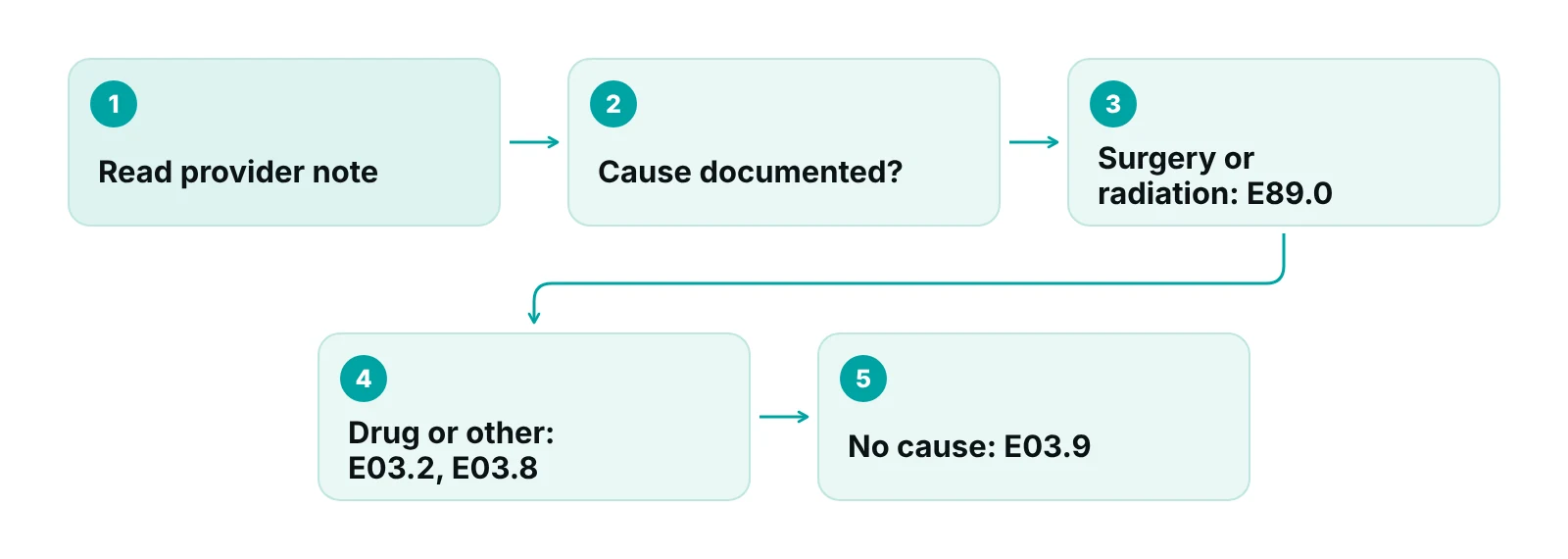
E03.9 is not enough when the provider documents a cause the code book can name. The most common case is hypothyroidism after thyroid surgery or radiation, which goes to E89.0, postprocedural hypothyroidism.
E89.0 includes postirradiation and postsurgical hypothyroidism, and the Index also routes “Status (post), thyroidectomy (hypothyroidism)” to it. E03 carries an Excludes1 note that names postprocedural hypothyroidism (E89.0), so the two do not belong on the same line of the claim for the same condition.
| Phrase in the note | Index entry | Code |
|---|---|---|
| Hypothyroidism, no cause given | Hypothyroidism (acquired) | E03.9 |
| Hypothyroidism due to surgery or postsurgical | Hypothyroidism, due to surgery / postsurgical | E89.0 |
| Hypothyroidism after radiation | Hypothyroidism, postirradiation / due to irradiation therapy | E89.0 |
| Status post thyroidectomy with hypothyroidism | Status (post), thyroidectomy (hypothyroidism) | E89.0 |
| Hypothyroidism due to a drug | Hypothyroidism, due to medicament NEC | E03.2 |
| Postinfectious hypothyroidism | Hypothyroidism, postinfectious | E03.3 |
| Specified type not listed elsewhere | Hypothyroidism, specified NEC | E03.8 |
| Subclinical, iodine-deficiency related | Hypothyroidism, subclinical, iodine-deficiency related | E02 |
Source: CDC National Center for Health Statistics, ICD-10-CM Index to Diseases and Injuries, FY2027. Always confirm the code in the Tabular List before you report it.
Drug-induced hypothyroidism: E03.2
E03.2 covers hypothyroidism due to medicaments and other outside substances. Its notes tell you to add a code for the adverse effect, if applicable, to identify the drug, and to code poisoning first if the cause is a poisoning. Both notes depend on what the provider documents, so ask when the note is vague.
Other specified types: E03.8
E03.8 is the home for a named type of hypothyroidism that has no code of its own. “Specified” means the provider named it. If the note says only “probably autoimmune” or “maybe medication-related,” query the provider before you pick a cause code.
Excludes1 and other notes that block a code pair
The notes in the Tabular List can stop a claim line from passing a code check. An Excludes1 note means the two conditions are generally not reported together, and the guidelines allow an exception only when the conditions are unrelated (CMS FY 2027 guidelines, Section I.A.12.a). Table 3 lists the notes that matter most for thyroid claims.
| Where the note sits | Type | What it says | What it means on a claim |
|---|---|---|---|
| E03 Other hypothyroidism | Excludes1 | Iodine-deficiency related hypothyroidism (E00-E02) and postprocedural hypothyroidism (E89.0) | Do not report E03.x with E89.0 for the same condition. |
| E03.2 | Use additional code | Adverse effect, if applicable, to identify the drug (T36-T50 with fifth or sixth character 5) | Add the drug code when the provider documents an adverse effect. |
| E03.2 | Code first | Poisoning due to drug or toxin, if applicable (T36-T65 with fifth or sixth character 1-4) | If the cause is a poisoning, sequence the poisoning code first. |
| E03.0 | Excludes1 | Transitory congenital goiter with normal function (P72.0) | Congenital cases need their own check. |
| E06 Thyroiditis | Excludes1 | Postpartum thyroiditis (O90.5) | A postpartum case moves out of E06. |
| E89 Postprocedural endocrine and metabolic disorders | Excludes2 | Intraoperative complications of endocrine system organ or structure (E36.0-, E36.1-, E36.8) | An intraoperative event is a different code family. |
| Chapter 4 (E00-E89) | Excludes1 | Transitory endocrine and metabolic disorders specific to newborn (P70-P74) | Newborn transitory conditions are coded elsewhere. |
Source: CDC National Center for Health Statistics, ICD-10-CM Tabular List, FY2027. Third column paraphrases the notes. Fourth column is our reading.
Two points stand out. First, the E03 Excludes1 note is the one that catches the thyroidectomy patient coded with both E03.9 and E89.0. Second, E03.2 is the only code in the E03 category that carries add-code and code-first notes.
Related thyroid codes that appear on the same claims
Hashimoto’s thyroiditis is indexed to E06.3, autoimmune thyroiditis, and the Tabular List includes Hashimoto’s thyroiditis under E06.3. The Index sends “Hypothyroidism, autoimmune” to the thyroiditis entry. If your note says Hashimoto’s hypothyroidism, review the E06 and E03 entries with your coding lead and use the provider’s exact wording.
E07.9, disorder of thyroid unspecified, is not a hypothyroidism code. It tells the payer that a thyroid disorder exists and nothing else. The post we replaced listed it among hypothyroidism codes, and we have corrected that here.
These codes sit at the center of endocrine billing, and the same logic applies wherever a provider documents hypothyroidism. If you run an endocrine practice, our endocrinology billing and RCM page shows how we handle diagnosis specificity inside a specialty workflow. For broader code families, our guide to CPT, ICD-10 and HCPCS codes explains how the three code sets work together on one claim.
What the provider has to document before you can code it
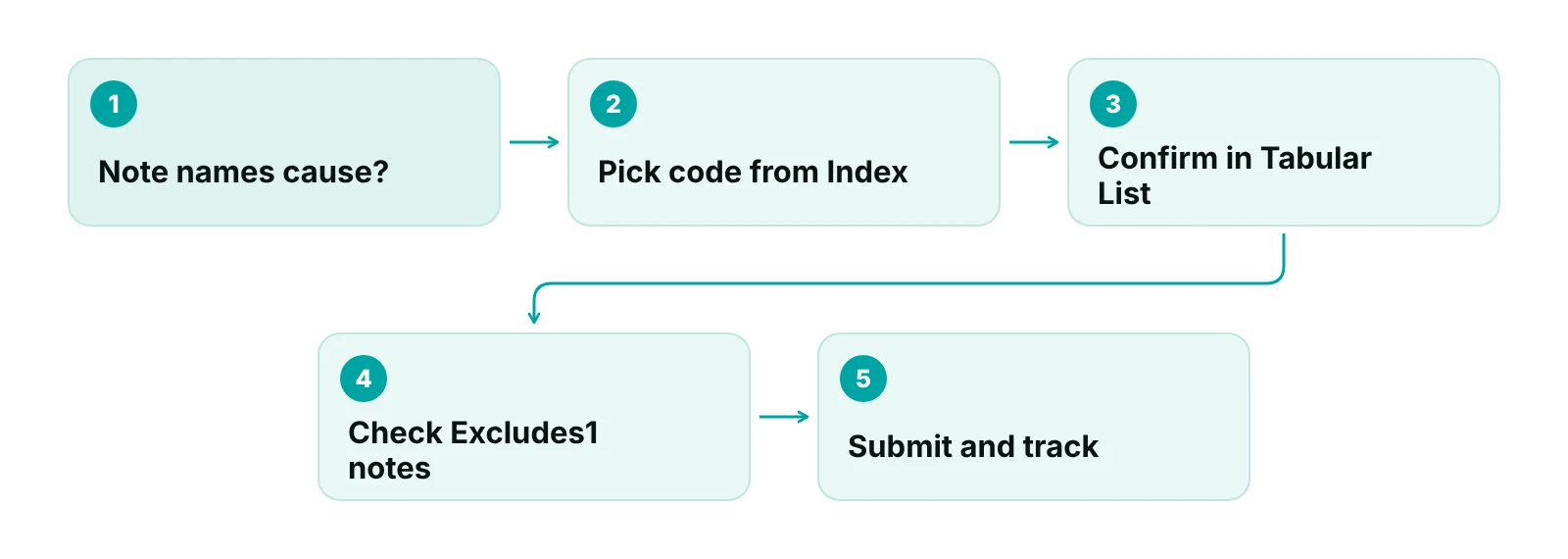
Code assignment is based on the documentation by the patient’s provider (CMS FY 2027 guidelines, Section I.B.14). A coder cannot add a cause from a surgical history entry or a problem list on their own.
- The diagnosis and its cause in one statement. “Hypothyroidism due to thyroidectomy” supports E89.0. “Hypothyroidism” plus a separate surgical history may not.
- Type, when known. Drug-induced, postinfectious, atrophic and autoimmune each point to a different code.
- The drug, for drug-induced cases. The E03.2 notes refer to identifying the drug.
- Current status. A diagnosis the provider considers resolved or only historical may not belong on this visit’s claim. Ask the provider rather than guess.
Lab tests such as thyroid panels are billed with CPT codes, and payers set their own diagnosis rules for them. We did not verify any payer’s diagnosis list for lab tests, so check your payer’s policy and our guide to ICD-10 coding for lab review before you build a rule into your system.
From the code to the claim: where errors show up
A wrong diagnosis code does not announce itself. It can pass your scrubber and still misstate the chart. These are the patterns we look for when we review thyroid claims.
- E03.9 reported for a patient whose note says thyroidectomy or radiation.
- E03.x and E89.0 reported together for the same condition.
- E07.9 used as a stand-in for hypothyroidism.
- A diagnosis copied forward from the last visit without checking the current note.
- A code chosen from an old code book or a superseded code set.
Our medical billing services team runs diagnosis checks before claims leave the building, and our end-to-end revenue cycle management work ties those checks to denial follow-up. Clean diagnosis codes also feed our guide to clean claims.
Want a second pair of eyes on your diagnosis coding?
Send us your current claim workflow and we will look at how notes, codes and edits line up. The audit is free, and pricing is quoted after it.
Our recommendations
- Put the cause in the diagnosis statement. We would ask providers to write the cause in the same sentence as the diagnosis when it is known. It gives the coder one clear line to code from.
- Build a query template for thyroid notes. A short query such as “Can you clarify the cause of the hypothyroidism?” costs a minute. A wrong code costs a correction later.
- Flag thyroidectomy and radiation in the history. We would set a review prompt whenever a thyroid surgery or radiation entry appears next to a hypothyroidism diagnosis, so E03.9 does not go out by default.
- Add an Excludes1 check for E03 and E89.0. This pair is easy to automate in an edit and costly to miss. We would run it before submission.
- Update the code set every October. ICD-10-CM changes each fiscal year. Confirm your code book, your EHR tables and your claim edits all carry the current set before the first claim of the new year.
- Do not use E07.9 as a convenience code. If the provider documents hypothyroidism, code hypothyroidism. Use E07.9 only when the thyroid disorder itself is unspecified.
Bottom line
The right hypothyroidism ICD-10 code depends on one thing the coder cannot supply: the provider’s documented cause. E03.9 is the fallback, E89.0 covers the postsurgical and postirradiation cases, and the Excludes1 note at E03 keeps the two apart. If your claims need a second review, our medical billing services and denial management services teams can help, or you can talk to our team about your setup.
Frequently asked questions
What is the ICD-10 code for hypothyroidism?
The default code is E03.9, hypothyroidism unspecified, when the provider documents hypothyroidism with no cause or type. If the note names a cause, a more specific code applies, such as E89.0 after surgery or radiation or E03.2 for a drug cause. This answer uses the FY2027 code set.
What is the ICD-10 code for hypothyroidism after thyroidectomy?
Hypothyroidism after thyroid surgery is E89.0, postprocedural hypothyroidism. The Index also sends postirradiation hypothyroidism and status post thyroidectomy with hypothyroidism to E89.0. The provider’s note should state the link between the surgery and the hypothyroidism, ideally in the same diagnosis statement. A surgical history entry alone leaves the coder guessing, so send a query when the link is unclear.
Can I report E03.9 and E89.0 together?
Generally not for the same condition. E03 has an Excludes1 note that names postprocedural hypothyroidism (E89.0). The guidelines allow an exception only when the two conditions are unrelated, so ask your coding lead before you use it. When in doubt, query the provider and let the documentation settle the choice.
Is E03.9 enough to bill a claim?
E03.9 is a complete, valid code, and the guidelines say unspecified codes have acceptable uses. It is the right choice only when the note holds no more specific information, such as a documented surgery, drug or infection cause. If the chart documents a cause, use the more specific code. Payer edits vary, so confirm your own payers’ rules.
Is E07.9 a hypothyroidism code?
No. E07.9 means disorder of thyroid, unspecified. It does not say the disorder is hypothyroidism. If the provider documents hypothyroidism, report E03.9 or the more specific code that fits the documented cause. Using E07.9 as a shortcut makes the claim less specific than the chart.
What code do I use for Hashimoto's thyroiditis?
E06.3, autoimmune thyroiditis, includes Hashimoto’s thyroiditis in the FY2027 Tabular List. The Index sends autoimmune hypothyroidism to the thyroiditis entry. If the note also states hypothyroidism, review the E06 and E03 entries with your coding lead and follow the provider’s exact wording. Do not assume a second code is needed.
Get your free practice audit
Tell us about your practice. We will contact you using the details you give.
- A review of your recent claims, denials and A/R aging
- Where your front desk and prior authorizations slow payment
- A prioritized fix list you keep, whether or not you hire us
Pricing is quoted after the audit, based on your volume and the services you choose. Prefer to talk? Call +1 (302) 556-2288.
Sources
- ICD-10-CM browser, FY2027 Index and Tabular List — CDC National Center for Health Statistics (2026)
- 2027 ICD-10-CM files — Centers for Medicare & Medicaid Services (2026)
- FY 2027 ICD-10-CM Official Guidelines for Coding and Reporting — CMS / NCHS (2026)
Disclaimer: This article is educational and is not legal, coding or compliance advice. ICD-10-CM is maintained by the CDC National Center for Health Statistics and CMS, and the code set changes each fiscal year. Payer rules vary, and the provider's documentation controls code assignment. Confirm each code in the current Tabular List and your payer's policy before you bill.