Before a facet joint or epidural steroid injection claim goes out, the note must show a covered diagnosis, how long the pain has lasted, which conservative care failed, a baseline score on a named pain or disability scale, the response to earlier injections on that same scale, the levels and side treated, and CT or fluoroscopic guidance.
Medicare pays for a spine injection when the record proves the coverage criteria were met, not because the care was right. This checklist turns the Local Coverage Determinations (LCDs) and billing articles into what must be in the note, per procedure, before the claim goes out. We use the WPS LCDs as the reference and flag where other Medicare Administrative Contractors (MACs) differ. For the wider picture, see our pain management billing services.
Key takeaways
- Insufficient documentation was 53.0% of Medicare fee-for-service improper payments in CMS’s 2025 data.
- Every note needs a named pain or disability scale at baseline and the same scale after each procedure.
- Under the WPS LCDs, ESIs need radicular pain for 4+ weeks; facet procedures need mainly axial pain for 3+ months.
- Diagnostic facet blocks need 80% relief; repeat ESIs, therapeutic facet injections and RFA need 50% sustained improvement.
- Hospital outpatient facet procedures and WISeR-state ESIs are reviewed before Medicare pays.
Why documentation decides whether injection claims get paid
Medicare reviewers judge a claim by the record alone. If the note does not show the coverage criteria, the payment can be counted as improper, even when the care was appropriate.
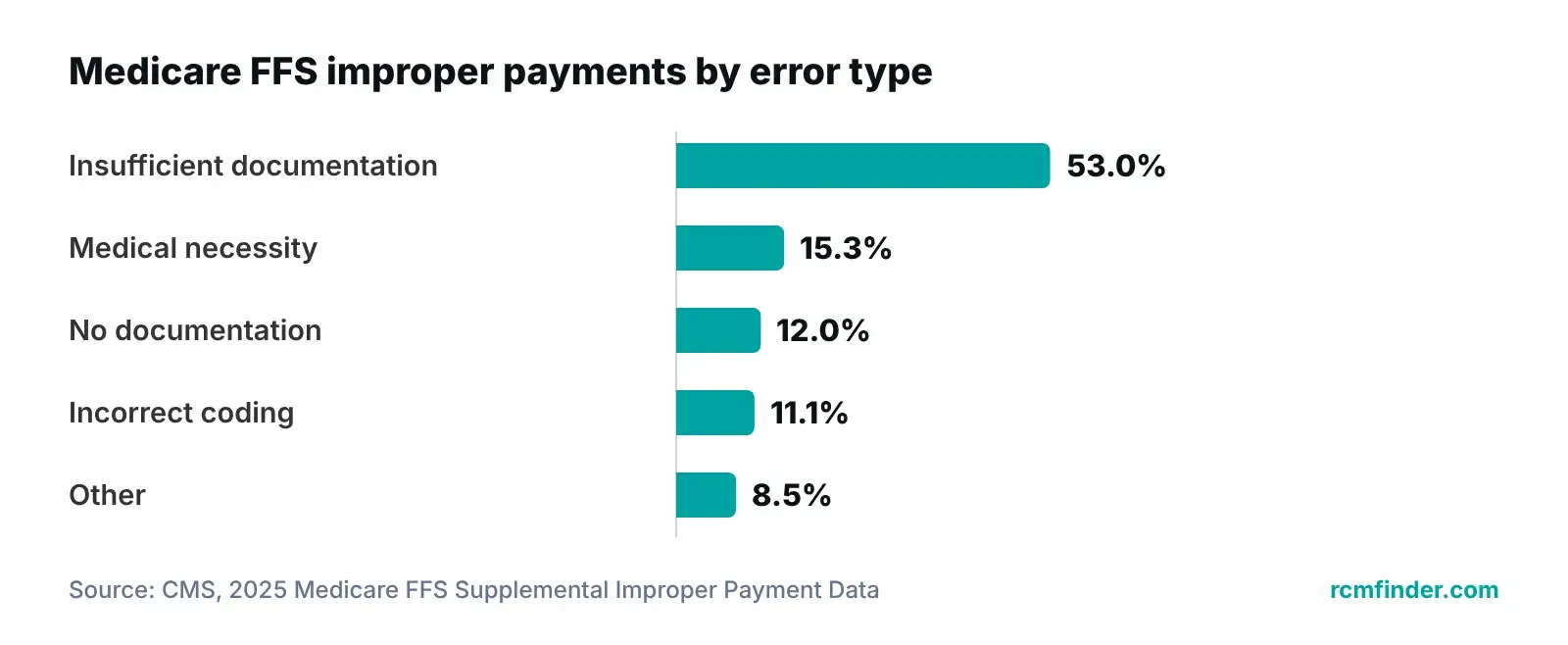
In CMS’s 2025 supplemental improper payment data (claims submitted July 2023 to June 2024), insufficient documentation caused 53.0% of Medicare fee-for-service improper payments, far ahead of medical necessity (15.3%) and incorrect coding (11.1%). The FY 2025 fact sheet puts the overall rate at 6.55%, or $28.83 billion. These figures cover all services, not pain procedures alone.
Spine injections also have an audit history: approved Recovery Audit topics for facet joint interventions (topic 0095, 2018) and epidural steroid injections (topic 0119, 2018), both complex reviews of medical necessity and documentation (see our guide to RAC audits).
The core checklist: what every injection note needs
Every facet or epidural note needs the same foundation: who, when, why, what was tried first, the pain on a named scale, what was done and who signed. Procedure rules sit on top.
- Patient identity on every page, legible, per Wellpoint’s ESI billing article A58745.
- A signed, dated note or operative report with the provider’s assessment, relevant history and test results, per CGS’s facet article A58364.
- A diagnosis the note supports, and a CPT code that describes what was done.
- Pain duration and conservative care: onset, what was tried, for how long, and the response.
- The scale’s name and score at baseline, then the same scale at every follow-up.
- Region, levels and side, plus CT or fluoroscopy and the drug and dose.
- The patient-specific reason for any sedation.
Noridian‘s facet documentation list (December 2023) adds anesthesia records, prior injections and their effect, an abbreviation key, signature logs and any Advance Beneficiary Notice.
Signatures count as documentation
CMS’s signature booklet MLN905364 (July 2025) says stamped signatures are generally not accepted, and the provider must sign entries drafted by a scribe, including AI tools. A missing signature on a record other than an order can be fixed with an attestation; most contractors allow 20 calendar days to send one (CERT reviews excepted).
Epidural steroid injection documentation checklist
An ESI note must show radicular pain or another listed condition for at least 4 weeks, failed or intolerable conservative care, concordant imaging and a baseline score. Items follow WPS LCD L39054 (revision effective April 30, 2026); Noridian L39240 uses the same core criteria.
Before the first injection
- Radiculopathy, radicular pain or neurogenic claudication from a listed cause, post-laminectomy syndrome or acute herpes zoster. Non-specific axial back pain does not qualify.
- History, exam and concordant imaging supporting that diagnosis.
- Pain for 4+ weeks, with failure of 4 weeks of conservative care or a reason it was not tolerated.
- Ongoing conservative care, such as active rehabilitation or a home exercise program.
In the procedure note
- Up to 2 transforaminal levels, or 1 interlaminar or caudal level, in one region. Bilateral interlaminar or caudal ESIs are not reasonable and necessary.
- CT or fluoroscopy with contrast; ultrasound without contrast only with a documented contrast allergy or pregnancy.
- Wellpoint A58745 adds: retained images (2+ views) of needle position and contrast flow, and for nerve root blocks the baseline score and relief right after the injection.
Before a repeat injection
- 50%+ pain improvement for 3+ months, or 50%+ better function, on the baseline scale.
- After a poor response, a retry after 14 days with a different approach, level or drug, with the rationale.
- No more than 4 sessions per region in a rolling 12 months; past 12 months, the rationale and notice to the primary care provider.
Facet joint documentation checklist: blocks, injections and RFA
Facet procedures start with mainly axial neck or low back pain for 3+ months despite conservative care. After that, each step depends on the documented response to the one before. Items follow WPS LCD L38841 (revision effective May 28, 2026), which names scales such as NRS, VAS, the Oswestry Disability Index and Roland-Morris.
Diagnostic blocks
- First block: pain causing a functional deficit, failed conservative care, no untreated radiculopathy or other cause such as fracture, and baseline pain and disability scores.
- An intra-articular block instead of a medial branch block needs the anatomic reason.
- Confirmatory block: 80%+ relief of the index pain from the first block on the same scale, and 2+ weeks since it, or the reason for an exception.
Therapeutic injections and ablation
- Therapeutic intra-articular injection: two blocks with 80%+ relief, and why the patient is not a candidate for ablation.
- First ablation: two medial branch blocks with 80%+ relief each. Repeat: 50%+ improvement for 6+ months, or 50%+ better function.
- New diagnostic blocks if 2+ years have passed and the pain source is unclear.
- Moderate sedation for ablation only with a documented patient-specific need; anxiety or preference is not enough.
Per region, in a rolling 12 months: 4 diagnostic, 4 therapeutic and 2 ablation sessions, at 1 or 2 levels each.
| Procedure | In the chart before scheduling | In the procedure note | Before the next session |
|---|---|---|---|
| ESI, first | Listed radicular diagnosis; 4+ weeks of pain; failed or intolerable conservative care; concordant imaging; baseline score | Approach and levels; CT or fluoroscopy with contrast; drug and dose; images kept | Response on the same scale |
| ESI, repeat | 50%+ improvement for 3+ months, or 50%+ better function | As above; rationale if approach, level or drug changed | No more than 4 sessions per region in 12 months |
| Medial branch block, first | Axial pain 3+ months; failed conservative care; no untreated radiculopathy; baseline pain and disability scores | Levels (1–2), side, guidance, agent | Score after the block, same scale |
| Medial branch block, confirmatory | 80%+ relief from block 1; 2+ weeks since it, or a documented exception | As above | Relief recorded for the ablation decision |
| Therapeutic facet injection | Two blocks with 80%+ relief; why ablation is not an option | Levels, side, guidance, injectate | 50%+ relief for 3+ months, or 50%+ better function |
| Radiofrequency ablation, first | Two blocks with 80%+ relief each | Levels counted by joint; guidance; reason for any sedation | Date and response |
| Radiofrequency ablation, repeat | 50%+ improvement for 6+ months, or 50%+ better function | As above | No more than 2 sessions per region in 12 months |
Sources: CMS Medicare Coverage Database — WPS LCDs L39054 (rev. eff. 04/30/2026) and L38841 (rev. eff. 05/28/2026); Wellpoint A58745 and CGS A58364 (2026). Thresholds are WPS’s; confirm your MAC’s version.
Match the claim line to the note: levels, sides and modifiers
A complete note can still be denied if the claim line says something different. Before release, check levels, laterality, KX and same-day services against the note.
| Claim element | What the note must show | Rule source |
|---|---|---|
| Facet levels and units | Joints treated, by level; nerves to one joint count as one level; 1–2 levels per session | CGS A58364; WPS L38841 |
| Bilateral facet or transforaminal ESI | Both sides treated and why; physicians bill one line with modifier 50, ASC facilities bill RT and LT lines | CGS A58364; Wellpoint A58745 |
| Interlaminar or caudal ESI (62321, 62323) | One level; never reported as bilateral | Wellpoint A58745; WPS L39054 |
| KX modifier | Criteria met; CGS: first two diagnostic facet lines; Wellpoint: diagnostic nerve root blocks | CGS A58364; Wellpoint A58745 |
| Image guidance | CT or fluoroscopy named; ultrasound-guided facet procedures not covered | WPS L38841; CGS A58364 |
| Same-day blocks | Separate necessity for each block with a facet procedure; none with an ESI except a facet cyst | WPS L38841; WPS L39054 |
| Anesthesia code 01992, same day | Patient-specific need; automated review denies it | WPS LCDs; CMS Recovery Audit topic 0229 |
Sources: CMS Medicare Coverage Database — CGS A58364 (R13, eff. 09/17/2026), Wellpoint A58745 (R6, eff. 04/01/2026), WPS L38841 and L39054; CMS Recovery Audit topic 0229 (2026). Codes are examples; check current CPT.
For 59 and the X modifiers, see our explainers on modifiers 25 vs 59 and when modifier 59 applies, and our claim scrubbing guide for common edits.
Anesthesia with spine injections
The WPS LCDs treat sedation as not reasonable and necessary for facet injections and usually unnecessary for ESIs. CMS’s Recovery Audit topic 0229 (July 2026) is an automated review denying anesthesia code 01992 billed the same day as facet injections, facet denervation or ESIs.
The MAC caveat: same core rules, different articles
The facet and ESI LCDs we checked from WPS, CGS and Noridian share the same core thresholds. Billing articles, checklists and revision dates differ, and those details decide claims. For example, CGS LCD L38773 closely matches the WPS facet criteria, yet CGS wants KX on the first two diagnostic lines. CGS (A58364) and Noridian (A58403) both revised their facet articles effective September 17, 2026 to add ablation coding for T12–L1 and L1–L2. Noridian’s facet LCD, L38801, now covers both its jurisdictions; the old Jurisdiction F LCD, L38803, was retired on April 16, 2026. Some coverage database pages also show proposed-LCD notices, so confirm which version is in effect.
| Contractor | Example states | Documents checked | What it adds |
|---|---|---|---|
| WPS (J5, J8) | Indiana, Michigan, Iowa, Kansas, Missouri, Nebraska | Facet LCD L38841 (rev. 05/28/2026); ESI LCD L39054 (rev. 04/30/2026) | The criteria used in this checklist |
| CGS (J15) | Kentucky, Ohio | Facet LCD L38773 (rev. 07/23/2026) and article A58364 (R13, 09/17/2026); OPD checklist tool (2024) | KX on first two diagnostic lines; Ohio is a WISeR state |
| Noridian (JE, JF) | California, Arizona, Washington and others | Facet LCD L38801 and ESI LCD L39240 (both rev. 04/16/2026); facet article A58403 R9 (09/17/2026) | One facet LCD for JE and JF (L38803 retired); Arizona and Washington are WISeR states |
| Wellpoint Federal (J6, JK) | Illinois, Minnesota, Wisconsin, New York, New England | ESI article A58745 (R6, 04/01/2026) | Images kept; nerve root block relief recorded; KX on diagnostic nerve root blocks |
| Medicare Advantage, commercial | All states | Each plan’s medical policy | Own criteria and prior authorization lists; WISeR excludes Medicare Advantage |
Sources: CMS Medicare Coverage Database (LCDs and articles as listed, read 2026-10-09); Noridian (2026); CGS Facet Joint Interventions Checklist Tool (2024); CMS WISeR model page (2026).
Prior authorization and prepayment review: when the note becomes the packet
Two Medicare programs review documentation before payment: hospital outpatient facet procedures nationwide and, in six WISeR states, ESIs. In both, this checklist becomes the request packet.
Hospital outpatient facet procedures
Under CMS’s hospital outpatient prior authorization program, facet joint interventions have needed approval since July 1, 2023, with standard reviews of up to 7 calendar days since January 1, 2025. The CMS OPD FAQ (November 2024) says claims without a provisional affirmation are denied and related physician and anesthesia services are not paid. ASC and office claims are outside the program, and an affirmation does not guarantee payment if, for example, a frequency limit is exceeded. CGS lists outdated documentation among common reasons for non-affirmation.
WISeR states: ESIs in the office, ASC and hospital outpatient department
CMS’s WISeR model runs from January 1, 2026 to December 31, 2031 in New Jersey, Ohio, Oklahoma, Texas, Arizona and Washington. Its fact sheet lists ESIs for pain management in office, ASC and hospital outpatient settings, and providers choose prior authorization or prepayment review. The operational guide (version 7.0, July 2026) mirrors the LCD documentation items, with decisions in 3 calendar days and affirmations valid for 120 days. Noridian notes that an ABN is required for expected denials. Our prior authorization guide covers the general process.
Find the gaps in your injection notes
Our free practice audit checks a sample of your facet and epidural claims against your MAC's rules and shows which gaps cost you most. Pricing is quoted after the audit.
Get a Free Practice AuditHow to run a pre-submission review in your practice
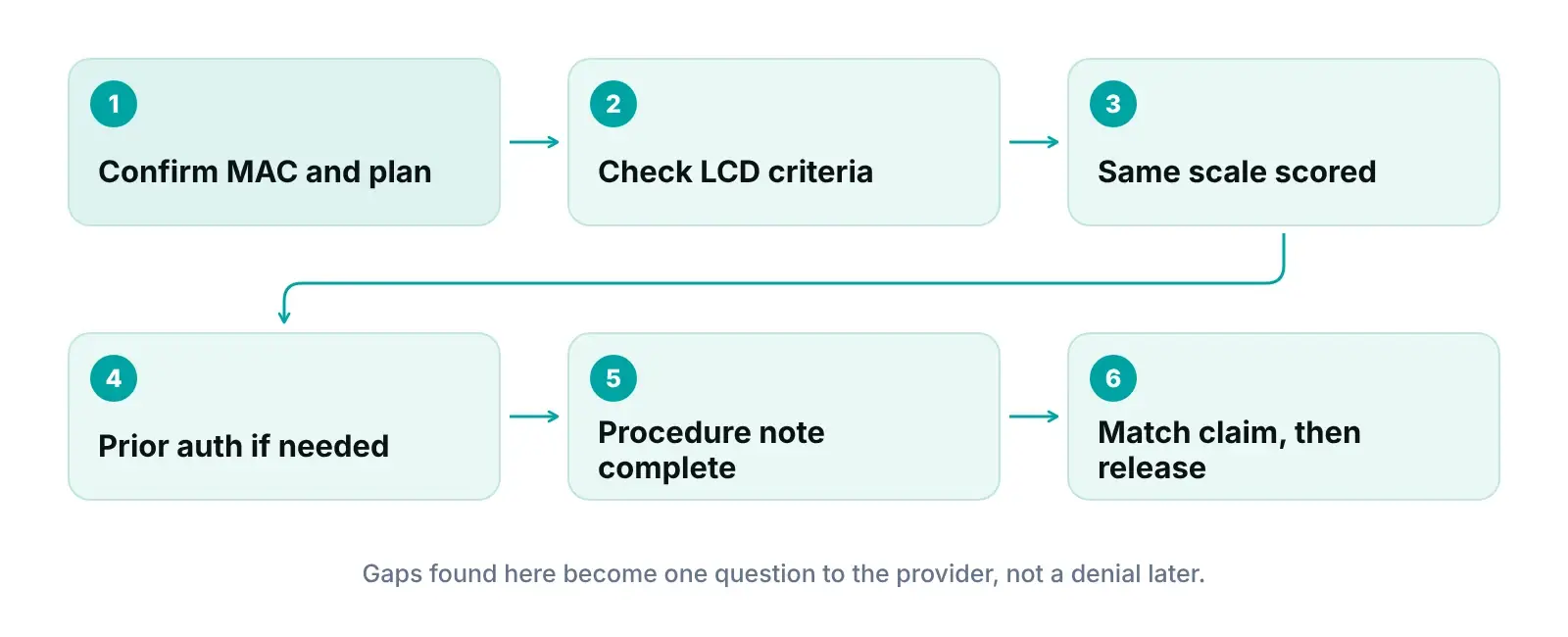
Hold every injection claim until someone other than the author checks it against the checklist. The fix then happens before the payer sees the record.
- Build the template: required fields for onset, conservative care, scale and score, levels, side, guidance and drug.
- Log sessions per region and show the rolling 12-month count at scheduling.
- Check site and state at booking: hospital outpatient facet cases need prior authorization; WISeR-state ESIs need it or face prepayment review.
- Compare note to claim using the claim-to-note table.
- Ask one specific question when something is missing, such as the scale used after the first block.
- Track denials by reason and feed repeat gaps back into the template.
“If a coder has to guess what relief the patient got, the claim is not ready. We would rather hold it and ask the provider one question than appeal it later.”
— Awais Afzal, Healthcare Operations & Data Analyst
We build our billing pipeline around how claims actually move through a practice: registration, charge entry, submission, payment and follow-up. In the RCM Finder portal, completeness checks run before submission and workflow rules can hold a claim and assign an owner, so a claim missing a pain score can be held before it goes out.
Diagnosis coding still drives medical necessity; see our guides to ICD-10 codes for back pain and neck pain ICD-10 coding. Virtual medical assistants can take on prior authorization requests, and our denial management guide covers what still gets through.
Our recommendations
- Name the scale in the template. We make the scale name and score required at baseline and every follow-up, so relief can be read from the note alone.
- Count sessions by region. Caps apply per spinal region in a rolling 12 months. We check the count before the visit is booked.
- Write the 'why' sentences. The LCDs want reasons for exceptions: no ablation, a shorter interval, sedation, a changed repeat. We give providers a one-line prompt for each.
- Check site of service and state first. Hospital outpatient facet cases and WISeR-state ESIs need approval or face prepayment review. We sort that out before the date is set.
- Re-read your MAC's article every quarter. Articles change between LCD revisions. We log the revision date behind each rule and keep images and signature logs ready to send.
Bottom line
Facet and epidural claims are decided in the note: a named scale, the response on that scale, a reason for each exception and a claim line that matches. If you want a second set of eyes on your injection claims, our pain management billing team works from your MAC’s documents as part of our end-to-end revenue cycle management.
Frequently asked questions
What documentation is required for a facet joint injection?
Under LCDs such as WPS L38841, the record needs mainly axial neck or low back pain for at least 3 months, failed conservative care, no untreated radiculopathy, and baseline pain and disability scores. Each later block needs the response on the same scale. The procedure note should show the levels, side, CT or fluoroscopic guidance and agent used, signed and dated by the provider.
How much relief must be documented before radiofrequency ablation?
Under the WPS and CGS facet LCDs, a first ablation needs two diagnostic medial branch blocks, each with at least 80% relief of the index pain on the same scale. A repeat ablation at the same site needs at least 50% pain improvement lasting 6 months or more, or a consistent gain in function on the same scale (WPS sets that at 50%).
What does Medicare need in the chart for an epidural steroid injection?
A listed condition such as radiculopathy, pain for at least 4 weeks, failed or intolerable conservative care, concordant imaging and a baseline score on a named scale. The note should record the approach, levels and CT or fluoroscopy with contrast. A repeat needs at least 50% improvement for 3 months, or 50% better function.
Do facet joint injections need prior authorization from Medicare?
In hospital outpatient departments, yes: CMS has required it since July 1, 2023, and claims without a provisional affirmation are denied. ASC and office claims are outside that program. Separately, the WISeR model covers ESIs in six states. Medicare Advantage and commercial plans set their own rules.
Can facet or epidural injections be done under ultrasound guidance?
Not for Medicare coverage under the LCDs we reviewed. Facet procedures need CT or fluoroscopy, and ultrasound-guided facet procedures are not covered. For ESIs, ultrasound without contrast is considered only with a documented contrast allergy or pregnancy.
How often should we check our MAC's LCD and billing article?
At least quarterly, and whenever denials change. In 2026 alone, the WPS, CGS and Noridian facet LCDs, two ESI LCDs and two facet articles were revised. Note the revision date you built each rule from.
Get your free practice audit
Tell us about your practice. A member of our operations team replies within one business day.
- A review of your recent claims, denials and A/R aging
- Where your front desk and prior authorizations slow payment
- A prioritized fix list you keep, whether or not you hire us
Pricing is quoted after the audit, based on your volume and the services you choose. Prefer to talk? Call +1 (302) 556-2288.
Sources
- 2025 Medicare Fee-for-Service Supplemental Improper Payment Data — CMS (2025)
- Fiscal Year 2025 Improper Payments Fact Sheet — CMS (2026)
- Recovery Audit topic 0095: Facet Joint Interventions — Medical Necessity and Documentation Requirements — CMS (2018)
- Recovery Audit topic 0119: Epidural Steroid Injection — Medical Necessity and Documentation Requirements — CMS (2018)
- Recovery Audit topic 0229: Anesthesia During Spine Pain Management Procedures — CMS (2026)
- LCD L38841: Facet Joint Interventions for Pain Management (WPS) — CMS Medicare Coverage Database (2026)
- LCD L39054: Epidural Steroid Injections for Pain Management (WPS) — CMS Medicare Coverage Database (2026)
- LCD L38773: Facet Joint Interventions for Pain Management (CGS) — CMS Medicare Coverage Database (2026)
- LCD L38801: Facet Joint Interventions for Pain Management (Noridian) — CMS Medicare Coverage Database (2026)
- LCD L39240: Epidural Steroid Injections for Pain Management (Noridian) — CMS Medicare Coverage Database (2026)
- Article A58364: Billing and Coding: Facet Joint Interventions for Pain Management (CGS) — CMS Medicare Coverage Database (2026)
- Article A58745: Billing and Coding: Epidural Steroid Injections for Pain Management (Wellpoint Federal) — CMS Medicare Coverage Database (2026)
- Facet Injections Documentation Requirements — Noridian Healthcare Solutions (2023)
- Billing and Coding: Facet Joint Interventions for Pain Management (A58403) — R9 — Noridian Healthcare Solutions (2026)
- Facet Joint Interventions Checklist Tool — CGS Administrators (2024)
- Prior Authorization for Certain Hospital Outpatient Department (OPD) Services — CMS (2026)
- OPD Prior Authorization Frequently Asked Questions — CMS (2024)
- WISeR (Wasteful and Inappropriate Service Reduction) Model — CMS Innovation Center (2026)
- WISeR Model Provider Fact Sheet — CMS Innovation Center (2025)
- WISeR Model Provider and Supplier Operational Guide, Version 7.0 — CMS Innovation Center (2026)
- WISeR Model — Arizona and Washington Providers and Suppliers — Noridian Healthcare Solutions (2026)
- Complying with Medicare Signature Requirements (MLN905364) — CMS Medicare Learning Network (2025)
Disclaimer: This article is general educational information for practice owners and managers. It is not legal, coding, compliance or medical advice. Medicare LCDs, billing articles and payer policies vary by contractor and plan and change often. Check your MAC's current documents, your payer contracts and the current CPT and ICD-10-CM code sets before billing.