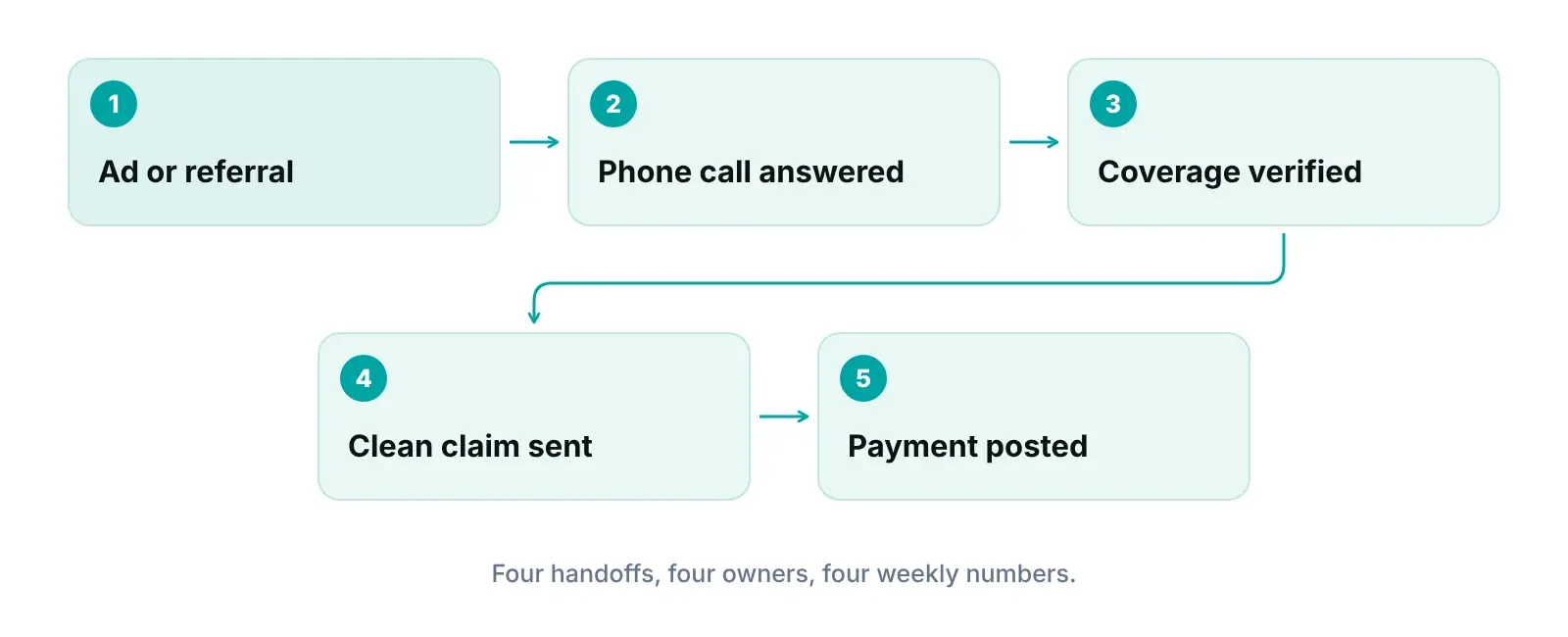
Revenue leakage in healthcare is money a practice earned, or could have earned, that never reaches the bank. In a medical practice it tends to slip at four handoffs: ad to phone call, booking to eligibility check, visit to claim, and claim to payment. Give each handoff one owner and one weekly number, and the leaks become visible.
Most practices look for lost revenue in the billing office. That is where leaks show up, but often not where they start. A new-patient call that rings out never becomes a claim. A wrong member ID typed at booking becomes a denial weeks later.
This guide follows one new patient from the ad to the payment. For each of the four handoffs it covers what breaks, who should own it and how to measure it. It is the thinking behind our end-to-end revenue cycle management work.
Key takeaways
- Revenue usually leaks between people or vendors, not inside one department.
- Watch four handoffs: ad to phone call, booking to eligibility, visit to claim, claim to payment.
- Give each handoff one owner and one or two weekly numbers.
- KFF, 2024 HealthCare.gov data: 19% of in-network claims denied; fewer than 1% of denials appealed.
- Medicare Open Enrollment changes take effect January 1, so re-verify coverage in January.
What is revenue leakage in healthcare?
Revenue leakage is the gap between what a practice should collect for its care and what it actually collects. It is not patient leakage, which usually means patients going to providers outside your network. In a practice it takes three forms:
- Revenue never captured: a prospective patient who never got booked, or a service that never became a charge.
- Revenue denied and not recovered: claims denied and never corrected, resubmitted or appealed.
- Revenue underpaid or written off: payments below the contracted amount, and balances closed without follow-up.
Each form tends to start at a handoff, where work passes from one person, team or vendor to the next. When each side assumes the other checked, nobody did.
“Revenue rarely disappears inside one department. It disappears between two of them, where each side assumes the other one checked.”
— Awais Afzal, Healthcare Operations & Data Analyst
| Handoff | What usually breaks | Who should own it | What to measure weekly |
|---|---|---|---|
| Ad → phone call | Unanswered calls, slow callbacks, no lead source | Practice manager | Answered call rate; lead source recorded |
| Booking → eligibility | Wrong or inactive plan; missing referral or authorization | Front-desk or eligibility lead | Verification rate; overdue authorizations |
| Visit → claim | Unsigned notes, missed charges, unsupported codes | Provider (note); biller or coder (charge) | Charge lag; clean claim rate |
| Claim → payment | Unworked denials, missed appeals, short payments | Billing or A/R lead | Denial rate; denial write-offs |
Operating framework, not sourced statistics. Formulas are in the scorecard below.
Handoff 1: Ad to phone call. Where does the new patient go?
The first leak happens before the patient exists in your EHR. A call rings out at lunch, a web form waits until the next afternoon, or the patient books but nobody records where they came from. You paid for the lead either way.
In an MGMA Stat poll in December 2025 (236 responses), 22% of practice leaders named phone access as their top patient access focus for 2026. No-shows (27%), online scheduling (24%) and wait times (21%) were the other main answers.
What breaks
- Calls go to voicemail during the check-in rush, at lunch or after hours.
- Web forms and voicemails get returned hours later, after the patient has called elsewhere.
- The ad promotes a service or plan the practice does not take.
- Insurance is not captured on the first call, so eligibility work slips to the day of the visit.
- Lead source is not recorded, so ad spend cannot be tied to booked or paid visits.
Who should own it
Marketing owns the promise the ad makes; the front desk owns the answer. The practice manager should own the number that connects them. Our healthcare marketing team aims campaigns at the services and plans a practice accepts, and our virtual medical assistants handle scheduling and intake in the practice’s time zone.
How to measure it
- Answered call rate: calls answered live ÷ calls received, by hour of day.
- Callback time: hours from web form or voicemail to first call back.
- Booking rate: new-patient calls that end in a booked visit.
- Cost per booked new patient: ad spend ÷ visits booked from that source (more in our medical marketing ROI guide).
Measure lead source without leaking patient data
HHS’s guidance on online tracking technologies (updated June 2024) says HIPAA applies when tracking tools capture protected health information, such as appointment scheduling details. Sharing it with a tracking vendor needs a Business Associate Agreement and a Privacy Rule permission, or the patient’s authorization; a cookie banner is not one. A June 20, 2024 court order vacated one part: public pages where tracking links only a visitor’s IP address to a page about a health condition or provider. Record lead source in your own scheduling system instead. This is not legal advice.
Handoff 2: Booking to eligibility. Is the visit billable before it happens?
A booked visit is not yet a billable visit. Coverage, the right payer, referral rules and prior authorization must be confirmed before the patient arrives, or the claim is in trouble before it exists.
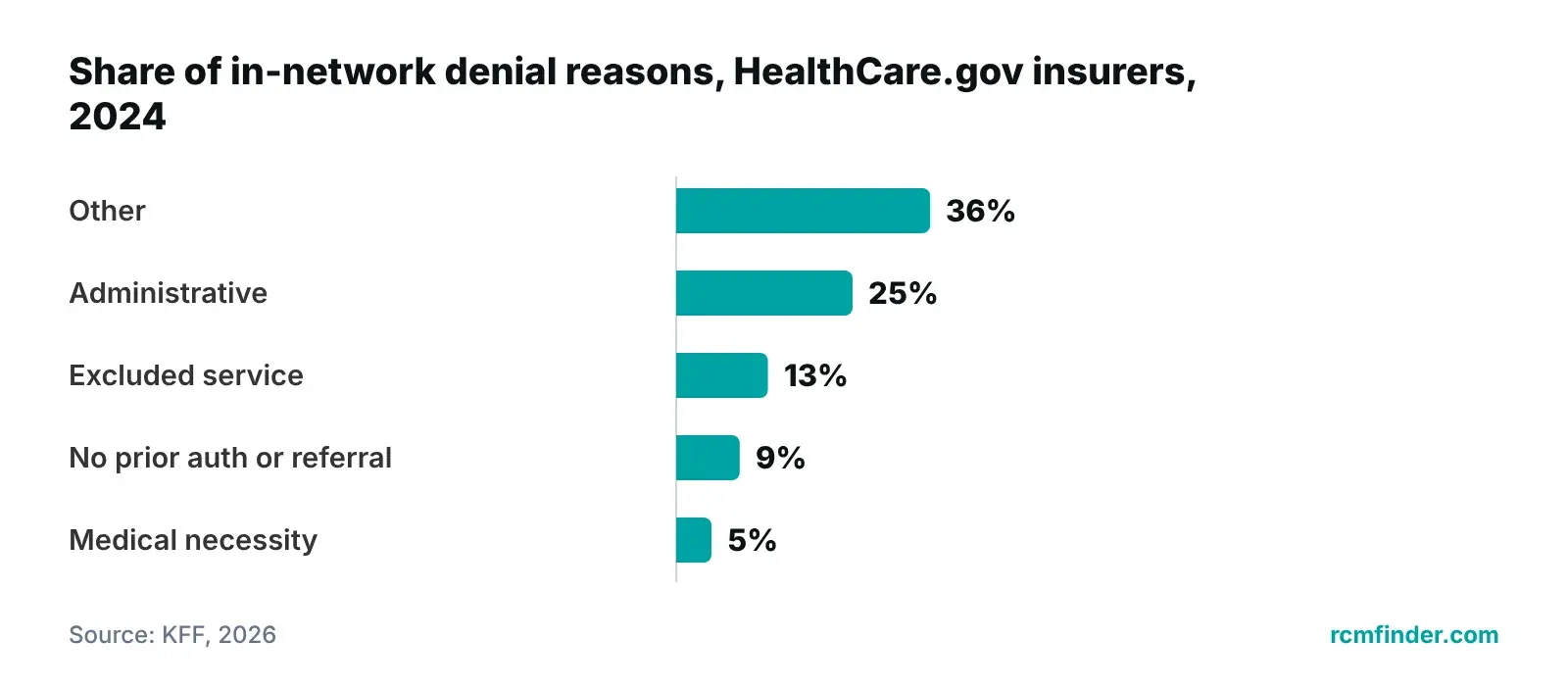
In KFF‘s analysis of 2024 HealthCare.gov insurer data, published in March 2026, 25% of in-network denial reasons were administrative and 9% were a lack of prior authorization or referral. Both often start at the front desk. In the AMA‘s 2025 physician survey, published in May 2026, practices averaged 40 prior authorizations per physician each week, taking 13 hours of physician and staff time.
Dates that change this handoff
Medicare Open Enrollment runs October 15 to December 7, with changes effective January 1. The CMS prior authorization final rule (CMS-0057-F), issued in January 2024, set payer decision deadlines starting in 2026.
| Date | What changes | Applies to | Front-desk action |
|---|---|---|---|
| Jan 1, 2026 (in effect) | Prior authorization decisions within 72 hours (expedited) or 7 calendar days (standard) | Medicare Advantage, Medicaid and CHIP plans (not federal-exchange QHPs) | Log send dates; chase overdue decisions |
| 2026 (in effect) | A specific reason is required for each prior authorization denial | Same payers, plus federal-exchange QHPs | Record the reason; fix or appeal |
| Mar 31, 2026, then yearly | Payers post prior authorization metrics online | Same payers | Check your main payers’ metrics |
| Oct 15 – Dec 7, 2026 | Medicare Open Enrollment: plan switches allowed | People with Medicare | Ask patients to bring any new card |
| Jan 1, 2027 | Enrollment changes take effect; Prior Authorization API due | Medicare patients; impacted payers | Re-verify at the first visit of the year |
| Jan 1 – Mar 31, 2027 | Medicare Advantage Open Enrollment; changes effective the next month | Medicare Advantage enrollees | Re-verify Medicare Advantage patients monthly |
Sources: CMS fact sheet on CMS-0057-F (2024); Medicare.gov, Joining a plan (2026). The prior authorization rule excludes drugs.
Who should own it and how to measure it
One front-desk or eligibility lead should own this handoff, with a named person for prior authorizations. Track weekly:
- Insurance verification rate: verified encounters ÷ registered encounters (HFMA MAP Key PA-3).
- Verified early: visits verified two or more business days ahead.
- Overdue authorizations: requests pending past the payer’s decision timeframe.
- Front-end denials: eligibility, registration and authorization denials as a share of all denials.
The 2024 CAQH Index (calendar-year 2023 data) put provider labor at $8.57 for a manual eligibility check versus $2.00 electronically. For workflows, see our insurance verification guide and prior authorization guide.
See which handoff costs your practice most
Our free practice audit reviews a sample of your claims, denials and A/R aging, plus how registration and eligibility work today, and shows what to fix first.
Get a Free Practice AuditHandoff 3: Visit to claim. Does every service become a clean claim?
After the visit, revenue leaks when notes stay unsigned, services never become charges, codes do not match the note, or a claim sits in a queue. None of it shows up as a denial; it never left the building.
What breaks
- Open notes that hold every charge behind them.
- Procedures, injections or supplies in the note but missing from the charge.
- Codes or modifiers the documentation does not support.
- Claims held for a missing field until the filing limit is close.
Filing limits are firm. Under 42 CFR 424.44, a Medicare claim must be filed no later than 1 calendar year after the date of service, with limited exceptions. Other payers set their own limits; for state rules, see our guide to medical billing time limits by state.
Who should own it
The provider owns finishing the note; the biller or coder owns an accurate charge. Someone other than the charge-entry person should match the day’s schedule to its charges daily.
How to measure it
- Charge lag: average days from date of service to claim submission, by provider.
- Visits without charges: completed appointments with no charge entered, checked daily.
- Clean claim rate: claims passing edits with no manual intervention ÷ claims accepted for billing (HFMA MAP Key CL-1).
Our clean claims guide covers the common edits. In the RCM Finder portal, a claim missing required data is stopped before submission, and automation rules can hold it and assign an owner. We build our billing pipeline around how claims actually move through a practice: registration, charge entry, submission, payment and follow-up.
Handoff 4: Claim to payment. Is every dollar collected or appealed?
Once a claim is sent, money leaks through denials nobody works, appeals nobody files, short payments nobody notices and patient balances nobody follows up.
KFF found that HealthCare.gov insurers denied 19% of in-network claims in 2024, from 3% to 36% by insurer, and fewer than 1% of denied claims were appealed. KFF counts consumers’ internal appeals, which are rare. Its denial rate leaves out claims resubmitted and then paid, but if a provider files a new claim instead, the original still counts as denied.
Most denials are worth working. In Premier‘s February 2025 survey of 280 hospitals’ 2023 claims, about 70% of denials were eventually overturned and paid, while the average cost to fight one rose from $43.84 in 2022 to $57.23 in 2023. Hospital data, but the lesson holds: a denial is delayed money until a deadline passes.
Who should own it
One billing or A/R lead should own every open claim until it is paid, appealed or deliberately written off. Write-offs above an amount you set should need the owner’s sign-off.
How to measure it
- Remittance denial rate: claims denied ÷ claims remitted (HFMA MAP Key AR-5), by payer and reason.
- Denials worked on time: share corrected or appealed before the payer’s appeal deadline.
- Underpayments: paid amount against contracted amount, line by line.
- Denial write-offs: net dollars written off as denials ÷ average monthly net patient service revenue (HFMA MAP Key AR-6).
Manual follow-up costs more, too: the 2024 CAQH Index put a manual claim status inquiry at $13.80 in provider labor, against $3.64 electronically. Our denial management guide covers root-cause tracking.
How to measure revenue leakage: one scorecard for all four handoffs
Put one or two numbers per handoff on one weekly scorecard, with published definitions where they exist, so each number means the same thing every week.
| Handoff | Metric | How to calculate it | Definition source |
|---|---|---|---|
| Ad → phone call | Answered call rate | Calls answered live ÷ calls received | Operating measure |
| Ad → phone call | Lead source recorded | New patients with a recorded source ÷ new patients booked | Operating measure |
| Booking → eligibility | Insurance verification rate | Verified encounters ÷ registered encounters | HFMA PA-3 |
| Visit → claim | Charge lag | Average days from date of service to claim submission | Operating measure |
| Visit → claim | Clean claim rate | Claims passing edits with no manual intervention ÷ claims accepted for billing | HFMA CL-1 |
| Claim → payment | Remittance denial rate | Claims denied ÷ claims remitted | HFMA AR-5 |
| Claim → payment | Denial write-offs | Net denial write-offs ÷ average monthly net patient service revenue | HFMA AR-6 |
Source: HFMA MAP Keys, 2023 edition. ‘Operating measure’ rows are working definitions, not published standards.
Why this scorecard has no targets
HFMA’s MAP Keys define formulas, not targets, and healthy ranges vary by specialty and payer mix. Track your own trend, and ask where any quoted benchmark comes from. Our guide to revenue cycle KPIs explains each metric.
Put a dollar figure on the leak
Enter your monthly claim volume, average claim value and denial rate in our revenue calculator for an estimate of your monthly revenue leakage.
Open the Revenue CalculatorWhy one owner across all four handoffs helps
Leaks cluster at handoffs because each side has its own owner, system and idea of done. Internal owners, one partner or a mix can all work, as long as one person sees the whole chain. That is how we built RCM Finder: four services run as one chain.
- Marketing: local SEO, Google Ads and reputation work aimed at the services and plans you accept.
- Virtual medical assistants: scheduling, eligibility checks, prior authorizations and intake, in your time zone.
- Revenue cycle management: coding support, claim scrubbing, denials and A/R follow-up inside your current EHR.
- Software: our practice management system tracks each claim by stage and owner, checks completeness before submission and flags underpayments. Calendar booking is in early access.
If every handoff already has an owner and a number, you may not need a partner. If one does not, start there.
Our recommendations
- Name one owner per handoff. Put a name next to each handoff on your scorecard. When two people share a handoff, nobody owns the gap.
- Set a callback standard for new-patient leads. Decide how fast a web form or voicemail gets a call back, and measure it weekly. We would rather see an honest slow number than no number.
- Verify before the visit, and again in January. Open Enrollment changes take effect January 1. Re-verify every patient at their first visit of the year, not only those who mention a new plan.
- Match the schedule to charges every day. A completed visit with no charge is the quietest leak in a practice. A daily check catches it while the note is fresh.
- Work denials by reason and deadline. We tag each denial with its reason and the handoff where it started, then work the nearest appeal deadline first. Repeat front-end reasons become front-desk checklist items.
- Keep ad tracking away from patient data. Record lead source in your own scheduling system. Do not send names, conditions or appointment details to ad platforms without a privacy review.
Bottom line
Revenue leakage is rarely one big failure. It is four small handoffs without a clear owner. Name the owner, pick one or two weekly numbers for each, and review them every week. For a second set of eyes, our revenue cycle management team can show you where your claims slip, starting with a free practice audit.
Frequently asked questions
What is the difference between revenue leakage and patient leakage?
Patient leakage usually means patients who are referred to, or choose, providers outside your network or health system. Revenue leakage is broader: any money your practice earned or could have earned but did not collect, from unanswered new-patient calls to missed charges, unworked denials and unnoticed underpayments. Patient leakage is one cause of lost revenue; the four handoffs cover the rest.
How do I estimate how much revenue my practice is leaking?
Start with numbers you already have. Total last quarter’s denial write-offs, count completed visits with no charge, and list open claims close to their filing or appeal limits. Then check your phone system for unanswered new-patient calls. Our revenue calculator gives a quick monthly estimate from claim volume, average claim value and denial rate. Compare against your own trend, not a generic benchmark.
Does Medicare Open Enrollment affect a practice's billing?
Yes, indirectly. Medicare Open Enrollment runs October 15 to December 7, and plan changes take effect January 1. Patients may move between Original Medicare and Medicare Advantage, or change plans, and still bring last year’s card. People already in a Medicare Advantage plan can switch again between January 1 and March 31. Re-verify coverage at each patient’s first visit of the year.
Is call tracking for medical ads a HIPAA risk?
It can be. HHS guidance says HIPAA applies when tracking tools capture protected health information, such as appointment details. Sharing that data with a vendor needs a Business Associate Agreement and a permitted purpose, or the patient’s authorization. A court vacated part of that guidance in June 2024, so get legal advice on your setup. Recording lead source in your own system keeps patient details out of ad platforms.
Which handoff usually leaks the most?
It depends on your specialty, payers and staffing, so measure rather than guess. Published data hints at the front end: in KFF’s 2024 HealthCare.gov data, administrative reasons and missing prior authorization or referral made up about a third of in-network denial reasons. Pull three months of remittances, tag each denial with the handoff where it started, and your own pattern will show.
Do we need to outsource to stop revenue leakage?
No. Many leaks close once each handoff has a named owner and a weekly number. Outside help makes sense when you cannot cover a handoff every day, such as phones at lunch, prior authorizations or denial follow-up. A hybrid is common: keep your front desk and hand specific tasks to a partner. Our free practice audit shows which handoff needs attention first.
Get your free practice audit
Tell us about your practice. A member of our operations team replies within one business day.
- A review of your recent claims, denials and A/R aging
- Where your front desk and prior authorizations slow payment
- A prioritized fix list you keep, whether or not you hire us
Pricing is quoted after the audit, based on your volume and the services you choose. Prefer to talk? Call +1 (302) 556-2288.
Sources
- Claims Denials and Appeals in ACA Marketplace Plans in 2024 — KFF (2026)
- AMA survey: Prior authorization reform pledge falls short with physicians — American Medical Association (2026)
- 2025 AMA Prior Authorization Physician Survey (results PDF) — American Medical Association (2026)
- Patient access priorities for 2026 — MGMA (MGMA Stat) (2025)
- CMS Interoperability and Prior Authorization Final Rule (CMS-0057-F) fact sheet — CMS (2024)
- Joining a plan — Medicare.gov (CMS) (2026)
- Use of Online Tracking Technologies by HIPAA Covered Entities and Business Associates — HHS Office for Civil Rights (2022 (updated June 26, 2024))
- 42 CFR 424.44 — Time limits for filing claims — eCFR (National Archives) (2026)
- 2024 CAQH Index Report — CAQH (2024)
- Claims Adjudication Costs Providers $25.7 Billion – $18 Billion is Potentially Unnecessary Expense — Premier Inc. (2025)
- MAP Keys, 2023 Edition — HFMA (2023)
Disclaimer: This article is general educational information for practice owners and managers. It is not legal, coding, billing-compliance or financial advice. Payer rules, filing limits, prior authorization requirements and privacy obligations vary by payer, plan and state and change often. Confirm requirements with the payer, your contracts and qualified advisors before acting.