
A year-end accounts receivable cleanup is a December review of every open balance before the books close. Work insurance A/R by payer and deadline, file or appeal claims before Medicare limits run out, research credit balances as possible overpayments, post unapplied cash, apply a written write-off policy, send patient statements and snapshot your KPIs.
Thanksgiving week is light for most billing teams, so pull the reports then and work them in December. The timing matters: Medicare claims for last December’s services are reaching their one-year filing limit, appeal windows on late-summer denials are closing, and many deductibles reset in January.
This checklist follows the order we work it, with the rule behind each deadline and the KPI definitions for your snapshot. For the basics, see our accounts receivable guide; for balances that have aged for years, read our post on legacy accounts receivable.
Key takeaways
- Work open claims by nearest deadline and dollar value, not by age alone.
- Medicare’s filing limit is 1 calendar year after the date of service: December 2025 services expire in December 2026.
- Medicare redetermination requests are due 120 days after you receive the initial determination.
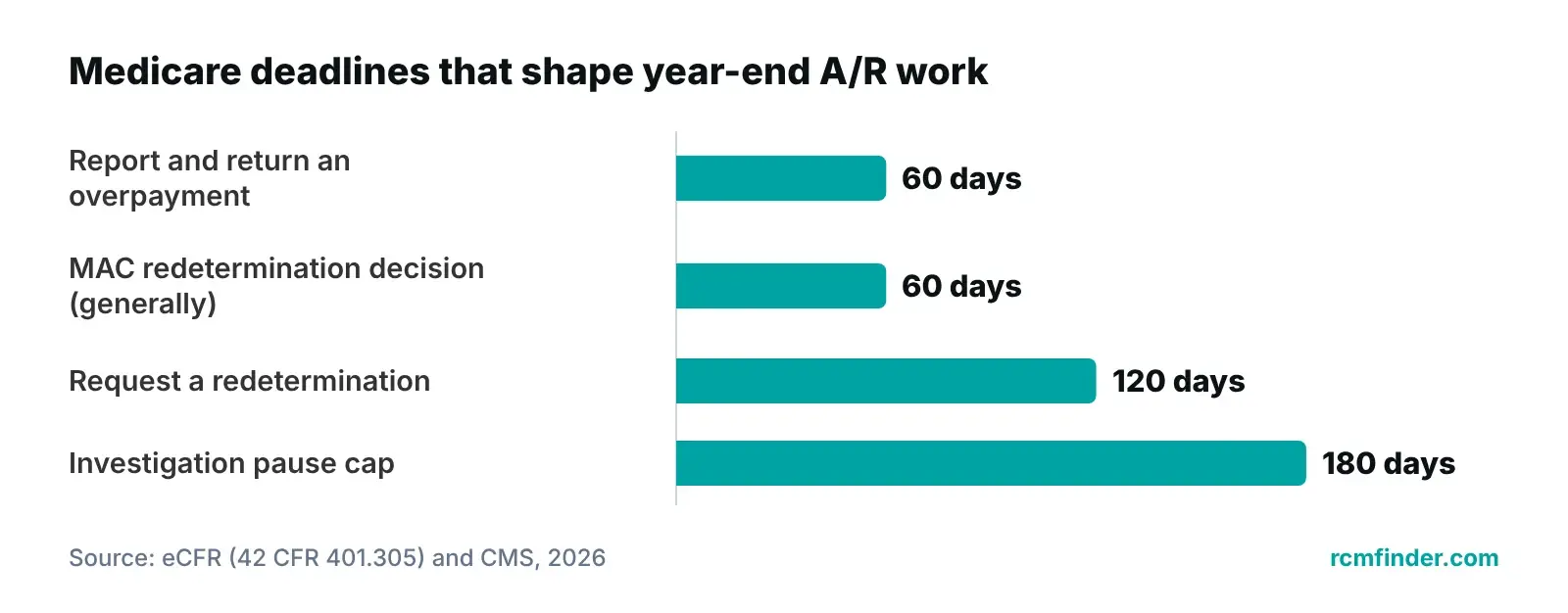
- Medicare overpayments are due back 60 days after identification; an investigation can pause that, capped at 180 days.
- Snapshot days in A/R, % over 90 days, denial rate and credit balances on December 31.
What does a year-end A/R cleanup cover?
A year-end A/R cleanup covers every balance still open on your aged trial balance: insurance claims, patient balances, credit balances and payments never applied. The goal is to collect what is still collectible, close what is not under a written policy, and start January with numbers you trust.
Monthly A/R work chases the newest or largest claims. A year-end sweep looks at the whole ledger, which is when old denials, stray credits and unposted deposits show up.
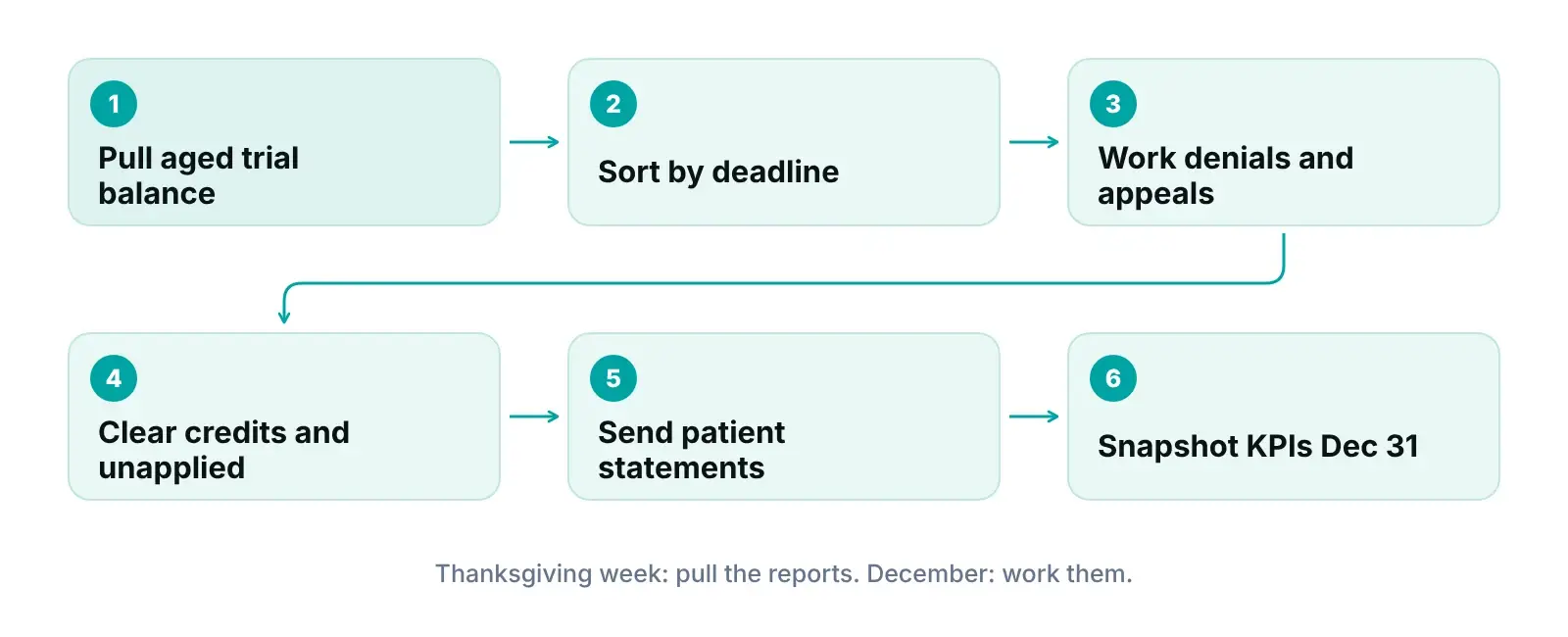
The checklist at a glance
- Pull reports in Thanksgiving week.
- Work the aging buckets by payer and deadline.
- Check timely filing on unbilled and rejected claims.
- Clear open denials before appeal windows close.
- Resolve credit balances and report overpayments.
- Post unapplied payments and reconcile deposits.
- Apply your written write-off policy.
- Send patient statements before deductibles reset.
- Snapshot your KPIs on December 31.
How should you work the aging buckets: by age, payer or deadline?
Sort by deadline first, then by dollar value, then by age. An aging report groups claims by days since the date of service, but two claims in the same bucket can face very different deadlines depending on the payer.
Run the aged trial balance by payer, with each claim’s date of service, last action and denial reason. HFMA‘s MAP Keys (2023 edition) age physician accounts from the date of service in five buckets: 0–30, 31–60, 61–90, 91–120 and over 120 days, the same ranges MGMA uses. HFMA leaves credit balances and unbilled accounts out of the buckets, so pull those as separate lists.
| Aging bucket | What usually sits here | December action | Watch for |
|---|---|---|---|
| 0–30 days | New claims awaiting payment | Confirm acceptance; fix rejections the same week | Rejected claims that were never accepted |
| 31–60 days | Claims past normal payer turnaround | Check claim status; answer records requests | Requests for information left unanswered |
| 61–90 days | Stalled or denied claims | Work denials by reason; send corrected claims | Appeal windows already running |
| 91–120 days | Claims at risk | Rank by deadline and value; escalate | Medicare’s 120-day redetermination window |
| Over 120 days | Old A/R, often from earlier years | Appeal, rebill, transfer or adjust under policy | Medicare’s 1-calendar-year filing limit |
| Credit balances (outside the buckets) | Patient prepayments, duplicate or excess payments | Research the cause, then refund or apply | Medicare’s 60-day report-and-return rule |
Sources: aging buckets from HFMA MAP Keys, 2023 edition (AR-1) and MGMA Data Definitions (2025); deadlines from 42 CFR 424.44 and 42 CFR 401.305 (eCFR, October 2026) and CMS’s redetermination page (modified March 2026). Other cells describe common operating patterns, not statistics.
Give each claim past 120 days one decision: appeal, correct and resubmit, transfer to patient responsibility where the remittance supports it, or adjust under your written policy. Our A/R recovery tips for small practices cover habits that keep this bucket small all year.
Which timely filing deadlines close in December?
Medicare claims must be filed within 1 calendar year after the date of service, so unbilled or rejected claims for December 2025 services reach their limit during December 2026. Medicaid and commercial limits differ, so check each payer.
Under 42 CFR 424.44 (eCFR, October 2026), a Medicare claim must be filed no later than the close of the period ending 1 calendar year after the date of service. Exceptions are narrow: an error by Medicare or its contractor, retroactive entitlement or certain retroactive Medicare Advantage disenrollments. A last day on a federal nonworkday moves to the next workday.
Medicaid works differently. Under 42 CFR 447.45, each state Medicaid agency must require claims no later than 12 months from the date of service; your state manual sets the details. For Medicare Advantage, commercial and workers’ compensation payers, check each contract or provider manual. Our state guide to medical billing time limits is a starting point; your contract is the final word.
Rejected is not the same as filed
A claim rejected by the clearinghouse or payer may never have been accepted. Until you see an acceptance or a remittance, treat its filing deadline as still running.
| Item | Rule | December check | Source |
|---|---|---|---|
| Medicare Part A/B claim filing | 1 calendar year after the date of service; narrow exceptions | List unbilled and rejected claims for December 2025 services | 42 CFR 424.44 |
| Medicaid claim submission | No later than 12 months from the date of service | Check the state manual for its own limit | 42 CFR 447.45(d) |
| Medicare Advantage, commercial, workers’ comp | Set by contract, provider manual and state law | Load each payer’s limit into the work queue | Your payer contracts |
| Medicare redetermination | 120 days from receipt of the initial determination (presumed 5 days after the notice date) | Sort open Medicare denials by notice date | CMS redetermination page |
| Medicare overpayment (Parts A/B) | 60 days after identification; investigation pause capped at 180 days after identification; 6-year lookback | Log the date each credit is confirmed as an overpayment | 42 CFR 401.305 |
Sources: eCFR, 42 CFR 424.44, 447.45 and 401.305 (current as of October 2026); CMS, First Level of Appeal: Redetermination by a Medicare Contractor (modified March 10, 2026).
How do you clear open denials before appeal windows close?
List every open denial with its notice date and the payer’s appeal window, then work the ones closest to expiring. For Medicare Part A and B, a redetermination request is due 120 days after you receive the initial determination.
CMS presumes the notice is received 5 calendar days after its date. No minimum dollar amount applies, and the contractor generally decides within 60 days of the request. Example: an initial determination dated August 28, 2026 is presumed received September 2, so the window closes December 31, 2026; one dated August 1 closes December 4. Most Medicare denials dated in August expire in December.
Commercial appeal windows come from the plan and your contract. As you work, group denials by reason; one reason across many claims usually points to a front-end fix, not another appeal. Our denial management guide covers the appeal workflow.
Not sure what is hiding in your aging report?
Our free practice audit reviews a sample of your claims, open denials, remittances and A/R aging, and shows which items to work first.
Get a Free Practice AuditWhat should you do with credit balances and overpayments?
Research every credit balance before year end. If it turns out to be a Medicare overpayment, federal rules require you to report and return it within 60 days after you identify it, with a pause allowed for a timely, good-faith investigation.
The CY 2025 Physician Fee Schedule final rule (published December 9, 2024; effective January 1, 2025) amended 42 CFR 401.305. You now identify an overpayment when you knowingly receive or retain it, with “knowingly” taken from the False Claims Act: actual knowledge, deliberate ignorance or reckless disregard. This replaced the “reasonable diligence” standard of the 2016 overpayment rule, which had no pause for investigations; the 180-day pause is new.
- Deadline: 60 days after identification, or the cost report due date if that is later and one applies.
- Investigation pause: a timely, good-faith investigation into related overpayments suspends the deadline until it concludes, but no later than 180 days after the first overpayment was identified.
- Lookback: overpayments identified within 6 years of receipt.
- How to report: your Medicare contractor’s claim adjustment, credit balance, self-refund or other stated process.
- Risk: an overpayment kept past the deadline is a False Claims Act obligation.
Not every credit is an overpayment. Many come from a patient paying before the claim adjudicates, a misposted payment or a duplicate. Find the cause, refund or move the money, and log the date research confirmed any overpayment. For payer take-backs, see our guide to recoupment in medical billing.
Commercial and patient credits follow other rules
42 CFR 401.305 covers Medicare Parts A and B. The statute behind it also reaches Medicaid overpayments, so return those through your state Medicaid agency’s process. Commercial refunds and offsets follow your contracts and state law. If a patient refund cannot be delivered, ask your accountant how your state treats unclaimed funds.
How do you clean up unapplied payments?
Post or resolve every payment sitting in an unapplied or suspense account, and match each deposit to its remittance. Unapplied cash makes balances look larger than they are and can lead to statements for amounts a patient already paid.
- Run the unapplied cash report and sort it by age and amount.
- Match each ERA and paper EOB to a bank deposit; flag deposits with no remittance and remittances with no deposit.
- Post patient payments to the visit they were meant for, unless your policy says otherwise.
- Resolve take-backs and offsets so each claim shows what the payer kept.
HFMA’s credit-balance measure (MAP Key AR-9) leaves undistributed cash clearing accounts out, so track unapplied cash on its own list with an owner. Then rerun the aged trial balance; the picture can shift once cash is posted.
How should you set a small-balance and write-off policy?
Put your write-off rules in writing before you use them, apply them the same way to every account, and label each adjustment by reason. Year-end write-offs without a policy hide real problems and can create compliance risk.
Keep these adjustment types separate so each one tells you something:
- Contractual adjustments: your charge minus the allowed amount.
- Denial write-offs: denied amounts you will not appeal (HFMA’s AR-6 tracks them).
- Small-balance adjustments: amounts under your policy’s threshold, after the required statements.
- Financial hardship: decided patient by patient, with documentation.
- Bad debt: balances closed or sent to collections after your collection steps.
Be careful with patient cost-sharing. The HHS Office of Inspector General warns that routinely waiving Medicare copayments could implicate the Anti-Kickback Statute, and that practices may not advertise copayment forgiveness. Waiving is acceptable after an individual determination that the patient cannot afford to pay, or after reasonable collection efforts fail. A December “clean slate” for every small patient balance is a question for your compliance advisor, not a cleanup step.
“A cleanup that ends with the same habits in January is a fire drill. We would rather find the step that keeps refilling the over-90 bucket and fix that.”
— Awais Afzal, Healthcare Operations & Data Analyst
Why send patient statements before deductibles reset?
Send final statements in early December, before new deductibles begin. In our view, this year’s balance is easier to settle before new-year costs arrive.
For Medicare, 42 CFR 410.160 allows only one Part B annual deductible per calendar year, and CMS set it at $283 for 2026, up from $257 in 2025. On the commercial side, KFF‘s 2025 Employer Health Benefits Survey found that 88% of workers with single coverage had a general annual deductible, averaging $1,886 across all firms and $2,631 at small firms (10 to 199 workers). Plan years vary, so check when each patient’s plan resets.
- Send final statements in the first half of December, with a clear due date and payment options.
- Offer a plan for larger balances; see our guide to setting up patient payment plans.
- Call patients with larger balances; our post on improving patient collections has more tactics.
- Re-verify coverage for January appointments, since plans and deductibles change.
Which A/R KPIs should you snapshot on December 31?
Snapshot days in A/R, the share of A/R over 90 days, the denial rate, denial write-offs, credit balances and the net collection rate. Write down which published definition each number uses, so next December compares like with like.
| KPI | Standard formula | Source | Why snapshot it |
|---|---|---|---|
| Days in A/R | Total A/R ÷ (adjusted FFS charges × 1/365) | MGMA Data Definitions | Baseline speed of collection |
| Net days in A/R | Net A/R ÷ average daily NPSR (last 3 months) | HFMA MAP Keys, FM-1 | Same idea on a net revenue basis |
| % of A/R over 90 days | Billed A/R aged 91–120 and over 120 days ÷ total billed A/R | HFMA MAP Keys, AR-1 (two buckets added) | Shows how much A/R is at risk |
| Remittance denial rate | Actionable claims denied ÷ claims remitted | HFMA MAP Keys, AR-5 | Tracks front-end and coding problems |
| Denial write-offs | Monthly net denial write-offs ÷ average monthly NPSR | HFMA MAP Keys, AR-6 | Shows money lost, not just delayed |
| Net days in credit balance | Credit balance dollars (absolute value) ÷ average daily NPSR | HFMA MAP Keys, AR-9 | Flags refund and overpayment backlog |
| Net collection rate | Net FFS revenue × 100 ÷ adjusted FFS charges | MGMA Data Definitions | Share of collectible charges collected |
Sources: HFMA MAP Keys, 2023 edition; MGMA Data Definitions (DataDive glossary, 2025). FFS = fee-for-service; NPSR = net patient service revenue. HFMA’s AR-1 reports each bucket separately; the over-90 share adds two of them. Neither source sets a universal target.
Take the snapshot twice: December 1, before the cleanup, and December 31, after it. The difference shows what the cleanup moved; January shows whether it lasts. Our guide to revenue cycle KPIs and essential A/R report metrics cover days in A/R, denial rate and net collection rate in more depth.
Estimate what denials cost you
Enter your monthly claim volume, average claim value and denial rate to estimate monthly revenue leakage before you set next year's goals.
Open the Revenue CalculatorOur recommendations
- Build the lists before December. We pull the aged trial balance, open denials, credit balances and unapplied cash in Thanksgiving week, so December goes to working accounts.
- Work deadlines before dollars. We sort open claims by the nearest filing or appeal date, then by value. A small claim expiring this week beats a larger one with months left.
- Log the date a credit becomes an overpayment. The 60-day clock runs from identification. We record when research confirms an overpayment and who owns the refund.
- Write the policy before the write-off. Adjustments made under deadline pressure tend to skip reason codes. We prefer a short written policy with thresholds, approvals and reason codes, reviewed by your compliance advisor.
- Freeze the snapshot with its definitions. We save the December 31 numbers with the formula and source beside each one, so next year compares like with like.
- Turn the top causes into January fixes. Every cleanup shows a few repeat causes. We give each one an owner and an upstream fix, so the over-90 bucket does not refill by spring.
Bottom line
A year-end A/R cleanup is a checklist, not a heroic effort: pull the reports, work by deadline, settle credits, apply your policy and freeze the numbers. If you want a team to run it with you, or keep A/R clean all year, see our end-to-end revenue cycle management services or start with a free practice audit.
Frequently asked questions
When should a medical practice start its year-end A/R cleanup?
Pull the reports in Thanksgiving week and work them through December. Working from December 1 leaves time to file Medicare claims for most December 2025 services before their one-year limit and to appeal most Medicare denials dated in August, whose 120-day redetermination window closes in December. Take a KPI snapshot before you start and another on December 31.
Can we still bill Medicare for a service from last December?
Possibly, if the filing period has not closed. Under 42 CFR 424.44, a Medicare claim must be filed within 1 calendar year after the date of service, so a December 10, 2025 service must be filed by December 10, 2026. Exceptions are narrow, such as an error by Medicare or its contractor or retroactive entitlement. File as soon as you find the claim.
Is every credit balance an overpayment?
No. A credit can come from a patient prepayment, a posting error or a payment that belongs on another account. Research the cause first. If it turns out to be a Medicare overpayment, 42 CFR 401.305 requires you to report and return it within 60 days after you identify it, with a pause of up to 180 days from identification for a timely, good-faith investigation of related overpayments.
Can we write off small patient balances at the end of the year?
You can adjust small balances under a written policy applied consistently, after the statements the policy requires. Be careful with Medicare patients: the HHS Office of Inspector General warns that routinely waiving copayments could implicate the Anti-Kickback Statute. Waivers are acceptable after an individual finding that the patient cannot afford to pay, or after reasonable collection efforts fail. Have your compliance advisor review the policy.
Which A/R numbers should we report to the owners for the year?
Report days in A/R, the share of A/R over 90 days, the remittance denial rate, denial write-offs, net days in credit balance and the net collection rate. State which definition each figure uses, HFMA MAP Keys or MGMA, and compare with your own prior months rather than a generic target. Our KPI guide covers days in A/R, denial rate and net collection rate in more depth.
What should we do with claims older than 120 days?
Give each claim one decision: appeal, correct and resubmit, transfer to patient responsibility where the remittance supports it, or adjust under your written policy. Check the filing and appeal deadline first, because some old claims can no longer be billed. Record the reason for every adjustment so next year’s cleanup shows which causes keep sending claims past 120 days.
Get your free practice audit
Tell us about your practice. A member of our operations team replies within one business day.
- A review of your recent claims, denials and A/R aging
- Where your front desk and prior authorizations slow payment
- A prioritized fix list you keep, whether or not you hire us
Pricing is quoted after the audit, based on your volume and the services you choose. Prefer to talk? Call +1 (302) 556-2288.
Sources
- 42 CFR 424.44 — Time limits for filing claims — eCFR (National Archives) (2026)
- 42 CFR 447.45 — Timely claims payment — eCFR (National Archives) (2026)
- 42 CFR 401.305 — Requirements for reporting and returning of overpayments — eCFR (National Archives) (2026)
- Medicare and Medicaid Programs; CY 2025 Payment Policies Under the Physician Fee Schedule and Other Changes to Part B Payment and Coverage Policies (final rule) — Federal Register (2024)
- Medicare Program; Reporting and Returning of Overpayments (final rule) — Federal Register (2016)
- 31 U.S.C. 3729 — False claims — GovInfo (U.S. Government Publishing Office) (2023)
- First Level of Appeal: Redetermination by a Medicare Contractor — CMS (2026)
- MAP Keys, 2023 Edition — HFMA (2023)
- MGMA Data Definitions (DataDive glossary) — MGMA (2025)
- 42 CFR 410.160 — Part B annual deductible — eCFR (National Archives) (2026)
- 2026 Medicare Parts A & B premiums and deductibles (fact sheet) — CMS (2025)
- 2025 Employer Health Benefits Survey — KFF (2025)
- Fraud & Abuse Laws (A Roadmap for New Physicians) — HHS Office of Inspector General (2021)
Disclaimer: This article is general educational information about revenue cycle operations. It is not legal, coding, billing-compliance, accounting or financial advice. Filing limits, appeal windows, overpayment duties and write-off rules vary by payer, plan, contract and state and change over time. Confirm requirements with the payer, your contracts and qualified advisors before acting.