
Ophthalmology Specialty

Ophthalmology Billing Services: How to Choose an Ophthalmology Billing Company

Cataract co-management, intravitreal drug claims, OCT limits and Medicare Advantage step therapy, handled with front-desk staff, patient marketing and a claims portal built on CMS and MAC rules.
  • Works inside your current EHR
  • US practice time zone, every shift
  • Weekly KPI reporting, or on your schedule
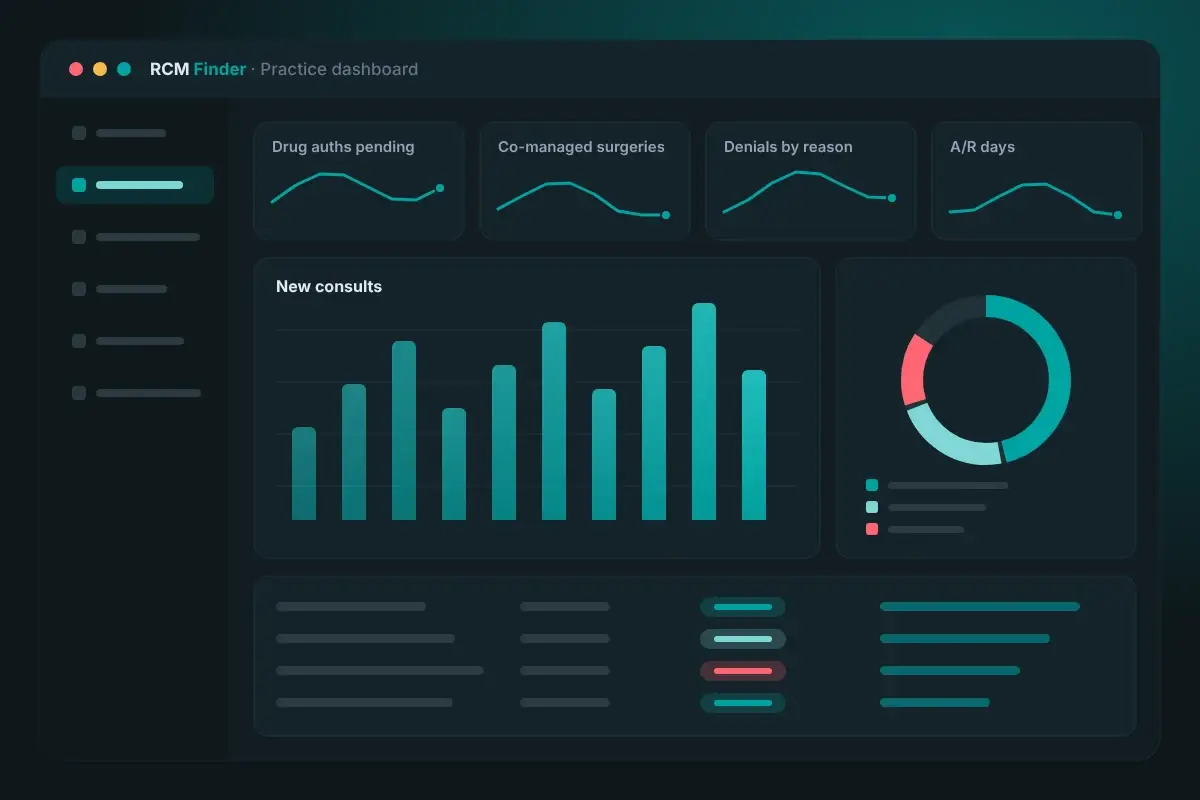
Ophthalmology billing dashboard with drug authorizations, co-managed surgeries, denials by reason, A/R days and consults

Quick answer

Ophthalmology billing services manage the claims an eye practice creates: eye exam and E/M visits, cataract surgery with co-management modifiers 54 and 55, intravitreal drug claims with correct units and JW or JZ, OCT frequency limits and Medicare Advantage step therapy. RCM Finder pairs that billing with front-desk assistants, patient marketing and a claims portal.

Disclaimer: This page is educational and is not legal, coding or compliance advice. Medicare LCDs, billing articles, fee schedule rules, drug payment limits and Medicare Advantage and commercial plan policies change often and vary by contractor and plan. Verify every code, limit and rule against your MAC's current documents, your payer contracts and the current CPT and HCPCS code sets before billing.

Why ophthalmology billing needs a specialist billing company

Ophthalmology billing needs a specialist because one eye practice runs several billing models at once: routine vision visits, medical eye exams, 90-day cataract surgery packages and injected drugs billed by the milligram. Each has its own rules, and imaging limits change by Medicare Administrative Contractor (MAC).

What a full-service ophthalmology billing company should cover

  • Registration and benefits: medical, vision and Medicare Advantage coverage identified before the visit.
  • Prior authorization: drugs, surgery and oculoplastic cases cleared before the date of service.
  • Coding and claims: eye codes or E/M, global-period modifiers, drug units and laterality.
  • A/R and denials: payments checked against fee schedules and drug limits; denials appealed.

What changed for 2025 and 2026

CMS's CY 2025 fee schedule fact sheet extended modifier 54 to every 90-day global surgery where the surgeon expects to provide only the operation, even when the transfer is informal. For 2026, the CY 2026 final rule fact sheet (October 31, 2025) sets the conversion factor at $33.40 for clinicians who are not qualifying APM participants, up from $32.35. It also applies a -2.5% efficiency adjustment to work RVUs of services that are not time-based; E/M visits are exempt.

The four pillars, built for an ophthalmology practice

Revenue in an eye practice leaks at the handoffs: a retina patient switches plans, a co-management letter never reaches the chart, a drug line goes out without JZ. We run all four pillars against one set of payer rules.

Pillar 1 · Healthcare Marketing

Healthcare Marketing for ophthalmology practices

Our healthcare digital marketing builds demand for cataract, glaucoma and retina care through local SEO, Google Ads and reputation work.

  • Location pages and a Google Business Profile per office
  • Patient pages for each condition you treat
  • Optometrist referral path, with no post-op promises
  • KPI: booked consults by source
Explore Healthcare Marketing
Pillar 2 · Virtual Medical Assistants

Virtual Medical Assistants for eye care front desks

Our virtual medical assistants for eye practices work on your practice's time zone. They sort medical and vision coverage, start drug and surgery authorizations, and check step therapy history and scan dates.

  • Coverage sorted at scheduling
  • Authorizations tracked to a decision
  • Last dose and last OCT date per eye
  • KPI: injections and surgeries cleared in advance
Explore Virtual Medical Assistants
Pillar 3 · End-to-End RCM

End-to-End RCM for ophthalmology claims

Our end-to-end ophthalmology revenue cycle management covers coding support, claim scrubbing, denial management and A/R follow-up, with added checks for 54 and 55, RT and LT, drug units and JW or JZ.

  • Drug units matched to the dose given
  • Co-management dates matched to the transfer letter
  • Appeals built from notes, scans and op reports
  • KPI: denials by reason and A/R days
Explore End-to-End RCM
Pillar 4 · Practice Management System

Practice Management System for eye care billing

Our practice management system tracks every claim by stage, applies specialty-aware billing logic per claim, checks data completeness before submission and flags payments below the expected amount.

  • Claims tracked by stage
  • Underpayment flags, including drug lines
  • Rules that hold claims missing a modifier or date
  • Early access: appointment booking with a calendar view
Explore Practice Management System

Find where your eye care claims leak

We review recent visit, surgery and injection claims, denials and authorization logs, then show what to fix first. Pricing is quoted after the audit.

Get a Free Practice Audit

Ophthalmology service lines: codes, rules and denial triggers

Each service line has its own coding, frequency or documentation rule. Codes are in our own words (the AMA owns CPT descriptors); check the current code set and your MAC's article.

Ophthalmology service lines: code examples, billing rules and common denial triggers
Service lineCode examples (our wording)Billing rule to checkCommon denial or leak
Office visits92002, 92012 (intermediate); 92004, 92014 (comprehensive); or E/M such as 99204Comprehensive visit: all 12 exam elements plus a plan (AAO)Elements missing; payer frequency edits on eye codes
Refraction92015 (glasses or contact lens prescription test)Excluded by Medicare; GY modifier; ABN optional (GX)Fee not collected because the patient was not told
Cataract surgery66984 (lens removal with implant); 66982 (complex)90-day global; 66982 needs a non-routine device or technique in the op note (CGS)Complex code without the device documented
Co-managed post-op careSurgery code with 54 (surgeon) or 55 (post-op provider)Written transfer and consent; surgery date as date of service; care dates in Item 1955 billed before a post-op visit; 54 missing when a transfer was expected
Intravitreal injection67028 plus drug: J0178 (aflibercept, 1 mg), J2778 (ranibizumab, 0.1 mg), J2777 (faricimab, 0.1 mg)Units match the dose; RT or LT on each drug line if eyes get different drugs; JZ, or a JW lineMissing JW or JZ; overfill billed
OCT imaging92133 (optic nerve); 92134 (retina)WPS: glaucoma 1 or 2 tests a year; retina 1 per eye every 2 months, monthly during injectionsScans over the limit; both codes reported together
Oculoplastics in a hospital outpatient department15820 to 15823, 67900 to 67904, 67906, 67908; 64612, 64615 with J0585 to J0588Medicare prior authorization since July 1, 2020; ASC and office cases excludedNo approval, so hospital and physician claims deny

Sources: AAO; CMS manuals, MLN907166 (2025), JW/JZ FAQ and OPD program; First Coast; Palmetto GBA; Noridian; MCD A56453, A53387, A56916, L34760 (checked October 2026); AAPC. Rules vary by MAC and payer.

Eye codes or E/M: choose by documentation and payer

Office visits can be reported with eye codes (920xx) or E/M codes. The AAO fact sheet says a comprehensive eye visit needs all 12 exam elements and a started or continued plan; an intermediate visit needs at least three. An AAO coding article notes that some commercial payers apply frequency edits to eye codes but not E/M. We set the rule per payer.

Vision plan or medical insurance: the reason for the visit decides

Medicare does not cover routine eye exams for glasses, and the Benefit Policy Manual excludes refractions by any practitioner. The exclusion does not reach physician services for eye disease, such as glaucoma or cataracts. First Coast says the GY modifier marks a statutorily excluded service and no ABN is needed. Medicare covers one pair of glasses after cataract surgery with an implanted lens and glaucoma tests once every 12 months for high-risk patients. See our ABN billing guide.

OCT imaging: frequency limits set by your MAC

Under WPS LCD L34760 (revision effective June 26, 2025; Part B in Indiana, Michigan, Iowa, Kansas, Missouri and Nebraska), glaucoma usually needs one or two OCT tests a year. Retinal disease allows at most one exam per eye every two months, or one per eye each month during active injections. CGS article A56692 uses similar limits. The AAO advises against reporting 92133 and 92134 together. Other MACs may differ.

Cataract surgery: the 90-day global period and co-management

Cataract surgery is paid as a 90-day global package. When another doctor takes over post-op care, the surgeon bills modifier 54 and the post-op provider bills 55, backed by a written transfer.

CMS's global surgery booklet (December 2025) says the package covers the day before surgery, the day of surgery and 90 days after. Modifier 57 marks the decision-for-surgery visit and 24 an unrelated post-op visit. For another procedure inside an open global period, CMS defines 58 (staged), 78 (unplanned return to the operating room) and 79 (unrelated).

Both co-managing doctors bill the same code and the surgery date. The transfer must be documented, and the new doctor must see the patient before billing. Palmetto GBA, a Medicare contractor, values cataract post-op care at 20% of the package and asks for the patient's written consent and care dates in Item 19. It says co-management should not be routine and bans quid pro quo arrangements.
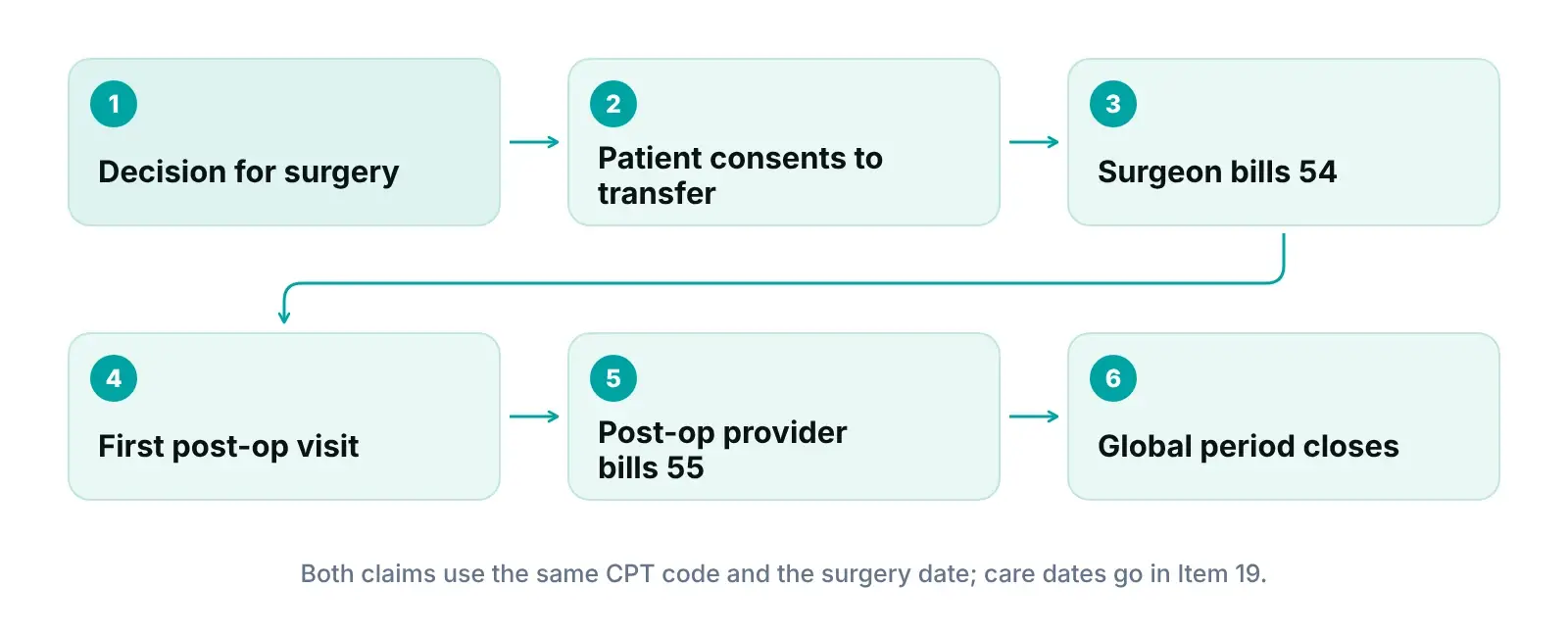
Cataract co-management billing flow from decision for surgery to modifier 54 and 55 claims and the end of the global period
How a co-managed cataract surgery becomes two claims on the same code and date.

Under CGS article A56453, complex cataract surgery (66982) needs a device or technique not used in routine surgery, such as iris hooks or a capsular support ring, named in the op note. With a premium lens, Palmetto says the patient pays for added refractive testing and the lens cost difference. See our cataract surgery CPT codes guide and our guide to getting paid for co-managed post-op care.

Intravitreal injections: drug codes, discard modifiers and prior authorization

Each intravitreal injection is billed as two lines: the injection (67028) and the drug, in units that match the dose. Commercial, Medicare Advantage and Medicaid plans may require prior authorization for anti-VEGF drugs, and some add step therapy.

Palmetto article A53387 (effective July 1, 2026) lists J0178, J0177 and biosimilar Q-codes for aflibercept. When each eye gets a different drug, RT or LT goes on the drug line. Coding for intravitreal bevacizumab depends on the MAC; in 2022 the AAO reported that Novitas said J9035 should not be used. See our J-codes billing guide.

For a single-dose container, CMS's JW and JZ FAQ requires a JW line for any discarded amount and, since July 1, 2023, JZ when nothing is discarded. Under 42 CFR 414.904, Part B generally pays these drugs at 106% of average sales price; biosimilars get their own ASP plus 6% (8% if qualifying) of the reference product's. CMS posts new payment limits each quarter, so we check drug payments against the current file.

Step therapy and deadlines in Medicare Advantage

Under a policy in a 2018 CMS fact sheet, Medicare Advantage plans may apply step therapy to Part B drugs from January 1, 2019. Under 42 CFR 422.136, it applies only to new administrations, with a lookback of at least 365 days. The AAO notes a plan may require bevacizumab (Avastin) before aflibercept (Eylea) or ranibizumab (Lucentis), and it opposes the practice.

Plans must decide standard Part B drug requests within 72 hours and expedited ones within 24 hours, with no extensions, under 42 CFR 422.568 and 422.572. From January 1, 2026, other services under prior authorization get seven calendar days, and the CMS-0057-F rule requires a specific denial reason, though it excludes drugs. A 2023 CMS fact sheet adds a transition of at least 90 days for patients mid-treatment who switch plans.
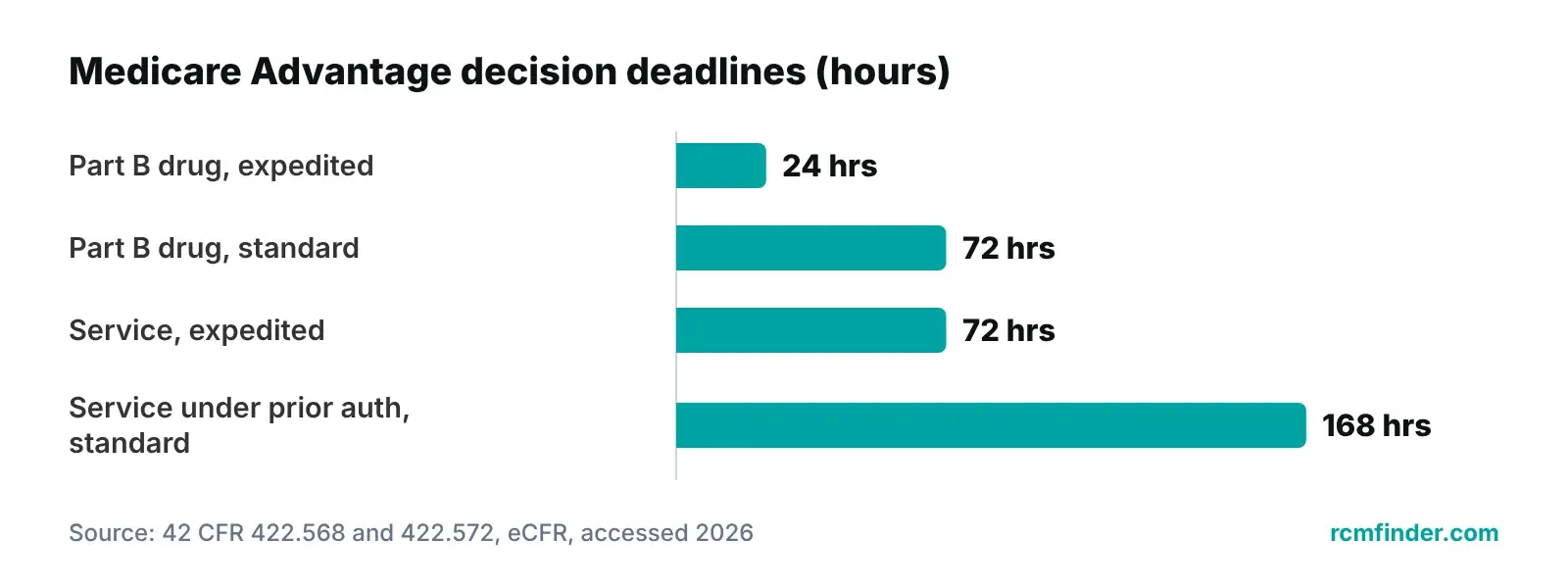
Bar chart of Medicare Advantage prior authorization decision deadlines in hours for Part B drugs and other services
Maximum decision times under 42 CFR 422.568 and 422.572. Seven calendar days equals 168 hours. Drug deadlines cannot be extended.

In the AMA’s 2025 survey of 1,000 physicians across specialties, released May 2026, physicians reported 40 prior authorizations and 13 hours of physician and staff time each week.

Under a CMS program, hospital outpatient blepharoplasty and botulinum toxin injections have needed Medicare prior authorization since July 1, 2020 (Noridian lists the codes). Per the CMS FAQ, related physician claims deny without it; ASC and office cases are excluded.

Pre-visit checklist: eye care prior authorization and payer rules our VMAs check before scheduling
RuleSourceWhat the VMA checks
MA step therapy for Part B drugs: new administrations only, 365-day lookback or longer42 CFR 422.136Last drug and dose date per eye
Plan may require a lower-cost drug and a documented failed response firstAAO retina pagePrior drugs and response charted before the request
MA Part B drug decisions: 72 hours standard, 24 hours expedited42 CFR 422.568, 422.572Request time logged; follow-up at the deadline
Other MA services under prior auth: 7 calendar days standard from 2026; specific denial reason42 CFR 422.568; CMS-0057-FSurgery request sent at the decision; denial reason saved
Plan switch: at least 90-day transition for an active course of treatmentCMS-4201-F fact sheet (2023)Plan change asked at each visit
Hospital outpatient blepharoplasty and botulinum toxin need approvalCMS OPD program; NoridianSite of service; approval on file
OCT limits: retina 1 per eye every 2 months, monthly during injectionsWPS LCD L34760 (2025)Last scan date per eye

Sources: eCFR 42 CFR 422.136, 422.568, 422.572 (October 2026); CMS (2023, 2024, 2026); AAO; Noridian; WPS L34760. Check each member's plan.

For the full workflow, read our prior authorization guide and our tips to speed up medication prior authorization.

See what drug and authorization delays cost

Enter your claim volume and denial rate to estimate what your eye practice is losing, then bring the numbers to your audit.

Open the Revenue Calculator

Growing an eye practice within privacy and review rules

Eye practices grow through local search, reviews and referring optometrists, and each channel has rules.

HHS guidance says tracking tools on login or appointment pages can collect protected health information, and a cookie banner is not a HIPAA authorization. A 2024 court order vacated part of it, but we still keep tracking off scheduling forms unless the vendor signs a BAA. The FTC's 2024 rule bans fake reviews and incentives tied to review sentiment.

With optometrists, we build a fast referral path but never promise post-op care in return. For optometry partners, see our guides to optometry billing services and managing an optometry practice.

In-house team, billing-only vendor or four-pillar partner?

Stay in-house if you have experienced eye care coders and front-desk time for authorizations. Use a billing-only vendor if claims are your only gap. Choose a combined partner when problems span scheduling, authorizations, billing and growth. Either way, judge an ophthalmology billing company on its work with your service lines, technology that shows every claim, and fees explained in writing.

Decision table: which billing model fits an ophthalmology practice?
JobIn-house teamBilling-only vendorFour-pillar partner (RCM Finder)
Drug prior authorization and step therapyFront desk, between callsUsually left to the practiceVMA checks history and tracks each request
Drug units, JW or JZ, payment limitsDepends on one billerFixed after the factChecked before submission and after payment
Co-management letters and datesPaper, often missingBills what it receivesVMA collects letters; RCM checks dates
Vision or medical coverageSorted at check-inUsually out of scopeSorted at scheduling
Patient growth and reviewsSeparate agency, or nobodyNot includedMarketing tied to booked consults
ReportingEHR reportsClaim reports onlyPortal and dashboards, consult to paid claim
Cost structureSalaries, benefits, turnoverVaries; ask how fees are setQuoted after a free practice audit

How it works

We start with a free audit and change nothing until you see the findings. We build our billing pipeline around how claims actually move through a practice: registration, charge entry, submission, payment and follow-up. For ophthalmology, we add the checks on this page.

  1. 1

    Free practice audit

    We review recent visit, cataract, injection and imaging claims, denials and authorization logs.

  2. 2

    Business Associate Agreement and access

    We put a Business Associate Agreement in place before accessing patient data. Then we work inside your existing EHR (for example PrognoCIS, eClinicalWorks or athenahealth).

  3. 3

    Payer-rule map

    Your MAC's articles and your plans' drug, surgery and step therapy rules become a pre-visit checklist and portal rules.

  4. 4

    Front desk and billing go live

    VMAs sort coverage, start authorizations and collect transfer letters. Claims are scrubbed, submitted and worked through denials and A/R.

  5. 5

    Weekly KPI review

    We review denials by reason, A/R days, drug underpayments, authorizations cleared in advance and new consults.

Talk to us about your eye practice

Tell us your service lines, your MAC and your hardest payer. We will tell you honestly whether we fit.

Call +1 (302) 556-2288

Compliance: what to ask any ophthalmology billing company

Any billing vendor that handles your patients' data is a HIPAA business associate and needs a Business Associate Agreement before any access. HHS names billing and claims processing as business associate work. The minimum necessary standard limits use to what each task needs, and the Security Rule's technical safeguards require access control, audit controls, integrity, person or entity authentication and transmission security.

Co-management also raises anti-kickback questions. In Advisory Opinion 11-14 (2011), OIG said it would not sanction one ophthalmology group's plan, relying on its certifications: no co-management agreements, transfers only when clinically appropriate and requested by the patient, and disclosure of extra fees. The opinion protects only that group.

  1. Will you and your subcontractors sign a BAA before any access?
  2. Can we see the audit log of who accessed our claims?
  3. What coding credential and eye care experience do your coders have?
  4. How do you handle 54 and 55 dates and transfer letters?
  5. How do you check drug units, JW or JZ and payment limits?
  6. Which MAC articles and plan step therapy policies do you track?

We use role-based access, audit logging and encrypted (HTTPS) connections, and we put a Business Associate Agreement in place before accessing patient data. For your side, use our HIPAA compliance checklist.

Who this is for, and who it is not for

We would rather tell you now than after you sign. Here is where we fit and where we do not.

A good fit if you are

  • Cataract practices that co-manage post-op care with optometrists
  • Retina practices with heavy injection volume and step therapy
  • Eye groups doing oculoplastic cases in hospital outpatient departments
  • Multi-location practices that want front desk, billing and growth in one view
  • Billing companies serving eye practices from one portal

Probably not a fit if you are

  • Hospital-employed ophthalmologists whose billing the hospital controls
  • Practices that want a fixed price before any audit
  • Practices seeking promised collection rates; we report measured KPIs
  • Groups that need a credentialing module or in-portal real-time eligibility today (coming next)

Expert recommendations from our operations team

What we would do first if we were running your practice's revenue cycle tomorrow.

  1. 01

    Sort vision and medical at booking

    We ask why the patient is coming in. A glasses check goes to the vision plan or self-pay; a disease visit goes to medical insurance.

  2. 02

    Treat each new anti-VEGF start as a step therapy check

    We note the last drug and dose date per eye. If the gap passes the plan's lookback, we check its preferred drug first.

  3. 03

    Check every drug line three ways

    Units match the dose, JZ or JW is present, and payment matches the current quarter's limit.

  4. 04

    Keep the co-management file with the claim

    The transfer letter, consent and care dates belong in both charts before the 54 and 55 claims go out.

  5. 05

    Prove complex cataract surgery in the op note

    We bill 66982 only when the note names the device or technique that made the case complex.

  6. 06

    Track OCT by eye and by condition

    Glaucoma and retina limits differ. We keep the last scan date per eye in front of the scheduler.

Frequently asked questions

What do ophthalmology billing services include?

They cover coding support, claim scrubbing, submission, denial management and A/R follow-up for eye exams, E/M visits, cataract and other surgery, intravitreal injections and imaging. A strong service also sorts vision and medical coverage at scheduling, clears drug and surgery authorizations, and checks drug units and co-management dates before claims go out. RCM Finder adds front-desk assistants, patient marketing and a claims portal, so one team owns the work from booking to payment.

How do we choose an ophthalmology billing company?

Ask for experience with your service lines, such as cataract co-management, anti-VEGF drugs and oculoplastics. Ask how they handle JW and JZ modifiers, step therapy and your MAC's OCT limits. Confirm they sign a Business Associate Agreement before any access, show you claims by stage and explain fees in writing. We put a Business Associate Agreement in place before accessing patient data and quote pricing after a free practice audit.

How is co-managed cataract surgery billed under Medicare?

The surgeon bills the surgery code with modifier 54, and the doctor who takes over post-op care bills the same code with modifier 55. Both use the surgery date as the date of service. CMS requires a documented transfer of care, and the post-op provider must see the patient before billing. Palmetto GBA values cataract post-op care at 20% of the global package and asks for the assumed-care date in Item 19.

Do intravitreal drug claims need the JW or JZ modifier?

Yes, for separately payable Part B drugs from single-dose containers. Since July 1, 2023, CMS has required JZ when nothing is discarded, and a discarded amount goes on a separate line with JW. Since October 1, 2023, claims missing these modifiers can be returned as unprocessable. Overfill cannot be billed. The rules do not apply to multiple-dose containers or to drugs packaged into hospital outpatient or ASC payment.

Can Medicare Advantage plans require step therapy for anti-VEGF drugs?

Yes. Since January 1, 2019, Medicare Advantage plans may apply step therapy to Part B drugs, but only to new administrations, with a lookback of at least 365 days. A plan may require a lower-cost drug such as bevacizumab first. Plans must decide standard Part B drug requests within 72 hours and expedited ones within 24 hours, with no extensions. Check the last dose date before every new request.

Does Medicare pay for refractions and routine eye exams?

No. Medicare excludes routine eye exams for glasses or contacts and refractions by any practitioner. It still covers physician services for eye disease, such as glaucoma or cataracts, and one pair of glasses or contacts after cataract surgery with an implanted lens. A refraction can be reported with the GY modifier; an ABN is not required, though a voluntary one uses GX. Tell patients about the fee before the visit.

No cost, no commitment

Get your free practice audit

Tell us about your practice. A member of our operations team replies within one business day.

  • A review of your recent claims, denials and A/R aging
  • Where your front desk and prior authorizations slow payment
  • A prioritized fix list you keep, whether or not you hire us

Pricing is quoted after the audit, based on your volume and the services you choose. Prefer to talk? Call +1 (302) 556-2288.

Tell us about your practice

RCMFinder Master Intake Form
AA

About the author: Awais Afzal

Healthcare Operations & Data Analyst, RCM Finder

Awais has spent more than 16 years in healthcare digital marketing and clinical operations management. He builds data-driven revenue cycle blueprints for high-ticket medical practices and leads product development of the RCM Finder portal. More about our team.

How we write: every figure, code and rule on this page was checked against the primary source listed below and independently fact-checked before publishing. We re-review this page every six months. Last reviewed October 12, 2026; next review April 12, 2027.

Sources

  1. Global Surgery Booklet (MLN907166) — CMS Medicare Learning Network (2025 (December))
  2. Calendar Year (CY) 2025 Medicare Physician Fee Schedule Final Rule fact sheet — CMS (2024 (November 1))
  3. Calendar Year (CY) 2026 Medicare Physician Fee Schedule Final Rule (CMS-1832-F) fact sheet — CMS (2025 (October 31))
  4. JW Modifier and JZ Modifier Policy Frequently Asked Questions — CMS (undated (reflects CY 2026 rules; accessed 2026-10-09))
  5. 42 CFR 422.136 Medicare Advantage (MA) and step therapy for Part B drugs — eCFR (current (accessed 2026-10-09))
  6. 42 CFR 422.568 Standard timeframes and notice requirements for organization determinations — eCFR (current (accessed 2026-10-09))
  7. 42 CFR 422.572 Timeframes and notice requirements for expedited organization determinations — eCFR (current (accessed 2026-10-09))
  8. Medicare Advantage Prior Authorization and Step Therapy for Part B Drugs (fact sheet) — CMS (2018 (August 7))
  9. 2024 Medicare Advantage and Part D Final Rule (CMS-4201-F) fact sheet — CMS (2023 (April 5))
  10. CMS Interoperability and Prior Authorization Final Rule (CMS-0057-F) fact sheet — CMS (2024 (January 17))
  11. Retina: Prior Authorization — American Academy of Ophthalmology (undated (accessed 2026-10-09))
  12. Step Therapy (advocacy) — American Academy of Ophthalmology (undated (accessed 2026-10-09))
  13. Fact Sheet for the Comprehensive Eye Visit Codes — American Academy of Ophthalmology (EyeNet) (undated (URL references April 2020; accessed 2026-10-09))
  14. Savvy Coder: Code This, Not That — American Academy of Ophthalmology (EyeNet) (undated (accessed 2026-10-09))
  15. Novitas confirms J9035 should not be used to bill intravitreal Avastin — American Academy of Ophthalmology (practice management news) (2022 (June 21))
  16. LCD L34760: Scanning Computerized Ophthalmic Diagnostic Imaging (SCODI) — CMS Medicare Coverage Database (WPS, J5/J8) (2025 (revision effective 06/26/2025))
  17. Billing and Coding: Scanning Computerized Ophthalmic Diagnostic Imaging (SCODI) (A56916) — CMS Medicare Coverage Database (WPS) (2026 (revision effective 04/30/2026))
  18. Billing and Coding: Scanning Computerized Ophthalmic Diagnostic Imaging (SCODI) (A56692) — CMS Medicare Coverage Database (CGS, J15) (2026 (revision effective 08/06/2026))
  19. Billing and Coding: Cataract Extraction (A56453) — CMS Medicare Coverage Database (CGS) (2025 (revision effective 10/01/2025))
  20. Billing and Coding: Aflibercept (EYLEA) (A53387) — CMS Medicare Coverage Database (Palmetto GBA) (2026 (R19, revision effective 07/01/2026))
  21. Medicare Coverage of Optometry and Co-management Services (Jurisdiction M Part B) — Palmetto GBA (Medicare contractor) (2021 (published 04/12/2021; accessed 2026-10-09))
  22. OIG Advisory Opinion No. 11-14 — HHS Office of Inspector General (2011 (September 30))
  23. Medicare Benefit Policy Manual, Chapter 16: General Exclusions from Coverage, §90 — CMS (2014 (Rev. 186))
  24. Eye exams (routine) — Medicare.gov (accessed 2026-10-09)
  25. Eyeglasses & contact lenses — Medicare.gov (accessed 2026-10-09)
  26. Glaucoma screenings — Medicare.gov (accessed 2026-10-09)
  27. CMS beneficiary notices — First Coast Service Options (Medicare contractor) (2026 (February 18))
  28. Prior Authorization for Certain Hospital Outpatient Department (OPD) Services — CMS (2026 (page modified 09/25/2026))
  29. OPD Prior Authorization Frequently Asked Questions — CMS (2024 (November 14))
  30. Prior Authorization (JE Part A) — Noridian Healthcare Solutions (Medicare contractor) (2025 (OPD section last updated May 7, 2025))
  31. AMA survey: Prior authorization reform pledge falls short with physicians — American Medical Association (2026 (May 13))
  32. ASP Pricing Files (Medicare Part B Drug Payment Limit Files) — CMS (2026 (October file dated 09/17/2026))
  33. 42 CFR 414.904 Average sales price as the basis for payment — eCFR (current (accessed 2026-10-09))
  34. Business Associates — HHS Office for Civil Rights (2026 (content last reviewed July 30, 2026))
  35. Minimum Necessary Requirement — HHS Office for Civil Rights (2013 (content last reviewed July 26, 2013))
  36. 45 CFR 164.312 Technical safeguards — eCFR (current (accessed 2026-10-09))
  37. Use of Online Tracking Technologies by HIPAA Covered Entities and Business Associates — HHS Office for Civil Rights (2024 (last reviewed June 26, 2024))
  38. Federal Trade Commission announces final rule banning fake reviews and testimonials — Federal Trade Commission (2024 (August 14))
  39. CPT 66984 code summary — AAPC (secondary; plain-language code meaning only) (accessed 2026-10-09)
  40. CPT 92015 code summary — AAPC (secondary; plain-language code meaning only) (accessed 2026-10-09)
  41. HCPCS J2778 code summary — AAPC (secondary; plain-language code meaning only) (accessed 2026-10-09)
  42. HCPCS J2777 code summary — AAPC (secondary; plain-language code meaning only) (accessed 2026-10-09)