
Cataract surgery CPT codes center on 66984 for standard extracapsular removal with a lens implant and 66982 for complex cases that need special devices or techniques, or involve a child. Codes 66987 and 66988 add endoscopic cyclophotocoagulation. Each carries a 90-day global period, so documentation and modifiers decide payment.
Cataract surgery is one of the most common procedures an ophthalmology practice bills, so small coding errors repeat quickly. The code family itself is short. Most problems come from three places: choosing between standard and complex, thin pre-operative documentation, and modifiers during the 90-day global period.
This guide explains each in plain terms for practice owners, billers and managers. It is written for the awareness stage: you will leave knowing what the codes mean, what a payer looks for and where to look next. It is general education, not coding advice. Always confirm descriptors in the current AMA CPT code book and requirements in your payer’s policy.
Key takeaways
- 66984 is the standard cataract code; 66982 is for complex cases defined by devices, techniques or a pediatric patient, not by how hard the surgery felt.
- 66987 and 66988 are the versions that include endoscopic cyclophotocoagulation; they are not interchangeable with 66982 and 66984.
- Medicare coverage rules come from each Medicare Administrative Contractor (MAC), so check your own contractor’s current policy before relying on any threshold.
- Surgical complications are part of the global package unless the patient returns to the operating or procedure room.
- Medicare does not cover the presbyopia-correcting function of a premium lens, so billing the patient for the difference must follow CMS rules.
What are the main cataract surgery CPT codes?
The main cataract surgery CPT codes are 66984, 66982, 66987 and 66988, with 66983, 66985 and 66986 for less common situations. The table below puts each in plain words. Descriptions are paraphrased from the American Academy of Ophthalmology (AAO) and a cross-check against a coding reference, because the exact wording belongs to the AMA.
| CPT code | Plain-words meaning | Use it when | Billing note |
|---|---|---|---|
| 66984 | Standard extracapsular cataract removal with lens implant, manual or mechanical technique | Routine cataract surgery with a lens implant | The default code; the base wording that 66982 builds on |
| 66982 | Same service, but complex: needs devices or techniques not generally used in routine surgery, or the patient is in the amblyogenic developmental stage | A qualifying device or technique was used and documented, or the patient is a young child | Complexity must be in the operative note |
| 66983 | One-stage intracapsular removal with lens implant | The lens is removed whole, which is uncommon today | Confirm the descriptor in the AMA code book |
| 66987 | Complex extracapsular removal with lens implant, including endoscopic cyclophotocoagulation | A 66982-type case where cyclophotocoagulation is performed at the same session | Do not add a separate cyclophotocoagulation code |
| 66988 | Standard extracapsular removal with lens implant, including endoscopic cyclophotocoagulation | A 66984-type case where cyclophotocoagulation is performed at the same session | AAO notes 66984, 66988 and 66711 are bundled, so bill one |
| 66985, 66986 | Lens-implant codes for situations other than a primary implant at the time of cataract removal | Secondary lens placement or lens exchange | Confirm descriptors in the AMA code book |
Source: AAO EyeNet and AAO coding pages (2022); EyeWorld (2007); Coding Ahead reference for 66983, 66987, 66988 descriptors. Descriptors paraphrased; confirm wording in AMA CPT.
A second group of codes covers other ways of removing lens material or dealing with the lens. A Palmetto GBA billing article (effective April 2023) lists 66830, 66840, 66850, 66852, 66920 and 66940 alongside the main family. These are not routine cataract-with-implant codes, so a practice that bills them often should pull the descriptors straight from the current CPT code book. For a refresher on how code sets differ, see how HCPCS and CPT codes differ.
One code per session
AAO’s 2022 coding column gives an example where 66984, 66988 and 66711 are bundled with one another, so only one is reported. Pick the code that describes everything that was done, then check your payer’s edit tables. Practices that want code-level help can read about ophthalmology billing and revenue cycle support.
How do you choose between 66984 and 66982?
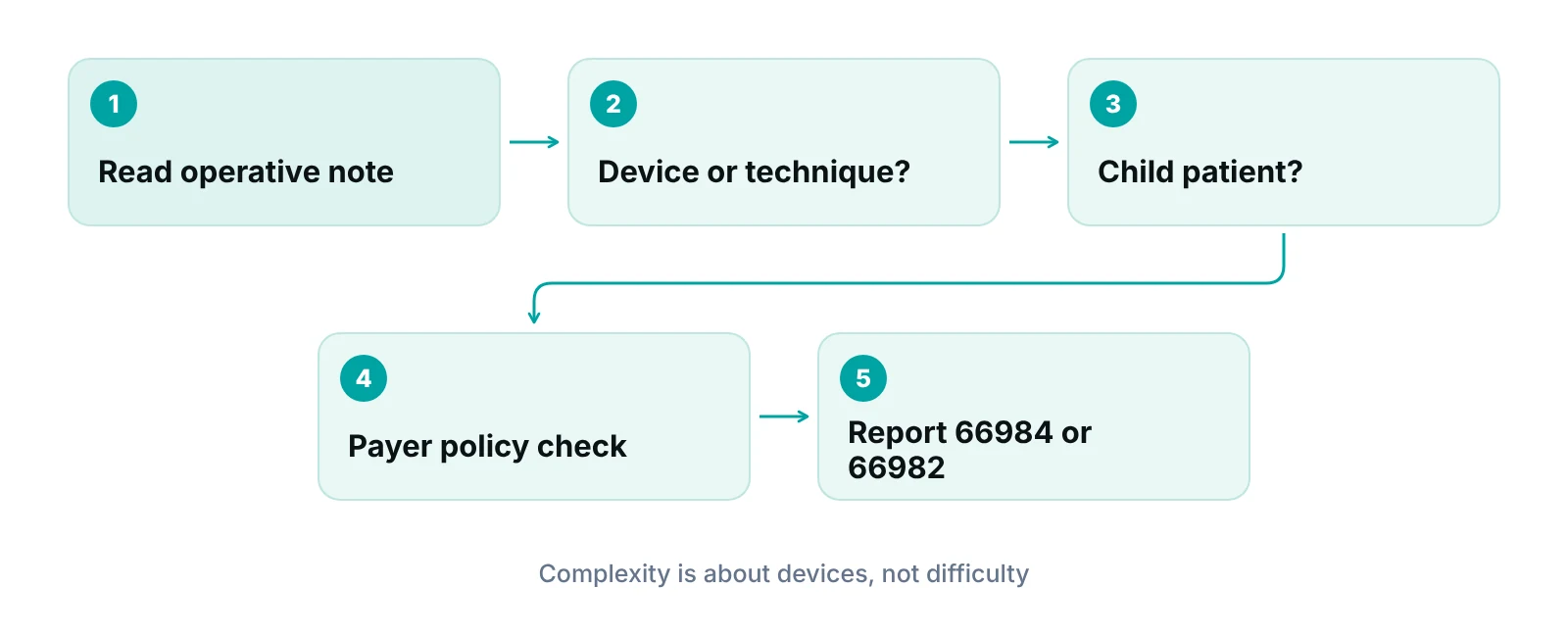
Choose 66982 only when the operative note shows a qualifying device or technique, or a patient in the amblyogenic developmental stage. According to an AAO coding article from 2023, the deciding factor is the additional device or the child patient, not how difficult the case was.
Questions to ask before choosing 66982
- Did a miotic pupil that would not dilate enough require a device such as an iris expansion device?
- Did the lens implant need extra support, such as a capsular tension ring or sutures?
- Is the patient a child in the amblyogenic developmental stage?
- Was the cataract mature enough to require dye for visualization? Some payers accept this, others do not, so check the policy first.
The AAO notes that if an unplanned device or technique becomes necessary during surgery, the surgeon and the facility should both report the case as complex. That only works when the operative note describes what was used and why.
| Situation | Complex (66982)? | Why |
|---|---|---|
| Miotic pupil needing an iris expansion device or retractors | Yes, with documentation | A device not generally used in routine surgery; some Medicare policies list specific devices |
| Weak zonules needing a capsular tension ring or lens suture support | Yes, with documentation | Extra support device or technique |
| Pediatric patient in the amblyogenic stage | Yes | Named in the code wording itself |
| Mature cataract needing dye to see the capsule | Depends on payer | The First Coast policy lists it; the AAO says not every contractor accepts it |
| Vitreous loss, iris prolapse or a dropped nucleus | No | Surgical complications do not make a case complex (EyeWorld, 2007) |
| Toric or presbyopia-correcting lens alone | No | The lens type does not change the extraction code (EyeWorld, 2007) |
Source: First Coast LCD L38926 (effective 07/11/2021); AAO (2022, 2023); EyeWorld (2007). Confirm your own contractor’s current policy.
Some Medicare policies also expect a supporting diagnosis for the complex code. AAO’s 2015 ICD-10 column says contractor policies required a non-cataract diagnosis, such as H21.221 or H57.01, alongside the cataract diagnosis for 66982. Verify this against the policy that applies to you today.
What documentation supports a cataract surgery claim?
The chart must show why surgery is medically necessary, and the details come from the Medicare Administrative Contractor (MAC) that pays you. The AAO’s 2017 EyeNet column notes that there is no national coverage determination setting a visual acuity cutoff, and requirements vary by payer.
What a Medicare policy typically wants to see
The First Coast Service Options policy L38926 (effective July 2021) is a good example. It covers surgery when visual function no longer meets the patient’s needs and glasses or other non-surgical measures do not fix it, with a pre-operative exam documenting items such as the following:
- Trouble with daily activities because of the visual impairment.
- Evidence that the cataract is causing the impairment.
- Glare, double vision or reduced quality of vision from the cataract.
- A lens opacity that blocks diagnosis or management of a back-of-the-eye condition.
- Lens-related inflammation or secondary glaucoma.
The same policy sets no specific visual acuity threshold. Older material, including the 2017 AAO column, said First Coast used 20/40. The policy now in effect does not state that, so any statement that a contractor requires a fixed number should be checked against the current policy text.
“Copying the same lifestyle sentence into every chart is a risk. Payers look for patient-specific functional impact.”
The AAO’s 2017 checklist also lists the patient’s chief complaint, a lifestyle complaint specific to the patient, evidence of a cataract, expected improvement, informed consent, a signed operative report and a signed legible exam. Timing of the qualifying exam differs by contractor, so check yours.
Pairing CPT with ICD-10-CM diagnosis codes
- H25 to H28: the lens chapter holds most cataract diagnoses; H25 is age-related cataract (AAO, 2015).
- E10.36 and E11.36: diabetic cataract with type 1 or type 2 diabetes. The Palmetto article also lists E08.36, E09.36 and E13.36.
- Q12.0-: congenital cataract family.
- Laterality: use the right-eye, left-eye or bilateral character the code requires, usually the sixth character, but the fifth for some codes such as H26.3-.
- Sequencing: for some secondary cataract codes and diabetic cataract codes, the underlying condition must be listed first, per the Palmetto article.
Specificity is a common weak spot. The old shorthand of “senile cataract” in a note does not map neatly to today’s code set, so build the diagnosis choice into the template the surgeon and scribe use. A clean claim starts with a diagnosis that matches the note.
Which modifiers and global-period rules apply?
Cataract codes carry a 90-day global period, so routine post-operative visits are bundled and several modifiers matter. Medicare’s Claims Processing Manual, Chapter 12 defines modifiers 24, 25 and 57, and the AAO explains the surgical ones.
| Modifier | Used for | Practical note |
|---|---|---|
| RT / LT | Right eye or left eye | Anatomical modifiers go last when more than one modifier applies |
| 24 | Unrelated E/M service by the same physician during the post-operative period | Needs documentation that the visit was unrelated |
| 25 | Significant, separately identifiable E/M service on the day of a procedure | Needs documentation in the record |
| 57 | E/M service that led to the decision for a procedure with a 90-day global period | Applies to the decision-for-surgery visit on or the day before surgery |
| 58 | Staged or related procedure during the post-operative period | Starts a new global period |
| 78 | Unplanned return to the operating or procedure room for a related procedure | Original global period continues; reduced payment |
| 79 | Unrelated procedure by the same physician during the post-operative period, such as surgery on the other eye | Starts a new global period |
| 54 / 55 | Surgery only (54) or post-operative care only (55) when care is split | Used for formal co-management; read the next paragraph |
Source: CMS Claims Processing Manual Ch. 12 (current revision); AAO EyeNet (2011, 2022); Review of Optometry (2003). Confirm against your payer’s current policy.
Co-management between a surgeon and an optometrist is common. In that arrangement, the surgeon reports the surgical code with modifier 54 and the optometrist reports the same code with modifier 55, and the post-operative payment is split by the share of care each provided (Review of Optometry, 2003). CMS’s Transmittal 2574 describes the split-payment logic for modifiers 54 and 55. For the optometry side, see billing for optometry and post-operative co-management.
Two more rules to keep straight. First, complications after surgery are included in the global package unless the patient has to return to the operating or procedure room (AAO, 2011). Second, a second-eye surgery within the first eye’s global period normally needs modifier 79 or the claim may go unpaid. For a broader explanation, see modifier 25 versus modifier 59.
How are premium lenses billed to Medicare patients?
Medicare pays for a conventional lens, not for the presbyopia-correcting function of a premium lens, so the patient may be charged for the extra. CMS Ruling 05-01 (May 2005) says that function does not fall into a Medicare benefit category and is not covered.
- The patient pays the portion of the facility and physician charge that exceeds the charge for a conventional lens.
- Exams and fitting services tied only to the premium function are non-covered.
- The AAO’s 2018 column adds that a toric lens was addressed in a separate 2007 ruling, and that patients must be free to choose a standard lens. A premium lens cannot be a condition of surgery.
- Per the AAO, an Advance Beneficiary Notice (ABN) is not required for the premium component, because it is excluded by statute. HCPCS V2788 (presbyopia-correcting) and V2787 (astigmatism-correcting) may be used to show the non-covered charge.
These rules apply to Medicare Part B. Commercial plans have their own policies, so verify each one. For facility-side differences, see ASC versus hospital outpatient billing.
Where do cataract claims go wrong, and how can a practice prevent it?
Cataract claims usually go wrong at four points: a thin pre-operative note, the wrong standard-or-complex choice, a missing modifier in the global period, and a premium-lens charge posted as a covered service. Each is a process problem, not a coding-knowledge problem.
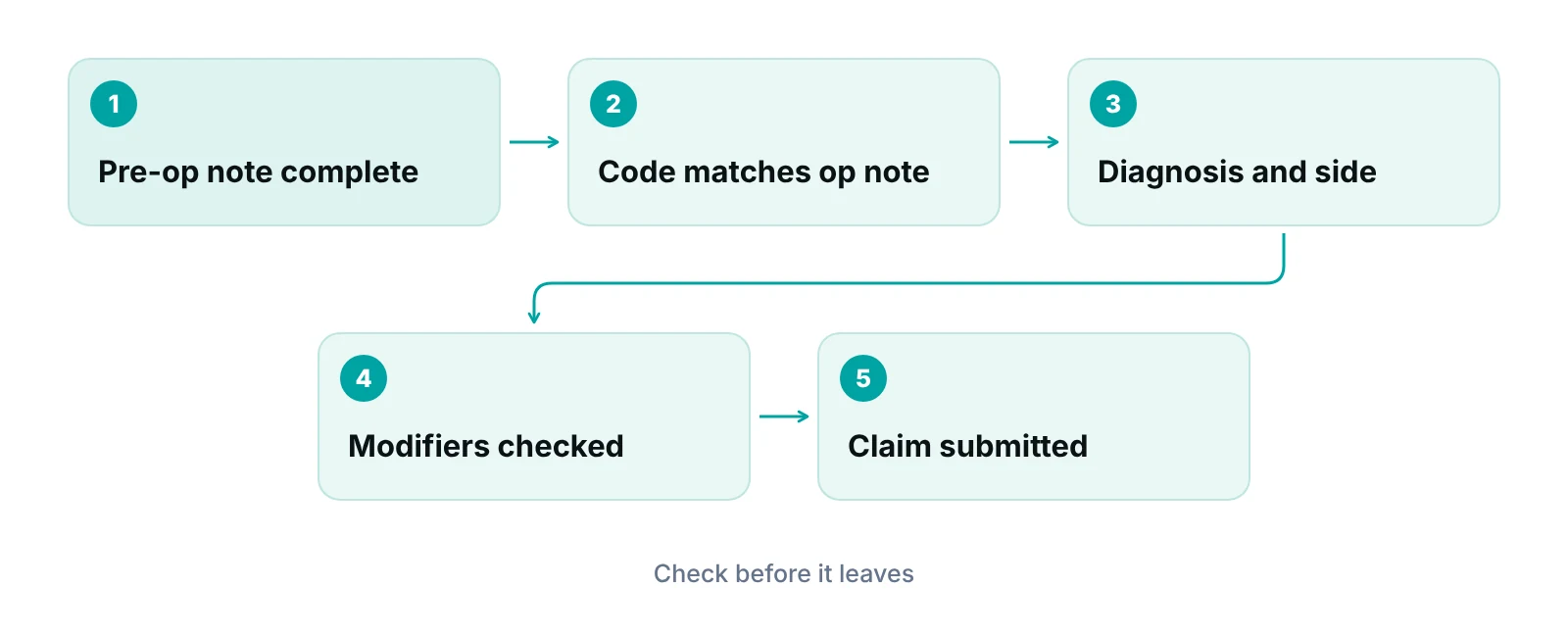
- Chart gaps: missing functional impact, consent or a signed operative report. Fix with a template the surgeon cannot skip.
- Code mismatch: complex billed without a documented device, or standard billed when the note shows one. A periodic review catches both; see types of medical coding audits.
- Global-period misses: unrelated visits or second-eye surgery billed without the right modifier.
- Denials left to age: worked late, a denied surgical claim is harder to win. A defined denial management services workflow keeps appeals on time. See also how to evaluate an ophthalmology billing partner.
A practice management system that tracks claims by stage can hold each claim with an owner and flag missing data before submission, which suits a checklist this long. It works with the EHR you already use and is not a replacement for it.
Want a second set of eyes on your cataract claims?
A free practice audit looks at your coding, documentation and denial patterns and shows where revenue is slipping. No obligation.
Our recommendations
- Build the complex-case test into the operative note. Add a short checklist for the four qualifying situations (iris device, lens support, pediatric, dye) so the surgeon records what was used and why.
- Read your own contractor's policy, not a summary. Find the current local coverage determination and billing article for your MAC and keep a one-page extract at the front desk. Do not rely on a fixed acuity number repeated online.
- Make the pre-operative exam a hard stop. Do not schedule surgery until the note shows patient-specific functional impact, expected benefit, consent and any required measures.
- Standardise modifier decisions for the global period. Write a one-page rule for second-eye surgery, unrelated visits and returns to the operating room, and have billing check it before submission.
- Script the premium-lens conversation and charge. Offer the standard lens as a real choice, quote the patient’s extra cost in writing, and post covered and non-covered charges separately.
- Audit a sample of cataract claims every quarter. Compare the code, diagnosis, side and modifiers to the note. Fix the template, not just the claim.
A claim tracker helps cataract checklists get done before submission.
RCM Finder's practice management portal tracks each claim by stage with an owner and runs data-completeness checks before submission. It works with the EHR you already use.
See how the RCM Finder portal works · Create a portal account
Disclosure: RCM Finder builds and sells this portal. It is a practice management system, not an EHR.
Bottom line
Cataract coding is a short list of codes surrounded by strict documentation and modifier rules. Choose 66984 or 66982 from the operative note, support medical necessity in the pre-operative exam, and watch the 90-day global period. If you want help turning this into a working process, see our ophthalmology billing and revenue cycle support or our medical billing and coding support.
Frequently asked questions
What is the CPT code for cataract surgery?
The standard code is 66984, for extracapsular cataract removal with a lens implant by manual or mechanical technique. Use 66982 when the case is complex because a device or technique not generally used in routine surgery was needed or the patient is a child in the amblyogenic stage. Confirm the descriptor in the current AMA CPT code book.
What is the difference between 66982 and 66984?
Both describe cataract removal with a lens implant. 66982 adds the requirement for devices or techniques not generally used in routine cataract surgery, or an amblyogenic developmental-stage patient. According to the AAO, difficulty alone does not make a case complex, and the operative note must document the device or technique.
How long is the global period for cataract surgery?
Cataract surgery codes carry a 90-day global period. Routine post-operative visits are bundled. Complications are included unless the patient returns to the operating or procedure room. Unrelated visits or procedures, such as surgery on the other eye, usually need a modifier such as 24 or 79. Verify with your payer.
Does Medicare require a specific visual acuity for cataract surgery?
There is no national rule setting a visual acuity cutoff, according to the AAO. The First Coast policy L38926 sets no specific threshold and looks at visual function and impact on daily activities. Other contractors and commercial plans may differ, so check the current policy for your contractor.
Can a practice charge a Medicare patient for a premium lens?
Yes, for the non-covered portion. Under CMS Ruling 05-01, Medicare does not cover the presbyopia-correcting function of a lens, and the patient pays the part of the charge that exceeds a conventional lens. The patient must be free to choose the standard lens. Commercial plans follow their own rules.
Which ICD-10 codes go with cataract surgery?
Common diagnoses fall in the H25 to H28 range, with E10.36 or E11.36 for diabetic cataract and Q12.0- for congenital cataract. Include the laterality character and follow sequencing notes for secondary or diabetic cataract. Check your contractor’s billing article for the accepted diagnosis list.
Get your free practice audit
Tell us about your practice. We will contact you using the details you give.
- A review of your recent claims, denials and A/R aging
- Where your front desk and prior authorizations slow payment
- A prioritized fix list you keep, whether or not you hire us
Pricing is quoted after the audit, based on your volume and the services you choose. Prefer to talk? Call +1 (302) 556-2288.
Sources
- Cataract Surgeries Coding — American Academy of Ophthalmology (2022)
- How to Document the Need for Cataract Surgery — AAO EyeNet (2017)
- Surgical Complications Part One: When to Use Modifiers — AAO EyeNet (2011)
- Complex cataract surgery coding: A refresher course — EyeWorld (2007)
- Know the right codes for cataracts — Review of Optometry (2003)
- LCD L38926 Cataract Extraction (including Complex Cataract Surgery) — First Coast Service Options (via AAO) (2021)
- Billing for Surgery: 10 Steps for Successful Coding — AAO EyeNet (2022)
- ICD-10 Codes: Cataract Family — AAO EyeNet (2015)
- CMS Ruling 05-01 — CMS (2005)
- Premium IOLs: A Legal and Ethical Guide — AAO EyeNet (2018)
- Billing and Coding Article A56613 Cataract Surgery — Palmetto GBA (via AAO) (2023)
- Coding Complex Cataract Cases — Ophthalmology Management / AAO (2023)
- Medicare Claims Processing Manual, Chapter 12 — CMS (2026)
- Transmittal 2574 — CMS (2012)
- Cataract Surgery CPT Codes — Coding Ahead (secondary reference) (n.d.)
Disclaimer: This page is general educational information about cataract surgery coding and billing. It is not legal, coding, billing-compliance or medical advice. CPT is a registered trademark of the American Medical Association, and code descriptions here are paraphrased. Payer and Medicare contractor rules vary and change, so confirm requirements with the payer, the current CPT code book and qualified advisors before acting.
