
Split professional and technical claims, prior authorization through radiology benefit managers, referral-focused marketing and a claims portal, built on CMS manuals and your payers' own rules.
By Awais Afzal | Healthcare Operations & Data Analyst
Published October 12, 2026 · Last reviewed October 12, 2026 · Next review April 12, 2027
Quick answer
Radiology billing services code and bill imaging claims: professional reads with modifier 26, technical or global claims by site, prior authorization through radiology benefit managers, and follow-up on denials and underpayments. RCM Finder pairs that billing work with front-desk assistants, referral-focused marketing and a claims portal, starting with a free practice audit.
On this page
Radiology billing is different because one study can become two claims, the site decides who bills each part, and Medicare cuts payment on some studies before anyone works the claim. Payers then add their own prior authorization rules.
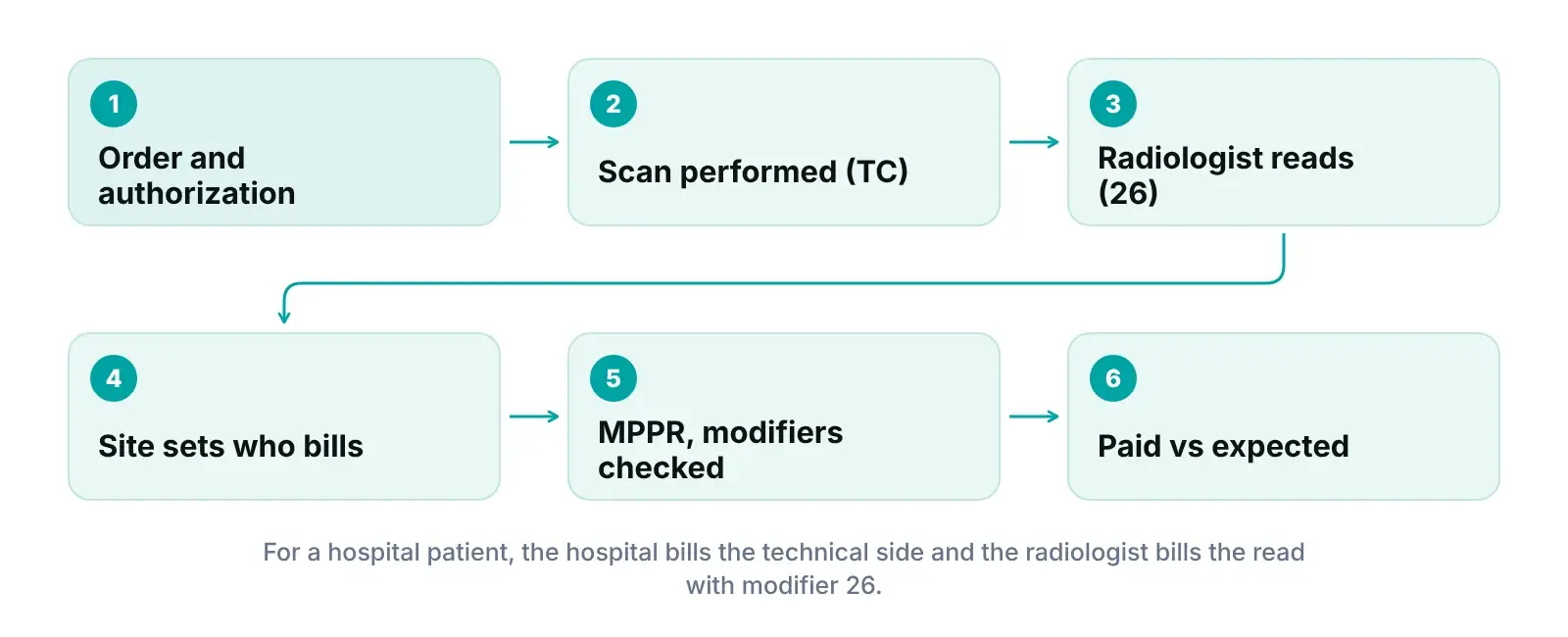
CMS MLN Matters SE0587 defines the professional component (modifier 26) as the physician's interpretation and the technical component (modifier TC) as staff, supplies and equipment. A global claim covers both. Noridian, a Medicare contractor, says the two parts equal the global allowance and are not split when you performed the whole service. Other contractors may word this differently.
For hospital patients, the split is required. Chapter 13 of CMS's claims processing manual pays the professional component in every setting but bars Part B contractors from paying the technical component for hospital patients; the hospital is paid for it instead (section 20.2.1). Codes also split by contrast and views, and the claim must match the report, order and approval.
CMS's CY 2026 fee schedule final rule fact sheet (October 31, 2025) set the conversion factor at $33.40 for clinicians who are not qualifying APM participants, up from $32.35. A -2.5% efficiency adjustment hits work RVUs of non-time-based services, and imaging is not among the exempt groups the fact sheet names; check the final code list. CMS also now recognizes greater indirect practice costs for office-based practitioners than for facility settings.
The CY 2027 proposed rule fact sheet (July 14, 2026) projects $32.84 for that group and asks whether the facility and non-facility payment difference is still appropriate. Check the final rule before budgeting.
An imaging practice needs orders coming in, studies approved before the scan, reads billed correctly for each site, and software that shows every claim. Each pillar handles one.
Revenue leaks at the handoffs, such as an MRI scanned before approval. We run all four pillars against one set of payer rules.
Our healthcare digital marketing builds orders from referring offices first, then helps referred patients choose you. See our radiology patient generation services.
Our virtual medical assistants for radiology work on your practice's time zone. They verify eligibility, confirm approvals before each scan and report study changes to the plan.
Our end-to-end radiology revenue cycle management covers coding support, claim scrubbing, denial management and A/R follow-up, with radiology checks on split billing, place of service and payment cuts.
Our practice management system tracks every claim by stage, applies specialty-aware billing logic per claim, checks data completeness and flags underpayments.
Find where your imaging claims leak
We review recent claims, remittances and authorization logs, then show where split billing, payment cuts or missing approvals cost you.
Each imaging family has its own contrast, view, accreditation or payment rule. Codes are described in our own words (the AMA owns CPT descriptors); check the current code set before billing. For full lists, see our radiology CPT codes guide and 2026 radiology CPT code updates.
| Service family | Code examples (our wording) | Billing nuance | Typical denial or payment trigger |
|---|---|---|---|
| Chest X-ray | 71045 (one view); 71046 (two or more views) | Bill the views the report shows. FX (film) and FY (computed radiography) cut the TC | View count differs from the report; FX or FY missing |
| Head CT | 70450 (no contrast); 70460 (with); 70470 (without, then with) | Contrast must match report, order and approval. Non-XR-29 scanners need modifier CT | Approved code differs from the one done, such as head vs neck |
| Abdomen and pelvis CT | 74176 (no contrast); 74177 (with); 74178 (without, then with) | Later studies in one session: TC cut 50%, PC cut 5% (MPPR) | Reduced lines never checked against expected payment |
| Brain MRI | 70551 (no contrast); 70552 (with); 70553 (without, then with) | Technical supplier needs CMS imaging accreditation | No approval, or approval for another code or site |
| Abdominal ultrasound | 76700 (complete); 76705 (limited, such as one organ or a follow-up) | Outside the accreditation rule. Complete or limited follows the report | Complete code billed for a limited study |
| Mammography | 77067 (screening, both breasts); 77066 (diagnostic, both breasts; CAD included when used) | FDA-certified supplier; a radiologist may order a diagnostic study from screening findings | Screening billed before 11 full months have passed |
| Hospital patient reads | Any of the above with modifier 26 | Hospital bills the TC. POS 21 inpatient, 19 or 22 outpatient; remote reads use the scan site's POS | Global or TC billed for a hospital patient |
Sources: CMS Claims Processing Manual ch. 13 (sections 20.1 to 20.2.6) and ch. 26 (section 10.5), accessed October 2026; CMS MLN Matters MM9647 (2016) and MM7631 (2013); CMS advanced diagnostic imaging accreditation page (2026); 42 CFR 410.32 and 410.34; AAPC code summaries for plain-language meanings. Rules vary by contractor and payer.
Under MLN Matters MM9647 (2016), Medicare cuts the technical component of the second and later imaging procedures in one session by 50%. Since January 1, 2017, the professional component of those later reads is cut by 5%, down from 25%, when the same physician or group reads them for the same patient in the same session. Chapter 13 of the claims processing manual adds equipment cuts to the technical component: 15% for CT on scanners that miss the NEMA XR-29 standard (modifier CT), 20% for film X-rays (FX) and 10% for computed radiography since 2023 (FY).
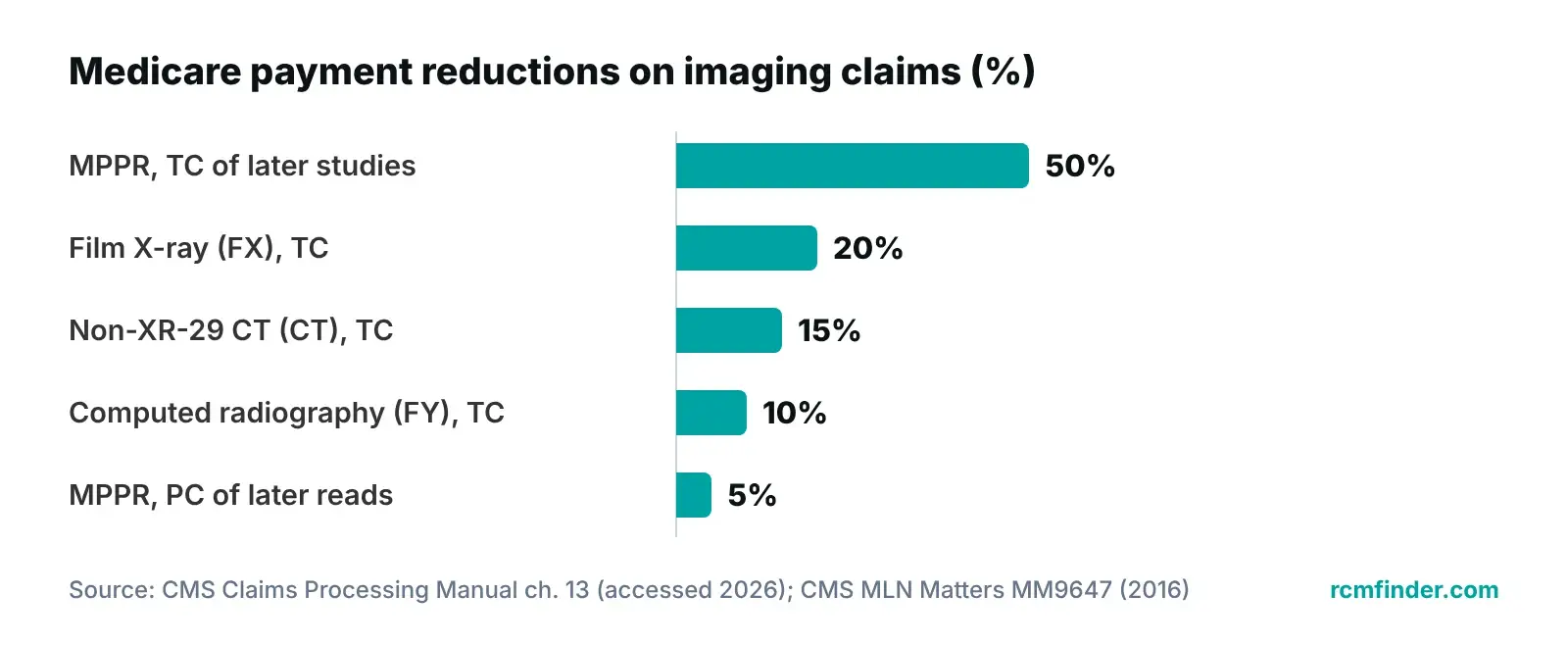
We compare each paid line with what it should have paid.
Medicare pays only for tests the treating physician orders (42 CFR 410.32). Under CMS's guidance on ordering diagnostic tests (Benefit Policy Manual, chapter 15, section 80.6), a testing facility may not swap or add a test without a new order, such as an MRI for an ordered CT. For patients who are not hospital patients, the radiologist may set views, section thickness and contrast unless the order specifies them, and documents it in the report.
For a separate encounter the same day, CMS's April 2026 modifier 59 and X{EPSU} booklet points to XE and says 59 is never just a way past an edit. See when modifier 59 applies.
The scan site decides the place-of-service code, the payment rate and who may bill the technical side. Independent diagnostic testing facilities (IDTFs) add their own enrollment standards.
Under section 10.5 of CMS's claims processing manual, chapter 26, a registered hospital inpatient gets at least POS 21, and a hospital outpatient gets POS 19 (off campus) or 22 (on campus). The same section notes that each code in the CMS place of service code set has a facility or non-facility designation for fee schedule payment. For a remote read, MLN Matters MM7631 (2013) says to report where the patient had the scan. See our guide to POS 11 vs POS 22.
42 CFR 410.33 sets the rules for IDTFs, which often bill the technical side. Among them:
A supplier of the technical component of MRI, CT or nuclear medicine, including PET, paid under the fee schedule must be accredited, per CMS. Approved accreditors are the American College of Radiology, the Intersocietal Accreditation Commission, The Joint Commission and RadSite. X-ray, ultrasound, mammography and hospitals fall outside this rule. Mammography suppliers need an FDA certificate (42 CFR 410.34).
Blue Cross and Blue Shield of Texas says Carelon has reviewed hospital outpatient CT, CTA, MRI and MRA for certain commercial members since January 1, 2025, and that providers may not bill the patient if a required authorization is missing. UnitedHealthcare has an MRI and CT site-of-service policy for some plans.
Confirm the approval before the scan. For many commercial and Medicaid plans that means a radiology benefit manager, and the approval must match the code, contrast and site.
Health Net uses Evolent for outpatient CT, MRI and PET, wants a separate authorization number for each procedure, and warns that failure to verify may mean non-payment. An eviCore FAQ for Aetna Better Health of Virginia (© 2025) has the ordering office request approval and the rendering facility confirm it.
UnitedHealthcare says CT, MRI, MRA, PET and nuclear cardiology may need approval, but says its Medicare Advantage and D-SNP plans do not require it for CT, MRI or MRA; its Community Plan section still requires radiology approval for D-SNP members in some states. From September 1, 2026, it added 70471 (head and neck CT angiography) and 75577 (software-based coronary plaque analysis) for its commercial and several other plans.
Since January 1, 2026, the CMS-0057-F final rule has required Medicare Advantage, Medicaid and CHIP plans to decide expedited requests within 72 hours and standard requests within seven calendar days, with a specific reason for any denial.
In the AMA’s 2025 survey of 1,000 physicians, released in May 2026, physicians averaged 40 prior authorizations and about 13 hours of physician and staff time each week.
| Rule | Source | What the VMA checks before the scan |
|---|---|---|
| Treating physician's order required; IDTFs may not add tests by protocol | 42 CFR 410.32 and 410.33 | Signed order with study and reason |
| Ordering office requests approval, one per procedure; rendering facility confirms it | eviCore FAQ, Aetna Better Health of Virginia (© 2025); Health Net (2026) | One approval number per code, with the approved site |
| Report any change to an authorization; approval dates vary | eviCore FAQ, Aetna Better Health of Virginia (© 2025) | Code, contrast and body area match the approval |
| Advanced imaging may need approval; MA and D-SNP plans exempt CT, MRI and MRA, with some state D-SNP exceptions | UnitedHealthcare (2026) | Plan type checked against the current code list |
| Emergency room, observation and inpatient studies exempt (UnitedHealthcare also exempts urgent care) | UnitedHealthcare; Health Net (2026) | Patient status confirmed first |
| Hospital outpatient CT and MRI may face site-of-care review | BCBSTX / Carelon (since Jan 1, 2025) | Planned site checked against the plan's rule |
| MA, Medicaid and CHIP: 72-hour expedited and 7-day standard decisions, with a specific denial reason | CMS-0057-F (in effect Jan 1, 2026) | Due date logged; follow-up that day; denial reason saved |
Sources: 42 CFR 410.32 and 410.33 (eCFR, current October 2026); eviCore FAQ for Aetna Better Health of Virginia (© 2025); Health Net radiology benefit management page (updated 04/16/2026); UnitedHealthcare radiology prior authorization page and June 1, 2026 update; BCBSTX Carelon page (2026); CMS-0057-F fact sheet (2024). Always check the member's current plan.
For the full workflow, read our prior authorization guide for providers.
See what delays and payment cuts cost you
Enter your claim volume and denial rate to estimate what your imaging practice is losing.
Imaging growth starts with referring providers, because most studies need an order. Patient-facing work then helps referred patients choose your location.
Under 42 CFR 410.33, an IDTF must not directly solicit patients and must accept only patients referred by an attending physician. For IDTF clients, we focus on referring offices and on location, hours and preparation details for patients who already have an order. Ask your counsel where the line sits.
HHS guidance on online tracking says tools on appointment pages may collect protected health information and that such vendors need a Business Associate Agreement. A 2024 court order vacated part of that guidance, but we still keep tracking off scheduling and order forms unless the vendor signs a BAA.
Stay in-house if you have experienced radiology coders and time for approvals. Use a billing-only vendor if claims are your only gap. Choose a combined partner when problems start at ordering.
| Job | In-house team | Billing-only vendor | Four-pillar partner (RCM Finder) |
|---|---|---|---|
| Approvals for CT, MRI and PET | Front desk or referring office | Usually left to the practice | VMA confirms each approval before the scan |
| 26, TC or global, and POS, by site | Depends on one coder | Fixed after a denial | Mapped by site, checked before submission |
| MPPR and FX, FY or CT cuts | Often posted without review | Posted as paid | Paid lines compared with expected amounts |
| Referral growth | A liaison, or nobody | Not included | Measured by orders per referring office |
| Reporting | EHR or RIS reports | Claim reports only | Portal and dashboards, from order to paid claim |
| Cost structure | Salaries, benefits, turnover | Varies; ask how fees are set | Quoted after a free practice audit |
For more on what makes imaging claims hard, see our post on the challenges of radiology medical billing.
We start with a free audit and change nothing until you see the findings. We build our billing pipeline around how claims actually move through a practice: registration, charge entry, submission, payment and follow-up. For radiology, we add the split-billing, authorization and payment-cut checks on this page.
We review recent claims, remittances and authorization logs, and map each site to its billing model.
We put a Business Associate Agreement in place before accessing patient data. Then we work inside your existing EHR (for example PrognoCIS, eClinicalWorks or athenahealth).
Your plans' approval and site-of-care rules become a pre-scan checklist and portal workflow rules.
VMAs confirm approvals before each scan. Claims are scrubbed, submitted and worked through denials and A/R.
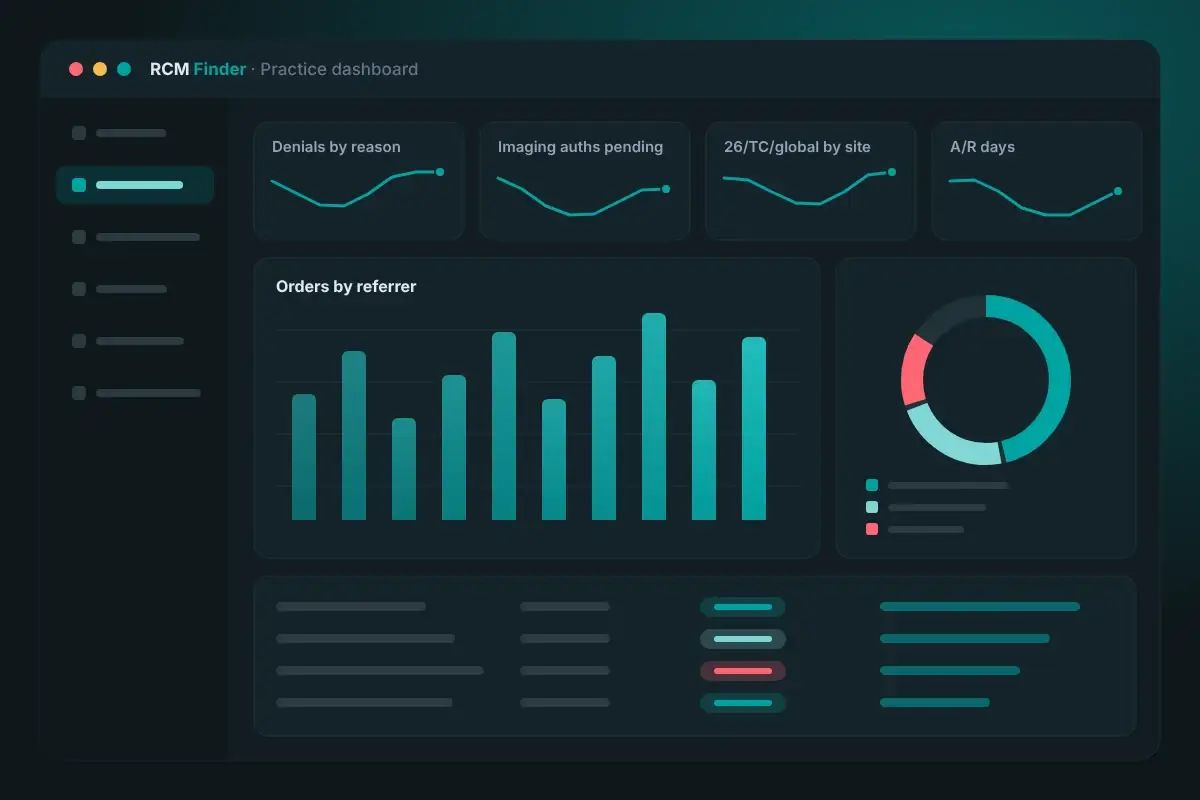
We review denials by reason, A/R days, studies cleared before the scan and orders by referring office. Add Own Practice Management System for more depth.
Talk to us about your imaging practice
Tell us your sites, modalities and hardest payer. We will tell you honestly whether we fit.
Any billing vendor that handles your patients' data is a HIPAA business associate. Get a Business Associate Agreement before they have any access, and check how they limit and log that access.
HHS guidance names billing and claims processing as business associate work. The minimum necessary standard limits use to what each task needs. The Security Rule's technical safeguards include access control, audit controls and transmission security.
Under 45 CFR 149.420, an out-of-network provider at an in-network facility may not bill a covered patient more than the applicable in-network cost sharing. Radiology is listed as an ancillary service, so the notice-and-consent exception cannot be used. Payment disputes with plans can go to the federal independent dispute resolution process.
We use role-based access, audit logging and encrypted (HTTPS) connections, and we put a Business Associate Agreement in place before accessing patient data. For your own side, use our HIPAA compliance checklist for medical practices.
We would rather tell you now than after you sign. Here is where we fit and where we do not.
A good fit if you are
Probably not a fit if you are
What we would do first if we were running your practice's revenue cycle tomorrow.
Before fixing denials, we list each site, who owns the equipment, who reads and which patients are hospital patients. That map decides global, 26 or TC, and the POS code.
If a plan requires approval and none is on file, the study waits. For plans under CMS-0057-F, we log the decision due date and follow up that day.
MPPR and the FX, FY and CT cuts never appear as denials. We compare each paid line with its expected amount.
We confirm each site's advanced imaging accreditation and FDA mammography certificate are current, because the technical claim depends on both.
Most imaging volume starts with an order, so we measure marketing by orders per referring office, not clicks.
Radiology billing services usually cover coding support, claim scrubbing, submission, denial management and A/R follow-up for imaging studies and reads. A good partner also handles split professional and technical billing by site, prior authorization through radiology benefit managers, and the Medicare payment reductions that never appear as denials. We add front-desk assistants, referral-focused marketing and a claims portal, so one team owns the process from order to payment.
Bill globally when your practice performs the whole study on its own equipment and your radiologist reads it. Use modifier 26 when your radiologist only reads the study, as with hospital patients, where Medicare pays the hospital for the technical side. For a remote read, CMS says to report the place of service where the patient had the scan. Check each code's rules in the fee schedule first.
Not right now. CMS paused the Appropriate Use Criteria program and rescinded its regulations effective January 1, 2024. It says Medicare claims should no longer include AUC consultation information and has not set a date to restart. Commercial, Medicaid and Medicare Advantage plans can still require their own prior authorization for CT, MRI and PET, often through a benefit manager, so check each plan.
That is usually the multiple procedure payment reduction. For imaging codes CMS flags for it, the technical component of the second and later procedures in one session is reduced by 50%. Since 2017, the professional component of those later reads is reduced by 5% when the same physician or group reads them for the same patient in the same session. The reduction is expected, but it should still be checked line by line.
Usually both have a role. In one eviCore FAQ for a Medicaid plan, the ordering physician or staff must request approval, and the rendering facility must confirm it was obtained. Health Net says providers rendering the service should verify the authorization, and that failure to do so may mean non-payment. Because the imaging center carries the claim risk, our VMAs confirm the approval before every scan.
It can be, if the vendor is treated as a business associate. HIPAA requires a Business Associate Agreement before the vendor receives patient data, and the agreement must require safeguards. We put a Business Associate Agreement in place before accessing patient data, and we use role-based access, audit logging and encrypted (HTTPS) connections. Pricing depends on your sites, volume and which pillars you need, so we quote it after a free practice audit.
Tell us about your practice. A member of our operations team replies within one business day.
Pricing is quoted after the audit, based on your volume and the services you choose. Prefer to talk? Call +1 (302) 556-2288.
Tell us about your practice
About the author: Awais Afzal
Healthcare Operations & Data Analyst, RCM Finder
Awais has spent more than 16 years in healthcare digital marketing and clinical operations management. He builds data-driven revenue cycle blueprints for high-ticket medical practices and leads product development of the RCM Finder portal. More about our team.
How we write: every figure, code and rule on this page was checked against the primary source listed below and independently fact-checked before publishing. We re-review this page every six months. Last reviewed October 12, 2026; next review April 12, 2027.
We use cookies to understand how our site is used and to measure our advertising. You can accept or reject non-essential cookies. See our Privacy Policy.