
Billing, prior authorization, patient marketing and a claims portal for interventional pain practices, built around Medicare LCD rules and your payers' own policies.
By Awais Afzal | Healthcare Operations & Data Analyst
Published October 12, 2026 · Last reviewed October 12, 2026 · Next review April 12, 2027
Quick answer
Pain management billing services handle coding, claim submission, denials and A/R for procedure-heavy pain practices. Done well, the work starts before the visit: checking Medicare LCD criteria, session limits and prior authorization, then coding modifiers and units correctly. RCM Finder pairs that billing with front-desk staff, patient marketing and a claims portal.
On this page
Pain management billing is different because most revenue comes from procedures Medicare pays for only when written criteria are met and documented. Those criteria live in Local Coverage Determinations (LCDs), which set pain durations, relief thresholds, level limits and session caps.
An epidural or a radiofrequency ablation is paid only if the chart shows why it was needed, how the patient responded last time, and how often that spinal region was treated in the past year. Miss one, and the claim can deny even when the care was right.
The rules also vary by Medicare Administrative Contractor (MAC). Indiana and Michigan, for example, fall under WPS, whose facet joint LCD (L38841) and epidural steroid injection LCD (L39054) list both states. Other MACs publish their own versions, such as CGS L38773 and Noridian L39240. Commercial and Medicare Advantage plans add their own policies on top.
We build our billing pipeline around how claims actually move through a practice: registration, charge entry, submission, payment and follow-up. That is why our process starts before the visit, not after the denial. For the neurology side of a combined practice, see our guides to neurology billing services and common neurology billing challenges.
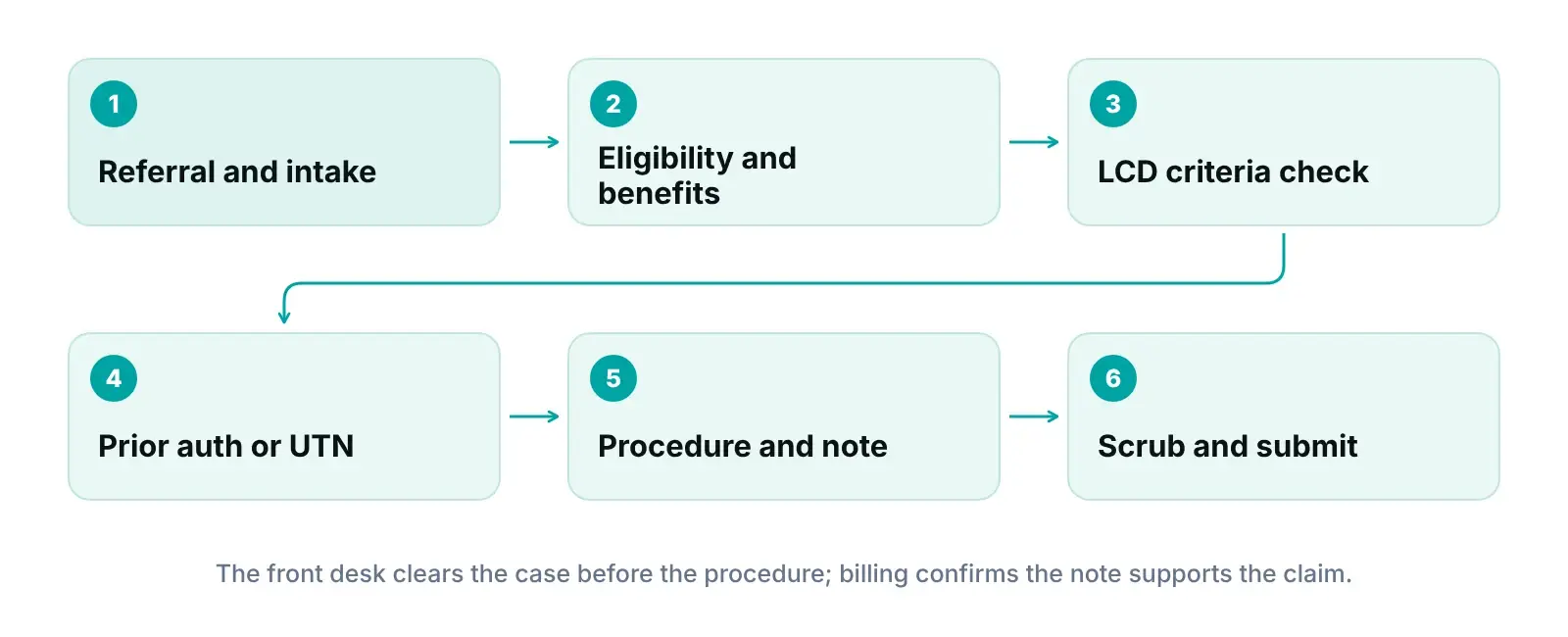
A pain practice needs four things working together: the right patients finding you, a front desk that clears each case before the visit, billing that codes and appeals correctly, and software that shows where every claim sits.
Revenue leaks at the handoffs. A campaign books an ablation consult for a patient with no diagnostic blocks. The front desk books a fifth epidural. Billing learns at denial time. We run all four pillars against one set of payer rules.
Our healthcare digital marketing builds demand around the conditions and procedures you offer, through local SEO, Google Ads and reputation work. Copy describes who is a candidate. We never market opioid prescribing.
Our virtual medical assistants cover your front desk on your practice's time zone. They verify eligibility, gather outside imaging and treatment history, send pain and function questionnaires, and start prior authorizations early.
Our end-to-end revenue cycle management covers coding support, claim scrubbing, denial management and A/R follow-up, with added checks on pain claims for modifiers, units, levels and diagnosis pairing.
Our practice management system portal tracks every claim by stage, applies specialty-aware billing logic per claim, checks data completeness before submission and flags underpayments.
See where your injection claims stall
We review recent pain procedure claims, denial reasons and your scheduling workflow, then show what to fix first. Pricing is quoted after the audit.
The LCDs and billing articles we reviewed point to a short list of denial triggers: a session cap already reached, a missing pain score, too many levels, the wrong bilateral modifier, or units that trip an edit. The table maps each to the procedures it hits.
Codes are examples, described in our own words; check the current code sets and your MAC's billing article. Details come from WPS L39054, WPS L38841, billing articles A58745 and A58364, a 2024 Noridian trigger point update, CMS MLN Matters SE18001 (2018) and Novitas L35006 with article A56645.
| Procedure | Code family (examples) | What the LCD asks to see | Frequent denial trigger |
|---|---|---|---|
| Epidural steroid injection | 62321, 62323 (interlaminar or caudal); 64479, 64480, 64483, 64484 (transforaminal, by level) | Pain 4+ weeks; conservative care failed or not tolerated; baseline pain or function score; CT or fluoroscopy with contrast | Fifth session in a region in 12 months; modifier 50 on 62321/62323; over two transforaminal levels |
| Facet injection or medial branch block | 64490–64492 (cervical/thoracic); 64493–64495 (lumbar/sacral) | Axial pain 3+ months; same pain scale before and after; 80%+ relief before a confirmatory block | Three or more levels (non-covered); ultrasound guidance; no recorded relief |
| Radiofrequency ablation | 64633–64634 (cervical/thoracic); 64635–64636 (lumbar/sacral) | Two diagnostic blocks with 80%+ relief; a repeat needs 50%+ relief for 6 months | Third session in a region in 12 months; units counted by nerve, not joint |
| Trigger point injection | 20552 (one or two muscles); 20553 (three or more) | Trigger point exam findings; pain scores before and after | Over three sessions in 12 months (Noridian); unclassified drug without name and dose |
| Urine drug testing | 80305–80307 (presumptive, by method); G0480–G0483 (definitive, by drug-class count) | An individual order with medical necessity documented | Blanket or routine standing orders; two codes from one range on one day |
| Anesthesia with spine injections | 01992 on the same day | Clear documentation of exceptional need | Sedation not documented as necessary; any same-day 01992 under automated Recovery Audit topic 0229 |
Sources: CMS Medicare Coverage Database — WPS LCDs L39054 and L38841 (2026), Wellpoint article A58745 (2026), CGS article A58364 (2026), Novitas LCD L35006; Noridian trigger point LCD update (2024); CMS MLN Matters SE18001 (2018); CMS Recovery Audit topic 0229 (2026). Rules vary by MAC and payer.
Diagnosis coding drives medical necessity on every one of these claims. See our guides to ICD-10 codes for back pain and neck pain ICD-10 coding. For non-injection services, see dry needling billing and CPT codes for laser therapy.
Bilateral reporting depends on who bills. The Medicare articles we reviewed tell physicians to report a bilateral facet or transforaminal injection at one level as one unit with modifier 50, while an ASC facility reports two lines with RT and LT. The Wellpoint article says bilateral interlaminar or caudal epidurals are not medically reasonable and necessary, so 62321 and 62323 are not billed as bilateral. Some MACs require KX on diagnostic facet blocks, and the CGS article warns that misuse can trigger medical review.
CMS's April 2026 MLN booklet on modifiers 59 and X{EPSU} defines XE (separate encounter), XS (separate structure), XP (separate practitioner) and XU (unusual non-overlapping service). It says to use 59 only when no more descriptive modifier fits, and never just to bypass an edit. See our explainers on modifiers 25 vs 59 and when modifier 59 applies.
Two CMS edit types hit pain claims. Procedure-to-procedure (PTP) edits deny the second code of a pair unless a proper modifier applies. Medically Unlikely Edits (MUEs) cap the units one provider normally reports for one patient on one date; some values are confidential. Noridian explains that units over the MUE are all denied, with appeal possible. Facet and ablation codes count joints, not nerves, per the CGS article, so counting nerves invites an MUE denial.
Pain management prior authorization starts at scheduling. For traditional Medicare, the national rule is narrow: in a hospital outpatient department, facet joint interventions have needed prior authorization since July 1, 2023, and implanted spinal neurostimulators since July 1, 2021. Commercial and Medicare Advantage plans keep their own lists.
CMS's prior authorization program for certain hospital OPD services covers facet joint interventions provided on or after July 1, 2023, and implanted spinal neurostimulators from July 1, 2021. The CMS OPD FAQ says claims without a provisional affirmation are denied, related physician services are not paid, and physicians or third parties may submit for the hospital. ASC and office claims are outside the program. Noridian lists 64490, 64491, 64493, 64494 and 64633–64636 in scope; 64492 and 64495 were removed in 2024.
The burden is real. In the AMA's 2025 prior authorization physician survey (published May 2026), physicians averaged 40 prior authorizations and 13 hours of physician and staff time per week. Our prior authorization guide covers the general process; below is the pain-specific layer.
| Payer rule | Source | What the front desk or VMA checks |
|---|---|---|
| Hospital OPD facet procedures (from July 1, 2023) and spinal neurostimulator implants (from July 1, 2021) need Medicare prior authorization | CMS OPD prior authorization program | Site of service; for OPD cases, the provisional affirmation and tracking number are on file |
| Epidurals: pain 4+ weeks; conservative care failed or not tolerated | WPS LCD L39054 | Onset date, prior conservative care and a baseline pain score are charted |
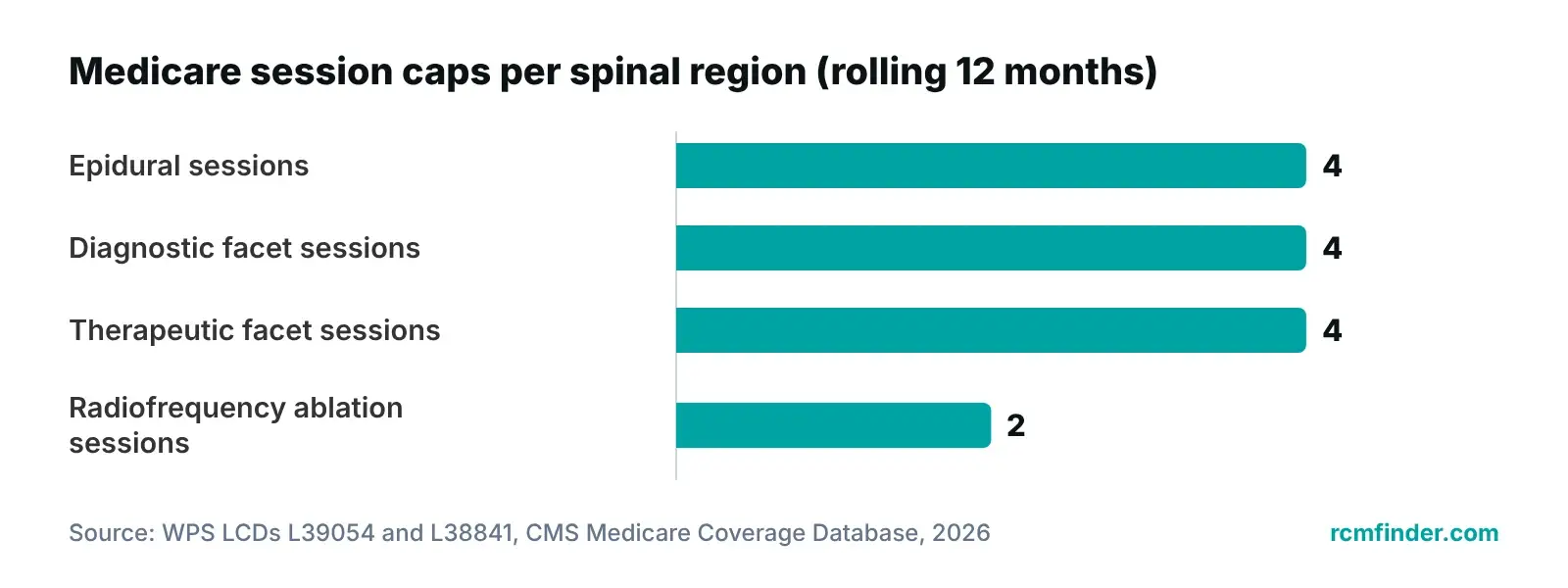
| Epidurals: up to 4 sessions per spinal region per rolling 12 months | WPS LCD L39054 | Prior epidural sessions in that region over 12 months |
| Facet: confirmatory block at least 2 weeks after a first block with 80%+ relief | WPS LCD L38841 | First-block relief recorded on the same scale; second block not booked early |
| RFA: up to 2 sessions per region per rolling 12 months; repeat needs 50%+ relief for 6 months | WPS LCD L38841 | Date and documented response of the last ablation |
| Trigger points: up to 3 sessions per rolling 12 months | Noridian LCD L34211 (example) | Session count; pre- and post-injection pain scores in the template |
| Drug testing: individual orders only; no blanket orders | Novitas L35006 and A56645 (example) | Order names the patient and reason; requisitions not pre-filled with diagnoses |
| Commercial and Medicare Advantage plans | Each plan's medical policy | That plan's prior authorization list and frequency limits |
Sources: CMS OPD prior authorization program page and OPD FAQ; CMS Medicare Coverage Database (WPS L39054 and L38841, 2026; Novitas L35006 and A56645); Noridian trigger point LCD update (2024). Limits are from the named contractor; yours may differ.
Estimate what denied injections cost you
Model how denials and slow A/R affect a procedure-heavy practice, then bring the numbers to your audit.
Pain management marketing should promote conditions, procedures and access, never medications. Google does not allow ads that promote prescription opioid painkillers, restricts prescription drug terms, and needs separate approval for addiction treatment ads.
Google's Healthcare and medicines policy bars ads promoting prescription opioid painkillers, with narrow exceptions, and restricts drug terms in ads, keywords and landing pages. Its addiction services policy requires an approved application per location, and the healthcare policy requires US addiction treatment providers to hold LegitScript certification. The CDC's 2022 opioid guideline also states that nonopioid therapies are preferred for subacute and chronic pain.
Candidate language matters for billing. If an ad implies ablation for anyone with back pain, the front desk inherits consults that fail the diagnostic block criteria. We write campaigns against the same LCD rules our billers use.
Choose based on where your claims break. If denials start at scheduling and documentation, a billing-only vendor sees them too late. If your front desk and charting are strong, outsourced billing alone may be enough.
| Question | In-house team | Billing-only vendor | Four-pillar partner |
|---|---|---|---|
| Who checks LCD criteria before scheduling? | Your front desk, if trained | Often out of scope | Virtual medical assistants, using billing's rules |
| Who handles hospital OPD facet prior authorizations? | Your staff or the hospital's | Depends on the contract | VMA team coordinates and logs the decision |
| Who catches modifier, unit and MUE errors? | Your biller, if pain-experienced | Vendor coders and scrubber | RCM team plus portal completeness checks |
| Who connects marketing to paid claims? | Rarely anyone | Not in scope | Shared KPIs from booked consult to paid claim |
| Whose time zone applies? | Yours | Varies; ask | Your practice's, every shift |
| Strongest fit when | Staff are trained and turnover is low | Front end is strong; you need claims work only | Gaps span scheduling, prior auth, billing and growth |
We will tell you in the audit if you need only one pillar. Our revenue cycle management services and virtual medical assistant services can be contracted separately.
We start with a free audit, put a Business Associate Agreement in place, then take over the parts you choose inside your existing EHR.
We review recent epidural, facet, ablation and drug testing claims, denial reasons and how procedures are booked. You get a prioritized fix list.
We put a Business Associate Agreement in place before accessing patient data, then set role-based access in your EHR (for example PrognoCIS, eClinicalWorks or athenahealth) and our portal.
We map your MACs and main plans: which LCDs apply, what needs prior authorization, and each plan's frequency limits.
Virtual medical assistants start pre-visit checks on your time zone. The RCM team scrubs, submits and works denials and A/R.
You see denial reasons, prior authorization turnaround, A/R days and underpayments each week, and we adjust rules where claims stall.
Talk through your pain practice workflow
Call to walk through your procedure mix, your MAC and where claims stall. We will tell you which pillars you need.
Any vendor that handles your claims is a HIPAA business associate and must sign a Business Associate Agreement before seeing patient data. Also ask how it limits access, logs activity and tracks LCD changes.
HHS names billing and claims processing as business associate functions; the agreement must require safeguards and limit use to what the contract allows. HHS's minimum necessary standard limits uses to what the task needs. See our HIPAA compliance checklist for medical practices. For RCM Finder: role-based access, an audit log, encrypted HTTPS connections, and we put a Business Associate Agreement in place before accessing patient data.
We would rather tell you now than after you sign. Here is where we fit and where we do not.
A good fit if you are
Probably not a fit if you are
What we would do first if we were running your practice's revenue cycle tomorrow.
Look up your contractor's facet and epidural LCDs and billing articles. We build every pain workflow from those documents, not a generic summary.
Caps apply per region in a rolling 12 months. We note the running count before the patient is booked.
LCDs want the same scale at baseline and follow-up. We give providers an intake form so relief percentages land in the note.
Hospital OPD facet cases need a Medicare provisional affirmation; ASC and office cases do not under that program. We check the site, then the plan.
We check every 59 for a more specific X modifier and a documented reason. If neither exists, the pair probably should not be billed.
Keep opioid and prescription drug terms out of ads, keywords and landing pages. Describe candidates honestly.
Avoid blanket and routine standing orders. We ask providers to document why each test is needed.
They cover coding support, claim scrubbing, submission, denial management and A/R follow-up for pain procedures such as epidurals, facet injections, medial branch blocks, radiofrequency ablation, trigger point injections and drug testing. A good service also checks payer criteria before the visit, because coverage for pain procedures depends on documented pain scores and session limits. RCM Finder adds front-desk staff, patient marketing and a claims portal, so the same rules apply from booking to payment.
Only in one setting under the national program. Since July 1, 2023, CMS has required prior authorization for facet joint interventions provided in hospital outpatient departments. Claims without a provisional affirmation are denied. Procedures billed by an ASC or a physician office are not part of that program. Medicare Advantage and commercial plans set their own rules, so check each plan before scheduling.
Under LCDs such as WPS L39054, Medicare covers no more than four epidural sessions per spinal region in a rolling 12 months. A repeat injection generally needs at least 50% improvement in pain lasting at least three months, or 50% better function, recorded on the same scale used at baseline. Each MAC publishes its own LCD, so confirm the limits that apply in your state.
Frequent triggers named in Medicare LCDs and billing articles include a session cap already reached, no recorded pain or function score, three or more facet levels in one session, the wrong bilateral modifier, units that exceed a Medically Unlikely Edit, and anesthesia billed with injections when sedation is not documented as necessary. Most of these can be caught before the visit or before the claim leaves, which is where we focus.
Yes, for conditions and procedures. Google does not allow ads that promote prescription opioid painkillers and restricts prescription drug terms in ads, keywords and landing pages. Advertising addiction or medication-assisted treatment needs a separate Google approval, and US providers need LegitScript certification. We build pain campaigns around diagnosis, interventional options and access to care.
Yes. Our team works inside your existing EHR, for example PrognoCIS, eClinicalWorks or athenahealth, and we put a Business Associate Agreement in place before accessing patient data. Pricing depends on your procedure mix, claim volume and which of the four pillars you need, so we quote it after a free practice audit rather than publishing a flat rate.
Guides from our operations team on topics covered on this page.
Tell us about your practice. A member of our operations team replies within one business day.
Pricing is quoted after the audit, based on your volume and the services you choose. Prefer to talk? Call +1 (302) 556-2288.
Tell us about your practice
About the author: Awais Afzal
Healthcare Operations & Data Analyst, RCM Finder
Awais has spent more than 16 years in healthcare digital marketing and clinical operations management. He builds data-driven revenue cycle blueprints for high-ticket medical practices and leads product development of the RCM Finder portal. More about our team.
How we write: every figure, code and rule on this page was checked against the primary source listed below and independently fact-checked before publishing. We re-review this page every six months. Last reviewed October 12, 2026; next review April 12, 2027.
We use cookies to understand how our site is used and to measure our advertising. You can accept or reject non-essential cookies. See our Privacy Policy.