Plan after-hours and holiday phone coverage in layers: a greeting that sends emergencies to 911, an on-call clinician for symptom calls, an answering service or nurse triage line if call volume warrants it, and non-clinical staff for scheduling and balance questions on open days. Any vendor that handles patient messages needs a signed BAA.
Christmas Day falls on Friday, December 25, 2026, and New Year’s Day on Friday, January 1, 2027 (Federal Reserve holiday schedule). Many offices close or run short-staffed around both long weekends while patients call about refills, January visits and deductibles.
This guide covers coverage options, the holiday greeting, getting messages into the chart, late-December calls and vendor requirements. Clinical triage stays with your clinicians. For the front desk’s wider role, see our article on how front desk staff affect the revenue cycle.
Key takeaways
- Clinical triage is a clinician’s job; answering services and virtual assistants take messages and follow a script.
- A holiday greeting gives the 911 instruction first, then closure dates, the urgent route and call-back timing.
- A service that takes or stores patient messages for you is a business associate and needs a BAA.
- Every after-hours message needs an owner, a time stamp and a disposition by the first open day.
- Automated appointment reminders can fit the TCPA healthcare exemption; balance reminders do not.
What are your options for after-hours and holiday phone coverage?
There are six common options, and most practices combine two or three, depending on call volume, who can take clinical calls and how long the office will be closed.
| Option | What it handles | Clinical decisions by | Best fit |
|---|---|---|---|
| Voicemail with emergency instructions | 911 instruction; routine messages | No one live; must point to a clinician | A backstop only |
| Answering service | Live agents take messages and reach the on-call clinician | The on-call clinician | A live voice; triage stays in-house |
| On-call clinician | Urgent calls, directly or through a service | The clinician | Every practice |
| Nurse triage line | Symptom calls assessed with written protocols | Registered nurse, with physician backup | High symptom-call volume |
| Virtual medical assistants | Booking, routing, insurance and balance questions in scheduled hours | Your clinicians, through an escalation script | Open but short-staffed holiday days |
| Online scheduling or patient portal | Self-service booking and non-urgent messages | Clinicians who review portal messages | Requests that can wait |
Decision guide based on common operating models and the American Academy of Pediatrics’ after-hours telephone care guidance (2021); no statistics.
The American Academy of Pediatrics (guidance updated 2021) names two outsourced routes, an answering service or an after-hours call center, and says encounters should be reviewed promptly by a physician or registered nurse. The service must sign a Business Associate Agreement, and written policies come first: covering clinicians’ hours, backup numbers and what to do if the covering clinician cannot be reached.
Voicemail alone cannot tell chest pain from a copay question, so use it only as a backstop. For message wording, see our guide to HIPAA-compliant voicemail.
Clinical triage is a clinician's job
Deciding how urgent a symptom is takes clinical judgment. Answering-service agents and virtual medical assistants take messages, follow your script and reach the on-call clinician fast; they never decide a symptom can wait. State scope-of-practice rules govern phone triage, so confirm yours with counsel.
Who should answer which calls? Draw the clinical line first
Decide which calls need a clinician before you choose a vendor. Symptom and medication calls go to a clinician; booking, rescheduling and balance questions can go to trained non-clinical staff.
Put that line in an escalation script your clinical lead approves: the triggers (a new or worsening symptom, a medication reaction, a post-procedure concern, a caller in distress), who to reach and how fast. Non-clinical staff follow it and document each hand-off.
Where virtual medical assistants fit
A virtual medical assistant (VMA) works remotely inside your EHR on non-clinical work: phones, scheduling, eligibility checks and balance questions. Our virtual medical assistant services run on your practice’s time zone during the hours you schedule, with no clinical advice and no triage. That suits open but short-staffed holiday days. Dental offices face the same split; see our dental virtual assistant guide.
Nurse triage is licensed work done from written protocols. For remote nursing roles, see our article on virtual nursing assistants; anyone taking symptom calls must be a licensed clinician.
“Every phone plan we review starts with one question: who decides whether a symptom can wait? If the answer is anyone other than a clinician, fix that before you add a single phone line.”
— Awais Afzal, Healthcare Operations & Data Analyst
Short-staffed on the days you are open?
See how our virtual medical assistants handle scheduling, insurance and balance calls inside your EHR, with clinical calls routed to your team.
See Virtual Medical Assistant ServicesWhat should a holiday phone greeting say?
Tell callers, in this order, what to do in an emergency, when you are closed, how to reach someone urgently and when routine messages will be returned. Keep it short and leave out anything about a specific patient.
- Emergency first: “If this is a medical emergency, hang up and call 911.” Behavioral health practices may also give the 988 Suicide & Crisis Lifeline (call or text 988).
- Dates with weekdays: “closed Thursday, December 24 and Friday, December 25.”
- The urgent route: “press 1 for the on-call provider,” or the answering service’s number.
- Routine requests: refills, appointments and billing questions, and when messages are returned.
- Self-service: the patient portal or online appointment scheduling.
- Languages: repeat it in your patients’ main languages.
Sample holiday greeting (adapt it with your clinical lead)
“You’ve reached [Practice name]. If this is a medical emergency, hang up and call 911. Our office is closed Thursday, December 24 and Friday, December 25. For an urgent medical question, press 1 to reach our on-call provider. For appointments, refills or billing questions, leave your name and a call-back number, or use our patient portal. We reopen Monday, December 28, and will return messages that day.” Record a second version for the New Year closure (Thursday, December 31, 2026 and Friday, January 1, 2027).
Call-backs after the holiday need the same care. HHS guidance allows answering-machine messages for patients but says to limit the details, for example to a name, a number and an appointment confirmation, or a request to call back. Reasonable requests to be contacted another way must be accommodated. See also our HIPAA guidelines for the front desk.
How do after-hours messages get into the patient record?
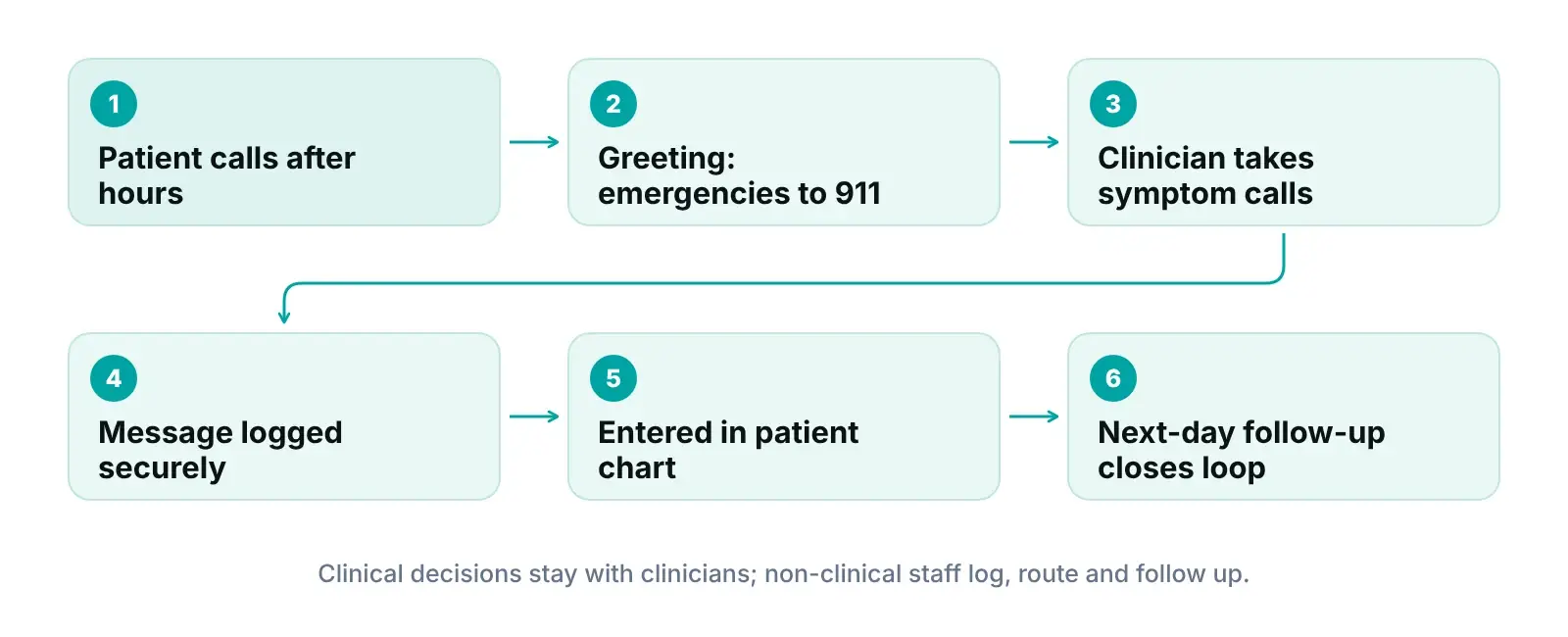
Every after-hours call about a patient belongs in the chart, with a time stamp, who handled it and what happened next. On the first open morning, one person reconciles the overnight log.
The AAP notes that a service can log encounters and enter relevant details into the chart, and prefers an electronic link to the practice so information arrives right away. In practice:
- One queue, one owner: service logs, on-call notes and portal messages land in one place, worked by one named person.
- Clinicians write clinical notes: a VMA or front-desk staffer may attach a message but never documents clinical advice.
- Close the loop: each message gets a disposition (called back, booked, routed to the nurse, refill request sent to the provider) by the end of the first open day.
The Security Rule’s technical safeguards at 45 CFR 164.312 include unique user identification, automatic logoff and audit controls. Give each agent or VMA their own login, never a shared front-desk account, so the audit log shows who handled each message.
How should you handle scheduling and balance calls in late December?
Give each call type an owner: book routine visits, route clinical questions to clinicians and answer deductible and balance questions from a script.
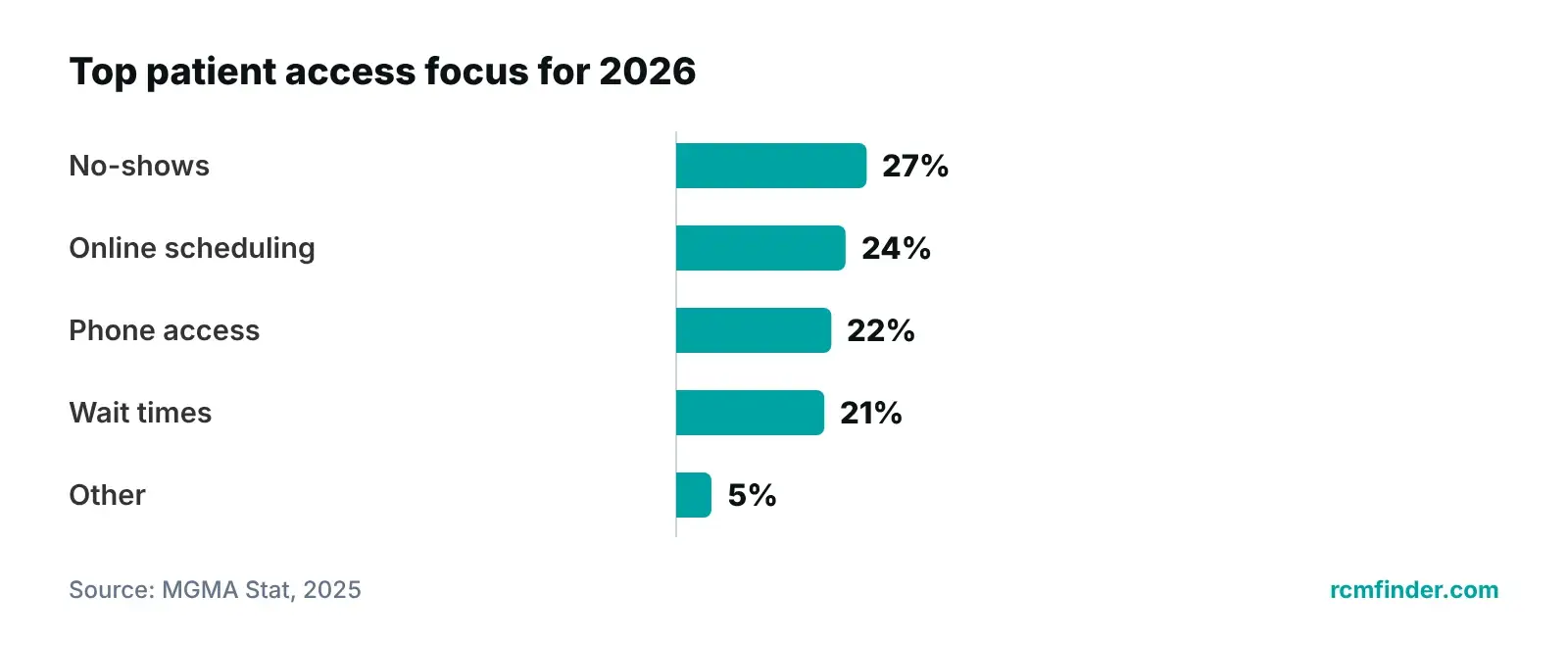
In a December 9, 2025 MGMA Stat poll with 236 responses, 22% of practice leaders named phone access as their top patient access focus for 2026, close behind no-shows (27%) and online scheduling (24%).
Deductible and balance questions
Deductibles on calendar-year plans reset on January 1, which prompts calls about booking before or after the new year. In KFF’s 2025 Employer Health Benefits Survey, 88% of workers with single coverage had a general annual deductible, averaging $1,886 among those with one. CMS set the 2026 Medicare Part B deductible at $283, up from $257 in 2025.
Give non-clinical staff a script: confirm identity, explain the balance from the statement, offer your patient payment plan options within policy and never predict next year’s coverage. Clear statements help; see our guide to patient-friendly billing statements. December 25 and January 1 are both Federal Reserve holidays, so electronic payments made just before may post later.
| Call type | Open days | Closed days and nights | Logged in |
|---|---|---|---|
| Emergency symptoms | Repeat the 911 instruction; alert a clinician | Greeting: call 911 | Clinician’s note |
| Urgent clinical question | Clinical staff, per the script | On-call clinician or triage line | Clinician’s note |
| Refill request | Provider queue | Message; on-call clinician decides if it can wait | EHR refill task |
| Booking or rescheduling | Front desk or VMA | Portal or message | Appointment record |
| Balance question | Billing staff or VMA, from the script | Returned on the first open day | Account note |
| Records request | Log the date received | Log the date received | Request log (30-day clock) |
| Self-pay visit booked | Good faith estimate on time | Named estimate owner | Estimate copy |
Sources: 45 CFR 164.524(b)(2) and 149.610(b), eCFR (current as of October 7, 2026); other cells are a planning template.
Two clocks keep running while you are closed: the 30-day deadline to act on a records access request under 45 CFR 164.524, and self-pay good faith estimates under 45 CFR 149.610, due 1 to 3 business days after scheduling depending on lead time. That section does not define “business day,” so name an estimate owner before you close.
Automated reminders and the TCPA healthcare exemption
Under 47 CFR 64.1200(a)(9)(iv), providers may send automated calls or texts to a patient’s cell phone without prior express consent only if they are free to the patient, go to the number the patient gave and stay within listed purposes such as appointment reminders, lab results and prescription notifications. Limits: one message a day, three a week, texts of 160 characters or less, and an opt-out in every message. Billing and debt-collection content is excluded, and a closure notice is not a listed purpose, so check consent with counsel first.
Find the gaps in your phone coverage
Our free practice audit reviews how calls, messages and balances are handled today and which non-clinical work a virtual medical assistant could take on.
Get a Free Practice AuditWhat should you require from an answering service or virtual assistant vendor?
Require a signed Business Associate Agreement before the vendor handles patient information, role-limited access, a named login for every agent, and written escalation and backup plans.
HHS defines a business associate as an organization that creates, receives, maintains or transmits protected health information on your behalf; an answering service that takes patient messages fits. The conduit exception covers only pure transmission, such as the postal service. The agreement must limit uses, require safeguards and incident reporting, and reach subcontractors, and business associates are directly liable for certain HIPAA provisions.
Under the minimum necessary standard, an after-hours agent usually needs the caller’s name, number and reason for calling, not the full chart. Incidental disclosures are permitted only with reasonable safeguards in place, which matters for agents working from home.
| Rule | What it says | What it means for coverage | Source |
|---|---|---|---|
| Business associates | Vendors handling PHI for you need a BAA | Answering services and VMA vendors sign a BAA first | HHS OCR |
| Leaving messages | Allowed, with limited details | Call-backs: name, number, request to call back | HHS FAQ |
| Minimum necessary | Limit PHI to what is needed; access by role | Agents get message-level access, not the full chart | HHS OCR |
| Technical safeguards | Unique user IDs, automatic logoff, audit controls, transmission security | One login per agent; audit logs on message systems | 45 CFR 164.312 |
| Right of access | Act within 30 days of receipt; one 30-day extension with a written reason | Log when a records request arrives, even over a holiday | 45 CFR 164.524 |
| TCPA healthcare exemption | Listed purposes only; 1 a day, 3 a week; no billing content | Appointment reminders may qualify; balance reminders do not | 47 CFR 64.1200(a)(9)(iv) |
Sources: HHS Office for Civil Rights guidance and FAQ (content last reviewed 2013–2026); eCFR, current as of October 7, 2026. Summaries, not legal advice.
Questions to ask any phone coverage vendor
- Will you sign our BAA before any agent handles patient information, and do your subcontractors sign one?
- Does every agent have their own login, and can we see the audit log?
- How fast does a symptom call reach our on-call clinician?
- How many agents cover our line, and what happens if your phones or systems fail?
- Can your staff cover extra or holiday-week shifts, and how much notice do you need?
- How do messages reach our EHR, and how do we get our logs back if we leave?
Our own setup: role-based access, audit logging, encrypted (HTTPS) connections, and we put a Business Associate Agreement in place before accessing patient data. Our VMAs work the hours you schedule, so ask us, as you would any vendor, what holiday-week coverage is available. For a wider review, use our HIPAA compliance checklist for medical practices.
Our recommendations
- Write the clinical line first. We start every phone plan by listing which calls need a clinician and having the clinical lead approve the escalation script.
- Never let voicemail be the only route. A recording should send emergencies to 911 and point urgent questions to a live clinician. Treat voicemail as a backstop for routine messages.
- Record and test greetings a week ahead. Record both greetings a week before the first closure, call them from an outside phone to confirm “press 1” reaches a person, and set reminders to switch back.
- Run one message queue with one owner. Service logs, on-call notes and portal messages land in one place, each closed out by the end of the first open day.
- Sign the BAA before the first routed call. We make sure the BAA is signed and each person has their own login before any patient call is routed to an outside team.
- Script January balance calls. Give non-clinical staff a short balance script, the payment plan policy and one rule: nobody predicts next year’s coverage. Keep balance reminders out of exemption-based automated texts.
Bottom line
Holiday phone coverage works when every call type has an owner: 911 for emergencies, a clinician for symptoms and trained non-clinical staff for everything else, with every message logged and closed. If short-staffed open days are your gap, see how our virtual medical assistant services handle non-clinical calls inside your EHR, or start with a free practice audit. For January’s billing questions, see our revenue cycle management services.
Frequently asked questions
Do medical practices need an after-hours answering service?
Not always, but every practice needs a live route for urgent clinical questions when the office is closed. A practice with few after-hours calls may use a greeting that sends emergencies to 911 and connects urgent callers to the on-call clinician. An answering service makes sense when call volume is higher or you want a live voice taking messages. Either way, a clinician makes the clinical decisions.
Does a medical answering service need to sign a BAA?
Yes, if it takes or stores patient messages for you. HHS defines a business associate as an entity that creates, receives, maintains or transmits protected health information on your behalf. The conduit exception covers only services that just transmit information, such as the postal service. The American Academy of Pediatrics also says an answering service or call center must sign a Business Associate Agreement.
Can a virtual medical assistant triage patient calls?
No. Triage means deciding how urgent a symptom is and what the patient should do, which is clinical work for a physician, advanced practice clinician or nurse within your state’s scope-of-practice rules. A virtual medical assistant handles non-clinical calls such as scheduling and balance questions, follows your written escalation script when a caller mentions symptoms, and documents the hand-off.
What should a medical office holiday voicemail say?
Start with “If this is a medical emergency, hang up and call 911.” Then give the closure dates with weekdays, how to reach the on-call provider for urgent questions, what to do about refills and appointments, and when messages will be returned. Keep it short, leave out patient-specific details and test it from an outside phone before you close.
Can we send automated holiday reminder texts to patients?
Appointment reminders may fit the TCPA healthcare exemption at 47 CFR 64.1200(a)(9)(iv) if they are free to the patient, go to the number the patient gave, stay within one message per day and three per week, and include an opt-out. Billing, accounting and debt-collection content is excluded from that exemption. Check your consent records with counsel before sending anything else.
Do HIPAA records-request deadlines pause over the holidays?
The rule contains no holiday pause. Under 45 CFR 164.524, a practice must act on a request for access no later than 30 days after receiving it, with one extension of up to 30 days if it gives the patient a written reason and a completion date. Log the date each request arrives, including during a holiday closure.
Get your free practice audit
Tell us about your practice. A member of our operations team replies within one business day.
- A review of your recent claims, denials and A/R aging
- Where your front desk and prior authorizations slow payment
- A prioritized fix list you keep, whether or not you hire us
Pricing is quoted after the audit, based on your volume and the services you choose. Prefer to talk? Call +1 (302) 556-2288.
Sources
- Business Associates — HHS Office for Civil Rights (2026 (last reviewed July 30, 2026))
- May physician's offices or pharmacists leave messages for patients at their homes? — HHS Office for Civil Rights (HIPAA FAQ) (2022 (last reviewed December 28, 2022))
- Incidental Uses and Disclosures — HHS Office for Civil Rights (2002 (last reviewed 2013))
- Minimum Necessary Requirement — HHS Office for Civil Rights (2003 (page modified March 2026))
- 45 CFR 164.312 — Technical safeguards — eCFR (National Archives) (2026 (current as of October 7, 2026))
- 45 CFR 164.524 — Access of individuals to protected health information — eCFR (National Archives) (2026 (current as of October 7, 2026))
- 45 CFR 149.610 — Good faith estimates for uninsured (or self-pay) individuals — eCFR (National Archives) (2026 (current as of October 7, 2026))
- 47 CFR 64.1200 — Delivery restrictions (TCPA rules) — eCFR (National Archives) (2026 (current as of October 7, 2026))
- After-Hours Telephone Care — American Academy of Pediatrics (2021 (updated August 11, 2021))
- Patient access priorities for 2026 (MGMA Stat) — MGMA (2025 (published December 10, 2025))
- 2025 Employer Health Benefits Survey — KFF (2025 (released October 22, 2025))
- 2026 Medicare Parts A & B Premiums and Deductibles (fact sheet) — CMS (2025 (released November 14, 2025))
- Federal Reserve Board holidays observed — Board of Governors of the Federal Reserve System (2026)
- Holiday schedules (Federal Reserve Financial Services) — Federal Reserve Banks (2026)
- 988 Suicide & Crisis Lifeline — SAMHSA (2025 (modified November 13, 2025))
Disclaimer: This article is general educational information about practice operations. It is not legal, HIPAA-compliance, TCPA or medical advice, and it does not tell anyone how to triage symptoms. Scope-of-practice rules, consent requirements and vendor and payer terms vary by state and contract and change over time. Confirm your plan with your clinical leadership and qualified advisors before acting.