
Wound Care Specialty

Wound Care Billing Services, Front Desk and Growth in One Plan

Debridement, skin substitutes under the 2026 Medicare rules, casting, negative pressure and hyperbaric claims, plus referral marketing and a claims portal for wound care practices.
  • Works inside your current EHR
  • US practice time zone, every shift
  • Weekly KPI reporting, or on your schedule
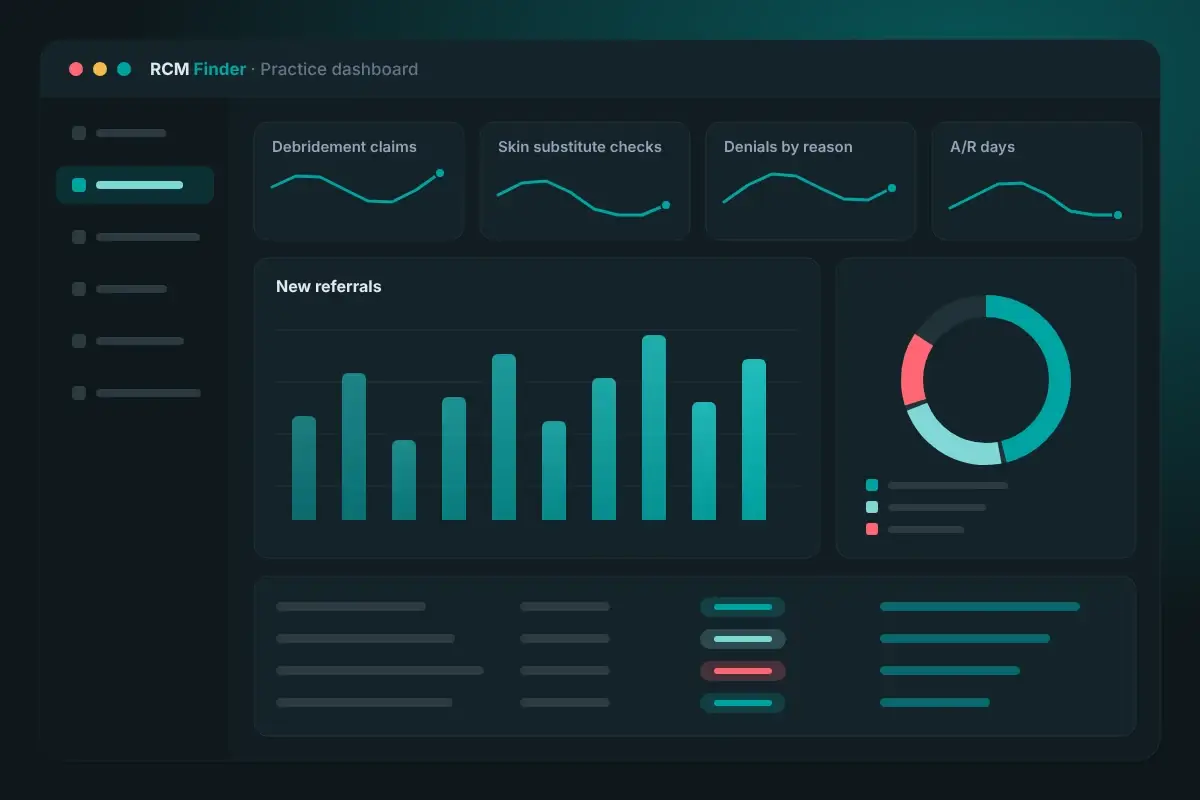
Wound care billing dashboard showing debridement claims, skin substitute checks, denials, A/R days and new referrals

Quick answer

Wound care billing services manage claims for debridement, skin substitutes, casting, negative pressure therapy and hyperbaric oxygen. They check depth, area, product, application codes and coverage history before billing. RCM Finder adds front-desk assistants, referral marketing and a claims portal, with pricing quoted after a free audit.

Disclaimer: This page is educational and is not legal, coding or compliance advice. CPT and HCPCS codes, Medicare rules, local coverage determinations, fee schedule amounts and payer policies change often and vary by contractor, setting and plan. Verify every code, limit and rule against current CMS documents, your Medicare Administrative Contractor's guidance, your payer contracts and the current CPT and HCPCS code sets before billing.

Why wound care billing is different

Wound care billing is different because one patient can generate debridement, casting, negative pressure, hyperbaric and skin substitute claims across weeks, each with its own depth, size, time and coverage rules. A note that is thin on one measurement can become a denial or an audit request.

Money is also moving fast. CMS reported that Medicare Part B spending on skin substitutes grew to over $10 billion in 2024. For 2026, CMS changed how most of these products are paid, and its own estimate is that the change cuts Medicare spending on them by nearly 90%. A clinic that still bills skin substitutes the 2025 way may bill a discarded amount Medicare will not pay.

  • Measurements drive payment. Depth, wound area in square centimeters and product use must match the claim line.
  • Services overlap. Debridement, casting, dressings and an office visit can land on one date, and some pairs are not paid together.
  • Coverage depends on history. Hyperbaric oxygen and negative pressure therapy ask what was tried first, and for how long.
  • Rules differ by setting and contractor. A physician office, a hospital outpatient department and each Medicare Administrative Contractor (MAC) can apply different rules.

For code detail, see our guides to wound care CPT coding, debridement CPT codes, skin graft CPT codes and wound types and treatment.

The four pillars, built for a wound care practice

A wound clinic earns revenue when a referral becomes a first visit, the visit is documented to the payer's standard, and the claim is paid. Our four pillars cover each link and share one claims portal.

You can buy any one pillar alone.

Pillar 1 · Healthcare Marketing

Healthcare Marketing for wound care practices

Our healthcare digital marketing aims at the people who send you patients (primary care, podiatrists, home health, nursing facilities) and at patients searching nearby.

  • Local pages for non-healing wound searches
  • Referral-partner pages and a referral form
  • Reviews answered without confirming a patient
  • KPI: new wound patients by referral source
Explore Healthcare Marketing
Pillar 2 · Virtual Medical Assistants

Virtual Medical Assistants for wound care front desks

Our virtual medical assistants work on your practice's time zone. They verify coverage, gather prior records and chase missing referrals. They do not make clinical decisions or take wound measurements.

  • Eligibility and plan type checked before the first visit
  • Prior wound history requested from referring offices
  • Prior authorization requests tracked where required
  • KPI: visits cleared before the date of service
Explore Virtual Medical Assistants
Pillar 3 · End-to-End RCM

End-to-End RCM for wound care claims

Our end-to-end revenue cycle management covers coding support, claim scrubbing, submission, denial management and A/R follow-up. For wound care, scrubbing checks depth, area, code pairs, product and application codes, and modifiers.

  • Claims held when depth or area is missing
  • Skin substitute lines checked for product, application code and size
  • Denials grouped by reason
  • KPI: denials by reason and A/R days
Explore End-to-End RCM
Pillar 4 · Practice Management System

Practice Management System for wound care tracking

Our practice management system gives billing teams a claim pipeline by stage, data-completeness checks, workflow rules, role-based access, an audit log and dashboards. Appointment booking is early access only.

  • Claims tracked by stage
  • Rules to flag or hold a claim
  • Underpayment detection against expected amounts
  • Audit log and role-based permissions
Explore Practice Management System

Find where your wound care claims leak

We review recent wound care claims and denials, then show what to fix first.

Get a Free Practice Audit

Wound care service families: codes, rules and denial triggers

Most wound care denials trace back to depth, area, a code pair that cannot be billed together, or a missing note. The table shows the rule behind each service and the denial we check for first.

Wound care service families: code examples, billing rules and typical denial triggers
Service familyCode examples (our wording)Billing rule to knowTypical denial trigger
Active (selective) wound care management97597, 97598Dressing changes alone generally do not qualify; not billed with 11042–11047 on the same woundDressing change billed as debridement; both code families on one wound
Surgical debridement by depth11042–11047 (subcutaneous, muscle or fascia, bone, with add-ons for more area)Code follows the deepest tissue removed, not the ulcer's depthNote gives no tissue level, or the level does not match the code
Same-day office visitE/M with modifier 25Paid only if separately identifiable and necessaryRoutine wound check billed with a debridement
Skin substitute application and productSheet application 15271–15278; non-sheet application G0681–G0684; product Q and A codesFrom 2026 most non-BLA products are paid as incident-to supplies; discarded product is not billableNo application code; wound size missing; JW or JZ on a non-BLA product
Casting and compression29445 (total contact cast), 29580 (Unna boot), 29581 (multilayer compression)Supplies are included; with same-area debridement, only debridement may be paidCasting billed with same-area debridement
Negative pressure wound therapy97605–97608 (clinic-applied therapy, durable or disposable equipment); home pump and supplies under the DME policyChronic wound, monthly measurements, prior wound program documentedNo measurements; eschar not debrided; osteomyelitis untreated
Hyperbaric oxygenChamber sessions; code set varies by settingNCD 20.29 lists covered conditions; diabetic wounds need Wagner grade III or higher and failed standard carePressure or stasis ulcer submitted; no 30-day healing record

Sources: First Coast wound care billing article A55818 for LCD L37166 (revision effective 2026); Noridian article A58565 for LCD L38902; CMS NCCI Policy Manual ch. 3 and ch. 4 (2026); First Coast and CMS notices on 2026 skin substitute payment; CMS NCD 20.29; CMS MLN negative pressure wound therapy compliance tip (2026). MAC rules differ; confirm yours.

Debridement: depth, area and the same-wound rule

First Coast's wound care article says the code should reflect the tissue level removed, that measurements should be taken after debridement, and that 97597 and 97598 should not be reported with 11042–11047 for the same wound. Older First Coast guidance adds that the first code covers the first 20 square centimeters, with add-on codes for each further band. Our scrub rule: the note must name the tissue level, the method and the area, or the claim waits for the clinic.

Frequency: what reviewers expect

Noridian's wound and ulcer care article says only a minority of patients appear to need more than twelve surgical excisional debridements in 360 days, and that more than four in a month is unlikely. Documented necessity and benefit can justify more. We treat these levels as flags for a note check, not hard stops. Other MACs may differ.
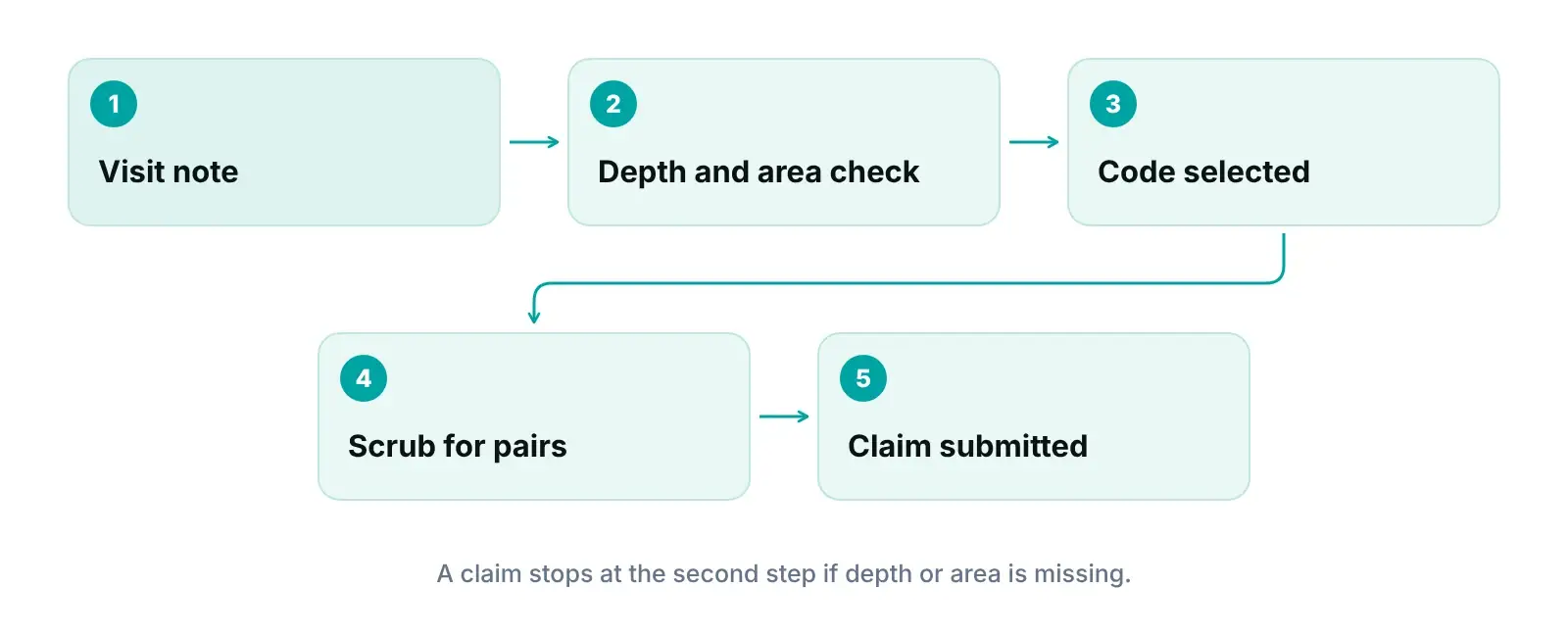
Diagram of a wound care debridement claim from visit note and measurements through coding and scrubbing to payment
How a wound visit becomes a clean debridement claim.

Total contact casting and compression

Noridian's article says supplies for total contact casting (29445) and Unna boots (29580) are included in those codes. When a debridement and a cast or boot are both done, only the debridement may be reimbursed. Casting alone may be paid if the wound is not debrided. The NCCI manual adds that casting, splinting and strapping are not reported separately when a musculoskeletal service is done on the same anatomic area.

Negative pressure wound therapy

CMS's provider compliance tip says a pump is covered for chronic ulcers present at least 30 days, such as stage 3 or 4 pressure ulcers and neuropathic, venous or arterial wounds, after a complete wound therapy program was tried or ruled out. It asks for measurements at least monthly and cites a 17% improper payment rate for 2024. Noridian lists exclusions, such as eschar that has not been debrided and untreated osteomyelitis near the wound.

Hyperbaric oxygen

Medicare covers hyperbaric oxygen only for conditions listed in National Coverage Determination 20.29, and only in a chamber. A diabetic lower-extremity wound needs all three: diabetes with a diabetes-caused wound, a Wagner grade of III or higher, and failure of standard wound therapy. Coverage begins after at least 30 days of standard care with no measurable healing, the wound is evaluated at least every 30 days, and coverage stops if a 30-day period shows no healing. Cutaneous, decubitus and stasis ulcers are not covered. We ask for the 30-day record before the first session is scheduled.

Skin substitutes in 2026: how Medicare now pays and what to bill

Since January 1, 2026, Medicare pays for most skin substitutes as incident-to supplies used with a covered application procedure, not as separately priced biologicals. CMS finalized a single payment rate across product categories, and a November 28, 2025 correction notice states that rate as $127.14 per square centimeter.

CMS's original fee schedule fact sheet said about $127.28, and the notice corrected references to that figure. Ask your MAC for the current amount before you build projections.

What changed in practice

  • Setting. The incident-to policy applies when the application procedure is paid under the fee schedule (non-facility) or the outpatient payment system. Per CMS, hospital outpatient products were packaged into application codes 15271–15278 and are now separate.
  • Biologics license products. First Coast reports that products marketed under a biologics license application remain separately paid as biologicals. Others are paid as supplies.
  • Non-sheet products. First Coast states that claims on or after January 1, 2026 need an application code (G0681–G0684) with the product code on the same date of service, and that payment follows the documented wound size in square centimeters.
  • Documentation. First Coast asks for the product name or maker, total wound size in square centimeters and records that support necessity.

Wastage, JW and JZ

The JW and JZ modifiers are for separately payable drugs and biologicals. CMS's JW and JZ FAQ says that for most non-BLA skin substitutes from January 1, 2026, only the administered portion is billable, discarded units cannot be billed with JW, and JZ is not appropriate when the entire product is used. First Coast says claims with JW or JZ on non-sheet skin substitutes are rejected.

Bundled debridement

The NCCI Policy Manual says debridement of a skin wound before a graft or skin substitute (15050–15278) is included in that procedure.

Local coverage and prior authorization

A draft LCD on skin substitutes for diabetic foot and venous leg ulcers did not take effect; Noridian reported it was removed effective January 1, 2026. Separately, CMS's WISeR model reviews selected services for Original Medicare patients in six states. Its FAQ says skin substitutes are included only in WISeR states with an active skin substitute LCD, so check your state before assuming a request is required.
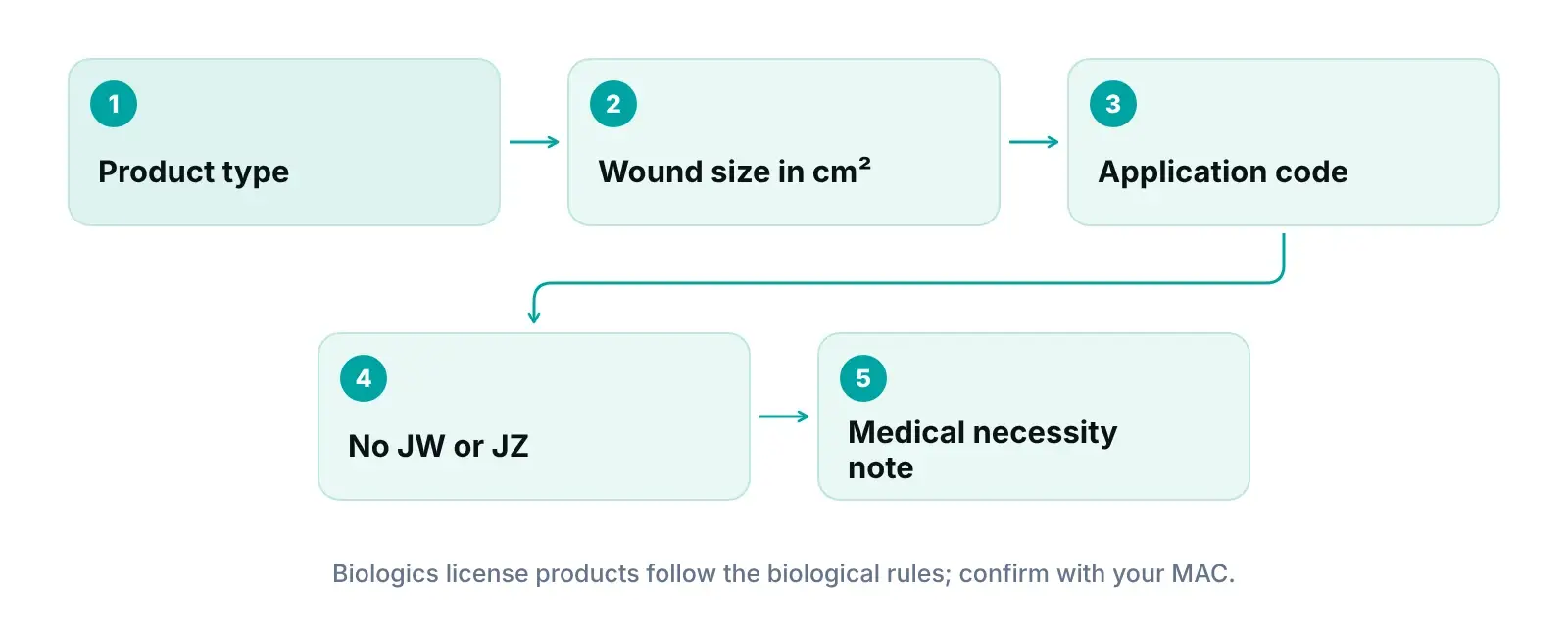
Diagram of skin substitute claim checks from product type and wound size to application code and wastage review
The checks a 2026 skin substitute claim passes before it is sent.

See what denials and rejections cost you

Enter your claim volume and denial rate to estimate what your practice is losing.

Open the Revenue Calculator

Hospital outpatient department or physician office: what changes

The same wound service is paid under different systems depending on where it is done. A physician office bills the professional claim under the physician fee schedule. A hospital outpatient department bills under the outpatient payment system. The 2026 skin substitute rule shows the split: CMS tied the supply payment to the fee schedule in the non-facility setting, or to the outpatient system in the hospital outpatient department.

First Coast's wound care article adds a setting rule: therapists doing active wound care add therapy modifiers and use therapy revenue codes, while non-therapists use non-therapy revenue codes. We ask every new clinic for its sites of service and who builds each claim. Related reading: endocrinology billing for diabetic foot care, general surgery billing for surgical wounds and podiatry modifiers.

Pre-visit checks: coverage, prior records and prior authorization

A wound claim is easier to pay when the front desk collects the right history before the visit. This checklist shows the rules we work from.

Pre-visit checklist: coverage and history rules our team checks for wound care patients
RuleSourceWhat the team checks before the visit
Hyperbaric oxygen for a diabetic foot wound needs diabetes, Wagner grade III or higher, and failed standard care of at least 30 daysCMS NCD 20.29Diabetes diagnosis, wound grade in the referral, and 30-day healing record
Home NPWT needs a chronic ulcer present 30 days or more and a documented wound programCMS MLN compliance tip (2026)Wound age, prior treatments tried, monthly measurement history
NPWT is denied for undebrided eschar, untreated osteomyelitis, cancer in the wound or an open fistulaNoridian DME notice (2024)Chart notes for each exclusion before a pump order
Non-BLA skin substitutes are paid as supplies; non-sheet products need G0681–G0684 and wound sizeFirst Coast notices (2026)Product type, application code planned, wound size in square centimeters
WISeR includes skin substitutes only in states with an active LCDCMS WISeR FAQPatient state, Original Medicare status, request needed or not
More than four debridements in a month or twelve in 360 days are treated as unusual unless documentedNoridian article A58565Count of recent debridements and documented benefit
Debridement plus casting on the same area: only debridement may be paidNoridian article A58565Same-day plan, so the claim matches the paid service

Sources: CMS NCD 20.29 (2017); CMS MLN negative pressure wound therapy compliance tip (2026); Noridian DME NPWT exclusions notice (2024); First Coast skin substitute notices (2026); CMS WISeR FAQ (2026); Noridian wound and ulcer care article A58565. Always check your patient's plan and your MAC's current policy.

For the front-desk steps behind this table, see our guides to patient insurance verification and prior authorization. Real-time eligibility checks inside the portal are coming next, so today the VMAs run them in the payer's own tools.

Growing a wound care practice through referral partners

Most new wound patients arrive by referral, so marketing starts with the people who send them.

  • Referral partners. Primary care offices, podiatrists, home health agencies and nursing facilities need one page on what you treat and how to refer.
  • Search. Patients and caregivers search by condition. Local pages built around those searches help.
  • Reporting. We tie leads to booked first visits.

In-house team, billing-only vendor or four-pillar partner?

The right model depends on who owns each wound-specific job today. Use the table to see where the gaps are.

Decision table: which model fits a wound care practice?
JobIn-house teamBilling-only vendorFour-pillar partner (RCM Finder)
Depth and area checksCoder reviews when time allowsCoded from the note as writtenClaims held until tissue level and area are present
Skin substitute claimsDepends on one biller's knowledgeOften billed from a charge sheetProduct, application code and size checked before submission
Hyperbaric and NPWT historyNurse tracks it; front desk may not see itRarely seen before the claimVMA requests 30-day records first
Referral growthA separate agency, or nobodyNot includedMarketing tied to booked visits
Denials and A/RWorked between other tasksWorked, with reporting that variesDenials grouped by reason with weekly review
Cost structureSalaries, benefits, turnoverVaries; ask how fees are setQuoted after a free practice audit

If you already run a strong in-house biller, you may only need analytics or front-desk help. Whatever you choose, review denial management monthly.

How it works

Onboarding starts with a free audit and a signed Business Associate Agreement.

  1. 1

    Free practice audit

    We review recent wound care claims, denials and eligibility records.

  2. 2

    Business Associate Agreement and access

    We put a Business Associate Agreement in place before accessing patient data. Then we work inside your existing EHR (for example PrognoCIS, eClinicalWorks or athenahealth).

  3. 3

    Payer-rule map

    Your top plans and your MAC's wound care policy become a checklist and portal rules.

  4. 4

    Front desk and billing go live

    VMAs check coverage and gather records. Claims are scrubbed, submitted and worked through denials and A/R.

  5. 5

    Weekly KPI review

    We review denials by reason, A/R days, claims held for missing measurements and new patients by referral source.

Talk to us about your wound care practice

Tell us your sites of service and hardest payer. We will say honestly whether we fit.

Call +1 (302) 556-2288

Compliance: what to ask any wound care billing company

Any vendor that touches patient data must sign a Business Associate Agreement. HHS guidance says a covered entity may share protected health information with a business associate only after getting satisfactory written assurances, and the agreement must require safeguards and reporting of security incidents.

Ask every vendor these questions:

  1. Will you sign a Business Associate Agreement before seeing patient data, and bind your subcontractors?
  2. Who has access to our records, and is access role-based with an audit log?
  3. Will you bill a skin substitute without product, application code and wound size on the claim?
  4. How do you handle discarded product under the 2026 rules?
  5. Will a coder query the clinic when depth or area is missing, instead of guessing?
  6. Who tells us when a MAC policy changes?
  7. Can you show reports by denial reason, not just totals?

For RCM Finder, the controls we state are role-based access, audit logging and encrypted (HTTPS) connections, and we put a Business Associate Agreement in place before accessing patient data. Our HIPAA compliance checklist covers what to verify in any vendor.

Who this is for, and who it is not for

We would rather tell you now than after you sign. Here is where we fit and where we do not.

A good fit if you are

  • Wound care clinics and wound centers billing Medicare and Medicare Advantage
  • Podiatry, vascular and surgical groups that run a wound program
  • Practices that apply skin substitutes and need the 2026 rules built into billing
  • Groups with hyperbaric or negative pressure therapy that want 30-day records checked up front
  • Billing companies serving wound care clients that want a shared claims portal

Probably not a fit if you are

  • Hospital-employed clinicians whose employer controls billing
  • Practices that want product billed regardless of documentation
  • Practices looking for promised collection rates; we report measured KPIs
  • Groups that need a credentialing module or in-portal real-time eligibility today (coming next)

Expert recommendations from our operations team

What we would do first if we were running your practice's revenue cycle tomorrow.

  1. 01

    Measure after you debride

    Payers expect depth and area that match the code. We ask clinics to record both in the procedure note.

  2. 02

    Name the tissue level

    Surgical debridement codes follow the deepest tissue removed. We query any note that says only “debrided.”

  3. 03

    Retire your 2025 skin substitute workflow

    Check product type, application code and wound size on every line, and stop billing discarded units.

  4. 04

    Keep a 30-day healing record

    Hyperbaric oxygen and NPWT turn on what was tried and when. We keep that history where billing can see it.

  5. 05

    Re-check rules each quarter

    The CY 2027 fee schedule final rule and MAC articles can change skin substitute payment. We review them when published.

Frequently asked questions

What do wound care billing services include?

They cover coding support, claim scrubbing, submission, denial management and A/R follow-up for debridement, skin substitutes, casting, negative pressure therapy and hyperbaric oxygen. A good partner also checks coverage history before visits and reports denials by reason. We add front-desk assistants, referral marketing and a claims portal, so one team handles the work from referral to payment.

How does Medicare pay for skin substitutes in 2026?

Starting January 1, 2026, most non-BLA skin substitutes are paid as incident-to supplies with a covered application procedure, at a single rate across FDA categories. A CMS correction notice states that rate as $127.14 per square centimeter. Products under a biologics license stay separately paid as biologicals. Confirm current amounts with your MAC, because geographic adjustments and later rule changes can affect what you are paid.

Can we bill JW for wasted skin substitute product?

Not for most non-BLA products from January 1, 2026. CMS says only the administered portion is billable, discarded units cannot be billed with JW, and JZ is not appropriate when the whole product is used. First Coast also reports rejection of claims with JW or JZ on non-sheet skin substitutes. Biologics license products follow the biological rules, so check your MAC.

When does Medicare cover hyperbaric oxygen for a diabetic foot ulcer?

NCD 20.29 requires type 1 or type 2 diabetes with a diabetes-caused lower-extremity wound, a Wagner grade of III or higher, and failure of standard wound therapy. Coverage starts only after at least 30 days of standard care with no measurable healing, and the wound is evaluated at least every 30 days. Pressure and stasis ulcers are not covered.

Can debridement and total contact casting be billed together?

Often only one is paid. Noridian's wound and ulcer care article says that when debridement and a total contact cast or Unna boot are both done, only the debridement may be reimbursed, and that casting alone may be paid if the wound is not debrided. Other MACs may differ, so check your contractor's policy and plan same-day services before the visit so the claim matches what is payable.

What does wound care billing cost with RCM Finder?

We quote pricing after a free practice audit, because it depends on your claim volume, sites of service and which pillars you use. The audit reviews your recent wound care claims and denials. You then get a written scope and price. We do not publish a rate, we do not guarantee collections and we report measured KPIs each week.

No cost, no commitment

Get your free practice audit

Tell us about your practice. A member of our operations team replies within one business day.

  • A review of your recent claims, denials and A/R aging
  • Where your front desk and prior authorizations slow payment
  • A prioritized fix list you keep, whether or not you hire us

Pricing is quoted after the audit, based on your volume and the services you choose. Prefer to talk? Call +1 (302) 556-2288.

Tell us about your practice

RCMFinder Master Intake Form
AA

About the author: Awais Afzal

Healthcare Operations & Data Analyst, RCM Finder

Awais has spent more than 16 years in healthcare digital marketing and clinical operations management. He builds data-driven revenue cycle blueprints for high-ticket medical practices and leads product development of the RCM Finder portal. More about our team.

How we write: every figure, code and rule on this page was checked against the primary source listed below and independently fact-checked before publishing. We re-review this page every six months. Last reviewed October 12, 2026; next review April 12, 2027.

Sources

  1. Calendar Year (CY) 2026 Medicare Physician Fee Schedule Final Rule (CMS-1832-F) fact sheet — CMS (2025)
  2. Correction notice to CY 2026 Physician Fee Schedule final rule (document 2025-21458) — Federal Register (public inspection) (2025 (filed for 11/28/2025))
  3. Calendar Year 2026 OPPS and ASC Final Rule (CMS-1834-FC) fact sheet — CMS (2025)
  4. CMS Modernizes Payment Accuracy and Significantly Cuts Spending Waste — CMS (2025 (October 31))
  5. Use of JW and JZ Modifiers when Billing for Separately Payable Incident-to Supplies — First Coast Service Options (2026 (January 30))
  6. Part B billing, payment methodology and documentation requirements for non-sheet skin substitute products — First Coast Service Options (2026)
  7. JW Modifier and JZ Modifier Policy FAQs — CMS (undated (reflects CY 2026 rules))
  8. Noridian removes skin substitute draft policy — Noridian Healthcare Solutions (2026 (January))
  9. WISeR (Wasteful and Inappropriate Service Reduction) Model — CMS (2026)
  10. WISeR Model Frequently Asked Questions — CMS (2026)
  11. Billing and Coding: Wound Care (A55818), LCD L37166 — CMS Medicare Coverage Database / First Coast Service Options (2026 (revision effective 01/01/2026))
  12. Wound Debridement Services coding guide (LCD L33566, older) — CMS Medicare Coverage Database / First Coast Service Options (2008, revised 2017)
  13. Billing and Coding: Wound and Ulcer Care (A58565), LCD L38902 — CMS Medicare Coverage Database / Noridian Healthcare Solutions (2026)
  14. Medicare NCCI Policy Manual, Chapter III (2026) — CMS (2026)
  15. Medicare NCCI Policy Manual, Chapter IV (2026) — CMS (2026)
  16. NCD 20.29 Hyperbaric Oxygen Therapy (Transmittal 203) — CMS (2017)
  17. Negative Pressure Wound Therapy (Provider Compliance Tip) — CMS Medicare Learning Network (2026 (modified February 11))
  18. Negative Pressure Wound Therapy Pumps (NPWT) Exclusions from Coverage — Noridian Healthcare Solutions (DME) (2024)
  19. Business Associates guidance — HHS Office for Civil Rights (current)
  20. CMS 2027 Medicare Physician Fee Schedule Proposed Rule: Key Changes for Wound Care — HMP Global (trade press) (2026)