
Same-day visits, biopsies, Mohs and pathology claims, biologic prior authorization, patient marketing and a claims portal for dermatology practices, built on CMS rules and your payers' own policies.
By Awais Afzal | Healthcare Operations & Data Analyst
Published October 12, 2026 · Last reviewed October 12, 2026 · Next review April 12, 2027
Quick answer
Dermatology billing services handle the claims a skin practice creates: same-day visits with modifier 25, biopsies coded by technique, destruction counts, Mohs stages and blocks, dermatopathology, and the line between cosmetic and medically necessary care. RCM Finder pairs that billing with front-desk assistants who start biologic approvals, patient marketing and a claims portal.
On this page
Dermatology billing is different because many visits pair an exam with minor procedures, and each lesion can carry its own code, diagnosis and coverage rule. Many practices also sell cosmetic services Medicare never covers.
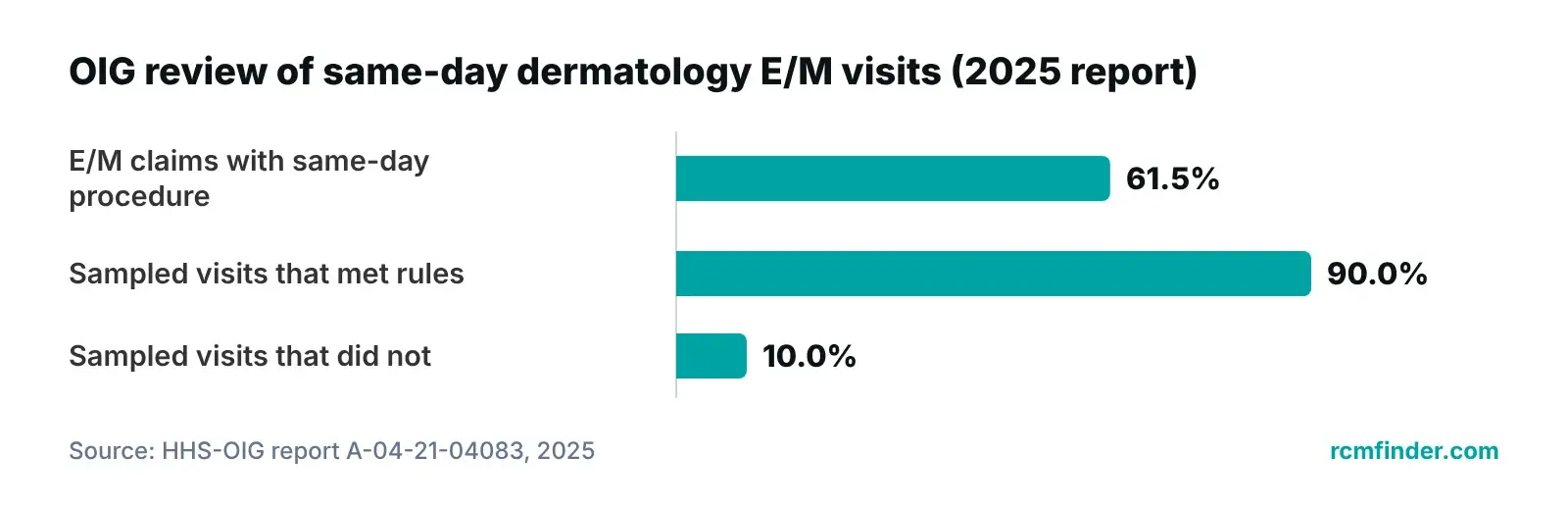
The same-day pattern draws audits. In a November 2025 HHS-OIG report, about 61.5% of Medicare-paid dermatology E/M claims in 2019 and 2020 included a same-day minor procedure by the same dermatologist. Of 100 sampled visits, 10 did not meet Medicare requirements, and OIG estimated $62,915,655 in overpayments. A March 2026 OIG work plan item adds an audit of same-day visits paid without modifier 25.
In its CY 2026 Physician Fee Schedule final rule fact sheet (October 31, 2025), CMS set the conversion factor at $33.40 for clinicians who are not qualifying APM participants, up from $32.35. It applied a -2.5% efficiency adjustment to services that are not time-based; E/M visits are exempt.
Revenue leaks at the handoffs: a cosmetic removal booked as medical, a Mohs case booked before the biopsy report arrives, a biologic prescribed before approval. We run all four pillars against one set of payer rules.
Our healthcare digital marketing builds demand for medical visits and any cosmetic services you offer, through local SEO, Google Ads and reputation work.
Our virtual medical assistants for dermatology run your front desk on your practice's time zone, from eligibility checks to biologic and phototherapy approvals.
Our end-to-end dermatology revenue cycle management covers coding support, claim scrubbing, denial management and A/R follow-up, with lesion-level checks on every claim.
Our practice management system tracks every claim by stage, applies specialty-aware billing logic per claim and checks data completeness before submission.
Find where your dermatology claims leak
We review recent same-day visits, biopsy and Mohs claims and authorization logs, then show what to fix first. Pricing is quoted after the audit.
Most dermatology denials trace to a few rules: a visit not separate from the procedure, more than one primary biopsy code, a wrong destruction count, pathology billed on Mohs margins, or cosmetic work billed as medical. Codes are described in our own words (the AMA owns CPT descriptors).
| Service family | Code examples (our wording) | Billing rule | Typical denial trigger |
|---|---|---|---|
| Visit on the day of a minor procedure | Office E/M with modifier 25; procedure with a 0- or 10-day global | Decision to treat is included; a separate visit must be significant and separately identifiable | Visit billed for the decision to treat; G2211 with a modifier 25 visit |
| Skin biopsy | 11102/11103 (tangential); 11104/11105 (punch); 11106/11107 (incisional) | One primary code, chosen in order (incisional, punch, tangential); others as add-ons | More than one primary biopsy code; biopsy of a lesion removed at that visit |
| Premalignant lesion destruction | 17000 (first lesion); 17003 (2nd to 14th, each); 17004 (15 or more) | Medicare covers actinic keratosis destruction without lesion or patient limits | 17004 billed with 17000 or 17003 |
| Benign lesion removal | 11300–11313 (shave removal); 17110 (up to 14); 17111 (15 or more) | Covered only with a documented reason such as bleeding, pain or diagnostic doubt | Removal for appearance alone; unlisted diagnosis |
| Mohs surgery | 17311/17312 (head, neck, hands, feet, genitalia); 17313/17314 (trunk, arms, legs); 17315 (blocks past five) | One physician as surgeon and pathologist; Appropriate Use Criteria apply | Surgical pathology on margin tissue; trunk or limb lesion without a listed indication |
| Dermatopathology | 88302–88309 (surgical pathology by level); 88331 (frozen section) | Global only if you prepare and read the slide; 26 for the reading alone | Global billed when an outside lab made the slide; Mohs claim without CLIA coverage |
| Phototherapy | 96910 (UVB with tar or petrolatum); 96912 (PUVA); 96913 (4–8 hour severe cases); 96920–96922 (excimer laser) | Medicare covers PUVA only after conventional treatment fails | No documented failure of other treatment; sessions past the approved count |
| Self-injected biologics | Dupilumab, secukinumab, risankizumab and similar drugs | On a self-administered drug list, so not Part B | Billed to Part B as an office drug |
Sources: CMS 2026 NCCI Policy Manual ch. 3; CMS Claims Processing Manual ch. 12 §30.6.6; CMS Transmittal 13015 (2024); AAD Dermatology World (2018); CMS Transmittal 1165 (2007); NCD 250.4 and 250.1; WPS DERM-008 coding guideline (2009, archived); Noridian LCDs L34233 and L35702 and articles A57161 and A56514 (2025–2026); Noridian modifier 26 page; Mass General Brigham Health Plan policy 043 (2025); Novitas A53127 (2026). Rules vary by contractor and payer.
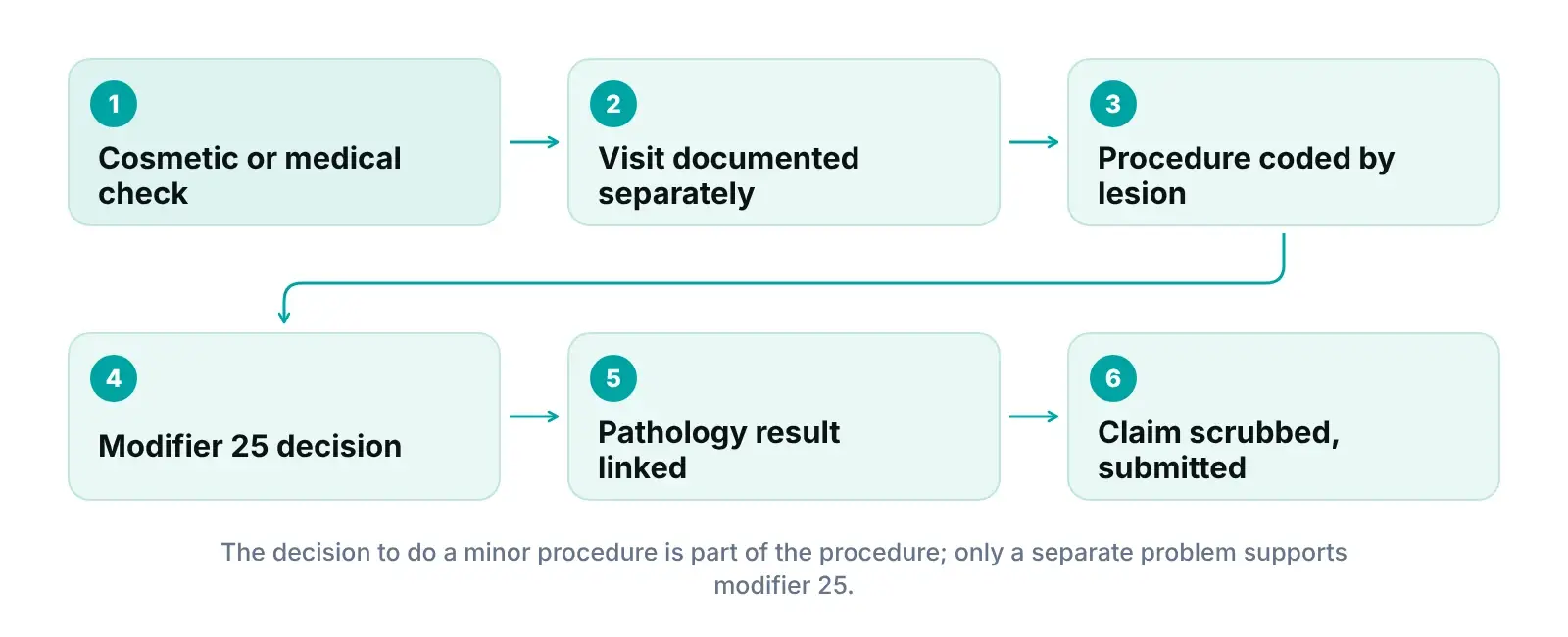
The 2026 NCCI Policy Manual says the decision to perform a minor procedure is part of that procedure's payment, and new-patient status alone does not justify a separate visit. The CMS claims processing manual adds that different diagnoses are not required, but both services must be documented. Under a December 2024 CMS transmittal, G2211 is not paid with a modifier 25 visit unless an annual wellness visit, vaccine administration or Part B preventive service is on the same day. See our explainer on modifier 25 vs 59.
Since 2019, skin biopsies are coded by technique, each with a first-lesion code and an add-on, as a Nevada Medicaid notice lists. The American Academy of Dermatology's Dermatology World explains that only one primary biopsy code is reported, chosen in this order: incisional, then punch, then tangential. NCCI folds a biopsy into the removal code when that lesion is removed at the same encounter. For actinic keratoses, NCD 250.4 covers destruction without restrictions based on lesion or patient characteristics.
Noridian's Mohs LCD (L35702) follows the 2012 Appropriate Use Criteria and requires one physician to act as surgeon and pathologist. Its billing article (A56514) says billing surgical pathology codes on Mohs margin tissue is inappropriate, and it denies those Mohs claims. NCCI allows a pre-Mohs biopsy and frozen section with modifier 59, XS, XU or 58, and repairs, grafts and flaps are billed separately; see our skin graft CPT codes guide. A 2007 CMS transmittal places the Mohs codes under CLIA edits. Other MACs may differ.
Noridian applies modifier 26 to pathology readings billed apart from the technical component, which CMS MLN Matters SE0587 defines as staff, supplies and equipment. Bill globally only when your practice prepares and reads the slide. See our pathology CPT codes guide.
Noridian's benign lesion billing article (A57161) lists diagnoses that pay alone and others that need a complicating diagnosis, and treats any unlisted code as unsupported. See our guides to eczema ICD-10 codes and ICD-10 codes for skin tags.
Decide whether a service is cosmetic or medically necessary when it is booked, document the reason, and tell the patient the price before the procedure.
Under 42 CFR 411.15(h), Medicare excludes cosmetic surgery, except prompt repair of accidental injury or improving the function of a malformed body member. Noridian's benign skin lesion LCD (L34233) covers removal only when the record shows a reason such as bleeding, intense itching, pain, inflammation, an obstructed orifice or vision, diagnostic doubt or repeated trauma. Removal for appearance alone is the patient's cost.
Chapter 30 of the CMS claims processing manual says ABNs are not required for statutorily excluded care such as cosmetic surgery, though CMS encourages voluntary notices. It rejects routine or blanket notices. Use the ABN (form CMS-R-131) when a covered service may be denied as not reasonable and necessary. CGS, a Medicare contractor, lists the claim modifiers:
Our guide to dermatology services covered by insurance and ABN guide for medical billing go deeper.
Start prior authorization when the visit or prescription is planned. In dermatology that usually means self-injected biologics for psoriasis and atopic dermatitis, and phototherapy.
Novitas's self-administered drug exclusion list (A53127) includes dupilumab, secukinumab, risankizumab and subcutaneous ustekinumab, among others. Drugs on these lists are self-administered more than 50% of the time, so Part B does not cover them as office drugs. For Medicare patients, coverage runs through the Part D plan, which CMS gives 72 hours for a standard decision and 24 hours for an expedited one.
For medical services, the CMS-0057-F rule has required Medicare Advantage, Medicaid and CHIP plans since January 1, 2026 to decide expedited requests within 72 hours and standard ones within seven calendar days; drugs are excluded. In the AMA's 2025 survey of 1,000 physicians (released May 2026), physicians averaged 40 prior authorizations and 13 hours of physician and staff time per week.
For phototherapy, Medicare's psoriasis NCD (250.1) covers PUVA only for intractable, disabling psoriasis that has not responded to conventional treatment. Commercial plans set their own rules. Mass General Brigham Health Plan's 2025 policy, for example, requires approval for photochemotherapy and excimer laser and allows up to 36 initial photochemotherapy treatments within 16 weeks.
| Rule | Source | What the VMA checks before the visit |
|---|---|---|
| Benign lesion removal needs a documented medical reason; cosmetic removal is the patient's cost | Noridian LCD L34233 (2025) | Reason for the visit; if cosmetic, price quoted and self-pay agreed |
| ABN not required for excluded care; no blanket ABNs; GA, GX, GY, GZ on claims | CMS Claims Processing Manual ch. 30; CGS | Mandatory ABN only when a covered service may be denied |
| Self-injected biologics on the self-administered drug list are not Part B drugs | Novitas A53127 (2026) | Drug plan, its approval form, prior treatments and pharmacy confirmed |
| Part D: 72 hours standard, 24 hours expedited; exception clock starts with the prescriber's statement | CMS Part D coverage determinations page | Request date logged; prescriber statement sent; follow-up on the due date |
| MA, Medicaid and CHIP medical requests: 72 hours expedited, 7 days standard; drugs excluded | CMS-0057-F; in effect Jan 1, 2026 | Due date logged; denial reason saved for appeal |
| PUVA covered for intractable, disabling psoriasis after conventional treatment fails | NCD 250.1 | Prior treatments and dates charted |
| Example plan: photochemotherapy and excimer need approval; photochemotherapy starts at up to 36 treatments in 16 weeks | Mass General Brigham Health Plan policy 043 (2025) | Sessions used vs approved |
| Mohs: trunk and limb lesions only for listed indications; if the site was biopsied in the last 60 days, get that report instead of repeating the biopsy | Noridian L35702 and A56514 | Lesion site and referring pathology report on file |
Sources: CMS Medicare Coverage Database (Noridian L34233, L35702, A56514, 2025–2026; Novitas A53127, 2026); CMS Claims Processing Manual ch. 30; CGS ABN page (2026); CMS Part D coverage determinations page (2024); CMS-0057-F fact sheet (2024); NCD 250.1; Mass General Brigham Health Plan policy 043 (2025). Always check the member's current plan.
See also our guide to expediting prior authorization for medication.
See what delays and denials cost you
Enter your claim volume and denial rate to estimate what your dermatology practice is losing.
Dermatology growth comes from medical and cosmetic demand, and both meet privacy rules when you use patient photos, reviews or website tracking.
Full face photos are HIPAA identifiers under 45 CFR 164.514, and 45 CFR 164.508 requires the patient's authorization to use protected health information for marketing. We post before-and-after photos only with a signed authorization. HHS guidance says tracking on appointment pages can collect protected health information. A 2024 court order vacated part of it; we still keep tracking off booking forms without a vendor BAA.
The FTC's 2024 final rule bans fake reviews and paying for reviews of a particular sentiment. Our review replies never confirm that someone is a patient. For the cosmetic side, see our aesthetic practice growth strategies.
Stay in-house if you have experienced dermatology coders and time for biologic approvals. Use a billing-only vendor if claims are your only gap. Choose a combined partner when problems start at booking.
| Job | In-house team | Billing-only vendor | Four-pillar partner (RCM Finder) |
|---|---|---|---|
| Cosmetic or medical, decided at booking | Front desk, if trained | Usually left to the practice | VMA flags it; price quoted first |
| Modifier 25 and lesion-level coding | Depends on one coder | Fixed on the claim, after the visit | Checked against the note before submission |
| Biologic and phototherapy approvals | Staff between calls | Usually out of scope | VMA tracks each request to a decision |
| Mohs and pathology claims | Surgeon's team | Coded from the charge sheet | Stages, blocks, repair and 26 or TC checked |
| Patient growth and reviews | A separate agency, or nobody | Not included | Marketing tied to booked visits |
| Cost structure | Salaries, benefits, turnover | Varies; ask how fees are set | Quoted after a free practice audit |
We start with a free audit and change nothing until you see the findings. We build our billing pipeline around how claims actually move through a practice: registration, charge entry, submission, payment and follow-up. For dermatology, we add the checks on this page.
We review recent same-day visits, biopsy, Mohs and pathology claims, cosmetic charges and authorization logs.
We put a Business Associate Agreement in place before accessing patient data. Then we work inside your existing EHR (for example PrognoCIS, eClinicalWorks or athenahealth).
Your contractor's lesion and Mohs documents and your plans' drug and procedure rules become a pre-visit checklist and portal rules.
VMAs sort cosmetic from medical and start approvals. Claims are coded by lesion, scrubbed, submitted and worked through denials and A/R.
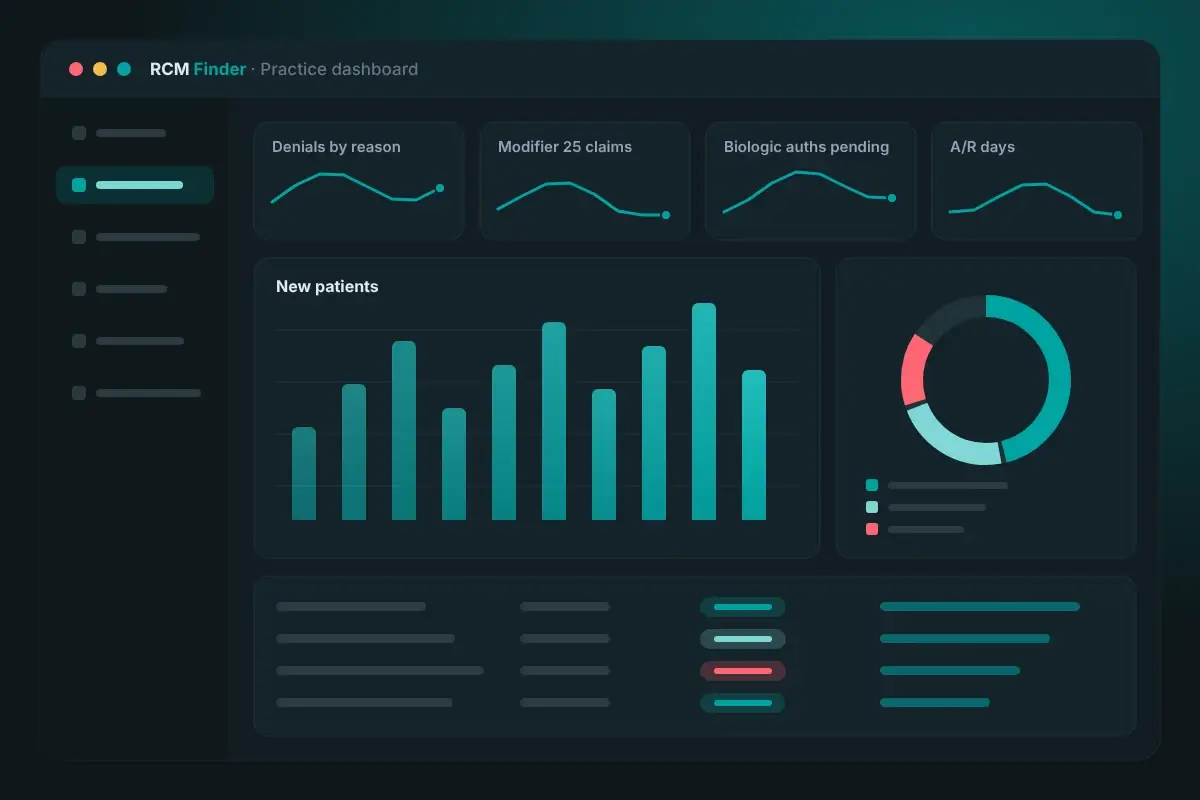
We review denials by reason, modifier 25 claims, A/R days and new patients by source each week.
Talk to us about your dermatology practice
Tell us your procedure mix, whether you run a Mohs lab and your hardest payer. We will tell you honestly whether we fit.
Any billing vendor that handles your patients' data is a HIPAA business associate. Get a Business Associate Agreement before they have any access, and check how they limit and log that access.
HHS guidance names billing, claims processing and practice management as business associate work, and subcontractors need their own agreement. The minimum necessary standard limits use to what each task needs. The Security Rule's technical safeguards require access control, audit controls, integrity controls, person or entity authentication and transmission security.
We use role-based access, audit logging and encrypted (HTTPS) connections, and we put a Business Associate Agreement in place before accessing patient data.
We would rather tell you now than after you sign. Here is where we fit and where we do not.
A good fit if you are
Probably not a fit if you are
What we would do first if we were running your practice's revenue cycle tomorrow.
We ask the reason for every lesion visit when it is booked. Cosmetic work is priced first and stays off the insurance claim.
OIG has audited dermatology same-day visits. We ask providers to document the separate problem apart from the decision to treat.
Each lesion gets its own technique, count, site and diagnosis. We check biopsy order and destruction counts before the claim leaves.
We collect the outside pathology report before the surgery date, so no biopsy is repeated without a documented reason.
We check the drug plan and its approval form before the first dose is planned, not after a Part B denial.
If CMS finalizes the 50% same-day reduction, we will model your visit-plus-procedure mix against the final rule.
They cover coding support, claim scrubbing, submission, denial management and A/R follow-up for dermatology visits and procedures: biopsies, destructions, excisions, Mohs surgery, phototherapy and pathology. A good service also separates cosmetic from medically necessary care before the visit and checks that each modifier 25 visit is documented. RCM Finder adds front-desk assistants, patient marketing and a claims portal, so the same rules apply from booking to payment.
Yes, when the visit is significant and separately identifiable from the procedure, reported with modifier 25. The decision to do a minor procedure is already included in the procedure's payment, so it does not justify a visit on its own. Different diagnoses are not required, but the record must support both services. CMS has proposed paying one of the two at 50% starting in 2027, so check the final rule.
Report one primary biopsy code and add-on codes for the rest. The American Academy of Dermatology explains the order: incisional first, then punch, then tangential. For example, one incisional, one punch and two tangential biopsies are coded 11106, 11105, 11103 and 11103. A biopsy of a lesion you remove at the same visit is included in the removal code.
No. CMS says an ABN is not required for care Medicare excludes by law, and cosmetic surgery is one of those exclusions. CMS does encourage a voluntary notice so the patient knows they will pay. On a claim, GY marks a statutorily excluded service and GX marks a voluntary notice. Use the mandatory ABN when a normally covered service may be denied as not medically necessary.
Usually not. Novitas, a Medicare contractor, lists dupilumab, secukinumab and similar self-injected biologics on its self-administered drug exclusion list, so Part B does not cover them as office drugs. Coverage runs through the patient's drug plan. Part D plans must decide standard coverage requests within 72 hours and expedited requests within 24 hours. Commercial plans set their own prior authorization rules.
Not for the margin tissue. The Mohs codes already include the surgeon's own pathology review, and Noridian says billing surgical pathology codes on Mohs margin tissue is inappropriate and denies those Mohs claims. A diagnostic biopsy and frozen section before Mohs can be reported separately with the right modifier, and separate, unrelated tissue may be covered with clear documentation. Repairs, grafts and flaps are billed separately. Other Medicare contractors may differ.
Tell us about your practice. A member of our operations team replies within one business day.
Pricing is quoted after the audit, based on your volume and the services you choose. Prefer to talk? Call +1 (302) 556-2288.
Tell us about your practice
About the author: Awais Afzal
Healthcare Operations & Data Analyst, RCM Finder
Awais has spent more than 16 years in healthcare digital marketing and clinical operations management. He builds data-driven revenue cycle blueprints for high-ticket medical practices and leads product development of the RCM Finder portal. More about our team.
How we write: every figure, code and rule on this page was checked against the primary source listed below and independently fact-checked before publishing. We re-review this page every six months. Last reviewed October 12, 2026; next review April 12, 2027.
We use cookies to understand how our site is used and to measure our advertising. You can accept or reject non-essential cookies. See our Privacy Policy.