
Aesthetic practice marketing works best as a short, measurable system: an accurate Google listing, treatment pages that answer patient questions, honest reviews, a fast reply to every inquiry, and compliant use of photos and testimonials. Most of this revenue is cash-pay, so judge every step by booked consultations, not clicks.
Most aesthetic services are paid for by the patient, not by an insurer. That changes the marketing job. There is no referral stream to lean on, no payer panel to be listed on, and no claim to appeal. The patient chooses you on trust, convenience and price, and you have to earn the first call. This guide is for owners and managers of dermatology, plastic surgery, medical spa and injector practices who are comparing what to do next. It replaces an older, generic list of 20 tips with a plan built on sources we checked in October 2026.
Key takeaways
- Cash-pay patients are won on trust and speed, so measure booked consultations and show rate, not likes or impressions.
- Neurotoxin and filler demand is large but flat to slightly up (2024 ASPS data), so winning means standing out locally, not waiting for market growth.
- Reviews, testimonials, influencer posts and patient photos are all regulated: FTC rules, HIPAA authorization and Google policy apply.
- Never offer a discount or free service in exchange for a Google review. Google prohibits it.
- Respond to every inquiry the same day; a missed call is a lost consult.
How aesthetic practice marketing differs from insurance-based marketing
Aesthetic practice marketing is the work of attracting and converting patients who pay out of pocket. Because insurers generally do not cover cosmetic care, the practice carries the whole sales conversation: price, trust and timing. The funnel is shorter than in insurance-based care, but each lead is easier to lose.
Medicare is a useful marker of the line. Under 42 CFR 411.15(h), Medicare excludes cosmetic surgery and related services, with exceptions for repairing an accidental injury or improving the function of a malformed body part. Commercial plans set their own rules, so check each policy before telling a patient anything about coverage.
| Question | Cash-pay aesthetic care | Insurance-billed medical care |
|---|---|---|
| Who pays? | The patient, usually at or before the visit | The payer, plus the patient’s share |
| What wins the booking? | Trust, results shown fairly, convenience, price clarity | Network status, referral, access |
| Main marketing risk | Misleading claims, undisclosed endorsements, privacy slips | Misrepresenting coverage or wait times |
| Key metric | Cost per booked consultation; consult-to-treatment rate | Referrals received; new-patient volume |
| Back-office load | Quotes, deposits, packages, payment plans | Eligibility, prior authorization, claims, denials |
Source: RCM Finder editorial comparison; Medicare cosmetic-surgery exclusion per 42 CFR 411.15(h) (eCFR).
Some practices do both. A dermatology practice, for example, may treat acne or skin cancer under insurance and offer injectables or lasers for cash. Keep the two lines separate in your marketing and your records. Our guide to dermatology services and insurance coverage explains how that boundary is usually drawn.
What the demand data says, and what it does not
Demand for non-surgical aesthetics is large and steady. The American Society of Plastic Surgeons (ASPS) counted 9,883,711 neurotoxin injection procedures in 2024, up 4% from 2023, and 5,331,426 hyaluronic acid filler procedures, up 1% (ASPS, 2024 minimally invasive procedure trends). Skin resurfacing, which ASPS defines to include lasers, peels and microdermabrasion, reached 3,703,305 procedures, up 6%.
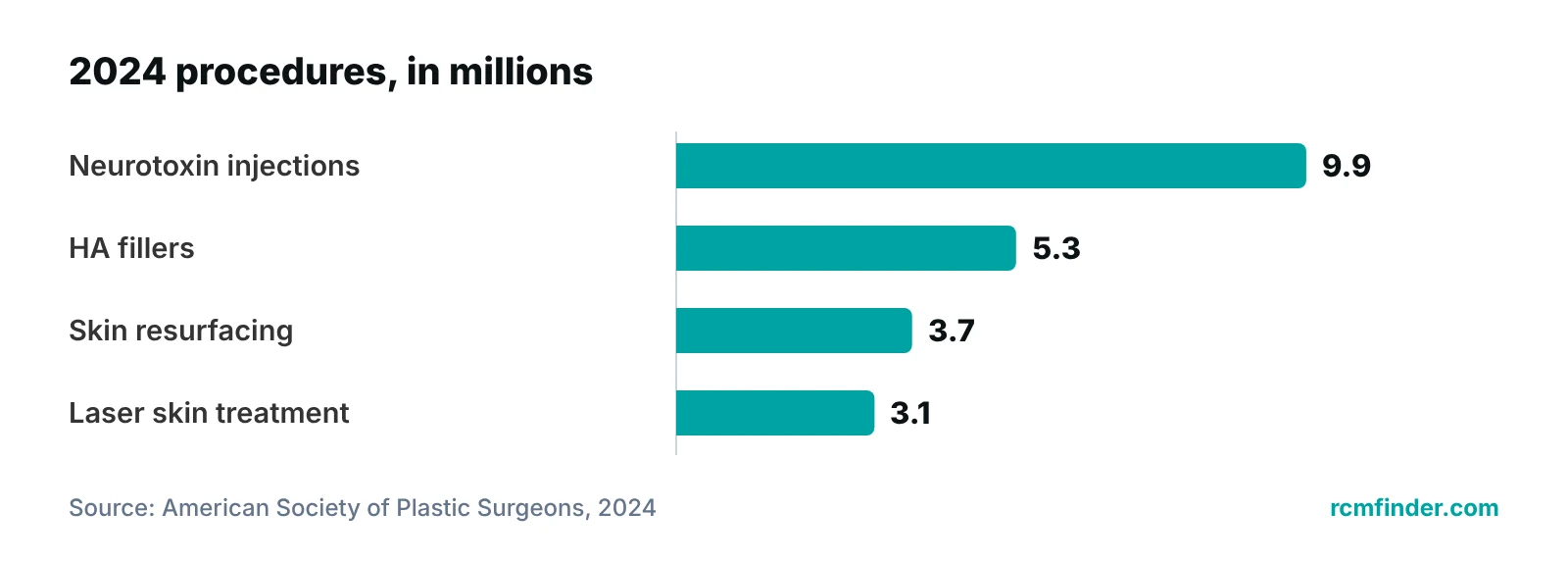
Read this carefully. The numbers show that demand is real, but growth in the biggest categories is small (4% and 1%). A practice cannot count on a rising market to fill its schedule. It has to win share locally. That is why the next sections focus on being found, being trusted and answering quickly.
The numbers also do not tell you what your own market looks like. Local competition, pricing and patient mix vary by city. Treat national data as context and your own booking data as the real guide.
Get found: your listing, treatment pages and local search
Start with the places a nearby patient looks first: your Google Business Profile and a clear page for each treatment. These are cheap, they compound, and they do not depend on ad spend.
- Google Business Profile: keep name, address, phone, hours, categories and services accurate and identical to your website. Inconsistent details confuse patients and can cause listing problems.
- One page per treatment: explain who it suits, what a visit involves, downtime, what it costs to start (a range or a consultation fee, if you publish prices), and who performs it with their credentials.
- Provider pages: licence, training and the exact services each clinician performs. Patients choose a person as much as a clinic.
- Plain-language FAQs: answer the questions your front desk hears every day, such as downtime, session count and how to prepare.
- Mobile first: a patient deciding between two clinics will call the one whose number is easiest to tap.
Our healthcare SEO guide covers the technical and local steps in detail, including privacy-aware tracking, so we will not repeat them here. If you want a team to run listings, pages and ads together, that is the work behind our healthcare digital marketing services.
If you are a dermatology practice, the way you describe medical and cosmetic care on one site matters. See how we think about dermatology practice operations when both lines share a front desk.
Turn inquiries into booked consultations
A cash-pay lead usually contacts two or three clinics at once. The practice that replies first with a clear next step often gets the consultation. This is the step most practices lose money on, and it costs nothing to fix.
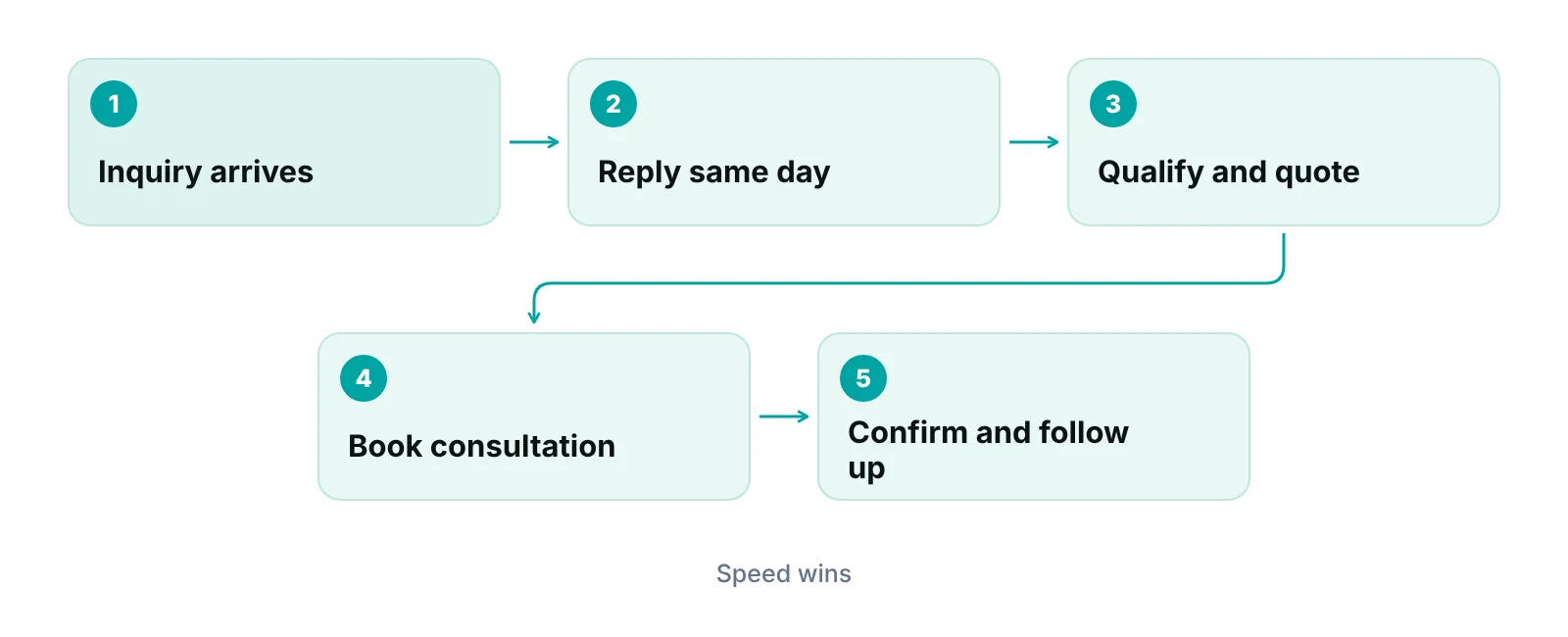
- One inbox: calls, web forms, texts and social messages land in one place with a named owner. Text and web-form tools can carry patient details, so keep them within your HIPAA policies.
- Same-day reply: set a target and track it. We suggest replying to every inquiry within the same business day, and during open hours as fast as you can.
- Short qualification: ask what the patient wants help with, any timing, and whether they have seen a clinician before. Do not give medical advice by text.
- Clear quote: give a consultation fee or price range, deposit and cancellation terms in writing.
- Confirm and remind: confirm by message the day before, and follow up after no-shows.
Many small practices cannot staff this every hour. That is where a trained remote front desk helps: answering calls, booking, confirming and following up inside your own scheduling system. Our virtual medical assistants for medical practices do this work in your time zone. Whether you use us or hire in-house, the steps above stay the same.
“In cash-pay care the phone is the product demo. If nobody picks up, the patient has already moved on to the next clinic.”
Reviews, testimonials, photos and influencers: the rules
These tools build trust, and they are also where aesthetic practices most often get into trouble. Three bodies matter: the Federal Trade Commission (FTC), the HHS Office for Civil Rights (OCR) and Google. State medical boards and advertising laws can add more, so ask your attorney.
| Practice | What the source says | What to do |
|---|---|---|
| Posting patient testimonials or photos | HHS OCR settled with a physical therapy practice for $25,000 (announced February 2016) after it posted testimonials with full names and full-face photos without valid authorization. | Get a written HIPAA authorization before using a patient’s story, name or recognisable photo in marketing. |
| Buying or faking reviews | The FTC’s rule at 16 CFR Part 465, effective October 21, 2024, prohibits fake reviews and buying reviews. It also covers undisclosed insider reviews and review suppression. | Never write, buy or edit reviews. Staff and family reviews must disclose the relationship. |
| Offering a perk for a Google review | Google states that offering incentives such as free or discounted goods or services in exchange for reviews is strictly prohibited. | Ask every patient with a link or QR code. Offer nothing in return. |
| Influencer and ambassador posts | FTC guidance says to disclose any financial, employment, personal or family relationship, including free or discounted products, and to place the disclosure with the endorsement. | Put ‘ad’ or ‘sponsored’ in the post itself and require it in your contracts. |
Sources: HHS OCR (2016); FTC, 16 CFR Part 465 final rule, Federal Register, August 22, 2024; Google Business Profile Help; FTC Disclosures 101 for Social Media Influencers.
Patient photos and before-and-after images
HIPAA’s Privacy Rule generally requires written authorization before protected health information is used for marketing. OCR has said this applies to websites and social media (HHS OCR resolution with Complete P.T.). A before-and-after image can identify a patient even without a name, so treat it as protected information and ask your privacy officer to approve the consent form. Our HIPAA compliance checklist for medical practices lists the other controls that marketing touches.
Reviews
Google allows you to ask customers to leave a review through a link or QR code, and the reviewer must be signed into a Google account (Google Business Profile Help). Ask everyone, not only happy patients, and reply to each review without confirming that the person was a patient. A reply that names a treatment can disclose health information. Our guide to online reputation management for doctors explains how to reply to negative reviews safely.
Influencers
If a patient or local creator receives a free treatment and posts about it, that is a material connection and must be disclosed. The FTC says the disclosure belongs with the message itself, not only on a profile page or behind a ‘more’ link (FTC, Disclosures 101). A creator’s treatment is also a clinical event with consent and privacy questions, so your clinical lead should sign off before any collaboration. The FTC’s review rule also names civil penalties for each violation (Federal Register, August 22, 2024).
Before you publish anything with a patient in it
Check written authorization, the photo date and treatment, state advertising and medical-board rules, and the platform’s own policy. When unsure, leave it out.
Where to spend: search, ads, social and email
Choose channels by what a cash-pay patient does before booking, not by what is fashionable. Most start with a search or a recommendation, look at your profile and photos, and then call or send a message.
| Channel | Best used for | Track | Watch out for |
|---|---|---|---|
| Local search and Google Business Profile | Patients searching ‘near me’ for a treatment | Calls, direction requests, form fills | Inconsistent listings; incentivised reviews |
| Paid search ads | Booked demand for high-value treatments | Cost per booked consultation | Claims you cannot support; tracking tools sending patient data to ad platforms |
| Social media | Showing the clinic, team and education | Messages and booked consultations from social | Patient images without authorization; undisclosed paid posts |
| Email and text | Reminders, offers to existing patients, recalls | Opens are weak; track bookings | Consent for texts; no health details in the message |
| Referrals from existing patients | Warm leads with high trust | Referral source at booking | Rewards for referrals need legal review |
Source: RCM Finder editorial guidance. No performance figures are claimed; test and measure in your own market.
Be careful with return-on-investment numbers you read online. Averages from other industries do not apply to a single-location clinic. Build your own number from booked consultations and treatment revenue, as our medical marketing ROI guide shows.
Want a second opinion on your inquiry flow?
We will review how your inquiries are answered today and where cash-pay consultations are being lost. Pricing, if you decide to work with us, is quoted after the audit.
Keep patients: recalls, packages and membership offers
Many aesthetic treatments repeat, so the cheapest new patient is often one you already treated. A simple recall system matters more than a complex loyalty program.
- Recall by treatment: set a reminder tied to the usual interval for each treatment, based on your clinicians’ guidance.
- Packages and memberships: state what is included, what it costs, expiry and refund terms in writing. State consumer laws and your medical board may restrict how you advertise treatment discounts, so check before launch.
- Clear payment terms: publish how deposits, cancellations and any payment plans work, before the patient books.
- Ask for feedback privately first: a short post-visit message tells you what to fix before a public review does.
What to measure each month
Five numbers tell you whether marketing is working. None of them needs special software. A spreadsheet works for the first few months.
- New inquiries by source (search, ads, social, referral, walk-in).
- Time to first reply for each inquiry.
- Consultation booked rate: consultations booked divided by inquiries.
- Show rate and treatment rate: consultations attended, and attended consultations that became a paid treatment.
- Cost per booked consultation: marketing spend divided by consultations booked.
If your practice also bills insurance for medical services, the same discipline applies to that side of the business. Our revenue calculator gives a rough view of what billing leakage could cost, and it is separate from the cash-pay numbers above.
Our recommendations
- Audit your listing and phone this week. We would call your own number at different times and check your Google Business Profile for accuracy. Fixing a wrong phone number or hours is the fastest gain.
- Set a same-day reply rule. We recommend one named owner for all inquiries and a written reply target. Review it weekly.
- Write the consent form before the campaign. We would have your privacy officer approve a photo and testimonial authorization before any before-and-after images are collected.
- Ask every patient for a review, with no reward. We suggest a link or QR code at checkout and a standing rule that nothing is offered in return.
- Pick two channels and measure them. We would run local search plus one other channel for three months and judge both by booked consultations.
- Review your claims line by line. We recommend a clinician and your attorney read every treatment page and ad for statements about results, safety or comparisons.
Bottom line
Aesthetic practices grow when the basics are reliable: a correct listing, honest reviews, authorised photos and a fast reply to every inquiry. If your front desk cannot cover that every day, a remote front-desk team can answer, book and follow up in your time zone, and you can talk to us about your inquiry flow. Start with the free practice audit.
Frequently asked questions
What is the best way to market an aesthetic practice?
There is no single best channel. For most practices the order is: an accurate Google Business Profile, clear treatment pages, honest reviews, and a fast reply to every inquiry. Add paid search or social once you can measure cost per booked consultation. Compliance with FTC, HIPAA and Google rules protects the whole effort.
Can I offer a discount to patients who leave a Google review?
No. Google’s Business Profile help states that offering incentives, such as free or discounted goods or services, in exchange for reviews is strictly prohibited. You may ask every patient for a review with a link or QR code. Keep the request neutral and offer nothing in return.
Can I post before-and-after photos on my website or Instagram?
Only with proper authorization. HIPAA generally requires a patient’s written authorization before health information is used for marketing, and HHS OCR has applied that to websites and social media. A photo can identify a patient even without a name. Ask your privacy officer and attorney to approve the form, and check state rules.
Do I have to disclose when an influencer is paid or receives free treatment?
Yes. FTC guidance says to disclose any financial, employment, personal or family relationship, including free or discounted products, and to place the disclosure with the post itself. Put the requirement in your written agreement. A clinical lead should also review consent and privacy for any treatment shown.
Does insurance pay for aesthetic procedures?
Generally not for cosmetic care. Medicare excludes cosmetic surgery and related services under 42 CFR 411.15(h), with exceptions such as repair of an accidental injury or improving the function of a malformed body part. Commercial plans set their own rules, so check the policy. Medically necessary dermatology care is billed separately.
How do I know if my marketing is working?
Track new inquiries by source, time to first reply, consultations booked, show rate, treatments sold and cost per booked consultation. Clicks and likes are weak signals in cash-pay care. Review the numbers monthly and cut channels that do not produce booked consultations after a fair test period.
Get your free practice audit
Tell us about your practice. We will contact you using the details you give.
- A review of your recent claims, denials and A/R aging
- Where your front desk and prior authorizations slow payment
- A prioritized fix list you keep, whether or not you hire us
Pricing is quoted after the audit, based on your volume and the services you choose. Prefer to talk? Call +1 (302) 556-2288.
Sources
- Plastic Surgery Statistics Report 2024: Minimally Invasive Procedure Trends — American Society of Plastic Surgeons (2024)
- Trade Regulation Rule on the Use of Consumer Reviews and Testimonials (16 CFR Part 465) — Federal Trade Commission / Federal Register (2024)
- Physical therapy provider settles HIPAA violations (Complete P.T.) — HHS Office for Civil Rights (2016)
- Business Profile Help: guidelines for reviews — Google (2026)
- Disclosures 101 for Social Media Influencers — Federal Trade Commission (2026)
- 42 CFR 411.15 Particular services excluded from coverage — eCFR (2026)
Disclaimer: This article is general educational information for practice owners and managers. It is not legal, HIPAA compliance, medical, coding or advertising advice. FTC, HHS, Google and state rules change and vary by state; have a healthcare attorney and your privacy officer review marketing materials, consent forms and review requests before use.
