
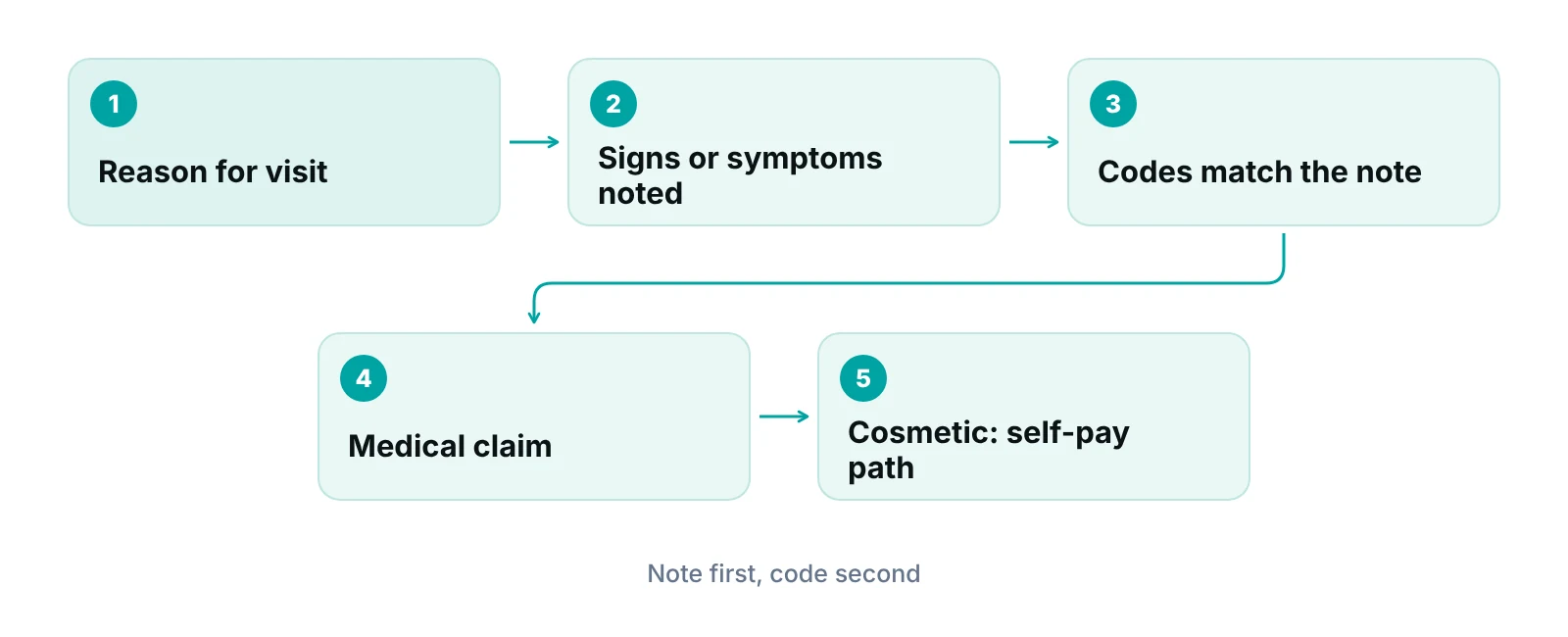
Dermatology insurance coverage depends on medical necessity: a service is billed as medical when the record shows a documented sign, symptom or diagnostic question, while cosmetic surgery and related services are excluded from Medicare. A practice should record the reason for each procedure, code it to the note, and tell patients early which services are likely self-pay.
Most online answers to “is dermatology covered by insurance” are written for patients and list services as covered or not covered. In a practice, that list is only the start. The claim is paid or denied on what the note says, how the lesion is coded and whether the patient was told in advance.
This guide is for dermatology practice managers and billers. It explains where the medical and cosmetic line sits, what two Medicare contractor articles ask the record to show, how lesion-removal codes are grouped, and how to handle a cosmetic service. For the wider picture, see our dermatology billing and revenue cycle page.
Key takeaways
- Medicare excludes cosmetic surgery and related services except prompt repair of accidental injury or improving the function of a malformed body part.
- One Medicare contractor treats lesion removal as non-cosmetic when signs or symptoms such as bleeding, pain, inflammation or diagnostic uncertainty are present.
- The US Preventive Services Task Force gave visual skin exams in adults without symptoms an “I” statement in 2023, so do not assume a plan covers them as prevention.
- Skin tags, shave removals, excisions and biopsies use different code families with different limits.
- For a purely cosmetic service, tell the patient before the visit, and bill it in the way the payer’s rules require.
What decides dermatology insurance coverage?
The purpose of the service decides it. A procedure done to diagnose or treat a condition that the record supports is a medical claim. A procedure done to change appearance is cosmetic, and cosmetic services are not a Medicare benefit.
The Medicare rule is in federal regulation. Under 42 CFR 411.15, cosmetic surgery and related services are excluded, except for prompt repair of accidental injury or for improving the function of a malformed body member. Commercial plans write their own policies and vary, so a Medicare rule is a baseline for staff training, not a statement about every payer.
Check your own contractor
The criteria below come from two Medicare contractor articles: National Government Services (Removal of Benign Skin Lesions, revision effective 2024) and Novitas Solutions (revision effective October 2023). Each covers specific states. Your Medicare Administrative Contractor’s current article, and each commercial payer’s policy, govern your claims.
Which signs make a lesion removal medical rather than cosmetic?
The record needs a sign, symptom or diagnostic question, not only a patient request. The National Government Services article says lesion removal “is not considered cosmetic when symptoms or signs which warrant medical intervention are present” (National Government Services, 2024).
| Sign in the record | What a note could capture | Why it matters |
|---|---|---|
| Bleeding, intense itching or pain | Which symptom, how often, and what the patient reports | These are named as symptoms that warrant medical intervention |
| Change in appearance | Redness, pigment change, growth or a rising number of lesions | Change is named as a sign, so a before-and-after description helps |
| Inflammation or infection | Pus, oozing, swelling or redness on exam | Physical findings are named as supporting evidence |
| Obstruction | A lesion that blocks an orifice or restricts eye function | Function, not appearance, is the reason for removal |
| Diagnostic uncertainty | Why the diagnosis is unclear and why malignancy is a realistic concern | The article names uncertainty, especially about malignancy, as a reason |
Source: National Government Services, Billing and Coding: Removal of Benign Skin Lesions (A54602), revision effective January 1, 2024.
Wart removal has its own criteria in that article, such as warts that spread or condyloma acuminata. Check the article for your contractor before building a wart template.
“A cosmetic request does not become a medical claim because the note was written after the fact. The reason has to be in the record at the visit.”
Is a routine skin check covered?
Do not assume so. In April 2023 the US Preventive Services Task Force gave a visual skin exam by a clinician, in adults without signs or symptoms, an I statement: the evidence was insufficient to assess the balance of benefits and harms (USPSTF, 2023). It neither recommends for nor against the screening.
That is a statement about evidence, not a coverage rule. But it means a full-body exam with no complaint is not an automatic preventive benefit, and plan policies differ. A visit for a changing mole or a new lesion is a different situation: the patient has a concern, and the note should say so.
Front-desk script
When a patient books a “skin check”, ask whether there is a specific spot, symptom or history. Record the answer at scheduling. Then verify the plan’s benefit for that visit type before the appointment, not after the claim.
How do lesion removal codes work, and where do claims go wrong?
Each removal method has its own code family, and the choice depends on method, lesion type and size. The two contractor articles group them as shown below. CPT descriptors belong to the AMA, so this table describes them in plain words; use the current CPT manual for exact wording.
| Code family | What it covers | Limit named in the article |
|---|---|---|
| 11200 and 11201 | Skin tag removal: 11200 for up to 15 tags, 11201 for each additional 10 | Skin tags are excluded from the excision and destruction codes below |
| 11300 to 11313 | Shave removal of a benign lesion, grouped by size | Not reported with a separate biopsy code for the same lesion |
| 11102 and 11103 | Tangential biopsy, shave done solely to get tissue for diagnosis | Pathology can be reported separately (88304 to 88305) |
| 11400 to 11446 | Excision of a benign lesion with margin, by size and site; the face has its own range, 11440 to 11446 | Size is the greatest clinical diameter plus the narrowest margin, measured before excision |
| 17000 to 17004 and 17110 to 17111 | Destruction of lesions | Skin tags are excluded from 17110 and 17111 |
Source: National Government Services (A54602, 2024) and Novitas Solutions (A57113, 2023), Billing and Coding: Removal of Benign Skin Lesions.
Three errors repeat in lesion claims. The first is using a skin tag code for a lesion that is not a skin tag, or an excision code for a skin tag. The second is reporting a biopsy and a shave removal for the same lesion. The third is a size that was measured after excision, or never recorded. For diagnosis coding on skin tags in particular, see our guide to ICD-10 coding for skin tags.
Novitas also states that, at the time of its revision, it applied no diagnosis limitations to skin tag removal codes 11200 and 11201. That can change, so confirm the current article before relying on it. ICD-10-CM codes also update each year; CMS lists the FY 2027 set as applying from October 1, 2026 to September 30, 2027.
What does the record need to show?
It needs to show why the service was needed, what was done, and that the codes match. The NGS article says records must “clearly document the medical necessity for the lesion removal(s).” Novitas adds that every page must be legible, carry patient identification and dates of service, and include the signature of the responsible practitioner.
- The reason for the visit or procedure in the clinician’s words, including signs or symptoms.
- Lesion site and size, measured before excision.
- The method used, matched to the code billed.
- A diagnosis code that the record supports; a malignant-type code on a benign-lesion procedure is a mismatch.
- A signature and credentials on the note before the claim is released.
- For a same-day visit and procedure, a separate statement of the significant, separately identifiable service (see modifier 25 below).
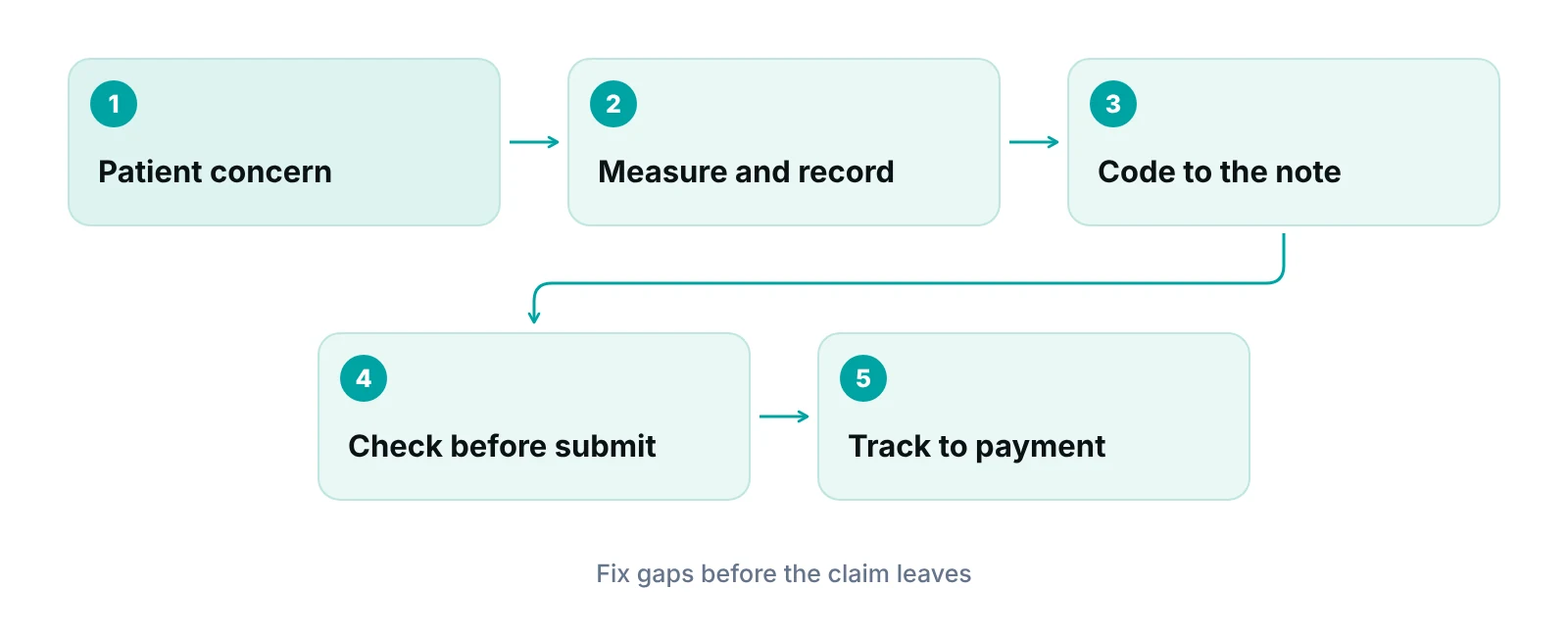
A periodic review catches these gaps before a payer does. Our guide to medical coding audits explains how to sample charts, and the basics of clean claims apply to every lesion claim.
Some of this can be built into tooling. A practice management system that tracks claims by stage can hold a claim at a stage until lesion site, size and diagnosis fields are filled, and flag it to an owner.
How should a cosmetic or non-covered service be handled?
Tell the patient before the service, document that you did, and bill only in the way the payer’s rules allow. The NGS article states that it is not appropriate to bill Medicare for non-covered services as if they were covered; Novitas makes the same point.
| Situation | Step named in the article | Note |
|---|---|---|
| Purely cosmetic removal | Use ICD-10-CM Z41.1, the encounter for cosmetic surgery | The claim may not need to be filed unless the patient asks for a formal Medicare denial |
| Service statutorily excluded | Append modifier GY | GY is defined as an item or service statutorily excluded or not meeting the definition of a Medicare benefit |
| Service likely to be non-covered | An ABN may be used | The article points to CMS Publication 100-04, Chapter 30 |
| Visit on the day of a minor procedure | Modifier 25 with a documented, significant, separately identifiable service | Routine pre-procedure work does not qualify |
| Decision to perform a minor procedure | Modifier 57 cannot be used | The decision is part of the procedure |
Source: National Government Services, A54602 (2024); Novitas Solutions, A57113 (2023).
For the notice itself, our ABN medical billing guide explains the form, and modifier 25 vs 59 covers same-day visits. Commercial payers set their own notice and billing rules, so read each contract.
What about prior authorization, networks and patient costs?
These are payer-specific, so check them for each plan before the visit. Whether a given procedure needs prior authorization, whether the dermatologist is in network, and what the deductible and copay are all come from the patient’s plan, not from the specialty.
Older guides printed cost ranges and out-of-network percentages for dermatology. Those figures had no source, so this guide leaves them out. Use the payer’s own benefit information and your fee schedule to give a patient an estimate. Our prior authorization guide covers how to track requests, and a denial for a missing authorization is a case for denial management services.
Not sure where your claims lose dermatology revenue?
A free practice audit looks at how your claims move from the visit note to payment and where medical-necessity denials start. Pricing, if you go further, is quoted after the audit.
Our recommendations
- Write the reason for every procedure into the note. We recommend a required field for the sign, symptom or diagnostic question behind each lesion procedure. The claim then follows the note.
- Classify services by payer before the visit. Make a short list that sorts each service as medical, cosmetic or screening for each major payer. Update it when a payer changes policy.
- Measure and record size before excision. Build a size and site field into the procedure template. Both contractor articles tie size to code choice.
- Script the cosmetic conversation. Give front-desk staff a standard way to say that a service is likely self-pay, to quote a price from the fee schedule, and to document that the patient was told.
- Hold unsigned notes. Do not release a claim until the note is signed with credentials. Missing signatures are an avoidable denial.
- Review a small sample each quarter. Pull lesion-removal claims and check reason, size, method, code and diagnosis against each other. Fix templates, not just claims.
Hold a dermatology claim until lesion site, size and diagnosis are filled.
Our practice management portal tracks each claim by stage with an owner and runs data-completeness checks before submission. It can flag a claim for review when fields that support medical necessity are missing.
See how the RCM Finder portal works · Create a portal account
Disclosure: RCM Finder builds and sells this portal. It is a practice management system, not an EHR.
Bottom line
Dermatology insurance coverage turns on what the note proves: a sign, symptom or diagnostic question for medical services, and a clear self-pay path for cosmetic ones. Document the reason, measure the lesion, code to the note, and tell patients early. If lesion or cosmetic-line denials keep returning, our medical billing services and denial management services can review the pattern, or you can talk to our team and request a free practice audit.
Frequently asked questions
Is dermatology covered by insurance?
Often, when the service is medically necessary and the record supports it. Cosmetic services are not. Medicare excludes cosmetic surgery and related services, and commercial plans set their own rules. Coverage depends on the plan, the purpose of the service and what the note documents.
When is a skin lesion removal considered cosmetic?
When no sign, symptom or diagnostic question supports it. One Medicare contractor treats removal as non-cosmetic when signs such as bleeding, pain, inflammation, obstruction or uncertainty about the diagnosis are present. Without any of those documented, expect a cosmetic review.
Is a routine full-body skin exam covered?
It depends on the plan. The US Preventive Services Task Force gave this exam in adults without symptoms an I statement in 2023, meaning the evidence is insufficient. That is not a coverage rule, so verify the benefit before the visit, and record any specific concern the patient reports.
Can skin tags be billed to insurance?
Skin tag removal has its own codes, 11200 and 11201, and skin tags are excluded from the benign excision and destruction codes. Medical necessity still matters. Read your contractor’s article and see our guide to ICD-10 coding for skin tags before billing.
What should we do when a patient wants a cosmetic procedure?
Tell the patient before the service that it is likely not covered, quote a price from your fee schedule and document the conversation. For Medicare, do not bill a non-covered service as if it were covered. Use the notice and modifier your contractor’s article names.
Do prior authorization rules apply to dermatology procedures?
Some plans require it for some procedures, and it varies by payer and by service. Check each plan’s policy before scheduling, track requests, and record the authorization number on the claim. A missing authorization is a common avoidable denial.
Get your free practice audit
Tell us about your practice. We will contact you using the details you give.
- A review of your recent claims, denials and A/R aging
- Where your front desk and prior authorizations slow payment
- A prioritized fix list you keep, whether or not you hire us
Pricing is quoted after the audit, based on your volume and the services you choose. Prefer to talk? Call +1 (302) 556-2288.
Sources
- 42 CFR 411.15, Particular services excluded from coverage — eCFR (2026)
- Billing and Coding: Removal of Benign Skin Lesions (A54602) — National Government Services (Medicare Administrative Contractor) (2024)
- Billing and Coding: Removal of Benign Skin Lesions (A57113) — Novitas Solutions (Medicare Administrative Contractor) (2023)
- Skin Cancer: Screening, Final Recommendation Statement — US Preventive Services Task Force (2023)
- ICD-10 Codes — Centers for Medicare & Medicaid Services (2026)
Disclaimer: This article is educational and is not legal, coding, billing or compliance advice. CPT codes are owned by the AMA, and code descriptors, payer policies and federal rules change and vary by payer and state. Verify current requirements with the official CPT manual, your Medicare Administrative Contractor, each commercial payer and your counsel before you act.
