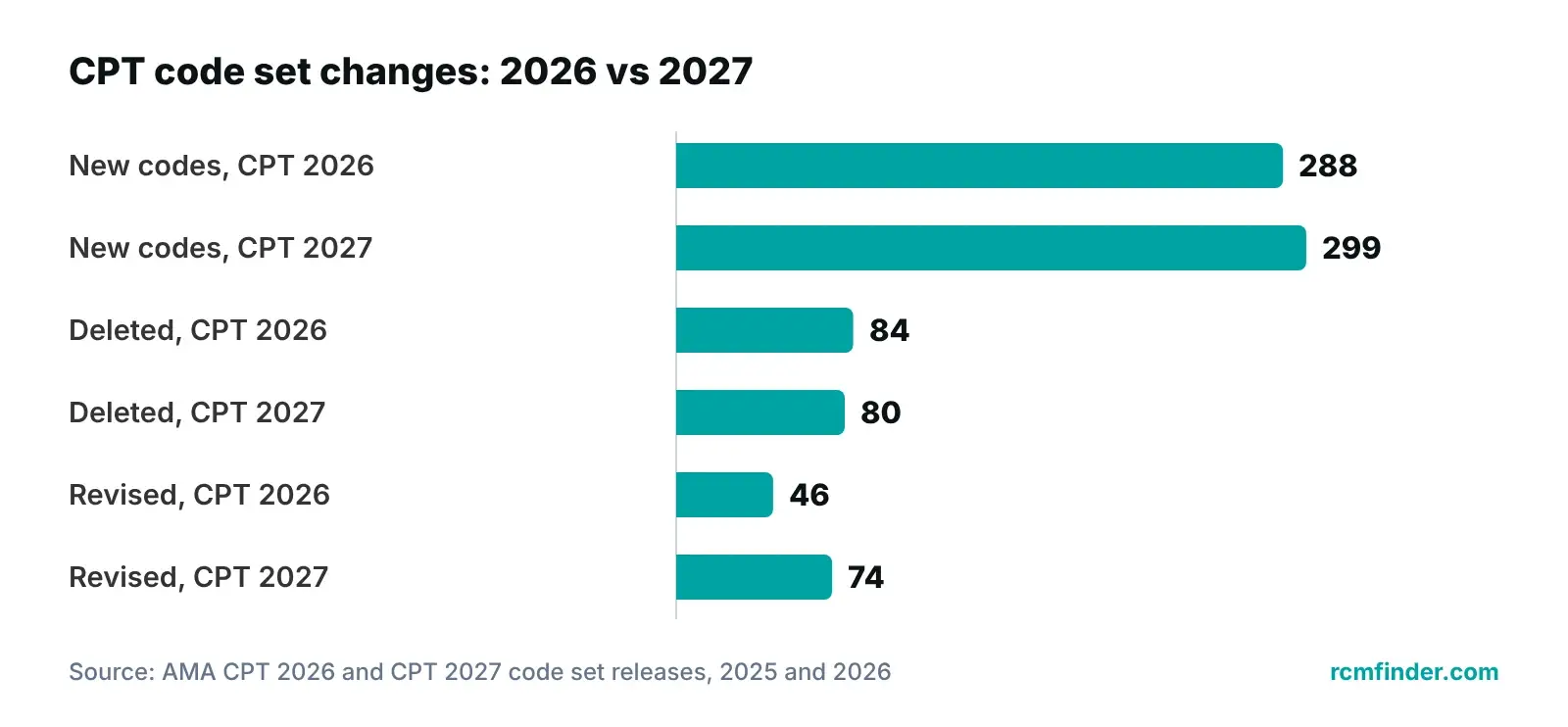
The AMA's CPT 2027 code set, released September 9, 2026, makes 453 changes: 299 new codes, 80 deletions and 74 revisions, effective January 1, 2027. Medicare's fee schedule, HCPCS Level II codes and NCCI edits change the same day. Update fee schedules, superbills, scrubber edits, contract rates and prior-authorization lists first, then watch January denials daily.
December is the last full month to get ready. The AMA released CPT 2027 on September 9, 2026. CMS proposed the 2027 Medicare Physician Fee Schedule in July. Medicare Open Enrollment ends December 7, so some patients will arrive in January on a different plan. All of it lands on claims with January 1, 2027 dates of service.
This post covers what the AMA and CMS have published, what is still pending and a checklist you can assign this week. If you need a refresher on how the code sets fit together, start with our guide to CPT, ICD-10 and HCPCS codes.
Key takeaways
- CPT 2027 has 453 changes (299 new, 80 deleted, 74 revised), effective January 1, 2027.
- The global maternity codes are deleted and replaced with phase-specific reporting.
- CMS proposed 2027 conversion factors of $33.17 and $32.84 in July 2026; switch to the final rule’s figures once published.
- HCPCS Level II files and NCCI edits update quarterly, including on January 1.
- Medicare gives no grace period for deleted codes: bill by date of service.
What changes in the CPT 2027 code set?
The CPT 2027 code set contains 453 changes: 299 new codes, 80 deletions and 74 revisions. The AMA announced it on September 9, 2026, and the codes take effect January 1, 2027.
That is a larger update than last year. The AMA’s CPT 2026 release listed 418 changes: 288 new codes, 84 deletions and 46 revisions. The AMA’s highlights cluster in a few clinical areas, so the practical work is finding which of your own codes are affected.
| Area | What changes (per the AMA) | What to review |
|---|---|---|
| Maternity care | Global maternity bundle replaced by phase-specific reporting; 17 codes deleted, 12 new, 6 revised | Contracts, fee schedules and superbills that use global maternity codes |
| Ventricular assist devices | New and revised guidelines; three new left ventricular assist device codes | Procedure charge lists and surgical order sets |
| Diaphragmatic hernia repair | Nine new codes covering open, laparoscopic and thoracoscopic approaches | Surgical charge capture and prior-authorization lists |
| Prostate biopsy | Updated codes and guidelines | Procedure templates and authorization lists |
| Biofeedback | New time-based code structure | Time documentation in visit templates |
| Radiology | New and revised codes; new table for head and neck MR angiography | Imaging order sets and authorization lists |
| Sleep medicine | Six new codes for unattended sleep studies, including studies outside sleep centers | Superbills, order sets and authorization lists |
| AI-related services | 10 new codes (43 in total); AI taxonomy updated | Software-assisted services you now perform |
Source: AMA CPT 2027 release (September 9, 2026) and maternity care FAQs (2026). ‘What to review’ is our guidance.
The biggest structural change: maternity care
Maternity care shows why a code list alone is not enough. The AMA’s CPT 2027 maternity FAQs say the global maternity codes are deleted and replaced with reporting by phase. Antepartum and postpartum visits are reported with E/M codes, labor management gets new codes (59080 to 59083), and vaginal and cesarean deliveries get new codes. In total, 35 maternity codes changed: 17 deleted, 12 new and 6 revised.
The AMA states that deleted codes are invalid for dates of service on or after January 1, 2027. For pregnancies that span the change, the AMA points to separate transition FAQs, which tell practices to check each payer’s transition policy; follow both. For how CPT is structured, see our guide to CPT codes in medical billing, and for an earlier cycle, our summary of the 2024 CPT code updates.
Where does the 2027 Medicare Physician Fee Schedule stand?
CMS proposed lower 2027 conversion factors in July 2026, and the final rule sets the rates that apply on January 1, 2027. Budget from the proposed figures until the final rule is out, and treat every number as provisional.
CMS’s July 14, 2026 fact sheet proposed a conversion factor of $33.17 for qualifying APM participants, down $0.40 (−1.19%) from $33.57, and $32.84 for other practitioners, down $0.56 (−1.68%) from $33.40. The one-year 2.50% increase that Public Law 119-21 provided for 2026 does not carry into 2027. Statutory updates of +0.75% for qualifying APM participants and +0.25% for others, plus an estimated +0.53% adjustment for proposed work RVU changes, offset part of that loss.
The proposed rule (CMS-1848-P) was published in the Federal Register on July 16, 2026, and comments closed September 14, 2026. Under 42 CFR 414.20, a Medicare fee is the service’s RVUs times a geographic adjustment factor times the conversion factor, so a conversion factor change moves every Medicare fee at once.
| Item | CY 2027 proposal | What to check |
|---|---|---|
| Conversion factor, qualifying APM participants | $33.17, down $0.40 (−1.19%) from $33.57 | Medicare revenue budget and expected amounts |
| Conversion factor, other practitioners | $32.84, down $0.56 (−1.68%) from $33.40 | Medicare revenue budget and expected amounts |
| 2.50% one-year increase for 2026 | Ends; not in the 2027 base | Year-over-year comparisons by code |
| Same-day office E/M and 0-, 10- or 90-day global procedure | Highest-value service paid at 100%, others at 50% | Revenue from visits billed with a same-day procedure |
| G2211 add-on | Becomes a modifier adding 16% to the E/M (32% for certain ACO practitioners) | Charge master, EHR modifiers and claim edits |
| Remote monitoring (RPM/RTM) | RTM for established patients only; separate initiating visit; practice-employed clinical staff | Monitoring enrollment and staffing workflows |
| Advance care planning | Two new HCPCS codes for services by clinical staff under direct supervision | Whether your staff deliver this service |
Source: CMS, CY 2027 PFS proposed rule fact sheet (July 14, 2026). Proposals only; the final rule may change them.
Proposed is not final
At the time of writing (October 2026), CMS had not released the final rule. The AMA expected it in early November 2026, with implementation starting January 1, 2027. Replace proposed numbers in your budget and fee tables with final ones as soon as they are published.
Our guide to RVUs in medical billing walks through the payment math, and our post on Medicare payment cuts in 2025 covers the earlier round of cuts.
What else changes on January 1, 2027?
HCPCS Level II codes, NCCI edits and many patients’ Medicare plans also change on January 1. Each can turn a claim that was correct in December into a January rejection.
HCPCS Level II quarterly update
CPT is HCPCS Level I, maintained by the AMA. CMS maintains HCPCS Level II, the alphanumeric codes for products, supplies and services not in CPT, and posts changes as quarterly public use files with the effective date in the file title. In October 2026 the newest file listed was the October 2026 update, so watch for the January 2027 file. Our HCPCS vs CPT guide explains which code set covers what.
NCCI edits, updated every quarter
CMS’s National Correct Coding Initiative updates its procedure-to-procedure (PTP) and medically unlikely edit (MUE) files quarterly. PTP edits stop code pairs that should not be billed together; MUEs limit units of service. Load the January 2027 files when CMS posts them, so your scrubber checks new codes against current pair and unit rules.
Medicare plan changes from Open Enrollment
Medicare Open Enrollment runs October 15 to December 7, and changes made in that window start January 1. Patients already in a Medicare Advantage plan can switch again from January 1 to March 31. Re-verify coverage at every patient’s first January visit; our insurance verification guide covers the steps.
No grace period for deleted codes
Medicare’s Claims Processing Manual, chapter 23, §20.4 says Part B contractors must reject services billed with discontinued HCPCS codes, and prior-year services are billed with the codes in effect that year. The old 90-day grace period ended with the 2005 fee schedule. Bill December 2026 visits with 2026 codes and January 2027 visits with 2027 codes, even when both go out the same week.
The January 1, 2027 readiness checklist
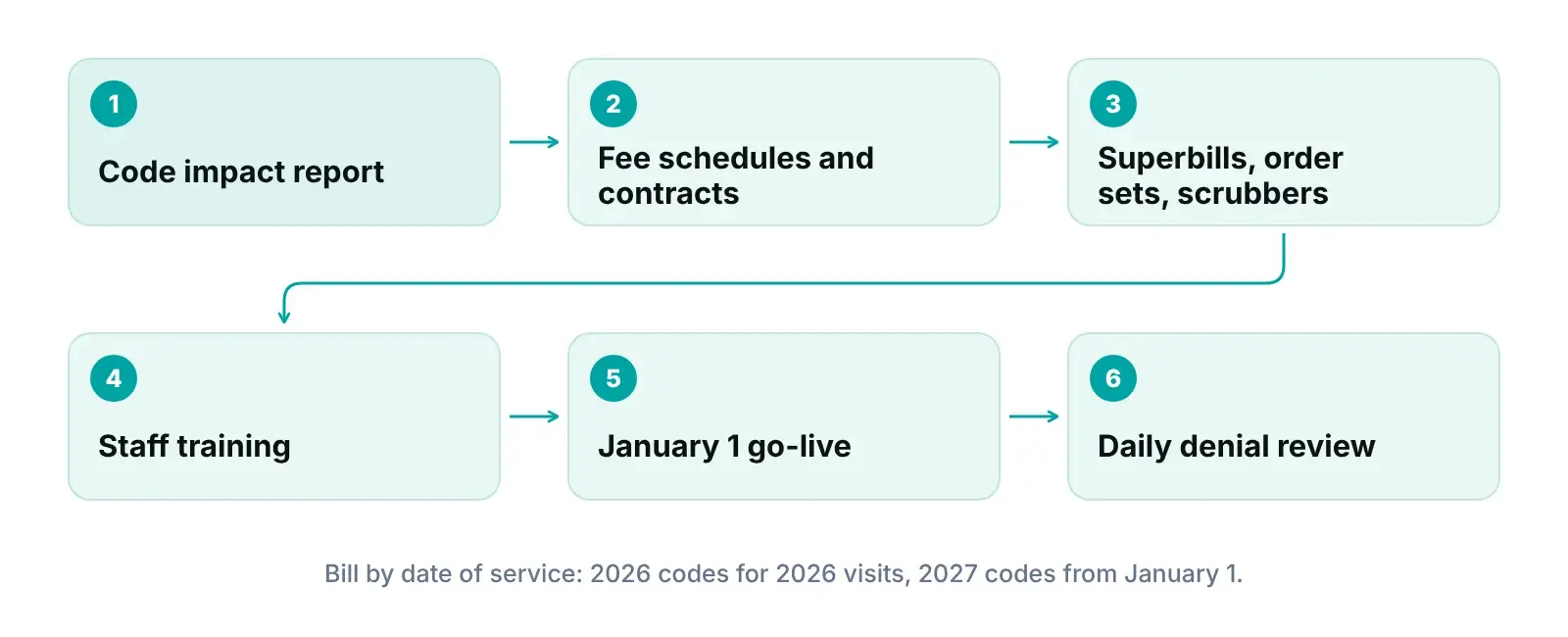
Start with a code impact report: every code you billed in the last 12 months, matched against the 2027 deletions and revisions. Then work through each area below so every change has an owner and a date.
| Area | What to do | Suggested owner | When |
|---|---|---|---|
| Fee schedule and chargemaster | Add new codes and charges, end-date deleted codes, load 2027 Medicare rates | Billing lead | As soon as the final rule is out |
| Superbills and EHR order sets | Remove deleted codes, add replacements, test templates | Practice manager and EHR admin | Built in December, live January 1 |
| Payer contracts and fee schedules | Find rates tied to deleted codes; ask payers how replacements are paid | Owner or practice manager | Early December |
| Claim scrubber and clearinghouse | Confirm CPT 2027, January HCPCS and January NCCI files are loaded | Billing lead and vendor | When CMS posts the January files |
| Prior authorization lists | Update code-keyed authorization lists for each payer | Front desk or authorization team | Before the first January visits |
| Staff training | Coders, providers and front desk on the changes that affect them | Coding lead | Mid to late December |
| January denial watch | Review rejections and denials by code and payer every day | Billing lead | January 2 through February |
Sources: AMA CPT 2027 preparation guidance (2026); Medicare Claims Processing Manual, chapter 23. Owners and timing are our suggestions.
Fee schedule and chargemaster
Add each new code with your charge, end-date deleted codes so they stop at December 31, 2026 dates of service, and re-read revised descriptors. Load the 2027 Medicare rates when CMS posts them; in October 2026 its relative value files page listed 2026 files only. Our practice management portal compares paid amounts with expected amounts, so 2027 rates need to be in place before January remittances arrive.
Superbills and EHR order sets
Superbills, favorites lists and order sets can hold the same codes for years. Remove deleted codes, add replacements and test each template before December 31. Our guide to superbills covers what each form should include.
Payer contracts and fee schedules
A contract rate attached to a deleted code needs a replacement. The AMA tells health plans to review contracts and fee schedules that reference the deleted global maternity codes; apply the same check to any deleted code in your contracts. Write to each major payer, ask how it will pay the replacement codes and keep the reply.
Claim scrubber and clearinghouse edits
Ask your clearinghouse and scrubber vendor when they will load CPT 2027 and the January HCPCS and NCCI files. The AMA expects vendors and clearinghouses to reject deleted codes for dates of service on or after January 1, 2027. Add your own rule as well: a 2026 date of service with a new 2027 code is an error. Our claim scrubbing guide lists other common edits.
Prior authorization lists
Payers key authorization lists to codes, so a deleted or split code changes the list. Check each payer’s 2027 list for the areas in the first table and update your intake checklist. An approval obtained under an old code may need to be matched to the new one. See our prior authorization guide.
Staff training
Train coders on the new guidelines, providers on documentation for the codes that changed in their specialty and front-desk staff on new authorization triggers. The AMA recommends training and proactive auditing for the maternity changes; a short audit of early January claims serves the same purpose for any change.
Not sure which of your codes are affected?
Our free practice audit reviews a sample of your claims and denials and shows where your billing workflow is most exposed before January.
Get a Free Practice AuditHow should you watch claims and denials in January 2027?
Review rejections and denials every day for the first weeks of January, sorted by code and payer. Code-update problems show up early and in patterns, so a daily check catches them before they pile up.
- Clearinghouse rejections for invalid or deleted codes: fix and resubmit the same day.
- Denials on new codes, by payer: one payer denying every claim with a new code usually points to a setup gap, not a coding error.
- NCCI pair and unit edits on new code combinations.
- Payments below the 2027 expected amount for each code.
- Eligibility denials from patients who changed Medicare plans on January 1.
“Code updates rarely fail on the new codes themselves. They fail in the templates, contracts and authorization lists where the old code was stored and forgotten.”
— Awais Afzal, Healthcare Operations & Data Analyst
Once the daily count settles, move the review to weekly and keep the tags. Similar problems can return with the April and July quarterly HCPCS and NCCI updates.
Need hands on the January denial queue?
Our revenue cycle team works inside your existing EHR, tags each denial by reason and stage, and reports what changed every week.
See Our RCM ServicesOur recommendations
- Run the code impact report first. We match the last 12 months of billed codes against the AMA’s 2027 deletions and revisions before changing anything. That list, however short, drives every other step.
- Budget on the proposal, rebuild on the final rule. We model Medicare revenue on CMS’s proposed conversion factor, then replace it with the final figure the week it is published.
- Get payer answers in writing. For every contracted rate tied to a deleted code, we ask the payer in writing how the replacement code will be paid. A written reply is easier to point to in a January dispute than a phone note.
- Make date of service the rule. We add a scrubber rule that blocks 2027 codes on 2026 dates of service and deleted codes on 2027 dates. December and January claims often go out in the same batch.
- Review the first claims for each new code. Before release, we check the first few claims carrying each new or revised code against the note and the payer’s policy. It is a small audit that catches setup errors before they repeat.
- Watch January daily, then weekly. We review rejections and denials by code and payer every day in early January, then weekly once the pattern is clear, and carry the fixes into the April update.
Bottom line
CPT 2027, the 2027 Medicare fee schedule and the January HCPCS and NCCI files all take effect on January 1, 2027. Find your affected codes, update fee schedules, superbills, scrubber edits, contracts and authorization lists in December, and watch January claims daily. If you want a team to run that with you, see our end-to-end revenue cycle management services or start with a free practice audit.
Frequently asked questions
When do the 2027 CPT codes take effect?
The CPT 2027 codes apply to dates of service on or after January 1, 2027. The AMA released the code set on September 9, 2026. It states that deleted codes are invalid for dates of service on or after January 1, 2027, so a December 2026 visit is still billed with the 2026 code even if you send the claim in January.
How many CPT codes changed for 2027?
The AMA counts 453 changes in CPT 2027: 299 new codes, 80 deletions and 74 revisions. CPT 2026 had 418 changes: 288 new codes, 84 deletions and 46 revisions. The largest single restructuring is maternity care, where 35 codes changed and the global maternity codes are replaced with reporting by phase of care.
Is there a grace period for deleted CPT codes?
Not for Medicare. The Medicare Claims Processing Manual says Part B contractors must reject services billed with discontinued HCPCS codes, and the old 90-day grace period ended with the 2005 fee schedule. Commercial payers set their own rules, so ask each major payer in writing and bill by date of service either way.
What is the 2027 Medicare conversion factor?
In its July 14, 2026 proposed rule, CMS proposed $33.17 for qualifying APM participants and $32.84 for other practitioners, down from $33.57 and $33.40 in 2026. Those are proposals. The AMA expected the final rule in early November 2026; use the final figures for your fee schedule and budget once CMS publishes them.
How often do HCPCS Level II codes and NCCI edits change?
CMS posts HCPCS Level II updates as quarterly files, with the effective date in each file name, and updates NCCI procedure-to-procedure and medically unlikely edit files every quarter. January 1 is one of those quarterly dates, so load the January files with CPT 2027 and check again in April and July.
What should a practice update first for CPT 2027?
Start with a list of every code you billed in the past year and mark the ones the AMA deleted or revised. That list tells you which fee schedule lines, superbills, order sets, contract rates and prior-authorization lists need work. Then confirm your clearinghouse and scrubber dates and train staff before January 1.
Get your free practice audit
Tell us about your practice. A member of our operations team replies within one business day.
- A review of your recent claims, denials and A/R aging
- Where your front desk and prior authorizations slow payment
- A prioritized fix list you keep, whether or not you hire us
Pricing is quoted after the audit, based on your volume and the services you choose. Prefer to talk? Call +1 (302) 556-2288.
Sources
- AMA releases CPT 2027 code set — American Medical Association (2026)
- AMA releases CPT 2026 code set — American Medical Association (2025)
- FAQs: CPT 2027 Maternity Care Services code changes — American Medical Association (2026)
- FAQs: Preparing for CPT 2027 Maternity Care Services code changes — American Medical Association (2026)
- FAQs: CPT 2027 coding for maternity care spanning the transition date — American Medical Association (2026)
- Calendar Year (CY) 2027 Medicare Physician Fee Schedule Proposed Rule (fact sheet) — CMS (2026)
- Medicare and Medicaid Programs; CY 2027 Payment Policies Under the Physician Fee Schedule and Other Changes to Part B Payment and Coverage Policies (CMS-1848-P) — Federal Register (2026)
- 42 CFR 414.20 — Formula for computing fee schedule amounts — eCFR (National Archives) (2026)
- National Correct Coding Initiative (NCCI) Edits — CMS (2026)
- HCPCS Quarterly Update — CMS (2026)
- Healthcare Common Procedure Coding System (HCPCS) — CMS (2026)
- PFS Relative Value Files — CMS (2026)
- Medicare Claims Processing Manual, Chapter 23 — Fee Schedule Administration and Coding Requirements — CMS (2026)
- Joining a plan — Medicare.gov (CMS) (2026)
Disclaimer: This article is general educational information about coding updates and revenue cycle operations. It is not legal, coding, billing-compliance or financial advice. CPT descriptors, Medicare payment rules, payer policies and contract terms vary and change; the CY 2027 Physician Fee Schedule figures above were proposals at the time of writing. Confirm requirements with the AMA CPT 2027 codebook, CMS, your payers and qualified advisors before acting.