
CPT 97110 is therapeutic exercise to develop strength, endurance, range of motion and flexibility, billed in 15-minute timed units with direct one-on-one contact. Medicare uses the 8-minute rule to turn total timed minutes into units, and a claim above the yearly KX threshold needs the KX modifier.
97110 is the workhorse code in outpatient therapy, and it draws more medical necessity reviews than almost any other. The code is simple, but the billing rules are not. Units depend on minutes, the notes must show skilled care, and Medicare adds a threshold above which the KX modifier is required.
This guide explains the unit rules, what the note should show, and how the KX threshold works. Dollar thresholds come from a CMS transmittal for calendar year 2026 and change each year, so confirm the current figure before you rely on it.
Key takeaways
- 97110 is a timed code, billed per 15 minutes of direct one-on-one care.
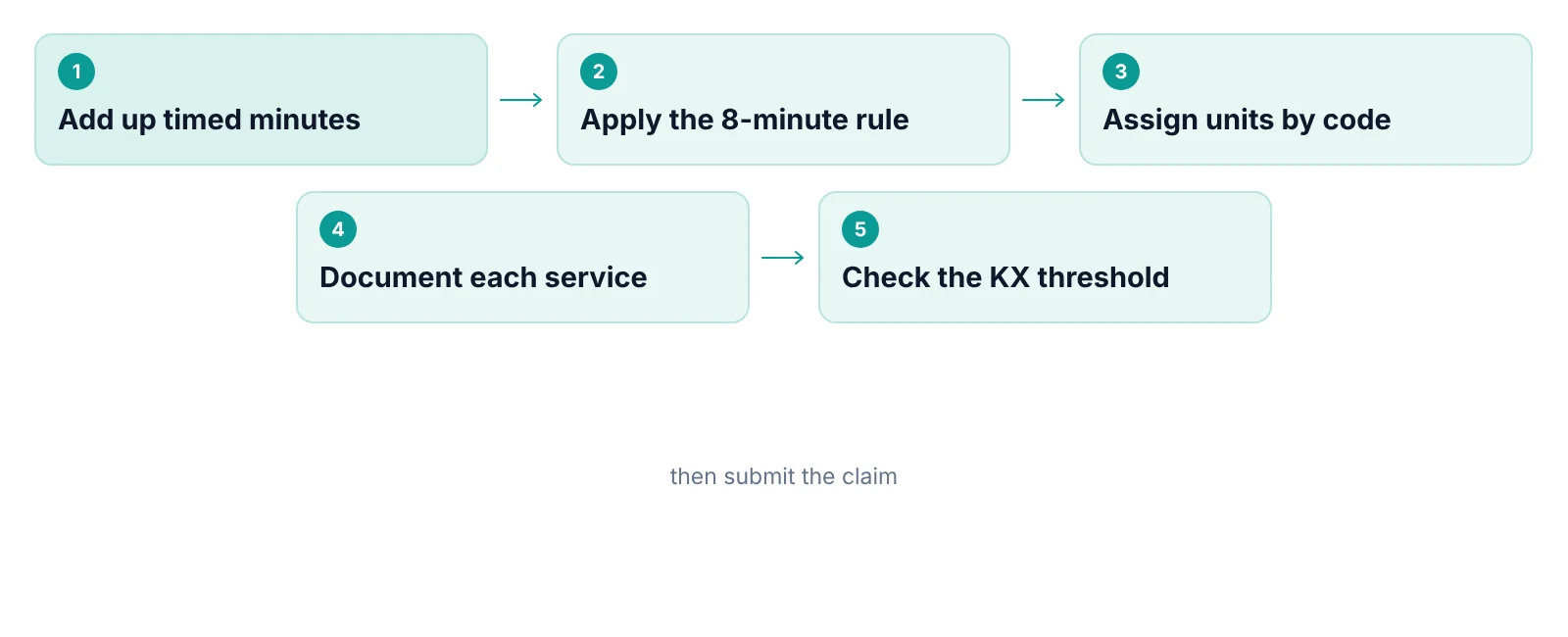
- The 8-minute rule counts total timed minutes across all timed codes to decide the total units.
- Claims above the KX threshold without the KX modifier are denied. The 2026 amount is $2,480 for PT and SLP combined and $2,480 for OT, per CMS.
- Notes must show skilled need and progress, not only a list of exercises.
What is CPT 97110?
97110 is therapeutic procedure, one or more areas, each 15 minutes, for therapeutic exercises to develop strength and endurance, range of motion and flexibility. It requires direct one-on-one contact between the therapist or assistant and the patient. Group exercise is billed under a different code.
| Item | Detail | Why it matters |
|---|---|---|
| Type | Timed code, per 15 minutes | Units depend on minutes |
| Contact | Direct, one-on-one | Time with several patients at once does not count as 97110 |
| Purpose | Strength, endurance, range of motion, flexibility | Notes should name the deficit being treated |
Descriptor paraphrased from the CPT code set. See also our guides to physical therapy CPT codes and PT billing units.
How does the 8-minute rule count units?
Medicare totals the minutes of all timed codes provided in a day, then converts the total to units. Seven minutes or less in one unit does not bill, and eight minutes or more can bill one unit, with the total across codes deciding how many units you can bill in all.
| Total timed minutes | Total units |
|---|---|
| 8 to 22 minutes | 1 unit |
| 23 to 37 minutes | 2 units |
| 38 to 52 minutes | 3 units |
| 53 to 67 minutes | 4 units |
Standard Medicare conversion for timed codes. The full method is explained in our 8-minute rule guide.
Assign units to the codes by the minutes spent on each. If 97110 took 25 minutes and another timed code took 12, the total is 37 minutes and two units. The extra minutes go where they were spent. Commercial payers may use a different method, so check each one.
What must a 97110 note show?
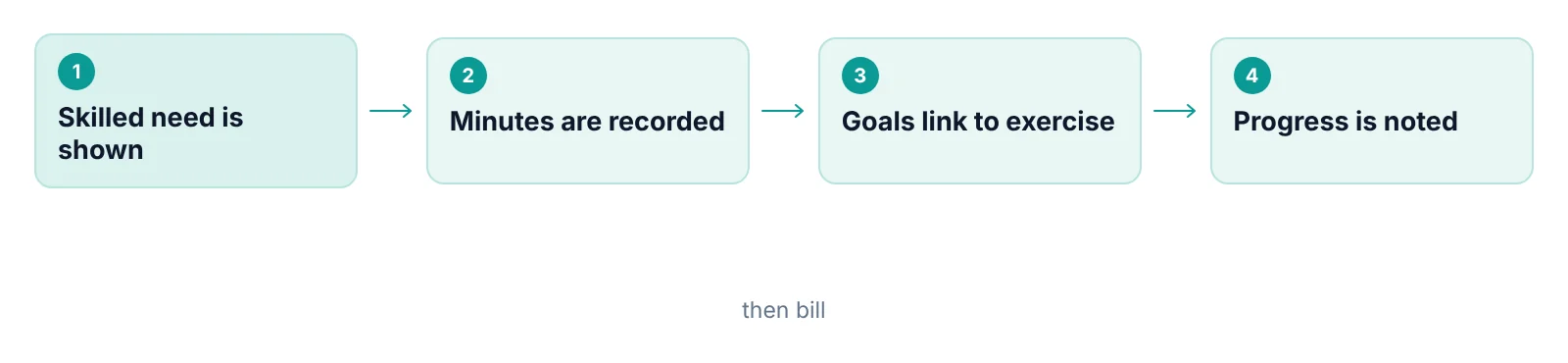
The note should show why the exercise needed skilled direction, what the patient did, the time, and how the patient responded. A plan of care with goals must exist, and the note should link the exercises to those goals.
| Element | What to record | Weak example |
|---|---|---|
| Skilled need | Why a therapist was needed, such as cueing, progression or safety | “Patient did exercises” |
| Minutes | Time spent on 97110 and other timed codes | No times recorded |
| Link to goals | Which goal the exercise addresses | Exercise not tied to the plan |
| Response | Pain, form, repetitions and change from last visit | Same text every visit |
See physical therapy evaluation and treatment coding for the wider documentation set.
Want a second pair of eyes on your claims?
Send us your recent denials and we will show where the same issue repeats. The audit is free and the fix list is yours to keep.
How does the KX modifier work with 97110?
Medicare has a yearly amount above which therapy claims need the KX modifier. The modifier states that the services are medically necessary and that the record supports it. A CMS transmittal for calendar year 2026 lists $2,480 for PT and SLP services combined and $2,480 for OT, and says claims above these amounts without KX are denied.
- KX threshold: $2,480 for PT and SLP combined, and $2,480 for OT in CY 2026.
- Targeted medical review threshold: $3,000 for each of the two groups, per the same transmittal.
- What KX means: the record supports medical necessity above the threshold.
Do not add KX automatically. Add it once the patient is above the threshold and the documentation supports the need.
What are the common 97110 billing errors?
| Error | Why it fails | Fix |
|---|---|---|
| Billing time with several patients as 97110 | Requires direct one-on-one contact | Use the group code where it applies |
| Units from the number of exercises | Units come from minutes | Record minutes per code |
| Same note text every visit | Looks cloned and shows no progress | Record change and response each visit |
| Missing KX above threshold | Claims are denied | Track patient totals and add KX when supported |
Examples are illustrative. Payers set their own edits.
When payers deny 97110 with a bundling code, see CO-97. For audit exposure, read our billing audits guide.
Related therapy billing guides
97110 is usually billed with other timed codes. See 97035 for ultrasound and physical therapy billing services for the wider process. For related payer rules, incident-to billing matters when assistants are involved.
Our recommendations
- Record minutes by code. Build a field for each timed code.
- Track the KX total. Alert staff when a patient nears the threshold.
- Vary notes with the patient. Record real change each visit.
- Check payer unit rules. Some payers do not use the 8-minute method.
- Train assistants on one-on-one rules. Concurrent patients change the code.
- Audit a sample monthly. Compare minutes to units billed.
Bottom line
97110 pays by the minute, so the minutes must be recorded and the skilled need shown. Track the KX threshold and review a sample of notes each month. For billing support, see our physical therapy billing services.
Frequently asked questions
How many minutes make one unit of 97110?
One unit is 15 minutes, but under the Medicare 8-minute rule you count total timed minutes across all timed codes. A total of 8 to 22 minutes supports one unit, 23 to 37 supports two, and so on. The units are then assigned to the codes by the minutes spent on each service.
Is 97110 a timed code?
Yes. 97110 is billed per 15 minutes of direct one-on-one care. That means the minutes of service must be recorded in the note. The unit count depends on total timed minutes, not on the number of exercises, and group exercise with several patients is billed under a different code.
What is the KX modifier threshold for 2026?
A CMS transmittal for calendar year 2026 lists $2,480 for PT and SLP services combined and $2,480 for OT. Claims above that amount without KX are denied. The amount changes each year, so check the current CMS notice before you rely on the figure in a workflow.
What does the KX modifier mean?
KX states that the therapy services above the threshold are medically necessary and that the medical record supports them. It is not a request to bypass review. If the record does not support the need, adding KX creates compliance risk. Add it when the patient is above the threshold and the note shows the skilled need.
Can an assistant bill 97110?
Services by a therapist assistant can be billed under the supervising therapist where Medicare rules allow, with the correct assistant modifier, and payment is reduced. Rules differ by payer and by setting, so confirm supervision and modifier requirements with each payer before you build the workflow.
What notes do reviewers want for 97110?
Reviewers want to see why skilled care was needed, minutes spent, link to the plan of care goals, and the patient’s response. A list of exercises with no skilled reason or progress is a common finding. Each note should reflect that visit, not a copied prior visit.
Get your free practice audit
Tell us about your practice. We will contact you using the details you give.
- A review of your recent claims, denials and A/R aging
- Where your front desk and prior authorizations slow payment
- A prioritized fix list you keep, whether or not you hire us
Pricing is quoted after the audit, based on your volume and the services you choose. Prefer to talk? Call +1 (302) 556-2288.
Sources
- Medicare Claims Processing Manual, Chapter 5 (Part B outpatient rehabilitation and CORF/OPT services) — Centers for Medicare & Medicaid Services (2026)
- Transmittal R13437CP: therapy thresholds for CY 2026 — Centers for Medicare & Medicaid Services (2026)
- Therapy cap and KX modifier — American Physical Therapy Association (2026)
- Therapy and the KX modifier — Palmetto GBA (2026)
- Medicare Benefit Policy Manual, Chapter 15 — Centers for Medicare & Medicaid Services (2026)
- Medicare Physician Fee Schedule — Centers for Medicare & Medicaid Services (2026)
Disclaimer: This article is educational and is not legal, coding, billing, medical or compliance advice. CPT codes and modifier descriptions are owned by the AMA, and code meanings, Medicare contractor policies and payer rules change and vary by payer, contractor and state. Verify current requirements with the official CPT manual, your payers and your counsel before you act.
