Medicare incident-to billing lets a supervising physician or practitioner bill, under their own NPI, services that auxiliary staff such as an NP or PA provide. It applies only in a non-institutional setting, after the physician started the care, with the required supervision and the physician staying involved. Billing under the NP's own NPI pays 85%.
Most practices ask about incident-to for one reason: an NP or PA is seeing established patients, and someone has to decide whose NPI goes on the claim. The wrong answer can mean a repayment request, so the rules matter more than the shortcut.
This guide rewrites our earlier post using Medicare’s own text: the regulation at 42 CFR 410.26, CMS’s incident-to page, the Benefit Policy Manual and the CY 2026 fee schedule transmittal. We removed the revenue, visit-ratio and penalty figures the older version carried, because none of them come from a Medicare source.
Key takeaways
- Only the supervising physician or practitioner can bill incident-to, in a non-institutional setting.
- The physician must personally perform the initial service and stay actively involved; there is no fixed visit ratio in the text.
- Since January 1, 2026, virtual presence by real-time audio/video can meet direct supervision for most services, not audio-only.
- Billing under the NP’s own NPI generally pays 85% of the fee schedule; incident-to pays 100%, per CMS.
- Commercial and Medicaid payers set their own incident-to policies.
What Medicare incident-to billing means
Incident-to is a billing rule, not a staffing model. CMS describes incident-to services as Medicare-covered services and supplies that auxiliary personnel provide as part of a physician’s or other practitioner’s professional service. The claim goes out under the supervising practitioner, who is the only one allowed to bill them (see CMS, Incident To Services & Supplies and 42 CFR 410.26).
Two things follow. First, the services must really be part of the physician’s own treatment of the patient, not a separate service by the NP or PA. Second, incident-to is a choice the practice makes only when every condition is met. When one condition fails, the service is billed under the NP’s or PA’s own NPI instead.
An NP or PA is not required to work incident-to. The Benefit Policy Manual says physician assistants, nurse practitioners and similar practitioners may provide services without direct physician supervision and bill directly for them (CMS Benefit Policy Manual, Chapter 15). The two routes pay differently, which is why the choice gets attention. We cover the payment difference in the last third of this guide.
Who counts as 'auxiliary personnel'
Under the regulation, auxiliary personnel are people acting under the supervision of the physician or practitioner, whether employees, leased employees or independent contractors. They must not be excluded from federal health programs, must not have a revoked Medicare enrollment, and must meet state licensure or other requirements for the service (42 CFR 410.26(a)(1)).
The requirements, in plain terms
Every condition has to be true for the service on the date of service. CMS lists them as a set, and the regulation adds the setting, the billing rule and the state-law test. Table 1 turns the text into a checklist your billing lead can run before a claim drops.
| Condition | What Medicare's text says | What to check in the chart |
|---|---|---|
| Setting | Furnished in a non-institutional setting to non-institutional patients. Non-institutional means any setting other than a hospital or skilled nursing facility. | Place of service is an office or clinic, not a hospital outpatient department or a covered SNF stay. |
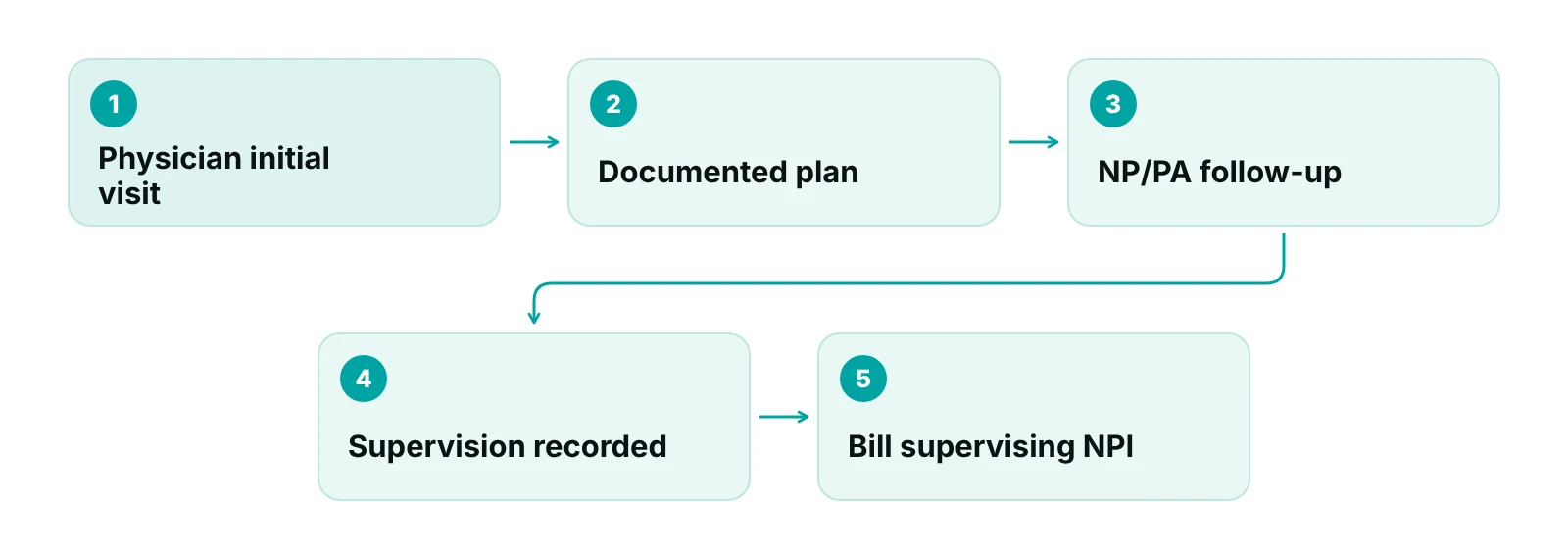
| Physician starts the care | The physician or practitioner personally performs the initial service and stays actively involved in the course of treatment. | A physician note that establishes the diagnosis and plan before the NP or PA follow-up. |
| Integral, incidental part of care | The service is an integral but incidental part of the physician’s diagnosis or treatment of an injury or illness. | The visit follows the plan in the physician’s note and is not a stand-alone service. |
| Commonly furnished in an office | It is the type of service commonly furnished in a physician’s office or clinic, and commonly included in the physician’s bill. | The service is routine office care, not a service unusual for your setting. |
| Supervision | Direct supervision is the general rule. Some services (certain care management and behavioral health services) allow general supervision. | Who was supervising on that date, where they were, and how that is recorded. |
| Who bills | Only the supervising physician or practitioner may bill. That person need not be the patient’s main treating physician. | The billing NPI is the supervising practitioner who was actually present or available. |
| Provider and state law | Auxiliary personnel must meet state requirements, and the service must comply with state law. | License, scope of practice and enrollment status are current and documented. |
Source: CMS, Incident To Services & Supplies; eCFR, 42 CFR 410.26(a)-(b) (current text, reviewed October 2026)
Notice what is not on the list. Medicare’s text sets no visit ratio, such as every third visit. The manual speaks of physician services at “a frequency that reflects the physician’s continuing active participation” in the course of treatment (Medicare Benefit Policy Manual, Chapter 15, section 60.2). That is a judgment your documentation has to support, not a number to hit.
It also does not require the NP and physician to work for the same medical group. The regulation allows the physician or practitioner to be an employee or an independent contractor, and it accepts leased employees and independent contractors as auxiliary personnel (42 CFR 410.26(a)(1), (b)(8)). The manual adds that the relationship with the billing entity must satisfy the rules for valid reassignment, so the enrollment paperwork still matters.
Direct supervision in 2026, including virtual presence
For most incident-to services, direct supervision now includes virtual presence through real-time audio and video, but not audio-only, effective January 1, 2026. Services with a 010 or 090 global surgery indicator are excluded (CMS Transmittal 13507, CY 2026 fee schedule final rule; 42 CFR 410.26(a)(2)).
Before this change, the manual described direct supervision as the physician being present in the office suite and immediately available, without having to be in the same room (Benefit Policy Manual, Chapter 15, section 60.1). Many older guides, including our earlier version of this one, stopped there. If your compliance policy still says the physician must be physically on site for every incident-to visit, it is now stricter than the Medicare rule for covered services. Check payer contracts and state law before relaxing it.
| Situation | Supervision level | Notes |
|---|---|---|
| Most incident-to services | Direct supervision | Presence may be virtual by real-time audio/video; audio-only does not count. |
| Services with a 010 or 090 global surgery indicator | Direct supervision, in person | The virtual-presence option excludes these services. |
| Designated care management services | General supervision | The physician’s overall direction and control; presence during the service is not required. |
| Behavioral health services by auxiliary personnel | General supervision | Same definition of general supervision applies. |
| Services with their own benefit category | Not an incident-to question | CMS tells contractors not to apply incident-to rules to services that have their own benefit category. |
Source: eCFR, 42 CFR 410.26(a)(2)-(3), (b)(5); CMS Transmittal 13507 (December 2025); CMS Benefit Policy Manual, Chapter 15, section 60
Check your Medicare contractor and payers
This guide covers Medicare. Commercial payers and Medicaid programs set their own incident-to policies, and some do not allow it at all. Your Medicare Administrative Contractor can also publish local guidance. Read each payer’s policy before applying Medicare’s rule to its claims.
Incident-to or the NP's own NPI: what changes
The same visit can be billed two ways, and the rules and payment differ. When the NP or PA bills under their own NPI, Medicare pays 85% of the physician fee schedule amount. When the visit qualifies as incident-to and the physician bills, CMS says it pays 100% of the fee schedule (CMS, Incident To Services & Supplies; CMS Transmittal R2656CP).
That gap is the reason practices want incident-to, and it is also the reason auditors look at it. We would not choose the route by the payment difference alone. We would choose it by whether the chart can prove each condition in Table 1.
| Question | Billed under the NP/PA's own NPI | Billed incident-to the physician |
|---|---|---|
| Whose NPI is on the claim | The NP or PA | The supervising physician or practitioner |
| Medicare payment | Generally 80% of the lesser of the charge or 85% of the physician fee schedule amount | 100% of the physician fee schedule amount, per CMS |
| Physician initial visit required | No | Yes. The physician personally performs the initial service |
| Supervision | Per Medicare and state scope-of-practice rules for the NP or PA | Direct supervision, which may be virtual in 2026 for most services |
| Setting | Not governed by the incident-to setting test | Non-institutional setting only |
| Main risk | Billing a service the NP did not personally perform | Billing incident-to when a condition was not met |
Source: CMS, Incident To Services & Supplies; CMS Transmittal R2656CP; eCFR, 42 CFR 410.26(b); CMS Benefit Policy Manual, Chapter 15

We state no dollar value, because the amount depends on your codes and locality. Model your own claims.
Rules you may have read that Medicare's text does not support
Several widely repeated statements are wrong or unsourced. A practice that builds its policy on them can both over-restrict and over-bill. Here is how we reconciled them against the regulation and CMS pages.
- “The physician must see the patient every third visit.” Not in the regulation or the manual sections we read. Medicare asks for continuing active participation, with no fixed ratio.
- “Both must be employed by the same group.” Medicare accepts employees, leased employees and independent contractors, subject to valid reassignment.
- “The physician must be physically present, always.” That was the long-standing reading of direct supervision. Since January 1, 2026, real-time audio/video presence also counts for most incident-to services.
- Revenue and penalty averages. Figures such as an average extra annual revenue, or a flat penalty per incident, have no Medicare source. We removed them. Exposure depends on the claims, the dates and the facts, not on an average.
- Post-surgery follow-up as an incident-to example. We removed the example. Whether a service is separately billable at all depends on the global surgery rules, which are a different question from incident-to.
If a vendor’s guide gives a clean number for any of these, ask where it comes from. A real rule has a citation.
Setting up incident-to so you can defend it
Compliance with incident-to is mostly documentation and routing. The front desk, the schedule and the claim have to agree on who saw the patient and who supervised. Primary care and internal medicine practices, where NPs and PAs often handle established-patient follow-up, tend to feel this first; see how we approach billing for family practice billing if that is your setting.
What the chart should show
- A physician note that establishes the diagnosis and plan of care for the problem.
- The NP or PA note that follows the plan, with the date and place of service.
- The name of the supervising practitioner for that date, and whether presence was in the office or virtual by audio/video.
- Evidence of the physician’s continuing involvement, such as a visit, a documented case review or a signed plan update.
What the claim process should catch
A rule that only lives in a policy binder fails at the claim. A practice management system that tracks claims by stage can hold a claim until the rendering provider, supervising practitioner and place of service are filled in, and can assign a reviewer when they conflict. It does not decide whether a visit is eligible. A person with coding and compliance knowledge still does that.
Enrollment is the other half. The NP or PA, and the billing arrangement, must be set up properly with the payer before the first visit. Our guide to credentialing for group practices explains that process, and credentialing and payer enrollment services cover it end to end.
Want a second pair of eyes on your incident-to claims?
We review a sample of your NP and PA claims against the checklist above and tell you what we found. Pricing, if you want help afterward, is quoted after the audit.
What goes wrong when incident-to is applied loosely
Incident-to errors usually come from habit rather than intent: a schedule built around the NP’s availability, a physician who was away, or a new problem that never reached the physician. Medicare may treat the resulting payments as overpayments, and knowingly submitting false claims carries separate legal exposure. We have not quoted a penalty figure, because we did not verify a current one for this post; ask your compliance counsel.
Internal review is the usual control. Our posts on medical billing compliance, types of coding audits and Medicare fee-for-service claims describe how to set up a sampling routine. For telehealth-heavy practices, the telehealth billing guide covers how remote presence interacts with place of service and modifiers.
“Incident-to is not a loophole. It is a narrow permission, and every claim that uses it is one you may have to explain.”
Deciding whether to handle this in-house or with a billing partner
If your NPs and PAs see a meaningful share of established-patient visits, you need either a trained internal reviewer or an outside team. The questions below separate a partner who understands incident-to from one who simply says yes.
- How do you confirm the supervising practitioner and the initial visit before a claim is billed?
- What happens when the schedule shows an NP visit but no physician was available?
- Which payers’ incident-to policies do you track, and where is that documented for us?
- Who reviews a sample of claims, how often, and what do you report back?
- Will you put a Business Associate Agreement in place before you access patient data?
Our medical billing services handle claim preparation and follow-up with the EHR you already use. The team works to your supervision policy; we do not decide eligibility for you. If you would rather start with a conversation, talk to our team.
Our recommendations
- Write one incident-to policy and keep it short. Put Table 1 in front of every scheduler, biller and provider. One page, signed off by your compliance contact, beats a long binder nobody opens.
- Update the supervision rule for 2026. If your policy says the physician must be physically on site, decide whether you will adopt virtual presence for eligible services. If you do, write down how it is recorded in the chart. If not, say why.
- Make the physician's first visit visible. Add a flag in the schedule or chart for established patients whose plan was set by a physician. An NP visit without that plan is billed under the NP’s NPI.
- Check the billing NPI against who was supervising. Before a claim goes out, confirm the billing physician was the supervisor on that date. That is where the schedule and the claim disagree most often.
- Sample claims every quarter. Pull a handful of incident-to claims per payer and trace each condition. Fix the pattern, not just the claim.
- Read each payer's own policy. Medicare’s rule is the baseline. Commercial plans and Medicaid may restrict or exclude incident-to billing, so keep a payer-by-payer note.
Hold NP and PA claims until supervision details are complete.
The RCM Finder portal tracks each claim by stage with an owner and runs data-completeness checks before submission, so a claim without a supervising practitioner can be held for review. It does not decide incident-to eligibility.
See how the RCM Finder portal works · Create a portal account
Disclosure: RCM Finder builds and sells this portal. It is a practice management system, not an EHR.
Bottom line
Medicare incident-to billing is workable when the physician started the care, supervision is met and recorded, and the setting qualifies. Treat the 85% versus 100% difference as a result of a clean chart, not a goal. If you want help with enrollment and claim review for NPs and PAs, start with our credentialing services or request a free practice audit.
Frequently asked questions
What is Medicare incident-to billing?
It lets the physician or practitioner who supervises auxiliary staff, such as an NP or PA, bill their services under the supervisor’s NPI. The service must be an integral part of the supervisor’s treatment, in a non-institutional setting, with direct supervision in most cases. Only the supervising practitioner may bill.
Does the physician have to be in the building in 2026?
Not always. Since January 1, 2026, real-time audio and video presence can meet direct supervision for most incident-to services under Medicare. Audio-only does not count, and services with a 010 or 090 global surgery indicator are excluded. Check commercial payers and state law separately.
Can an NP start a new patient's care under incident-to?
Not as auxiliary staff. CMS requires the billing physician or practitioner to personally perform the initial service and stay actively involved. If an NP starts care without that, bill under the NP’s own NPI, subject to payer rules. Ask your Medicare contractor about edge cases.
Is there a rule that the physician must see the patient every third visit?
We found no such fixed ratio in 42 CFR 410.26 or the manual sections we reviewed. The manual asks for physician services at a frequency that reflects continuing active participation. Document that involvement, and check payer or contractor policies that may be stricter.
Do the NP and the physician need the same employer?
No. Medicare accepts employees, leased employees and independent contractors as auxiliary personnel, and the physician may be an employee or an independent contractor. The billing arrangement must meet reassignment rules, so keep enrollment records current.
How much more does incident-to pay than billing under the NP's NPI?
CMS says incident-to services billed by the supervising physician are paid at 100% of the physician fee schedule, while an NP or PA billing directly is generally paid at 85%. Actual dollars depend on the code and locality, so model your own claims.
Get your free practice audit
Tell us about your practice. We will contact you using the details you give.
- A review of your recent claims, denials and A/R aging
- Where your front desk and prior authorizations slow payment
- A prioritized fix list you keep, whether or not you hire us
Pricing is quoted after the audit, based on your volume and the services you choose. Prefer to talk? Call +1 (302) 556-2288.
Sources
- 42 CFR 410.26 Services and supplies incident to a physician's professional services — eCFR (2026)
- Incident To Services & Supplies — CMS (2026)
- CMS Transmittal 13507 (CR 14315), CY 2026 Physician Fee Schedule final rule — CMS (2025)
- Medicare Benefit Policy Manual, Chapter 15 (Rev. 11355) — CMS (2022)
- Medicare Benefit Policy Manual, Chapter 15, sections 60-60.3 (hosted copy) — CMS manual text, hosted by MICMT (2015)
- CMS Transmittal R2656CP — CMS (2013)
Disclaimer: This article is educational and is not legal, coding or compliance advice. Medicare rules change and payer policies vary. Confirm current requirements with CMS, your Medicare Administrative Contractor and your compliance counsel before billing.