
Chronic care management billing pays for monthly, mostly non-face-to-face care coordination for a Medicare patient with two or more chronic conditions expected to last at least 12 months. Pick CPT 99490, 99487 or 99491 by whose time counts and how complex the care is, after consent and a care plan are documented.
Most CCM claims fail before the claim is built: no initiating visit, no consent in the chart, or minutes already counted for another service. This guide covers the codes, the rules and what we could and could not confirm for 2026. It reflects CMS pages we read on October 14, 2026, and it is written for practice owners and billing leads, not for clinical decisions. Our earlier version listed dollar rates and a revenue example that we could not support, so we removed them.
Key takeaways
- CCM needs two or more chronic conditions expected to last at least 12 months or until death, with significant risk of decline.
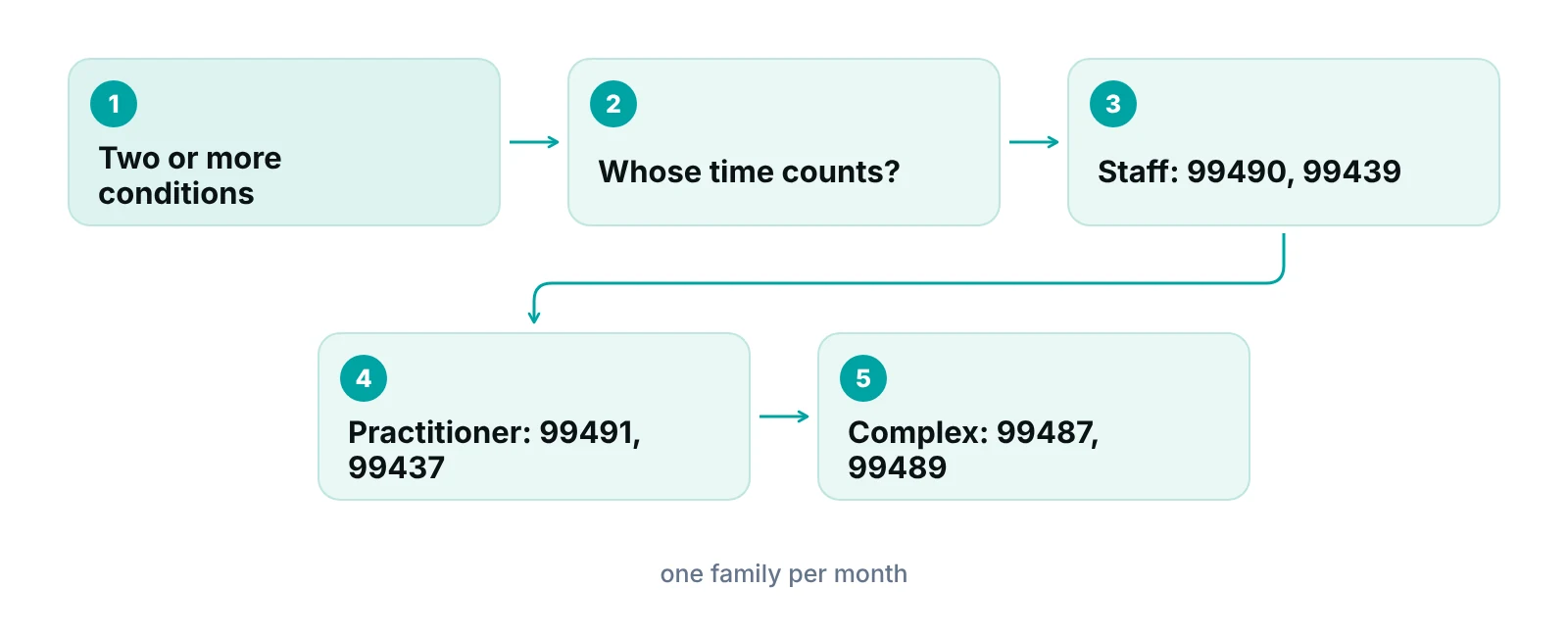
- 99490 and 99439 use staff or practitioner time; 99491 and 99437 count only the billing practitioner’s personal time; 99487 and 99489 are complex CCM.
- Consent is written or verbal, documented once, and must cover cost sharing and the one-practitioner-per-month rule.
- Do not report 99491 in the same month as 99490, and do not mix complex and non-complex CCM in a month.
- Medicare pays CCM under the PFS in 2026; the 2027 conversion factor is only a proposal.
Who qualifies for chronic care management?
A Medicare patient qualifies when they have two or more chronic conditions expected to last at least 12 months or until death, and those conditions put the patient at significant risk of death, acute exacerbation or decompensation, or functional decline. That is the two-chronic-conditions rule in the CMS MLN booklet MLN909188 (June 2025).
The service is mostly non-face-to-face. The same booklet describes it as care coordination of at least 20 minutes per calendar month. Your chart should name the conditions you counted and say why they meet the risk test.
Physicians, certified nurse midwives, clinical nurse specialists, nurse practitioners and physician assistants may bill CCM. Clinical staff can furnish the service under the billing practitioner’s direction on an incident-to basis, under general supervision. Our Medicare incident-to billing guide covers the wider incident-to rules.
Cost sharing applies to CCM, and some patients have Medigap coverage that helps with it. Tell the patient about possible cost sharing before you bill. That conversation is part of consent, covered below.
Which CCM CPT codes do you bill, and whose time counts?
Six CPT codes cover chronic care management. Three questions choose the code: whose time was spent, how many minutes were logged, and whether the care was complex.
| Code | Whose time counts | Time unit in the month | Typical fit |
|---|---|---|---|
| 99490 | Clinical staff or billing practitioner | First 20 minutes | Standard CCM run by a care coordinator |
| +99439 | Clinical staff or billing practitioner | Each additional 20 minutes | Add-on after 99490 |
| 99491 | Billing practitioner’s personal time only | First 30 minutes | The physician or other practitioner does the coordination |
| +99437 | Billing practitioner’s personal time only | Each additional 30 minutes | Add-on after 99491 |
| 99487 | Clinical staff or billing practitioner | First 60 minutes | Complex CCM with moderate or high complexity decision-making |
| +99489 | Clinical staff or billing practitioner | Each additional 30 minutes | Add-on after 99487 |
Source: CMS, MLN909188 Chronic Care Management Services (June 2025), Table 2. Code descriptions paraphrased; CPT is a trademark of the AMA.
Corrected from our earlier post
We previously described 99491 as a code for the first face-to-face visit, and 99437 as a code for further visits. That was wrong. Both are CCM codes based on the billing practitioner’s own non-face-to-face time. Neither is a visit code.
Complex CCM (99487 and 99489) requires moderate to high complexity medical decision-making in addition to the comprehensive care plan, according to the CMS MLN booklet MLN909188 (June 2025). Document the decision-making in the note, not just the minutes. For how those same diagnoses feed risk capture, see our HCC coding guide.
What must be in place before you bill the first month?
Five things have to exist in the chart before the first CCM claim: an initiating visit where required, documented consent, a comprehensive care plan, 24/7 access for urgent needs, and a certified EHR record. Each comes from the CMS booklet.
Initiating visit
CMS requires an initiating visit for new patients and for patients you have not seen within the previous year. It must happen during a comprehensive face-to-face E/M visit, an annual wellness visit or an initial preventive physical exam, and CCM must be discussed there. If it was not discussed, the visit does not count. Our earlier post said every patient needs a face-to-face visit to start. The booklet limits that rule to new patients and patients not seen in the past year.
Consent
Written or verbal consent is required before you bill. Document five points: that CCM is available, the possible cost-sharing, that only one practitioner can bill CCM in a calendar month, that the patient can stop at any time with the stop taking effect at the end of the calendar month, and that you explained these points and whether the patient accepted or declined. Consent is needed once, unless the patient switches to a different CCM practitioner.
Care plan, access and EHR
- Care plan: create, revise and monitor a patient-centered electronic plan built from physical, mental, cognitive, psychosocial, functional and environmental assessments plus an inventory of resources and supports. Make it available inside and outside the practice, and give copies to the patient or caregiver when needed.
- 24/7 access: urgent-need access to a physician, qualified practitioner or clinical staff, with a named care team member for routine contact and phone plus secure asynchronous options.
- Certified EHR: record demographics, problems, medications and medication allergies in a certified EHR version that meets the booklet’s date test.
Our guide to clear documentation in medical billing shows how to build these elements into templates. Our insurance verification guide covers checking coverage and cost sharing before you enroll a patient.
Which services can you not bill in the same month as CCM?
Several pairings are not allowed in one calendar month, and the biggest is non-complex plus complex CCM. Run a conflict check before every claim.
| Situation | What CMS says | What to do |
|---|---|---|
| Non-complex and complex CCM | Not billable in the same calendar month | Choose one family per patient per month |
| 99491 or 99437 with 99487, 99489, 99490 or 99439 | Do not report together in the same month | Do not split one patient’s month across staff-time and practitioner-time codes |
| G0181, G0182 or CPT 90951 to 90970 | CCM cannot be billed in the same service period | Check the patient’s other billed services first |
| Complex CCM and prolonged E/M | Not billable in the same calendar month | Pick one or the other |
| Time counted for another billed code | Time spent cannot also count toward CCM | Keep a time log that is not shared across codes |
| RPM or RTM | Either can be billed with CCM or TCM, but not both | Choose one remote monitoring type |
| Transitional care management (99495, 99496) | 99487, 99489, 99490 and 99491 can be reported during the TCM period | Confirm the dates of service overlap correctly |
Source: CMS, MLN909188 Chronic Care Management Services (June 2025).
Why the old revenue example failed
Our earlier post totaled 99490 for 300 patients plus 99491 for 100 of the same patients in one month. CMS says 99491 is not reported in the same month as 99490, so the total was not billable. We removed the example and all dollar figures that went with it.
Only one practitioner can bill CCM for a patient in a calendar month. If a patient’s cardiologist and primary care physician both enroll the patient, only one practitioner may bill that month. Ask the patient who else is managing their chronic conditions when you obtain consent.
Is chronic care management still paid in 2026?
Yes, in the CMS pages we read. The CMS MLN booklet MLN909188 (June 2025) says Medicare pays for CCM under the Physician Fee Schedule (PFS), and CMS’s CY 2026 PFS final rule fact sheet (issued October 31, 2025, effective on or after January 1, 2026) exempts time-based care management codes from the new efficiency adjustment. We could not confirm per-code dollar rates from a CMS page, so we do not quote any.
| Item | Status | Year |
|---|---|---|
| Payment basis | Medicare pays for CCM under the Physician Fee Schedule | 2026 |
| Efficiency adjustment | -2.5% applied to work values of non-time-based services; time-based codes, including care management, are exempt | 2026 (final) |
| Conversion factor | $33.57 for qualifying APM participants; $33.40 for others (from $32.35) | 2026 (final) |
| Per-code dollar rates | Not confirmed from a CMS page; look up your locality’s rate | Current year |
| Proposed conversion factor | $33.17 (qualifying APM) and $32.84 (others), proposed July 14, 2026, effective on or after January 1, 2027 | 2027 (proposed) |
| CCM in the CY 2027 proposal | The fact sheet we read does not mention CCM or APCM | 2027 (proposed) |
Source: CMS, CY 2026 PFS final rule fact sheet (October 31, 2025); CMS, CY 2027 PFS proposed rule fact sheet (July 14, 2026); CMS MLN909188 (June 2025).
The 2027 numbers are a proposal. Read the final rule before you build a 2027 forecast. A fact sheet that does not mention CCM does not prove the full proposed rule is silent on it.
Rural health clinics and FQHCs
For rural health clinics (RHCs) and federally qualified health centers (FQHCs), the code story differs. G0511 is the HCPCS code for general care management services, and a Noridian Medicare notice said those facilities could keep billing it through September 30, 2025 while updating billing systems. CMS’s CY 2026 fact sheet says that, starting January 1, 2026, RHCs and FQHCs must report the individual codes for CoCM and communications technology-based services (G0512 and G0071), and that care management services designated under the PFS will be paid as separate care coordination services. We found no clear statement on whether G0511 is still active, so ask your Medicare Administrative Contractor (MAC) before you bill it.
Should you bill CCM or advanced primary care management?
Choose by how your practice runs care: CCM pays for tracked minutes, and advanced primary care management (APCM) pays one monthly code without minute counting. The CMS MLN booklet MLN909188 (June 2025) lists APCM as G0556, G0557 and G0558 and says it combines elements of several care management and communication services, including CCM, principal care management, transitional care management, interprofessional consultations and online digital E/M.
For 2026, the CMS fact sheet says CMS finalized optional add-on codes for behavioral health integration and psychiatric collaborative care, billed only when the same practitioner reports the APCM base code in the same month. We did not verify the APCM eligibility rules, level definitions or payment, so read CMS’s APCM guidance before you switch.
- CCM fits when your team already logs minutes and you want to bill complex CCM or practitioner-time codes where they apply.
- APCM may fit when minute tracking is the main burden and you can meet its requirements for the whole patient panel.
- Either way, the same patient should not be double-billed for overlapping care management in a month.
Do not move a whole panel to APCM until you have read CMS’s APCM requirements and compared its payment with what your CCM minutes pay today.
How do you run the monthly CCM billing cycle?
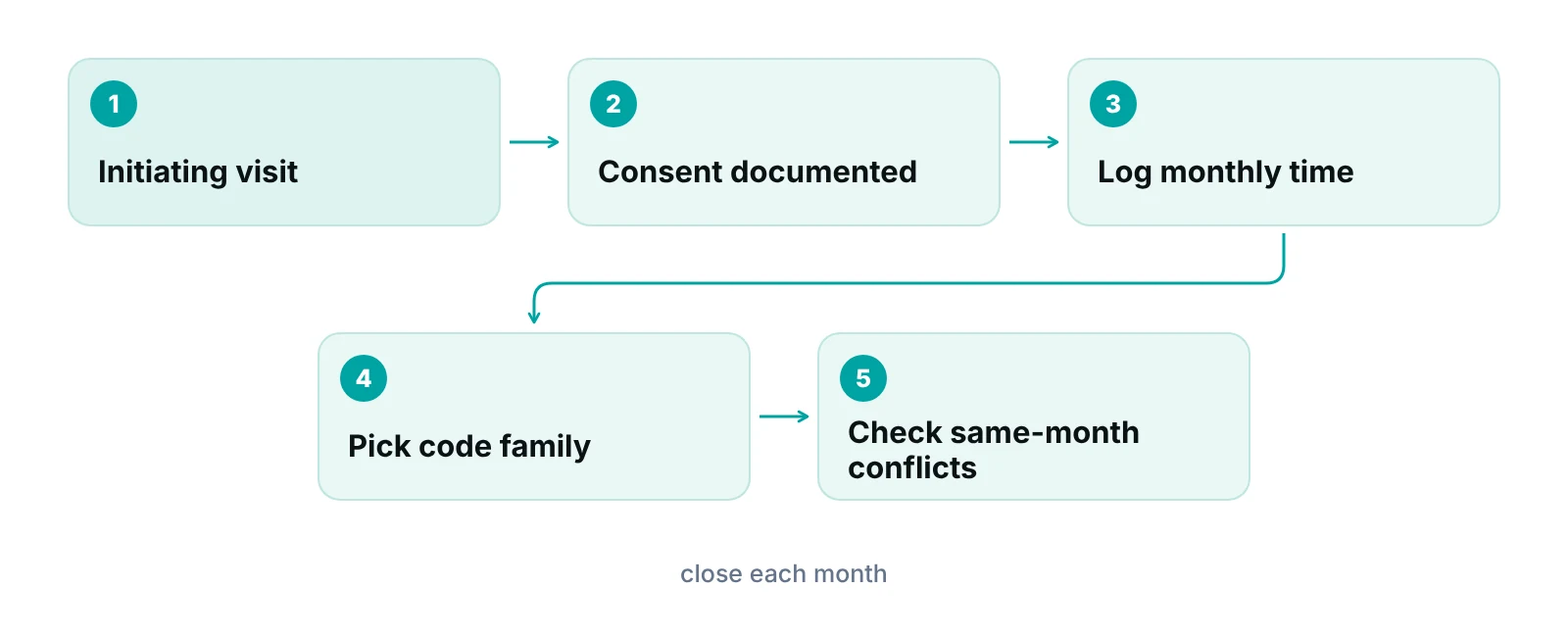
Treat CCM as a month-end billing cycle, because codes are based on time per calendar month. Our internal medicine billing and coding support page explains how we support practices adding CCM.
- Confirm the initiating visit (or that the patient was seen in the past year) and the consent note.
- Log time by person and date during the month, and keep it separate from time for any other billed service.
- On the last day of the month, total the minutes by whose time counts.
- Pick one code family from Table 1, and check Table 2 for conflicts.
- Submit through your normal claim process and track the result with the same denial follow-up you use for other claims.
See our guide to clean claims and our overview of medical billing audits for how to review a sample before a payer does. For Medicare basics beyond CCM, read our Medicare billing guide.
What should you check before you launch or expand CCM?
Check the chart before the claim: consent, initiating visit, care plan, time totals and same-month conflicts. A short sample review shows whether your CCM process will survive a payer question.
- A consent note exists for each enrolled patient and names the five points above.
- Each patient has a documented reason they meet the two-condition and risk test.
- Minutes are logged by person and date, and totals match the code billed.
- No patient has CCM billed by two practices in the same month.
- No same-month conflicts from Table 2 appear in the claim history.
Have us review your CCM billing process
Send us a sample of recent care-management claims and the chart notes behind them. We will check consent, time totals and same-month conflicts with you. The audit is free, and pricing, if you want help, is quoted afterward.
Our recommendations
- Make consent part of the initiating-visit template. Add the five consent points to the E/M, annual wellness visit or preventive visit template, so enrollment happens at the visit where CCM is discussed. A consent field that is easy to skip will be skipped.
- Name one owner for the monthly close. One person should total the minutes, pick the code family and run the conflict check. Split ownership is how patients end up with two codes that cannot be billed together.
- Log time by person, date and activity. Whose time counts changes the code. A single running total for the month cannot support 99491 versus 99490 if the staff and practitioner minutes are mixed.
- Ask every patient who else is managing their conditions. Only one practitioner can bill CCM per calendar month. Ask at consent, write the answer down, and revisit it when claims deny.
- Decide CCM versus APCM on purpose. Read CMS’s APCM guidance, compare it with your CCM minutes and eligible patients, and decide for the whole panel. Do not mix them casually.
- Re-check every January and after each final rule. Codes, values and rules change each Physician Fee Schedule year. Calendar a review after the CY 2027 final rule and again at the start of 2027.
Bottom line
Chronic care management billing pays when the chart proves the basics: two qualifying conditions, an initiating visit where required, documented consent, a care plan and honest monthly minutes. Pick one code family per patient per month, run the conflict check and read the final rule before you plan for 2027. If you want help, see our medical billing and coding support or our end-to-end revenue cycle management service, estimate the cost of denials with our revenue calculator, or talk to us.
Frequently asked questions
What is the two chronic conditions rule for CCM?
Medicare requires two or more chronic conditions expected to last at least 12 months or until death. They must place the patient at significant risk of death, acute exacerbation or decompensation, or functional decline. Document which conditions you counted and why they meet that risk test.
What is the difference between CPT 99490 and 99491?
Both are CCM codes. 99490 covers the first 20 minutes of clinical staff or practitioner time in a month. 99491 covers the first 30 minutes of the billing practitioner’s own time. Do not report 99491 in the same month as 99490 for the same patient.
Do I need patient consent every month for CCM?
No. CMS requires written or verbal consent before you bill, and it is needed once, unless the patient switches to a different CCM practitioner. Document that you explained availability, cost sharing, the one-practitioner-per-month rule and the right to stop, and record whether the patient accepted.
Can I bill CCM during a transitional care management period or with remote monitoring?
CMS says 99487, 99489, 99490 and 99491 can be reported during the TCM period (99495 or 99496). Either remote physiologic monitoring or remote therapeutic monitoring can be billed with CCM or TCM, but not both. Check your MAC for local edits.
Is chronic care management paid by Medicare in 2026?
Yes, in the CMS pages we read. Medicare pays for CCM under the Physician Fee Schedule, and CMS’s CY 2026 final rule fact sheet exempts time-based care management codes from the efficiency adjustment. Look up your locality’s current rate, because we could not confirm per-code amounts.
What is G0511 and can my RHC or FQHC still use it?
G0511 is the HCPCS code for general care management services billed by RHCs and FQHCs. Noridian said it could be billed through September 30, 2025. We found no clear later guidance, so confirm its status with your MAC before billing.
Get your free practice audit
Tell us about your practice. We will contact you using the details you give.
- A review of your recent claims, denials and A/R aging
- Where your front desk and prior authorizations slow payment
- A prioritized fix list you keep, whether or not you hire us
Pricing is quoted after the audit, based on your volume and the services you choose. Prefer to talk? Call +1 (302) 556-2288.
Sources
- Chronic Care Management Services (MLN909188), June 2025 — CMS (Medicare Learning Network), hosted by HHS (2025)
- MLN909188 – Chronic Care Management Services (guidance page) — HHS Guidance Portal (2019)
- CY 2026 Medicare Physician Fee Schedule Final Rule (CMS-1832-F) fact sheet — CMS (2025)
- CY 2027 Medicare Physician Fee Schedule Proposed Rule fact sheet — CMS (2026)
- CMS extends G0511 billing for FQHCs and RHCs until September 30, 2025 — Noridian Healthcare Solutions (Medicare Administrative Contractor) (2025)
Disclaimer: This post is general educational information about revenue cycle operations. It is not legal, coding, billing-compliance or clinical advice. CPT is a registered trademark of the American Medical Association. Code definitions, Medicare rules and payer policies change and vary by plan and MAC. Confirm current codes and requirements with the AMA CPT code set, CMS, your MAC and each payer before you bill.
