
A good credentialing service for mental health providers prepares and tracks your payer applications while you stay the owner of your licenses, logins and attestations. Choose by asking how it handles your license types, who controls your CAQH and Medicare accounts, what it does after approval, and what the contract says.
Most mental health practices do not need a vendor ranking. They need a way to decide whether to hire help at all and a fair way to compare the people who pitch them. This guide covers that decision. It does not repeat the application steps, which are in our therapist insurance credentialing guide. This is general information, not legal or compliance advice, and payer rules vary.
Key takeaways
- Decide first whether help is worth it: the answer depends on how many clinicians, how many payers and how much staff time you have.
- Some duties never transfer: you sign, you attest in CAQH, and you answer for what is submitted in your name.
- Ask who holds your CAQH, NPPES and Medicare logins, and insist you keep ownership.
- Treat success rates, fixed turnaround claims and payer ‘partnerships’ as questions to test, not standards.
- Get scope, data-security terms and exit terms in writing before work starts.
What a credentialing service does for a mental health practice
A credentialing service prepares, submits and follows up on your insurance applications so clinicians can be paid in-network. It does not approve you. Each payer, each state Medicaid program and Medicare decide that for themselves.
For a behavioral health practice the work is more than filling in forms. You may have several license types (counselors, marriage and family therapists, social workers, psychologists, prescribers), clinicians still working toward full licensure, telehealth across state lines and a steady flow of new hires. Each adds an application, a payer rule or a date to track. If you want the plan-by-plan picture first, see our behavioral and mental health RCM operations page.
In practice, a service typically covers some mix of these tasks. Services differ, so ask which ones are in scope:
- Building and updating your CAQH ProView profile and collecting supporting documents.
- Preparing and submitting applications to commercial plans, Medicaid and Medicare.
- Following up with payers and logging each contact and date.
- Tracking re-attestation, recredentialing and revalidation deadlines.
- Reporting changes such as a new address, license renewal or new location.
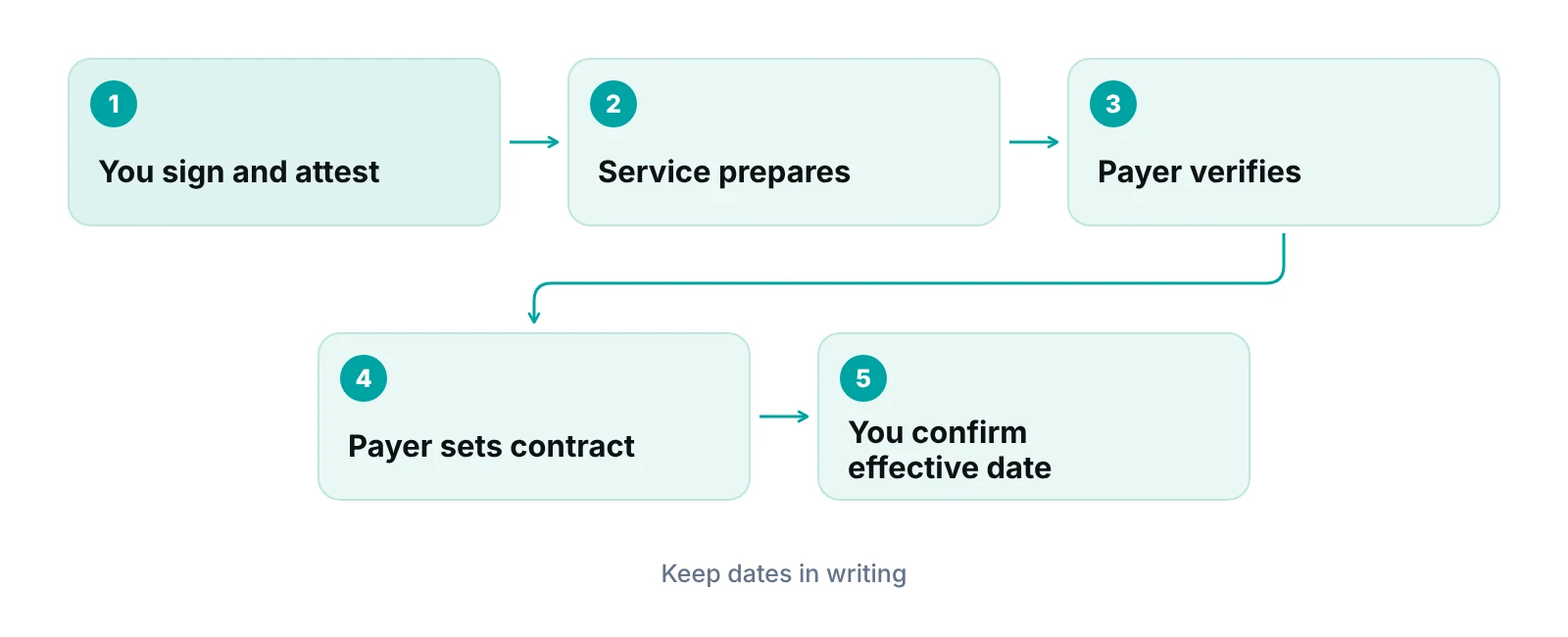
- Confirming your effective date in writing before you schedule insured clients.
Credentialing is not billing
A service that gets you on a panel has not fixed claims that fail for coding or eligibility reasons. Those are billing problems. If you are also comparing billing help, our guide on questions to ask when choosing a medical billing company covers that decision separately.
Do you need a service, or can you do it yourself?
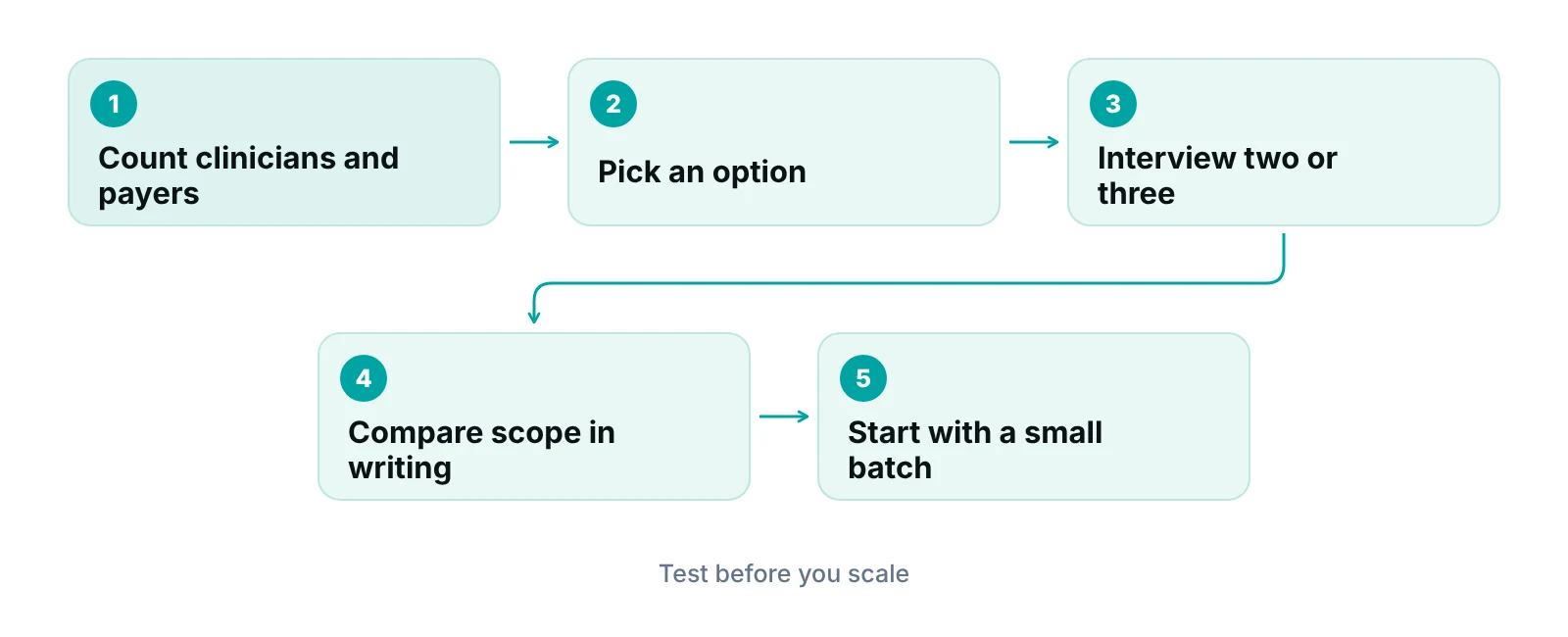
Hire help when the paperwork is costing more of your time or your delayed start dates than the service would. For one clinician and two or three plans, doing it yourself is realistic. For a group adding clinicians and payers, the tracking alone often justifies a partner.
| Option | Fits when | Watch for | What you still own |
|---|---|---|---|
| Do it yourself | One or two clinicians, a short panel list, and an owner or manager with time to follow up | Missed re-attestation dates; applications that stall because no one chases them | Everything |
| Independent consultant | A small practice that wants help with a first round of applications | Single point of failure if they are away; unclear handoff of your files | Signatures, attestation, login ownership |
| Credentialing company | A growing group with many clinicians, payers and recurring deadlines | Scope creep in the contract; reports that show activity but not dates | Signatures, attestation, final accuracy of what is submitted |
| Billing partner that also credentials | You want one team for enrollment, eligibility and claims | Make sure credentialing scope, staffing and reporting are written out, not assumed | Signatures, attestation, final accuracy of what is submitted |
Source: RCM Finder editorial framework, not a statistic.
If you decide to hire, start with what the work involves and who does it. Our credentialing services page lists how we approach payer enrollment so you can compare scope against any other proposal.
What stays with you, whoever you hire
Some duties cannot be handed off. Your signature, your attestation and your responsibility for accuracy stay with you. A vendor can remind you and prepare the work, but the filings are in your name.
CAQH ProView, the shared profile many commercial plans use, is free to providers, and CAQH says only you can authorize who has access to your information, according to its ProView quick reference. The same document sets re-attestation at every 120 days (180 days for providers practicing in Illinois). CAQH’s provider user guide adds that after you update information you must complete attestation so authorized organizations can see the new version.
Medicare adds its own deadlines. Under 42 CFR 424.516, physicians and non-physician practitioners must report a change of ownership, adverse legal action or a change in practice location within 30 days, and other enrollment changes within 90 days. Under 42 CFR 424.515, most providers must revalidate every 5 years. A service that does not track these, or that keeps you out of the loop, is a risk even if it files a perfect first application.
| Duty | What the rule or document says | Why it matters when you hire help |
|---|---|---|
| CAQH re-attestation | Every 120 days (180 in Illinois) | An expired attestation can hold up plans reading your profile; ask who is reminded and who attests |
| CAQH access | Only the provider authorizes who can view the profile | Confirm the service asks you before adding plans, and that you can see the Authorize page |
| Medicare reporting, 30 days | Ownership change, adverse legal action, practice location change | Tell the service the day you sign a new lease or add a site |
| Medicare reporting, 90 days | All other enrollment changes | Agree who sends the update and how you will see proof |
| Medicare revalidation | Every 5 years for most providers | Ask how the service tracks the due date for each clinician |
| Medicare effective date | For physicians and non-physician practitioners, the later of the filing date of an approved application or the date services began at a new location | Filing date matters, so ask how fast the service files once your documents are complete |
Sources: CAQH ProView Quick Reference and Provider User Guide; 42 CFR 424.515, 424.516 and 424.520 (Cornell LII).
If you treat Medicare patients, ask whether the service has enrolled your license type before. Medicare payment for marriage and family therapists and mental health counselors began January 1, 2024, and both can enroll through PECOS or the paper CMS-855I, according to the CMS MFT and MHC FAQ. That is still a newer path than physician enrollment, so a specific answer from the vendor is worth more than a general one.
Questions to ask a credentialing service before you sign
Ask questions that force specific answers. The strongest vendors show you how they work; the weakest give you a number or a promise. Use the table below on every call so you compare like with like.
| Topic | Ask | A good answer | Red flag |
|---|---|---|---|
| Behavioral health experience | Which license types and supervised or associate clinicians have you enrolled, and in which states? | Names license types and shows how payer rules for them differ | ‘We do every specialty’ with no examples |
| Account ownership | Who creates and holds my CAQH, NPPES and Medicare logins? | You own them; the service gets access you can revoke | The service holds the only login |
| Visibility | How will I see each application’s status and dates? | A shared tracker or regular report with submission dates and payer contacts | Monthly summary with no dates |
| Timelines | What range have you seen recently for each payer, and when does your clock start and stop? | Recent ranges by payer, labeled as estimates, with clear start and stop points | One fixed turnaround for every payer |
| After approval | Do you confirm the effective date and contract in writing, and track recredentialing? | Yes, with a deadline calendar for each clinician | Work ends at ‘application submitted’ |
| Exclusion screening | Do you check the OIG exclusion list, and how often? | A stated routine and what happens if a hit appears | No process, or only at hire |
| Pricing | What is the pricing model, what is included, and what costs extra? | A written scope listing each payer, clinician and fee type | Vague ‘custom’ pricing with surprise fees |
| Exit | What happens to my files and logins if I leave? | Documents returned and access removed within a stated period | No exit terms |
Be careful with benchmarks. Roundup articles often list a ‘success rate’ or a standard turnaround as if they were industry norms. We found no official source for either. Processing times differ by payer, so a number someone gives you is their experience, not a rule. Ask them to show recent actual dates instead.
Payer ‘partnerships’ deserve the same test. A service can prepare, submit and chase applications, but the payer makes the decision, and a plan may be closed to new providers. Ask what the service does when a plan is closed or pauses enrollment. If you plan to join Medicaid, see our Medicaid credentialing guide for how that side differs, and our guide to insurance panels for therapists if you have not chosen plans yet.
Want to see what our credentialing support covers?
Compare our scope against any other proposal. We list what we do, what stays with you and how you see progress.
Contract, data and compliance terms to settle in writing
Settle three things in the contract: what the service handles, what data it can see, and how you leave. Do this before work starts, not after the first missed deadline.
Business associate agreement
Credentialing mostly uses your own professional data, such as license, work history and malpractice coverage. HHS does not say in its business associate guidance whether that data counts as protected health information. What HHS does say is that a covered entity may disclose PHI to a business associate only after getting satisfactory assurances in a contract or other written arrangement, according to the HHS business associates guidance. So if the service will also see client information, for example through eligibility checks or claims work, ask for a business associate agreement before anyone gets access. Our HIPAA compliance checklist for medical practices explains what to look for.
What NCQA certification does and does not tell you
Some vendors cite NCQA. NCQA’s credentials verification organization (CVO) certification evaluates organizations that verify practitioner credentials, and it is open to organizations that do so for health plans, behavioral health organizations, physician organizations or other healthcare organizations, according to the NCQA CVO FAQs. A service that prepares and submits your applications may do different work. If a vendor cites the certification, ask what it covers, whether it is current, and whether it applies to the services you are buying. If a vendor does not have it, that alone is not a flaw.
Exclusion screening
The OIG’s exclusion list is replaced every month with the current version, according to the OIG LEIE downloads page, and OIG says health care entities should routinely check it, per its exclusions guidance. Ask whether the service screens clinicians and how it will tell you about a match. If you already screen staff, make sure the two processes do not conflict.
Scope, pricing and exit
- List every payer, clinician and task in scope, and what counts as ‘done’ for each.
- Ask for the pricing model in writing, and what happens if an application is rejected or must be refiled.
- Agree how often you receive status reports and who on your side signs and attests.
- Confirm what happens to your documents and account access when the contract ends.
- Check whether the contract renews automatically and how much notice you must give.
Red flags, and when a service is not the right choice
Walk away from guarantees and from anyone who will not let you see your own accounts. Those two signs predict most of the trouble owners report later.
- A promised approval or a fixed date for every payer.
- Refusing to give you access to your CAQH, NPPES or Medicare accounts.
- No written scope, or a scope that ends when applications are submitted.
- Pressure to sign before you have seen sample reports.
- Unnamed ‘insider’ payer relationships offered as a reason to pick them.
- No answer on how they protect client or staff data.
A service is also not the right choice if you have a single clinician with a short panel list and the time to follow up. In that case, a checklist and a calendar may be enough. And if your claims are the problem, fix billing first. Credentialing and billing work together: if eligibility errors are part of what is costing you, our behavioral health eligibility verification guide is a better starting point.
If you want a second set of eyes on how delegated arrangements work, our delegated vs non-delegated credentialing guide explains the difference in plain terms.
A fair way to compare two or three vendors
Give every vendor the same brief and score the answers side by side. This stops the best presenter from winning by default.
- Write one page listing clinicians, license types, states, telehealth plans and target payers.
- Send the same page to each vendor and ask for a written scope and pricing model.
- Ask each vendor the questions in the table above, and write the answers down.
- Ask for a sample status report with dates, not a sales summary.
- Read the contract for scope, data terms, exit terms and renewals.
- Start with a small batch of applications and review dates before adding more.
“I would rather lose a deal by being specific about who does what than win it by being vague. Credentialing delays usually start with an unclear handoff, not a hard application.”
— Awais Afzal, Healthcare Operations & Data Analyst
Not sure what your credentialing scope should include?
Send us your clinicians, license types, states and payer list. We will review the paperwork involved and tell you what a reasonable scope looks like.
Our recommendations
- Write your scope before you talk to any vendor. List every clinician, license type, state and payer. Vendors that see the same brief give answers you can compare.
- Keep ownership of your accounts. Your CAQH, NPPES and Medicare logins should stay in your name. Give the service access you can revoke.
- Ask for dates, not promises. Ask each vendor to show recent application dates by payer. A range with clear start and stop points is more honest than one number.
- Put the deadline calendar in the contract. CAQH re-attestation and Medicare reporting and revalidation are recurring. Agree who tracks each one and how you see proof.
- Get the effective date in writing before you book clients. Approval is not the same as an effective date. Ask the service to confirm it per payer, and hold insured sessions until you have it.
- Pilot first. Start with a small batch of applications. Review dates and communication before you add more clinicians or payers.
Bottom line
Choose a credentialing service for mental health providers on scope, visibility and ownership, not on promises. Get the scope, data terms and exit terms in writing, keep your accounts, and ask for dates. If you want us to look at your situation, our credentialing services and medical billing services pages show how we work, and you can contact our team to ask about scope. Pricing is quoted after a free audit.
Frequently asked questions
Do I need a credentialing service for a solo therapy practice?
Not always. With one clinician and a short list of plans, a checklist, a calendar and steady follow-up can be enough. Consider help when applications multiply, deadlines slip, or staff time is better spent on clients. Ask yourself how many hours follow-up takes and what a delayed start date costs.
How much does a credentialing service cost?
It varies by vendor and scope, and we cannot give a reliable figure. Ask each vendor for the pricing model in writing: what is included per clinician and payer, what costs extra, and what happens if an application is rejected. Compare scope before price.
Should a credentialing service hold my CAQH password?
You should stay the owner of the profile. CAQH says only the provider authorizes who can access their information, and the provider must complete attestation. A service can work in your profile with access you can revoke, but it should not be the only holder of your login.
How long will a credentialing service take?
We found no official standard, and times differ by payer. Ask the vendor for recent ranges by payer and when their clock starts and stops. Be cautious of a single fixed turnaround for every plan.
Do I need a business associate agreement with a credentialing service?
It depends on what the service will see. HHS says a covered entity may disclose PHI to a business associate only with satisfactory assurances in a contract or written arrangement. If the service will access client information, ask for a BAA before access starts.
Is an NCQA-certified service better?
Not necessarily. NCQA’s CVO certification evaluates organizations that verify practitioner credentials for health plans and other organizations. Ask what the certification covers, whether it is current and whether it applies to the work you are buying.
Get your free practice audit
Tell us about your practice. We will contact you using the details you give.
- A review of your recent claims, denials and A/R aging
- Where your front desk and prior authorizations slow payment
- A prioritized fix list you keep, whether or not you hire us
Pricing is quoted after the audit, based on your volume and the services you choose. Prefer to talk? Call +1 (302) 556-2288.
Sources
- ProView Quick Reference (PR-QuickRef) — CAQH (current)
- CAQH ProView Provider User Guide — CAQH (current)
- 42 CFR 424.516 Additional provider and supplier requirements — Legal Information Institute (Cornell Law School) (current)
- 42 CFR 424.515 Requirements for reporting changes and revalidation — Legal Information Institute (Cornell Law School) (current)
- 42 CFR 424.520 Effective date of Medicare billing privileges — Legal Information Institute (Cornell Law School) (current)
- MFT and MHC FAQ — CMS (2023)
- Business Associates guidance — HHS Office for Civil Rights (current)
- Credentials Verification Organization FAQs — NCQA (current)
- LEIE Downloadable Databases — HHS Office of Inspector General (current)
- Exclusions: tips for checking the LEIE — HHS Office of Inspector General (current)
Disclaimer: This page is general educational information for practice owners and clinicians. It is not legal, coding, billing-compliance or financial advice. Payer rules, timelines and state requirements vary and change; confirm current requirements with each payer, your state Medicaid agency, your Medicare contractor and a qualified advisor before acting. We do not rank or recommend any named vendor.